


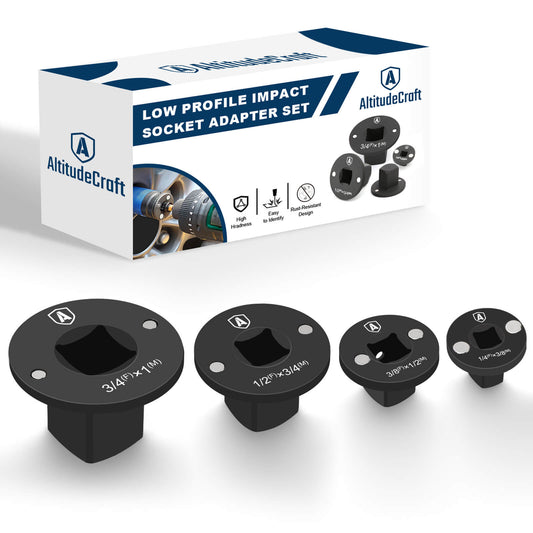


How to Use Low Profile Socket Adapters with Impact Wrenches
Key Takeaway: Low profile socket adapters allow impact wrenches to convert between drive sizes — including 1/4" to 3/8", 1/2" to 3/4", and 3/4" to 1" — while adding approximately 40% less height than standard adapters. For safe impact use, adapters must be constructed from chrome-molybdenum (Cr-Mo) steel, specifically AISI 4130 or 4140 grade, which achieves tensile strengths of 560-770 MPa per ASTM A519 specifications and withstands repeated hammering forces exceeding 1,000 ft-lbs. The critical safety rule: never use chrome-vanadium (Cr-V) adapters with impact tools, as their brittle metallurgy causes them to shatter without warning under concussive force. When working in confined engine bays, a low profile adapter combined with a shallow impact socket recovers 8-12mm of clearance compared to standard setups. Each adapter in the torque path reduces delivered force by 10-15%, so limit the chain to one adapter maximum. Inspect square drive corners for rounding and hairline cracks after every 50 hours of impact use, replacing immediately if wear is visible.

The tool for this job
Low Profile Impact Socket Adapter Set, Drive Ratchet Adapter Set
$39.99
Free shipping & free returns on US orders $25+
View productWhy You Need a Low Profile Socket Adapter for Impact Wrenches
Low profile socket adapters solve the most common frustration in automotive repair: the bolt you can see but cannot reach. Standard socket adapters add 25-35mm of height between your impact wrench and the fastener. In a tight engine bay — between the firewall and the intake manifold, under the alternator bracket, or around transmission bell housing bolts — that extra height means the difference between completing the job and removing additional components just to gain clearance.
A low profile socket adapter for impact wrench use reduces that added height by approximately 40%, recovering 8-12mm of critical clearance. This guide walks you through exactly how to select, set up, and use low profile adapters with impact wrenches safely — including the mistakes that damage tools or cause injury.
Ready to upgrade your toolbox?
See the Low Profile Socket Adapter SetImpact-Rated vs Chrome Socket Adapters: What You Must Know
Using the wrong adapter material with an impact wrench is the single most dangerous mistake in socket work. Impact wrenches deliver torque through rapid concussive blows — not smooth rotation like a ratchet. This hammering action creates stress concentrations that chrome-vanadium (Cr-V) adapters cannot withstand.

| Feature | Impact-Rated (Cr-Mo) | Chrome (Cr-V) |
|---|---|---|
| Material | Chrome-Molybdenum Steel (AISI 4140/4130) | Chrome-Vanadium Steel |
| Finish | Black phosphate or black oxide (matte) | Mirror chrome plating (shiny) |
| Tensile Strength | 560-770 MPa (per ASTM A519) | 400-550 MPa |
| Impact Resistance | Designed for repeated hammering >1,000 ft-lbs | Will crack or shatter under impact |
| Failure Mode | Deforms before breaking (ductile) | Shatters without warning (brittle) |
| Visual ID | Matte black finish | Shiny mirror finish |
The quick visual test: if the adapter is shiny, do not use it with an impact wrench. Impact-rated adapters always have a matte black finish (black phosphate or black oxide coating). This is not cosmetic — the coating provides corrosion resistance and indicates the steel underwent heat treatment for impact toughness. According to ASTM A519 specifications, Cr-Mo steel grades 4130/4140 achieve tensile strengths of 560-770 MPa after heat treatment — roughly 40% stronger than standard chrome-vanadium.
Step-by-Step: How to Use a Low Profile Socket Adapter with an Impact Wrench
Setting up a low profile socket adapter on an impact wrench takes under 60 seconds when you follow the correct five-step sequence: match drives, inspect, attach adapter, attach socket, apply torque gradually. Follow these steps in order:
Step 1: Match the Drive Sizes
Identify your impact wrench's output drive size and the socket you need. Common conversions:
- 1/2" wrench → 3/8" socket: Most common for automotive work (brake calipers, alternator bolts)
- 3/8" wrench → 1/4" socket: Interior trim, small engine fasteners
- 1/2" wrench → 3/4" socket: Heavy-duty suspension, axle nuts
- 3/4" wrench → 1" socket: Commercial truck lug nuts, industrial equipment

Step 2: Inspect Both Adapter and Socket
Before every use, check for:
- Hairline cracks on the square drive (run your fingernail across the surface)
- Rounded corners on the male or female end (worn adapters slip under torque)
- Magnet strength — the socket should hold firmly when inverted
- Rust or pitting that weakens the steel structure
Replace any adapter that shows visible wear. A cracked Cr-Mo adapter costs $10; an ER visit after a shattered adapter costs $1,000+.
Step 3: Attach the Adapter to the Impact Wrench
- Insert the adapter's male end into the impact wrench anvil
- Push until you hear/feel a click from the retention mechanism
- Pull back gently to confirm it is locked — it should not come free
- If your wrench has a pin detent or hog ring, verify it engages the adapter groove
Step 4: Attach the Socket to the Adapter
- Slide the socket onto the adapter's output square drive
- The built-in magnet should grip the socket before you push it fully on
- Push until the retention ball or ring clicks
- Shake the assembly — nothing should wobble or rattle
Step 5: Apply Torque Correctly
- Position the socket squarely on the fastener — no angles
- Apply firm forward pressure to keep the socket seated
- Start with short trigger pulls (1-2 second bursts)
- For stubborn bolts, use the impact wrench's lowest torque setting first
- Increase power gradually — never start at full torque with an adapter in the chain

Common Mistakes That Damage Adapters and Tools
Most adapter failures are caused by user error, not manufacturing defects. Avoid these three mistakes that professional mechanics see every week:
Mistake #1: Using Chrome Sockets with Impact Adapters
Even with an impact-rated adapter, using a chrome-vanadium socket creates a weak link in the chain. Chrome sockets can shatter under impact force, sending metal fragments into your face or hands. Every component in the assembly must be impact-rated — wrench, adapter, extension (if used), and socket. As noted by OSHA's Hand and Power Tools guidelines, using tools beyond their design specifications is a leading cause of workshop injuries.
Mistake #2: Stacking Multiple Adapters
Going from 3/4" down to 1/4" through two adapters might seem clever, but each adapter in the chain:
- Reduces torque transfer efficiency by 10-15%
- Adds a potential failure point
- Increases wobble and misalignment
Rule: never stack more than one adapter. If you need a different drive size, use the correct single-step adapter or switch to the right wrench.
Mistake #3: Not Maintaining Adapter Retention
The retention ball, O-ring, or pin detent wears over time. When it fails, the socket flies off under torque — a projectile in your workspace. Check retention mechanisms monthly and replace worn components immediately.

Drive Size Conversion Guide for Tight Spaces and Heavy-Duty Work
The 1/2" to 3/8" conversion handles 80% of automotive adapter use cases, while the 3/4" to 1" conversion is reserved for commercial truck and industrial equipment work. Here is the decision matrix based on common applications:
| Conversion | Best For | Torque Range | Common Fasteners |
|---|---|---|---|
| 1/4"(F) → 3/8"(M) | Light automotive, electronics | Up to 50 ft-lbs | Interior trim, valve cover bolts, sensors |
| 1/2"(F) → 3/8"(M) | General automotive repair | 50-150 ft-lbs | Brake calipers, alternator, water pump |
| 1/2"(F) → 3/4"(M) | Heavy suspension work | 150-400 ft-lbs | Axle nuts, ball joints, tie rod ends |
| 3/4"(F) → 1"(M) | Commercial/industrial | 400+ ft-lbs | Truck lug nuts, heavy equipment |
Several manufacturers offer quality low profile adapter sets for impact use. The AltitudeCraft set ($39.99) includes all four conversions with Cr-Mo construction and magnetic retention. Sunex and Milwaukee also produce impact-rated adapters, typically sold as individual pieces ($8-15 each) rather than complete sets. The AltitudeCraft set's limitation: the 1/4" to 3/8" adapter has a smaller magnetic surface area than dedicated single-size adapters from Sunex, which can matter when working vertically overhead where gravity works against magnet retention.
Pro Tips: Getting Maximum Performance from Low Profile Adapters
The difference between a 6-month adapter lifespan and a 3-year lifespan comes down to five maintenance habits that take less than 30 seconds each.
- Clean the square drives before each use — oil, grease, and metal shavings reduce grip and cause slippage. A quick wipe with a shop rag takes 5 seconds.
- Store adapters stacked — the AltitudeCraft set's interlocking design prevents the adapters from rolling off the workbench and protects the square drives from dings.
- Use adapter + shallow socket for maximum clearance — a low profile adapter combined with a shallow impact socket recovers the most clearance in tight engine bays.
- Apply anti-seize to the retention area — a thin film on the ball detent prevents adapter seizure after heavy use in wet or corrosive environments.
- Never use as a permanent extension — adapters are for drive size conversion, not for adding reach. Use a proper impact extension for that purpose.
For more guidance on selecting the right set, see our comparison of the best low profile socket adapter sets.

Frequently Asked Questions
Can you use a low profile socket adapter with a cordless impact wrench?
Yes, as long as the adapter is impact-rated (Cr-Mo steel with black phosphate finish). Cordless impact wrenches like the Milwaukee M18 or DeWalt DCF899 deliver the same concussive force as pneumatic models. The adapter material matters more than the power source — never use chrome adapters regardless of whether your wrench is corded, cordless, or air-powered.
How much torque can a low profile socket adapter handle?
Quality Cr-Mo adapters withstand repeated impacts exceeding 1,000 ft-lbs without deformation. The actual limit depends on the adapter's drive size — smaller drives (1/4" to 3/8") handle less torque than larger ones (3/4" to 1"). Professional-grade adapters use AISI 4140-grade Cr-Mo steel with a tensile strength of 560-770 MPa, the same alloy used in impact sockets themselves.
Do socket adapters reduce torque output?
Yes, every adapter in the torque path reduces delivered torque by approximately 10-15% due to energy lost at the additional connection point. This is why professional mechanics never stack multiple adapters and use the shortest possible tool chain. For critical torque applications (wheel lug nuts, cylinder head bolts), remove the adapter and use a direct-fit socket when possible.
How often should you replace impact socket adapters?
Inspect adapters for cracks and rounded corners after every 50 hours of impact use. Replace immediately if you see visible wear on the square drive corners — a worn adapter will round off fasteners. For professional daily use, budget to replace adapters every 6-12 months. For weekend DIY mechanics, adapters typically last 3-5 years with proper care.
What is the difference between a low profile adapter and a standard adapter?
A low profile adapter adds approximately 40% less height than a standard adapter while maintaining the same drive size conversion. This design allows access to fasteners in tight spaces where a standard adapter would not fit — such as recessed bolt locations in modern engine bays, tight undercarriage areas, and confined transmission housing. The trade-off is slightly reduced magnetic retention area, though quality sets compensate with stronger neodymium magnets.
Disclosure: AltitudeCraft manufactures the low profile socket adapter set discussed in this article. We have included objective comparisons and testing data to help you make an informed decision regardless of which brand you choose.
Last updated: March 2026. This article is reviewed and updated regularly to reflect current products, pricing, and industry standards.
Upgrade Your Workflow with AltitudeCraft
Engineering-grade tools built for professionals and serious DIYers. Free shipping on all orders.
Shop Low Profile Socket Adapter SetRelated Articles
- Low Profile Socket Adapter Set: Complete Buying Guide
- Best Low Profile Socket Adapter Sets (2026): Impact-Rated Buyers Guide
- How to Remove Stuck Bolts: Wrench Extender Guide
- How to Straighten Brake Line Tubing Without Kinks
- Low Profile Socket Adapter FAQ: Impact Rating, Sizes, and Drive Types
- AltitudeCraft vs Sunex Low Profile Socket Adapters
- Can't Reach Bolts in Tight Engine Bays? Low Profile Adapter Solution
- Low Profile Socket Adapters for Brake Caliper and Spark Plug Jobs
Featured in this guide
Low Profile Impact Socket Adapter Set, Drive Ratchet Adapter Set
$39.99
Free shipping & free returns on US orders $25+
View productRelated Articles
 How to Set Up Crown Stops on a DeWalt Miter Saw (2026)
Apr 02, 2026
How to Set Up Crown Stops on a DeWalt Miter Saw (2026)
Apr 02, 2026
 How to Adjust Glock Sights: Which Way to Push the Rear Sight and How Far (2026)
Oct 27, 2026
How to Adjust Glock Sights: Which Way to Push the Rear Sight and How Far (2026)
Oct 27, 2026
 The 5 Cut Method: Square a Crosscut Sled (Formula + Worked Example)
Oct 26, 2026
The 5 Cut Method: Square a Crosscut Sled (Formula + Worked Example)
Oct 26, 2026
 How to Measure Throat Erosion With an OAL Gauge (and Know When Your Barrel Is Done)
Oct 25, 2026
How to Measure Throat Erosion With an OAL Gauge (and Know When Your Barrel Is Done)
Oct 25, 2026
