




Low Profile Socket Adapter FAQ: Impact Rating, Sizes, and Drive Types
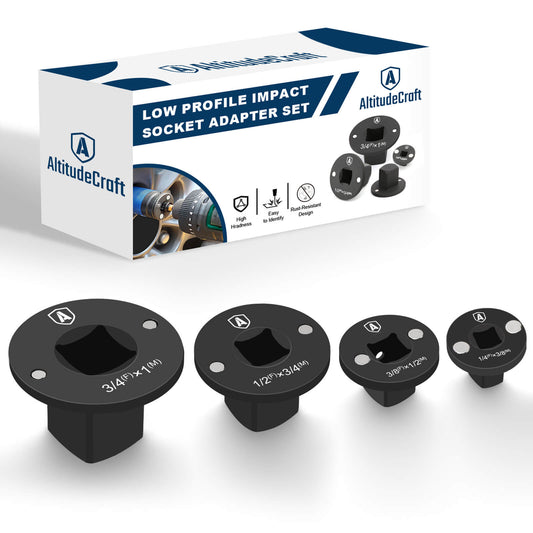
Key Takeaway: Low profile socket adapters convert between standard drive sizes (1/4", 3/8", 1/2", 3/4", and 1") while adding approximately 40% less height than conventional adapters, recovering 8-12mm of clearance in tight engine bays. Impact-rated adapters use chrome-molybdenum (Cr-Mo) steel — specifically AISI 4130 or 4140 grade — with tensile strength of 560-770 MPa per ASTM A519 specifications, identifiable by their matte black phosphate finish. Chrome-vanadium adapters with shiny finishes must never be used with impact wrenches, as their brittle metallurgy causes them to shatter without warning under concussive force. Torque limits vary by drive size: 1/4" drives handle up to approximately 50 ft-lbs, 1/2" drives handle 150-250 ft-lbs, and 3/4" drives are rated to 1,500 ft-lbs according to industry socket specifications. Each adapter in the torque chain reduces delivered force by 10-15%, making stacking multiple adapters both inefficient and unsafe. Magnetic retention with neodymium magnets, laser-etched markings, and stackable storage designs are standard features in quality four-piece sets priced between $30-50.

The tool for this job
Low Profile Impact Socket Adapter Set, Drive Ratchet Adapter Set
$39.99
Free shipping & free returns on US orders $25+
View productWhat Is a Low Profile Socket Adapter and Why Does It Matter?
A low profile socket adapter is a drive size converter engineered to add minimal height between your wrench and socket — typically 40% less than standard adapters. This matters because in modern vehicle engine bays, the clearance between components is measured in millimeters. A standard adapter that adds 30-35mm might prevent you from reaching a recessed bolt, while a low profile version adding only 18-22mm lets you complete the job without removing surrounding components.
Low profile adapters serve the same function as standard adapters — converting between drive sizes like 1/2" to 3/8" or 3/4" to 1" — but their compact geometry makes them essential for automotive repair, HVAC work, and any application where space is limited. For a detailed guide on choosing between different types, see our complete buying guide.

Impact Rating and Material Questions
Are low profile socket adapters safe for impact wrenches?
Only if the adapter is specifically rated for impact use and constructed from chrome-molybdenum (Cr-Mo) steel. Impact wrenches deliver torque through rapid concussive blows that create stress concentrations standard materials cannot withstand. Cr-Mo steel (AISI 4130 or 4140 grade) achieves tensile strengths of 560-770 MPa per ASTM A519 specifications, making it roughly 40% stronger than chrome-vanadium steel used in non-impact adapters.
The quick identification rule: matte black finish = impact-rated, shiny chrome finish = not impact-safe. The black phosphate or black oxide coating on impact adapters is not cosmetic — it indicates the steel underwent heat treatment for impact toughness.
What happens if you use a chrome adapter with an impact wrench?
Chrome-vanadium (Cr-V) adapters can shatter without warning under impact force, sending metal fragments at high velocity. Unlike Cr-Mo steel which deforms before breaking (ductile failure), Cr-V steel fails catastrophically (brittle fracture). This is the most dangerous mistake in socket work — a $10 adapter choice can result in serious injury. For a detailed comparison between materials, see our impact wrench adapter tutorial.
What Cr-Mo grade do quality adapters use?
Professional-grade impact adapters use AISI 4140 or 4130 chrome-molybdenum steel, the same alloy used in impact sockets themselves. The key properties of this alloy:
| Property | Cr-Mo (4140) | Cr-V (Standard) |
|---|---|---|
| Tensile Strength | 560-770 MPa | 400-550 MPa |
| Chromium Content | 0.80-1.10% | 0.80-1.10% |
| Molybdenum Content | 0.15-0.25% | None |
| Failure Mode | Ductile (deforms first) | Brittle (shatters) |
| Impact Use | Designed for impact | Hand tools only |
The molybdenum content is the critical difference — it gives the steel its impact toughness and resistance to fatigue under repeated hammering.

Drive Sizes and Compatibility Questions
What drive size conversions are available?
Standard low profile adapter sets cover four conversions that handle 95% of automotive and industrial applications:
| Conversion | Typical Use | Max Torque |
|---|---|---|
| 1/4" (F) → 3/8" (M) | Sensors, trim screws, small engine bolts | ~50 ft-lbs |
| 1/2" (F) → 3/8" (M) | Brake calipers, alternator, water pump | ~150 ft-lbs |
| 1/2" (F) → 3/4" (M) | Axle nuts, suspension, ball joints | ~400 ft-lbs |
| 3/4" (F) → 1" (M) | Truck lug nuts, heavy equipment | ~1,500 ft-lbs |
The torque limits shown are approximate industry-standard ratings per socket drive specifications. For reference, a typical passenger car lug nut requires 80-100 ft-lbs, well within 1/2" drive capacity.
Can I use a socket adapter with a cordless impact driver (not just a wrench)?
Yes, but understand the difference between impact drivers and impact wrenches. Impact drivers use a 1/4" hex collet and are designed primarily for driving screws. Socket adapters with hex shanks convert the driver to accept sockets, but torque output is typically limited to 150-200 ft-lbs — fine for light fastener work but insufficient for lug nuts or suspension bolts. Impact wrenches use square drive anvils and deliver 300-1,000+ ft-lbs for heavy-duty fastening.
Do adapters fit between different brands of sockets and wrenches?
Yes — drive sizes are standardized across all socket and wrench manufacturers. A 1/2" square drive is 1/2" regardless of whether your wrench is Milwaukee, DeWalt, Snap-on, or pneumatic. The adapter connects universally between brands. The only compatibility concern is ensuring the adapter retention mechanism (ball detent, hog ring, or pin) matches your wrench's anvil style.

Performance and Maintenance Questions
Do socket adapters reduce torque output?
Yes — each adapter in the torque path reduces delivered force by approximately 10-15%. This loss occurs at the connection point due to slight play between the square drives. For most applications this reduction is negligible, but for torque-critical fasteners (cylinder head bolts, wheel lug nuts requiring exact specs), remove the adapter and use a direct-fit socket. Never stack two adapters — the cumulative loss (20-30%) and increased wobble make the setup unsafe.
How long do impact socket adapters last?
With proper maintenance, impact-rated adapters last 3-5 years for weekend DIY use and 6-12 months under daily professional use. The primary wear points are the square drive corners (which round over time) and the retention mechanism (ball detent or spring). Inspect after every 50 hours of impact use. Replace immediately if you notice:
- Visible rounding on square drive corners
- Hairline cracks (run your fingernail across the surface to detect)
- Socket wobble or loose fit that was not present when new
- Weak magnetic retention (socket falls off when inverted)
How do I clean and maintain socket adapters?
Wipe square drives with a shop rag before each use to remove oil, grease, and metal shavings that cause slippage. For deeper cleaning, soak in solvent (mineral spirits or brake cleaner), dry thoroughly, and apply a thin film of light machine oil to prevent rust. Store in a dry location — the stackable design of quality sets keeps square drives protected from dings and contamination.

Buying and Value Questions
Should I buy a complete set or individual adapters?
A four-piece set is more cost-effective and ensures you have every common conversion on hand. Individual impact-rated adapters from brands like Sunex or Milwaukee typically cost $8-15 each ($32-60 for four). Complete sets like the AltitudeCraft Low Profile Set at $39.99 include all four conversions with matched magnetic retention and stackable storage. The main advantage of individual buying: you can select specific brands known for a particular drive size — for example, Sunex's 1/4" to 3/8" adapter has slightly stronger magnetic retention for overhead work.
What is the difference between a reducer and an adapter?
In socket terminology, a "reducer" converts from a larger drive to a smaller one (stepping down), while an "adapter" is the general term covering both step-up and step-down conversions. For example, a 1/2" to 3/8" piece is technically a reducer. In practice, most manufacturers and mechanics use "adapter" for all drive size converters regardless of direction. Low profile sets include both reducers and step-up converters.
Are magnetic adapters better than non-magnetic ones?
For most applications, magnetic retention significantly improves usability and safety. Magnets hold the socket in place during positioning — critical when working in tight spaces where you cannot see the fastener directly. However, magnets add a small amount of height and weight. In ultra-tight clearance situations where every fraction of a millimeter matters, a non-magnetic adapter with a ball detent may be preferable. Quality magnetic adapters use neodymium magnets rated to hold sockets securely even under impact wrench vibration at 7,500+ RPM.

Frequently Asked Questions
Can I use low profile adapters with a torque wrench?
Yes, low profile adapters work with torque wrenches for final tightening. The adapter does not affect the torque reading on a click-type torque wrench as long as you maintain a straight-line setup. Using an adapter at an angle or with a wobble extension will give inaccurate readings. For torque-critical applications, use the adapter only for access and switch to a direct-fit socket for the final torque pass when possible.
Do I need impact-rated adapters for a ratchet or hand wrench?
No. Chrome-vanadium adapters are perfectly safe and appropriate for hand tools like ratchets, breaker bars, and torque wrenches. Impact rating only matters when using power tools that deliver concussive blows — impact wrenches, impact drivers, and pneumatic tools. However, many mechanics prefer Cr-Mo adapters for all applications because they last longer and eliminate the risk of accidentally using the wrong adapter with an impact tool.
What retention mechanism is best for impact use?
Ball detent with spring is the most common and reliable retention mechanism for impact adapters. Hog ring retention provides the strongest hold but is slightly harder to install and remove. Pin-style retention is the most secure but requires a separate retaining pin. For most mechanics, ball detent provides the best balance of security, ease of use, and durability.
Can adapters be used with extensions?
Yes, but follow one rule: adapter first, then extension, then socket. Never place the adapter after the extension. Also, every component in the chain must be impact-rated if using an impact wrench. Adding extensions reduces torque delivery and increases wobble, so use the shortest extension possible. For detailed setup steps, see our step-by-step adapter guide.
How many adapters can I stack together?
Zero stacking is ideal; one adapter maximum is the hard rule. Each adapter reduces torque by 10-15% and adds a potential failure point. Going from 3/4" to 1/4" through two adapters creates a chain that loses 20-30% of torque and introduces dangerous wobble. If you need a conversion your single adapter does not cover, switch to the correct wrench size rather than stacking adapters.
For a comprehensive comparison of available adapter sets, see our best socket adapter sets buyer's guide.
Disclosure: AltitudeCraft manufactures the low profile socket adapter set referenced in this article. We have included objective technical data and competitor references to help you make an informed decision regardless of which brand you choose.
Last updated: March 2026. This article is reviewed and updated regularly to reflect current products, pricing, and industry standards.
Related Articles
- Low Profile Socket Adapter Set: Complete Buying Guide
- Best Low Profile Socket Adapter Sets (2026): Impact-Rated Buyers Guide
- How to Use Low Profile Socket Adapters with Impact Wrenches
- How to Remove Stuck Bolts: Wrench Extender Guide
- AltitudeCraft vs Sunex Low Profile Socket Adapters
- Can't Reach Bolts in Tight Engine Bays? Low Profile Adapter Solution
- Low Profile Socket Adapters for Brake Caliper and Spark Plug Jobs
Featured in this guide
Low Profile Impact Socket Adapter Set, Drive Ratchet Adapter Set
$39.99
Free shipping & free returns on US orders $25+
View productRelated Articles
 Miter Saw Protractor FAQ Reading Angles Accuracy and Calibration (2026)
Apr 02, 2026
Miter Saw Protractor FAQ Reading Angles Accuracy and Calibration (2026)
Apr 02, 2026
 Miter Saw Crown Stops FAQ: Compatibility Angles and Setup Tips (2026)
Apr 02, 2026
Miter Saw Crown Stops FAQ: Compatibility Angles and Setup Tips (2026)
Apr 02, 2026
 Dumbbell to Barbell Converter FAQ: Weight Limits, Fit, and Safety (2026)
Apr 02, 2026
Dumbbell to Barbell Converter FAQ: Weight Limits, Fit, and Safety (2026)
Apr 02, 2026
 How to Adjust Glock Sights: Which Way to Push the Rear Sight and How Far (2026)
Oct 27, 2026
How to Adjust Glock Sights: Which Way to Push the Rear Sight and How Far (2026)
Oct 27, 2026
