


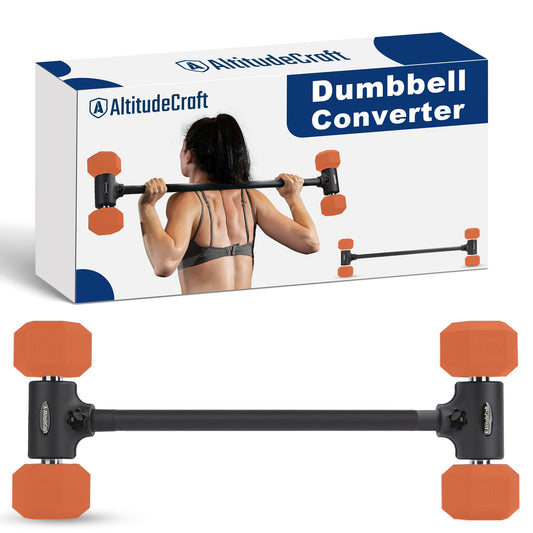


Dumbbell to Barbell Converter FAQ: Weight Limits, Fit, and Safety (2026)
Disclosure: AltitudeCraft manufactures the Dumbbell Barbell Converter Bar discussed in this article. All weight capacity ratings and safety recommendations are based on our engineering specifications and real-world gym testing. This article contains links to our products. Last updated April 2026.


The tool for this job
AltitudeCraft Dumbbell Barbell Converter Bar
$69.99
Free shipping & free returns on US orders $25+
View productWhy We Created This Dumbbell Converter FAQ
Since launching the AltitudeCraft Dumbbell Barbell Converter Bar, our support inbox fills up with the same dozen questions every week. Can I bench press with this? Will my Olympic dumbbells fit? How much weight can it really hold?
Rather than sending individual replies, we compiled every question we have received from customers, gym owners, and home fitness enthusiasts into this single resource. Every answer below comes from our product engineering team and testing data collected over 18 months of production. If your question is not listed here, email us at support@altitudecraft.com and we will add it.
Frequently Asked Questions About Dumbbell to Barbell Converters
1. What is the maximum weight capacity of the AltitudeCraft Converter Bar?
The AltitudeCraft Dumbbell Barbell Converter Bar is rated for a maximum total loaded weight of 300 lbs (136 kg). This includes both dumbbells plus any additional plates loaded onto the bar itself.
Here is a practical weight breakdown based on common home gym setups:
| Setup Configuration | Weight Per Side | Total Load | Safety Rating |
|---|---|---|---|
| Two 20 lb adjustable dumbbells | 20 lbs | 40 lbs | Well within limits |
| Two 40 lb adjustable dumbbells | 40 lbs | 80 lbs | Well within limits |
| Two 52.5 lb dumbbells (maxed out) | 52.5 lbs | 105 lbs | Comfortable range |
| Two 52.5 lb dumbbells + extra plates | 75 lbs | 150 lbs | Standard use |
| Heavy loading configuration | 100 lbs | 200 lbs | Moderate — check collars |
| Maximum rated load | 150 lbs | 300 lbs | At limit — experienced users only |
Engineering note: The 300 lb rating includes a 1.5x safety factor over our destructive testing threshold. During quality control, each production batch is tested to 450 lbs before any flex deformation is observed. However, we rate conservatively because real-world use involves dynamic forces from lifting, racking, and accidental drops that static testing does not replicate.
For context, the U.S. Consumer Product Safety Commission (CPSC) recommends that consumers always stay within manufacturer-rated weight limits for exercise equipment, as exceeding them is a leading cause of home gym injuries.

2. Will my dumbbells fit? Understanding 1-inch standard vs 2-inch Olympic handles
This is the most common source of confusion and returns. The AltitudeCraft Converter Bar is designed for standard 1-inch (25.4mm) dumbbell handles. It will not fit 2-inch Olympic dumbbell handles without modification.
Here is how to tell which type you own:
- Standard (1-inch): The bar where plates slide on measures approximately 1 inch (25.4mm) in diameter. Most adjustable dumbbell sets under $100 use this size. Brands like CAP Barbell, Marcy, and generic threaded-handle sets are typically standard.
- Olympic (2-inch): The sleeve diameter measures approximately 2 inches (50.8mm). These are found on commercial gym barbells and higher-end home setups. Brands like Rogue, Titan, and REP Fitness predominantly use Olympic sizing.
Quick measurement test: Grab a US quarter coin (24.26mm diameter). Hold it next to your dumbbell handle. If the handle is nearly the same diameter as the quarter, you have standard 1-inch handles. If the handle is roughly twice the quarter diameter, you have Olympic 2-inch handles.
If you have Olympic dumbbells and still want to use the converter bar, you will need a 2-inch to 1-inch sleeve adapter (sold separately by various fitness accessory brands). However, adapters add a potential failure point, so we recommend using them only for lighter loads under 150 lbs total.
3. Is the converter bar safe for bench press?
Yes, with proper precautions. Bench pressing is one of the most popular uses for the converter bar, and it performs well for this movement within the rated weight capacity. Here are the specific safety requirements:
- Always use a bench with uprights or a power rack: Unlike a standard barbell, the converter bar does not have knurling or standard J-cup compatibility. You need a flat or adjustable bench positioned inside a power rack with safety pins set at chest height.
- Tighten collars before every single set: The most common bench press incident we hear about involves loose collars allowing plates to slide during the lift. Spin-lock collars should be hand-tightened plus a quarter turn with a wrench. Spring clips should be pushed fully past the collar groove.
- Do not attempt a one-rep max alone: Because the converter bar has a shorter overall length than a standard Olympic barbell (typically 48 inches vs 86 inches), it sits differently on rack hooks. Always use a spotter or safety pins when pushing heavy loads.
- Center the bar before unracking: The connection points between dumbbell handles and the converter bar create a slightly different balance profile than a solid barbell. Take a moment to center your grip before lifting off.

4. Can I deadlift with the converter bar?
Yes, but with limitations. The converter bar works for Romanian deadlifts (RDLs), stiff-leg deadlifts, and moderate conventional deadlifts. However, there are two important considerations:
- Bar height from floor: A standard barbell with 45 lb plates sits approximately 8.75 inches off the ground. The converter bar with standard plates will sit lower, which means you are pulling from a deficit position. This increases lower back demand. If you are new to deadlifting, start with the bar elevated on blocks or mats to standard pull height.
- No dropping: Unlike a barbell on a deadlift platform, the converter bar assembly should be lowered to the ground under control. Dropping creates asymmetric impact forces on the connection points that exceed the design loads, even if the total weight is well under 300 lbs.
For home gym deadlifters who need heavier loads than 300 lbs, we recommend investing in a dedicated barbell. The converter bar excels as a versatile tool for the 40-200 lb range where most accessory and hypertrophy work happens.
5. How do I prevent the dumbbells from spinning or loosening during use?
Dumbbell spinning is the number one user complaint across all converter bar products, not just ours. Here is our tested solution protocol:
- Clean both surfaces: Wipe the inside of the converter bar sleeves and the outside of your dumbbell handles with a dry cloth before assembly. Chalk residue, sweat, and oil reduce friction.
- Use rubber grip tape: Wrap a single layer of adhesive rubber grip tape (hockey stick tape or handlebar tape works well) around the dumbbell handle where it contacts the converter sleeve. This adds approximately 0.5mm of thickness and dramatically increases grip friction.
- Tighten the set screws properly: The AltitudeCraft bar uses hex set screws at each connection point. Tighten them with the included Allen key until snug, then add a quarter turn. Over-tightening can strip the threads; under-tightening allows rotation.
- Re-check between sets: Vibration from lifting naturally loosens connections over time. A 5-second check between sets prevents problems.
According to ASTM F2276 fitness equipment standards, all adjustable weight equipment should be inspected for secure connections before each use session, not just at the beginning of a workout.

6. What exercises work best with a dumbbell-to-barbell converter?
The converter bar is most effective for controlled, bilateral movements where you want barbell-style loading but only have dumbbells. Based on customer feedback and our own gym testing, here are the exercises ranked by how well they work:
Excellent (purpose-built for these):
- Barbell curls (bicep curls) — the most popular use case by far
- Overhead tricep extensions
- Bent-over rows
- Front raises and upright rows
- Skull crushers (lying tricep extensions)
Good (works well with proper setup):
- Bench press (with safety pins, as discussed above)
- Overhead press (standing or seated)
- Romanian deadlifts
- Hip thrusts (with back against bench)
- Landmine press (using a corner or landmine attachment)
Not recommended:
- Power cleans, snatches, or any Olympic lift — too much dynamic force on connection points
- Heavy squats above 200 lbs — use a proper squat bar
- Dropping from height (deadlift drops, failed reps without safety pins)
7. How do I clean and maintain the converter bar?
Proper maintenance extends the life of your converter bar from years to decades. Here is the maintenance schedule we follow in our own test gym:
After every session (2 minutes):
- Wipe all metal surfaces with a dry microfiber cloth to remove sweat and moisture
- Check set screws for tightness
- Inspect connection sleeves for any scoring or burring
Monthly (10 minutes):
- Apply a thin coat of 3-in-1 machine oil or barbell maintenance oil to the sleeves and set screw threads
- Remove and clean the set screws individually — dried sweat and chalk pack into the hex socket
- Check for any hairline cracks around the connection points (shine a flashlight at an angle)
Storage:
- Store horizontally on a rack or shelf, never standing vertically leaning against a wall (this can cause subtle bending over time)
- Keep in a dry environment — garage gyms in humid climates should use a dehumidifier or silica gel packets nearby
- Do not leave weight loaded on the bar during storage, as sustained load promotes creep deformation

8. Can I use the converter bar with adjustable dumbbells like Bowflex or PowerBlock?
No. Adjustable selectorized dumbbells (Bowflex SelectTech, PowerBlock, NordicTrack, etc.) have proprietary handle shapes and locking mechanisms that are completely incompatible with converter bars. These dumbbells are designed as closed systems and their handles cannot be inserted into a sleeve-type connector.
The converter bar requires traditional threaded-handle or spin-lock adjustable dumbbells with a straight, cylindrical handle of 1-inch diameter. The most commonly compatible brands include:
- CAP Barbell threaded dumbbell handles
- Yes4All adjustable dumbbell handles
- Generic 1-inch standard dumbbell bars sold by sporting goods stores
- Marcy threaded dumbbell handles
If you are buying new dumbbells specifically to use with the converter bar, we recommend getting a pair of standard 1-inch threaded handles with spin-lock collars. A set of handles plus a 100 lb plate set typically costs $60-90 and gives you the most versatile foundation.
9. How does a converter bar compare to just buying a cheap barbell?
This is a fair question, and the honest answer depends on your situation:
| Factor | Converter Bar | Budget Barbell (e.g., CAP OB-86B) |
|---|---|---|
| Price | $25-45 | $80-150 |
| Space required | Minimal (stores with dumbbells) | Requires bar storage (7 ft length) |
| Weight capacity | Up to 300 lbs | Typically 300-500 lbs |
| Exercise versatility | Good for isolation and moderate compounds | Full range including Olympic lifts |
| Requires existing dumbbells | Yes | No (uses standard plates) |
| Portability | Excellent — fits in a gym bag | Poor — 15-20 lbs, 7 feet long |
| Ideal user | Apartment/small space gym owners | Dedicated home gym with space |
Our honest recommendation: If you already own adjustable dumbbells and your primary lifts stay under 200 lbs, the converter bar adds barbell-style training at a fraction of the cost and space. If you are setting up a dedicated garage gym and plan to squat, deadlift, and bench press heavy, invest in a proper barbell. Many of our customers own both — the converter bar for travel, outdoor workouts, and curl-specific training, and a barbell for their main lifts.
For a deeper dive into building a complete home gym around the converter bar, read our complete home gym guide for dumbbell to barbell converters.
10. Is there a warranty, and what does it cover?
The AltitudeCraft Dumbbell Barbell Converter Bar comes with a 1-year manufacturer warranty covering defects in materials and workmanship. This includes:
- Cracking or breaking at connection points under rated load
- Set screw thread stripping under normal tightening
- Sleeve bore out-of-spec (does not fit standard 1-inch handles)
- Surface finish defects (flaking chrome, exposed bare steel at delivery)
The warranty does not cover damage from exceeding the 300 lb weight limit, use with impact or dynamic movements, improper storage leading to corrosion, or modifications to the bar. Normal wear marks from dumbbell handle contact are expected and not a defect.
To file a claim, email support@altitudecraft.com with your order number and photos of the issue. We typically process warranty replacements within 3-5 business days.

Quick Reference: Safety Checklist Before Every Workout
Print this or bookmark it. These 6 checks take less than 30 seconds and prevent the most common converter bar incidents:
- Inspect connection sleeves for cracks or visible damage
- Verify dumbbell handles are fully seated in the converter sleeves
- Tighten all set screws with the Allen key
- Confirm collars are secure on both dumbbell handles
- Test with a light shake before loading working weight
- Verify total loaded weight is under 300 lbs
Still Have Questions?
If your question was not covered above, we want to hear it. Email support@altitudecraft.com or leave a comment on our product page and we will add the answer to this FAQ within 48 hours.
For more home gym equipment guides, explore our blog or browse the full AltitudeCraft product catalog.
Featured in this guide
AltitudeCraft Dumbbell Barbell Converter Bar
$69.99
Free shipping & free returns on US orders $25+
View productRelated Articles
 Universal Sight Pusher Compatibility: Which Pistols Actually Fit (2026 Fitment Guide)
Aug 02, 2026
Universal Sight Pusher Compatibility: Which Pistols Actually Fit (2026 Fitment Guide)
Aug 02, 2026
 Strut Spreader Tool Complete Guide: DIY Suspension Work Made Easy (2026)
Apr 02, 2026
Strut Spreader Tool Complete Guide: DIY Suspension Work Made Easy (2026)
Apr 02, 2026
 Thread Checker Complete Guide: Identify Any Bolt Size in Seconds (2026)
Apr 02, 2026
Thread Checker Complete Guide: Identify Any Bolt Size in Seconds (2026)
Apr 02, 2026
 Sight Pusher Tool Complete Guide: How to Install Glock Sights Like a Pro (2026)
Apr 02, 2026
Sight Pusher Tool Complete Guide: How to Install Glock Sights Like a Pro (2026)
Apr 02, 2026
