


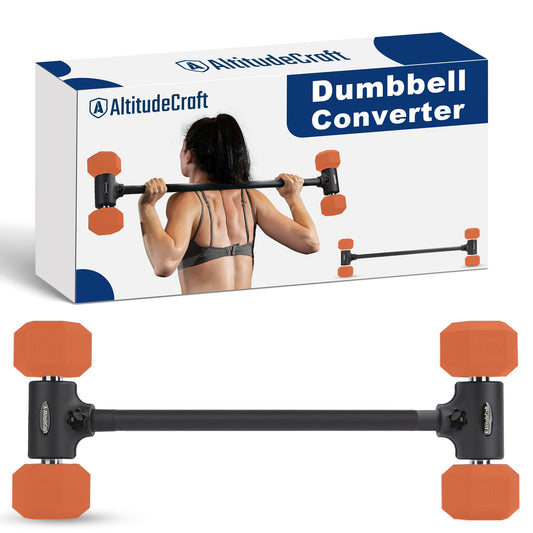


Dumbbell to Barbell Converter: Will It Fit Your Dumbbells? (2026)
Key Takeaway
A dumbbell-to-barbell converter does not take weight plates. It clamps onto the bare handles of dumbbells you already own. That single distinction decides whether the product works for you, and it is the one thing most buying guides get wrong. If your dumbbells have an exposed straight handle between the heads — fixed hex, rubber hex, round steel, or spin-lock — a clamp-style converter will almost certainly fit. If your dumbbells are selectorized (Bowflex SelectTech, PowerBlock, REP QuickDraw), the plate tray or cage wraps the handle and there is nothing to clamp. No adapter bridges that gap.
We pulled our own Amazon return record for this product — 151 returns across two years — and read every customer comment. Not one described a bar that bent, cracked, or failed under load. Every mechanically-relevant comment said some version of the same thing: it would not attach to my dumbbells. This guide is written to fix that, even where the honest answer is "don't buy it."


The tool for this job
AltitudeCraft Dumbbell Barbell Converter Bar
$69.99
Free shipping & free returns on US orders $25+
View productTwo Completely Different Products Share One Name
Search "dumbbell to barbell converter" and the results mix two mechanisms that have almost nothing in common. Buyers who do not notice the difference are the buyers who return the product.
| Clamp-on converter (this product) | Short plate-loaded bar | |
|---|---|---|
| What it holds | Two assembled dumbbells | Loose weight plates |
| What you must own | Dumbbells with a bare handle | Plates with the right centre hole |
| Collars needed? | No — there are none | Yes, spring or spin-lock |
| Plate hole size matters? | No. Irrelevant. | Yes — 1" standard vs 2" Olympic |
| Deciding spec | Dumbbell handle diameter and exposed handle length | Sleeve diameter and sleeve length |
| Typical total length | ~40 in (it is a full-width bar) | 14–20 in |
| Fails when… | Your dumbbells have no exposed handle | Your plates have the wrong hole |
If a guide tells you to "measure the centre hole of your dumbbell plates" before buying a converter, it is describing the second product, not the first. Advice about collars, Olympic sleeves and plate diameters is simply inapplicable to a clamp-style bar. The rest of this article deals only with clamp-style converters, because that is what the AltitudeCraft Dumbbell Barbell Converter Bar is.
How the Clamp Actually Works
Each end of the bar carries a clamp block: a serrated cradle that opens on a hand-turned bolt, closes around the dumbbell handle, and locks. Three steps, no tools.

Because the clamp bites a cylinder, three properties of your dumbbells decide the outcome:
- Handle diameter — it must land inside the clamp's grip range.
- Exposed handle length — the straight section between the heads must be long enough for a clamp block to sit on. On this bar the clamp body stands about 4.5 in tall and needs roughly two inches of bare shaft.
- Head clearance — oversized heads on very heavy dumbbells can foul the bar before the clamp closes.
The Number Nobody Publishes: Handle Diameter Changes Inside One Set
Here is the fact that explains most "it fits one dumbbell but not the other" complaints, and you will not find it on a converter's product page. The handle diameter of a hex dumbbell is not constant across a set. It grows with the weight. Manufacturers publish this openly:
| Manufacturer | Published handle diameter | Spread within one range |
|---|---|---|
| American Barbell rubber hex | 28 mm @ 3 lb · 31 mm @ 5–45 lb · 33 mm @ 50–100 lb | 5 mm |
| Barbell Standard rubber hex | 27 mm @ 5–15 lb · 33 mm on heavier | 6 mm |
| York Barbell rubber hex | 25 mm @ 2.5 lb rising to 35 mm @ 120 lb | 10 mm |
| Bells of Steel straight-handle hex | 28–34 mm depending on weight | 6 mm |
A clamp has a fixed travel. A 10 mm spread across your own rack means the clamp can grip your 45s firmly and still feel slack on your 15s. In our returns, one customer summarised it in three words: "Incorrect Size | Too loose." That is not a defective unit. That is a real dimensional spread meeting a fixed jaw, and it is predictable before you buy.
What to do about it: measure the handle of the lightest pair you intend to use, not the heaviest. If the lightest pair sits at the bottom of the clamp range, it is the pair that will slip. Most people converting for pressing and rowing use their mid-weight dumbbells anyway — check those.
Which Dumbbells Fit, and Which Are Hard No's

| Dumbbell type | Exposed straight handle? | Verdict |
|---|---|---|
| Fixed rubber or cast hex | Yes, typically 4–6 in | ✅ Best case — check diameter on your lightest pair |
| Round / 12-sided fixed dumbbells | Yes | ✅ Works; heads are larger, check clearance on 50 lb+ |
| Spin-lock adjustable (threaded shaft, screw collars) | Yes, and usually long | ✅ Works — clamp on the knurled centre, clear of the threads |
| Chrome / steel handles with loose plates | Yes | ✅ Works, but keep collars tight; a loose plate under a bar is a hazard |
| Selectorized dial dumbbells (Bowflex SelectTech 552 and similar) | No — plate tabs surround the grip | ❌ Structural no-fit |
| PowerBlock-style cage blocks | No — the cage is the body | ❌ Structural no-fit |
| REP QuickDraw and similar cradle systems | No | ❌ Structural no-fit — confirmed by our own return data |
| Very short "compact" dumbbells | Sometimes < 2 in | ⚠️ Measure first — the clamp block needs room |
The clearest evidence we have for the bottom half of that table came from a customer, not a lab. From our return log, verbatim:
"This barbell is not compatible with the REP QuickDraw dumbbells. The design of the cage doesn't fit the clamping mechanism of this barbell."
That is an accurate engineering description of the failure, and it applies to the whole selectorized category. If you own dial or cage adjustables, a clamp converter is the wrong product — look instead at a short plate-loaded bar and a set of loose plates.
What Our Own Returns Say (151 of Them)
Most buying guides talk about durability. Our data says durability is not the problem. Across 151 returns for this SKU, Amazon's own reason codes break down like this:
| Return reason code | Count | Share |
|---|---|---|
| Unwanted item / changed mind | 47 | 31.1% |
| Defective | 36 | 23.8% |
| Not as described | 25 | 16.6% |
| Ordered wrong item | 15 | 9.9% |
| Damaged in transit / by warehouse | 7 | 4.6% |
| All other codes | 21 | 13.9% |
The interesting part is what happens when you read the free-text comments instead of trusting the code. Seventeen returns carried a written comment. Every comment that referred to the product's mechanism was about fit, not failure: "Doesn't fit the dumbbells we have," "Not compatible w my dumbells," "Too loose," "The barbell is hard to attach dumbells too," "Additional equipment would be required to use properly." Zero comments described a bar bending, a clamp cracking, or a shaft failing under load.
So the 23.8% coded Defective is, to a large extent, a documentation failure wearing a hardware costume. When a customer cannot make a product attach, "defective" is the nearest available button. The fix is not a stronger clamp — it is telling people the handle spec before they check out. That is what the fit table above is for.
What the Bar Adds to Your Loading

Do the arithmetic before your first session, because it changes what a "set" means. Two 30 lb dumbbells plus a 6.23 lb bar is 66.2 lb total, not 60. For pressing that is welcome. For a first attempt at an overhead press it may not be.
| Dumbbell pair | Bar | Total on the bar | Rough equivalent |
|---|---|---|---|
| 2 × 15 lb | 6.23 lb | 36.2 lb | Lighter than an empty Olympic bar (45 lb) |
| 2 × 25 lb | 6.23 lb | 56.2 lb | Empty Olympic bar + 11 lb |
| 2 × 40 lb | 6.23 lb | 86.2 lb | Bar + a 20 lb plate per side |
| 2 × 50 lb | 6.23 lb | 106.2 lb | Bar + 30 lb per side |
| 2 × 100 lb (rated max) | 6.23 lb | 206.2 lb | Bar + 80 lb per side |
The rating is 100 lb per side. Treat that as a ceiling, not a target: unlike a barbell sleeve, the load here sits in a clamped joint, and a clamped joint is only as good as how tight you made it. Re-check both clamps after your first warm-up set of any new session — the same way you would re-check collars.
Where a Converter Genuinely Beats a Barbell
Converters get sold on exercise count. The more honest pitch is geometry and storage. A 39.76 in bar loaded with your existing dumbbells occupies roughly half the width of a 7 ft Olympic bar, needs no rack, and disassembles back into two dumbbells in about ten seconds. In a spare bedroom or a garage bay that still holds a car, that is often the entire argument — and it is the same case we make in our guide to training when there is no room for a barbell.

The training rationale is not exotic. Bilateral, multi-joint loading is the backbone of the ACSM position stand on progression models in resistance training, and a converter is simply the cheapest way to get a two-handed bar path when you already own dumbbells. For the specific movement list and set-up cues, see our dumbbell-to-barbell setup and exercise guide, and for bench and deadlift specifics, our bench press and deadlift walkthrough.
Where It Does Not Replace a Barbell

Three honest limits:
- It is not a dropping bar. There is no bearing, no whip, no rotation, and clamped dumbbells are not designed to hit the floor. Cleans, snatches and any missed-rep bailout are out.
- The mass is outboard and off-axis. Dumbbell heads sit above and below the bar line rather than concentric with it. Some lifters find that stabilising; on heavy overhead work it feels less predictable than a plate-loaded bar.
- Grip width is fixed by your dumbbells. Clamp position is adjustable within the exposed handle, but total span is set by the bar. If you want a genuine wide-grip bench, this is not the tool.
Before You Buy: A Three-Minute Check
- Pick up the lightest pair you plan to use. Is there a straight, bare section of handle at least 2 in long between the heads? If no — stop, it will not fit.
- Measure that handle's diameter with a caliper or a strip of paper. Expect roughly 25–35 mm for fixed hex; note the number.
- Repeat on the heaviest pair you plan to use. If the two numbers differ by more than about 6 mm, plan to use only the heavier end of your range on the bar.
- Check head clearance: rest the dumbbell against a broom handle in the clamp position. If a head fouls the shaft, that pair is out.
- Add it up: dumbbell pair + 6.23 lb. Is the total something you can unrack and control from the floor without a spotter?
If steps 1–4 pass, a clamp converter is a genuinely good buy. If step 1 fails, no converter in this category will help you, and we would rather you knew that now. Compare specific models in our dumbbell-to-barbell converter buyer's guide or read the head-to-head in AltitudeCraft vs Yes4All.
Frequently Asked Questions
Does a dumbbell to barbell converter use weight plates?
No. A clamp-style converter takes no plates at all — it grips the handles of two assembled dumbbells, one at each end, mounted perpendicular to the bar. Plate hole size, collars and sleeve length are specifications of a different product (a short plate-loaded bar) and have no bearing on whether a clamp converter fits your setup.
Will a converter bar fit my dumbbells?
It fits if your dumbbells have an exposed straight handle of at least about 2 in with a diameter inside the clamp's range — which covers fixed hex, rubber hex, round, 12-sided and spin-lock dumbbells. It does not fit selectorized dial or cage dumbbells such as Bowflex SelectTech, PowerBlock or REP QuickDraw, because the plate tray or cage surrounds the handle and leaves nothing to clamp.
Why does the clamp hold my heavy dumbbells but feel loose on the light ones?
Because hex dumbbell handles get thicker as the weight goes up. American Barbell publishes 28 mm at 3 lb and 33 mm at 50–100 lb; York Barbell spans 25 mm to 35 mm across its range. A fixed-travel clamp meeting a 5–10 mm spread will grip firmly at one end of your rack and slacken at the other. Measure your lightest intended pair, not your heaviest.
How much weight can a dumbbell to barbell converter hold?
The AltitudeCraft bar is rated to 100 lb per side, so 200 lb of dumbbells plus the bar's own 6.23 lb. Treat the rating as a ceiling. The load is carried in a clamped joint, so re-check both clamps after your first warm-up set rather than assuming the initial tighten held.
Does the bar's own weight count?
Yes, and people routinely forget it. At 6.23 lb, two 25 lb dumbbells give you 56.2 lb on the bar — already more than an empty Olympic barbell. Add it into your working numbers from session one.
How long is a dumbbell barbell converter bar?
This one is 39.76 in overall with a 4.5 in clamp block at each end. Note that short 14–20 in specs quoted in many guides describe plate-loaded converter bars, not clamp-style bars — a clamp bar has to span a full two-handed grip.
Can I use a converter bar for squats and overhead press?
Yes for both, within the rating. What it is not suited to is anything that ends with the bar leaving your hands — cleans, snatches, or a bailout from a missed rep. There is no rotating sleeve and no whip, and clamped dumbbells are not made to be dropped.
Can I use it with spin-lock adjustable dumbbells?
Yes. Clamp on the knurled centre section, clear of the threaded portion, and make sure the screw collars on the dumbbell itself are fully tightened first. A loose plate on a dumbbell that is now part of a barbell is a hazard you do not want overhead.
My converter arrived and will not attach — is it defective?
Usually not. In our own return data, 36 of 151 returns were coded Defective, yet not one written comment described a broken or bent part; the mechanically-relevant comments all described a fit problem. Before returning, check the three fit criteria — exposed handle length, handle diameter, and head clearance. If your dumbbells are selectorized, the incompatibility is structural and no adjustment will solve it.
Is a converter as good as a real barbell?
For bilateral pressing, rowing, curling and squatting at moderate loads in a small space, it does the job at a fraction of the cost and footprint. For Olympic lifting, heavy powerlifting, or anything requiring bar whip and rotating sleeves, it is not a substitute. Full weight-limit and safety detail is in our converter FAQ on weight limits, fit and safety.
Related Articles
Featured in this guide
AltitudeCraft Dumbbell Barbell Converter Bar
$69.99
Free shipping & free returns on US orders $25+
View productRelated Articles
 How to Adjust Glock Sights: Which Way to Push the Rear Sight and How Far (2026)
Oct 27, 2026
How to Adjust Glock Sights: Which Way to Push the Rear Sight and How Far (2026)
Oct 27, 2026
 The 5 Cut Method: Square a Crosscut Sled (Formula + Worked Example)
Oct 26, 2026
The 5 Cut Method: Square a Crosscut Sled (Formula + Worked Example)
Oct 26, 2026
 How to Measure Throat Erosion With an OAL Gauge (and Know When Your Barrel Is Done)
Oct 25, 2026
How to Measure Throat Erosion With an OAL Gauge (and Know When Your Barrel Is Done)
Oct 25, 2026
 How to Drill a Hole Through a Pipe So Both Sides Line Up (2026)
Oct 24, 2026
How to Drill a Hole Through a Pipe So Both Sides Line Up (2026)
Oct 24, 2026
