




The 5 Cut Method: Square a Crosscut Sled (Formula + Worked Example)
Last updated: October 2026 | By AltitudeCraft Team
The 5 cut method squares a crosscut sled by cutting all four edges of a test board, then cutting a thin strip off the first edge again. If the sled fence is out of square, the strip comes out tapered, and the taper is four times the real error. That magnification is why the method beats a framing square: calipers can read an error of a few thousandths that no square will show. When the method fails, the cause is usually the math, not the cutting. People skip the divide-by-4, or they plug the wrong length into the formula.
Disclosure: AltitudeCraft makes a dial-indicator table saw alignment gauge. The 5-cut method needs no gauge, and we say below exactly where ours helps and where it doesn't.
Key Takeaway
The 5-cut method checks whether a crosscut sled's fence is square to the direction the sled travels. You cut all four edges of a flat test board, rotating it 90 degrees the same way each time, then cut a narrow strip off the first edge again. Measure the strip's width at two marked points near its ends, and measure the distance between those points. The difference between the two widths equals four times the fence error over that distance. Divide the difference by 4, divide by the distance between the points, and multiply by the distance from the fence's pivot screw to the point you adjust. The result is how far to move the free end of the fence. The test cannot detect runner play or a blade that isn't parallel to the miter slot, so check both before you trust it.

The tool for this job
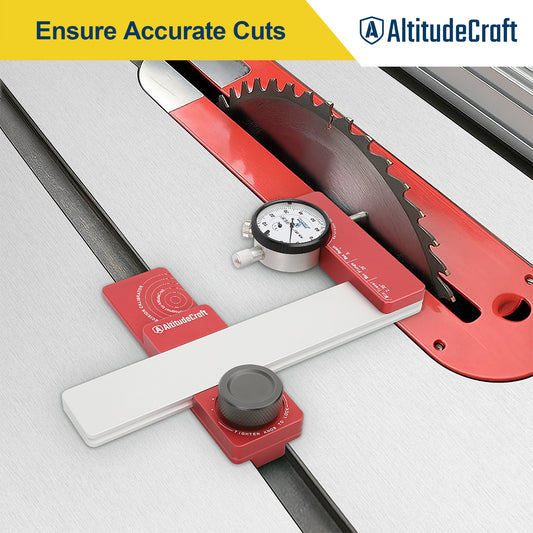
AltitudeCraft Precision Table Saw Alignment Gauge
$89.99
Free shipping & free returns on US orders $25+
View productWhat is the 5 cut method, and why does it divide by 4?
The 5-cut method measures fence error by stacking it four times onto one strip of wood. Woodworker William Ng popularized it in a video uploaded in February 2012 that has passed 2.7 million views. His video description gives the formula in one line: "(A-B) ÷ 4 ÷ Length of 5th cut x Distance between pivot point and the point of adjustment = Error" (William Ng, YouTube).
The 4 comes from simple geometry. Say the fence is off square by a small angle, e. Cuts 2, 3 and 4 each leave a corner of 90° + e against the edge cut before them. A four-sided board's corners always add up to 360°, so the remaining corner, between the new edge 4 and the original edge 1, must be 90° − 3e. The fifth cut re-cuts edge 1 at 90° + e to edge 4. The new edge differs from the old one by (90° + e) − (90° − 3e) = 4e. The strip you cut off is that 4e wedge.
What do you need before you start the 5-cut test?
You need a flat test board, calipers, a sled with a pivoting fence, and runners that don't wiggle.
- A flat piece of plywood or MDF, as large as your sled crosscuts comfortably. A longer strip shows the same error as a bigger taper.
- Digital or dial calipers. A tape measure can't resolve the difference you're looking for.
- A pencil to number the edges 1 to 4.
- A fence that can pivot, usually on one screw at one end, with a clamp or slotted hole at the other end.
How do you fix crosscut sled runner slop?
Runner slop has to go before any 5-cut test, because the test assumes the sled travels in one straight path. Fine Woodworking's Alan Turner fits his sled runners with no side play, and says "I lightly clamp them snug against the inside edge of the slots when gluing on the front fence" (Fine Woodworking). If the sled can shift sideways, the board can take two different paths past the blade. No fence adjustment fixes that. Adjustable metal runners with set screws let you take up play without rebuilding the sled.
How to square a crosscut sled with the 5-cut method, step by step
Cut, rotate the same way, and repeat. Only the edge against the fence changes between cuts.
- Label the board. Mark the edges 1, 2, 3 and 4 going around it.
- Cut edge 1. Hold edge 4 against the fence and trim a thin amount off edge 1.
- Rotate and cut edge 2. Turn the board 90° so edge 1 sits on the fence. KM Tools tells users to "turn the wood 90 degrees counter-clockwise between cuts" (KM Tools). Whichever way you choose, never switch.
- Cut edges 3 and 4 the same way. Each cut uses the previous cut edge as its reference.
- Make the fifth cut. Put edge 4 back on the fence and cut a strip about 1/2 in. wide off edge 1.
- Mark and measure. Make two pencil marks about an inch in from each end of the strip, away from any tear-out. Measure the width at each mark (A and B) with calipers. Then measure the distance between the marks.
- Do the math (next section), move the free end of the fence, and re-test on a fresh board.

How do you calculate the 5 cut method formula? A worked example
The 5 cut method formula is (A − B) ÷ 4 ÷ distance between measuring points × pivot-to-adjustment distance. The result is how far to move the adjustable end of the fence. The numbers below are illustrative, not a measurement from a specific sled.
| Step | What you do | Example value |
|---|---|---|
| 1. Measure A and B | Strip width at each pencil mark | A = 0.531 in., B = 0.503 in. |
| 2. Find the difference | A − B | 0.028 in. |
| 3. Divide by 4 | Removes the 4x magnification | 0.007 in. |
| 4. Divide by mark-to-mark distance | Error per inch (marks 20 in. apart) | 0.00035 in. per in. |
| 5. Multiply by pivot distance | Pivot screw to adjustment point (24 in.) | Move the fence end 0.0084 in. |
In this example the fence is off by about 0.02°, or 0.0042 in. per foot of cut. No square will show that, but calipers read it easily. Make a move that small with a feeler gauge, not by eye.
Which way do you move the fence? The formula gives the size of the move. The direction depends on which end of the strip is wider and which way you rotated. If you're unsure, make the move and re-test. If the taper shrinks, you went the right way. If it roughly doubles, reverse it.
Common 5-cut method mistakes (and how to fix them)
Most failed 5-cut tests come from math or handling, not from the sled.
- Forgetting to divide by 4. You move the fence four times too far and overshoot.
- Using the whole fence length. The formula wants the pivot-to-adjustment distance. On a sled with a centered pivot, that's about half the fence length.
- Using the strip length instead of the mark-to-mark distance. If you measure an inch in from each end, divide by the distance between your marks.
- Switching rotation direction. Turning one way and then the other cancels part of the error and hides it.
- A board that isn't flat. A cupped panel rocks on the base, and each cut lands at a slightly different angle.
- Letting the board creep. If the board shifts during a cut, the test measures your grip. Hold it firmly against the fence, or add sandpaper to the fence face.

Crosscut sled not square, burning at the end of the cut, or inconsistent? What each symptom means
A sled can pass the 5-cut test and still cut badly, because the test checks only one of three things. The fence must be square to the sled's travel. The travel must be steady, with no runner slop. And the blade must be parallel to that travel. The 5-cut method only checks the first.
| What you see | Likely cause | What to do |
|---|---|---|
| The fifth-cut strip is tapered | Fence not square to sled travel | Use the formula and move the fence |
| Results change from test to test | Runner slop in the slots, or the board slipping | Refit or replace the runners; improve grip on the fence |
| Burning or a second groove near the end of the cut | Back teeth rubbing: blade not parallel to the slot | Check blade-to-slot alignment with a dial indicator |
| Square on narrow parts, off or burning on wide ones | Fence face not straight, or a bowed runner | Check the fence with a straightedge; replace the runner |
The burning row comes from a real case. A Sawmill Creek member found the last few inches of each sled cut "bumped out slightly," with the back of the blade cutting a fresh groove. The first reply: "I would check the alignment of the blade to the miter slot you are using." Another member in the thread traced burning on wide boards to a bowed runner.

5-cut method vs 2-cut method vs a square: which should you use?
Use a square to get close, then a cut test to get exact.
| Method | Magnifies error | Tells you how far to move? | Best for |
|---|---|---|---|
| Framing or engineer's square | No | No | First rough setting |
| 2-cut method (cut, flip, compare) | About 2x (flipping doubles the error) | Not directly | Quick shop sleds, no math |
| 5-cut method | 4x | Yes, with the formula | Furniture-grade crosscuts |
Not everyone likes the math. YouTuber House Doctor Ray titled a video "DO NOT use 5 cut method for table saw sled." In its description he calls his alternative a "simple and intuitive 2 cut method" where "no math is required" (House Doctor Ray, YouTube). That's a fair choice for a quick sled. For furniture parts, the extra magnification is worth a minute of math.
Can a dial indicator square a crosscut sled?
Not the fence. A slot-riding dial indicator checks the saw, which is the part the 5-cut test can't see. Our table saw alignment gauge rides in a standard 3/4 in. (19 mm) miter slot and holds a 0.001 in. dial against the blade. That's the blade-to-slot check from the symptom table. Our guide to table saw alignment walks through it.
The arm reaches 2.50 to 6.50 in. from the slot, so it can't sweep a sled fence. Our own return records show why we spell this out. Of 25 Amazon returns of this gauge, only 3 came with a written note, and all 3 described fit limits rather than defects. One buyer could not change the blade angle relative to the miter slots on their saw. Another tried to use it on a miter saw, which has no miter slot. Know what a tool measures before you buy it. The same dial-indicator habits apply to tramming a CNC router spindle or centering work in a 4-jaw chuck.

Is a square crosscut sled safer?
A tuned sled supports the work on both sides of the blade, so crosscuts are more controlled than freehand. OSHA's woodworking guidance warns that kickbacks "can result if the blade height is not correct or if the blade is not maintained properly" (OSHA Woodworking eTool). Keep your hands out of the blade's exit path, and never reach over a running blade for an offcut.
Frequently Asked Questions About the 5-Cut Method
How big should the test board be for the 5 cut method?
Use the largest flat panel your crosscut sled handles comfortably. A strip twice as long shows twice the taper for the same fence error, so a bigger board makes the error easier to read.
Why do you divide by 4 in the 5 cut method?
Cuts 2, 3 and 4 leave three corners at 90° plus the fence error, so the fourth corner must be 90° minus three times the error. The fifth cut corrects that corner, and the strip it removes holds four times the error.
How wide should the fifth cut strip be?
About 1/2 in. is common. It needs to be wide enough to measure easily with calipers and stay a single clean offcut.
Can the 5 cut method square a miter gauge?
Yes. The same rotation and math work for a miter gauge fence. A miter gauge bar usually has more play than a fitted sled runner, so push it against the same side of the slot for every cut.
Does the 5-cut method check blade alignment?
No. It checks the fence against the sled's travel. Burning or a stepped cut near the end of a crosscut points to a blade that isn't parallel to the miter slot. Check that separately with a dial indicator.
The bottom line
To square a crosscut sled with the 5 cut method, cut all four edges of a flat board with the same rotation, then cut a strip off the first edge. Measure the strip at two marks, divide the difference by 4 and by the distance between the marks, and multiply by the pivot-to-adjustment distance. Re-test after every move. Before you start, remove runner slop and confirm the blade is parallel to the slot. For that blade check, our table saw alignment gauge fits standard 3/4 in. miter slots.

Related Reading
- Table Saw Alignment: How to Check Blade-to-Slot Parallelism
- How to Tram a CNC Router Spindle
- How to Find and Transfer Angles With a Miter Saw Protractor
About the author
The AltitudeCraft Team designs and supports workshop measurement tools, including a dial-indicator table saw alignment gauge. This guide draws on attributed sources and on return notes from our own customers. The worked example uses illustrative numbers. We did not run a new sled test for this article.
Featured in this guide
AltitudeCraft Precision Table Saw Alignment Gauge
$89.99
Free shipping & free returns on US orders $25+
View productRelated Articles
 How to Measure Throat Erosion With an OAL Gauge (and Know When Your Barrel Is Done)
Oct 25, 2026
 How to Drill a Hole Through a Pipe So Both Sides Line Up (2026)
Oct 24, 2026
 How to Disconnect a Fuel Injector Connector Without Breaking the Clip (2026)
Oct 23, 2026
 How to Set Up a Full-Length Sizing Die: Bump .001–.004" by Rifle (2026)
Oct 22, 2026
