


How to Measure Throat Erosion With an OAL Gauge (and Know When Your Barrel Is Done)
Last updated: October 2026 | By AltitudeCraft Team
To measure throat erosion, record your cartridge's length to the lands with one marked bullet when the barrel is new, then re-measure the same bullet, in the same modified case, at a fixed round count. As hot gas wears the start of the rifling forward, that number grows. The growth is your throat erosion. Nothing about the method is hard. The hard part is keeping the reading repeatable, because a dirty throat, a different bullet or a heavier push on the rod can shift the reading as much as, or more than, the wear you're trying to see.
Disclosure: AltitudeCraft makes OAL gauges and a bullet comparator. We note below where a borescope or a dedicated throat gauge does a job our tools can't.
Key Takeaway
Throat erosion is the forward wear of the rifling's leading edge, caused by heat and powder gas just ahead of the chamber. You can't see it on a target until it is advanced, but you can track it with a length measurement. Seat a reference bullet in a modified case, push it gently until it touches the lands, and measure base-to-ogive with a comparator. Record that baseline with the round count. Re-measure the same bullet on a clean throat at a fixed interval. A steady increase means the throat is moving forward. Small, random swings usually mean measurement error, not wear. Once you know the rate, you can keep the same jump by seating longer, or plan a barrel change before accuracy falls off. A borescope shows the surface condition. The length measurement tells you how far the lands have moved.

The tool for this job
AltitudeCraft Overall Length Gauge Straight, Compatible with Bolt-Action and Single-Shot Firearms
$31.99
Free shipping & free returns on US orders $25+
View productWhat is throat erosion, and why does the length to the lands grow?
Throat erosion is wear at the very start of the rifling, and it shows up as a longer measurement to the lands. Every shot sends hot, high-pressure gas across the first fraction of an inch of bore. Load Development's AJ Deysel describes the cause as "throat erosion from the intense heat and pressure of burning powder" (Load Development). A 2026 overview of barrel service life on The Firearm Blog adds that "Heat accelerates erosion and can alter the mechanical properties of barrel steel" (The Firearm Blog).
As the leading edge of the lands wears away, the point where a bullet first touches the rifling moves toward the muzzle. A bullet seated to the same length now sits farther from the lands than it did when the barrel was new. That extra jump is what changes how a load shoots. It is also why a simple length measurement works: if the lands move forward 0.010 inch, your reading to the lands grows by about 0.010 inch.
GunsAmerica's long-running write-up on the Hornady Lock-N-Load gauge says you can "stay on top of your throat erosion by measuring it from time to time." It uses a 20-thousandths example: if the bullet now reaches the rifling 0.020 inch farther out, try seating that much longer and see whether accuracy returns (GunsAmerica).
What do you need to measure throat erosion at home?
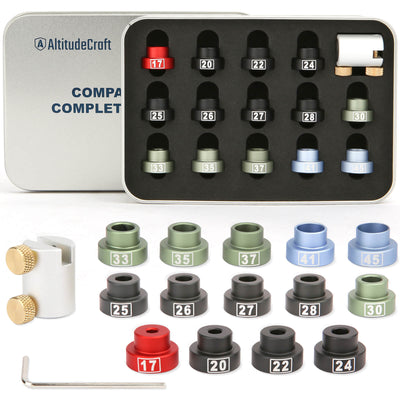
You need four things: an OAL gauge, a modified case for your cartridge, a bullet comparator and a caliper. The OAL gauge holds a bullet in a threaded modified case and lets you push it forward until it stops against the lands. The comparator measures from the bullet's ogive instead of its tip. That matters because tips vary from bullet to bullet, while the ogive is the part that actually touches the rifling.
- OAL gauge. Use a straight gauge for bolt actions and single shots. Lever actions have their own limits; see our 30-30 OAL guide. Use a curved one for ARs and other rifles you can only reach through the ejection port.
- Modified case. The case must match your cartridge and thread onto the gauge. The gauge doesn't include one.
- Bullet comparator. Pick the insert that matches your bullet diameter, for example .264 for 6.5 mm or .308 for .30 caliber.
- Caliper that reads to 0.001 inch.
- Materials, if you buy ours: both gauges are aluminum; the comparator body is 6061 aluminum with color-coded, hard-anodized inserts.
- One reference bullet per load, marked with a fine pen and stored with your logbook.

What our own returns say. We keyword-matched the comments on all 70 Amazon returns of our straight OAL gauge (a simple text match, not hand-coded). Eight comments mention a case, screw or part; five mention fit or the firearm. Only one said the gauge didn't measure accurately, and 29 left no comment.
One buyer wrote that they had marked up the box "before I was aware that I could not use on my particular firearm." So check two things before you buy: that a modified case exists for your cartridge, and that you can reach the chamber in a straight line. If you can't, you'll need the curved version.
How to measure throat erosion: setting the baseline in 6 steps
The baseline only works if you can repeat it exactly, so control the bullet, the case, the throat and your hand. Our OAL gauge guide covers the basic touch-the-lands technique in detail. Here is the version tuned for tracking wear over time.
- Clean the throat. Clean the bore as usual, including copper and the carbon ring just ahead of the chamber. Leftover fouling makes the throat read short. Then it suddenly reads longer after a deep clean, which looks like erosion.
- Thread the modified case on fully. Snug it the same way every time.
- Insert the gauge and push gently. Push the rod with light, even pressure until the bullet just stops. Don't tap or force it. A hard push can wedge the bullet into the lands and add thousandths that aren't real.
- Lock and remove. Tighten the thumb screw and slide the gauge out. Then unthread the modified case from the gauge with the bullet still in it, without nudging the bullet.
- Measure base-to-ogive. Put the comparator on your caliper and measure that case-and-bullet assembly from the case base to the bullet's ogive. Repeat steps 3-5 three to five times and record the median.
- Log it. Write the date, round count, bullet lot, reading and spread. Mark the reference bullet so you use the same one next time.

Our CBTO measurement guide covers the comparator side in detail.

How often should you check for throat erosion?
Check more often when the barrel is new or the load is hot, and less often once the rate settles. One suggestion on a long-range hunting forum is to re-measure every 100 to 250 rounds depending on load intensity. Retailers of dedicated throat erosion gauges for the M1 Garand and AR-type rifles suggest a comparative reading every 1,000 rounds. That spacing suits a service rifle. On a hot cartridge, a tuned precision load can drift out of its best jump well before then. The intervals below are our suggested starting points, not a published standard.
| Situation | Suggested interval | Why |
|---|---|---|
| New barrel, first 300 rounds | Every 100 rounds | Shooters often report faster change early, then a slower steady rate |
| Hot, overbore cartridge or fast strings | Every 100-150 rounds | More heat per shot means faster throat wear |
| Moderate load, settled barrel | Every 200-250 rounds | Enough change between checks to see above the noise |
| Hunting rifle, low volume | Once a season, before load work | Wear is slow; you mainly want a reference before re-zeroing |
How fast will your numbers move? There is no reliable single figure. Reports on precision-rifle forums run from roughly half a thousandth to several thousandths of an inch per 100 rounds. Shooters note the rate depends on cartridge, powder charge and how hard the barrel is run, and that it isn't linear. Treat any number you read online, including those, as one shooter's barrel. Your own log is the only rate that applies to your rifle.
What should a throat erosion log look like?
A useful log has one row per check and keeps the variables that can fake erosion. The numbers below are an illustrative layout, not measurements from a real barrel.
| Date | Round count | Bullet / lot | Median CBTO to lands | Spread (5 readings) | Change from baseline |
|---|---|---|---|---|---|
| Baseline | 0 | Ref. bullet A, lot 1 | 2.250 | 0.002 | — |
| Check 1 | 150 | Ref. bullet A, lot 1 | 2.254 | 0.001 | +0.004 |
| Check 2 | 350 | Ref. bullet A, lot 1 | 2.257 | 0.002 | +0.007 |
Look at the spread column before the change column. If five readings spread 0.004 inch, a 0.003-inch "change" means nothing. A trend you can trust rises across several checks and stays larger than your normal spread.
Why your reading changed when the throat didn't: 4 false signals
A sudden jump in a reading often comes from the measurement, not the barrel. Before you decide the throat has moved, rule these out.
- A different bullet or lot. Ogive shape varies between bullet models and even between lots. On one long-running forum thread, a shooter saw swings of more than 0.030 inch on a .270, and the first reply was to try a bullet with a different ogive. Always use the same marked reference bullet.
- Fouling in the throat. If the last reading was taken dirty and this one after a deep clean, the "growth" may be copper and carbon coming out.
- A loose modified case. A case that isn't fully threaded on shifts the whole reading.
- Push pressure. A firm shove seats the bullet into the lands and reads long. A spread wider than usual is the giveaway.

Here is a short video from Long Range Only that walks through measuring a rifle's throat with a gauge and a bullet.
How much throat erosion is too much? Chase the lands, rework the load, or rebarrel
The amount of erosion matters less than what it does to your groups. Load Development notes that precision shooters usually treat accuracy worse than about 1 MOA as the end of a barrel's useful life, and the author advises you "replace your barrel as soon as you notice a drop in accuracy." Use the log to decide what to do before you reach that point.
| What you see | Likely meaning | What to do |
|---|---|---|
| Reading grows slowly; groups unchanged | Normal wear, load still tolerant | Keep logging; no change needed |
| Reading grows; groups open slightly | Jump has grown past the load's sweet spot | "Chase the lands": seat longer by the measured change to restore the original jump |
| Chasing hits magazine length, or the bullet barely sits in the neck | You can't follow the lands any further | Re-develop the load at a longer jump, or plan a rebarrel or set-back |
| Groups stay open after re-tuning | Seating changes no longer fix it; the cause may not be jump alone | Borescope it; budget for a new barrel |
Chasing the lands has limits. A seated bullet needs enough bearing surface in the case neck to hold it, and a magazine-fed rifle has a maximum length. Our seating depth tuning guide covers how to re-test jump once you hit those walls. Shoulder bump is a separate measurement that doesn't change with throat wear; see our full-length sizing die setup guide for that.
OAL gauge vs borescope vs throat erosion gauge: which should you use?
Each tool answers a different question, so serious shooters often use two of them. GunsAmerica calls the OAL tool "the only accurate way to measure throat erosion." That overstates it. A borescope doesn't give you a length, but it shows heat checking and fire cracking that a length reading can't.
| Tool | What it tells you | Limits | Best for |
|---|---|---|---|
| OAL gauge + comparator | How far the lands have moved, in thousandths | Needs a baseline; sensitive to technique; needs a modified case | Handloaders tracking jump over a barrel's life |
| Borescope | Surface condition: fire cracking, copper, pitting | No length number; images take practice to read | Used rifles with no history; diagnosing lost accuracy |
| Dedicated throat erosion gauge | A comparative reading from a fixed plug | Specific to one caliber or rifle family | Service rifles such as the M1 Garand and AR platforms |
For a longer look at what a borescope shows, Ultimate Reloader's borescoping video covers setup and how to read throat images.

Can you measure throat erosion on a used rifle with no baseline?
Yes, but only as a starting point, not as a verdict. Without a new-barrel number, a single reading tells you where the lands are today, not how far they've moved. Chamber drawings don't convert directly into a reading for your bullet, and reamers vary, so a "new" number from another rifle is only a rough guide. Instead, borescope the throat to judge its surface, take today's reading as your baseline, and start the log now. Until you have a trend, judge the rifle mainly by how it groups with a known load.
Frequently Asked Questions About Throat Erosion
How do you measure throat erosion without special tools?
Some shooters make a "poor man's" gauge by cutting slots in the neck of a sized case so it holds a bullet loosely, then chambering it and measuring. It works, but it's less repeatable than a threaded modified case and gauge, especially across many months.
Does cleaning affect throat erosion readings?
Yes. Copper and carbon in the throat make the reading shorter. Always measure in the same cleaned condition, or a deep clean will look like sudden erosion.
How many rounds before throat erosion shows up?
Wear starts with the first shots. Whether you can measure it yet depends on how fast your barrel wears compared with your measurement spread. That's why the first check comes at around 100 rounds, and why a hot load is checked sooner.
Should I seat bullets longer as my throat erodes?
If your load was tuned at a specific jump, seating longer by the measured change keeps that jump. That works until you reach magazine length or too little bullet in the neck. After that, re-develop the load.
Can I use bullet tip length instead of the ogive?
Not reliably. Tip length includes bullet-tip variation, which can be larger than the wear you're trying to see. Measure base-to-ogive with a comparator.
Is throat erosion the same as a shot-out barrel?
No. Throat erosion is one cause of lost accuracy. A barrel is "done" when it no longer groups well enough for your use, which can come from throat wear, crown damage or other bore wear.
Related Reading
- OAL Gauge: How to Measure Distance to the Lands
- How to Measure CBTO With a Bullet Comparator
- Seating Depth Tuning Guide for Long-Range Precision
The bottom line
To measure throat erosion, set a baseline on a new or newly acquired barrel with one marked reference bullet. Re-measure base-to-ogive at the lands on a clean throat at a fixed round count, and log the median and spread. Trust a trend, not a single jump. If you need the tools, our straight OAL gauge fits bolt actions and single shots. The curved OAL gauge reaches through ejection ports, and the bullet comparator kit covers .17 to .45 caliber.

About the author
The AltitudeCraft Team designs and supports reloading measurement tools, including OAL gauges, bullet comparators and headspace comparators. This guide draws on attributed sources and on recurring questions and return notes from our own customers. The log table is an illustrative layout. We did not run a new barrel-wear test for this article.
Featured in this guide
AltitudeCraft Overall Length Gauge Straight, Compatible with Bolt-Action and Single-Shot Firearms
$31.99
Free shipping & free returns on US orders $25+
View productRelated Articles
 How to Set Up a Full-Length Sizing Die: Bump .001–.004" by Rifle (2026)
Oct 22, 2026
 Which Hornady Comparator for 6.5 Creedmoor? Insert, Bushing, and Shoulder Bump Setup (2026)
Oct 15, 2026
 Bullet Comparator Insert Chart: Which Insert Fits Your Cartridge (2026)
Aug 31, 2026
 Lock-N-Load Bushing Won't Lock? Diagnose Spin, Slop, and Fitment (2026)
Aug 09, 2026
