




Which Hornady Comparator for 6.5 Creedmoor? Insert, Bushing, and Shoulder Bump Setup (2026)
Last updated: October 2026 | By the AltitudeCraft Team
If you are asking which Hornady comparator for 6.5 Creedmoor you need, the answer is two parts: the .264" bullet insert for seating depth and the C (.375") headspace bushing for shoulder position. Hornady's own bushing chart lists 6.5 Creedmoor under C .375, and the bullet insert simply matches the 6.5 mm bullet diameter of .264".
Getting the parts right is the easy half. The harder half is reading them the same way every time, deciding how far to bump the shoulder, and knowing why your numbers will never match a load manual or a friend's comparator. This guide covers all of it for one cartridge only, so every number below applies to your 6.5 Creedmoor.
Key Takeaway
A 6.5 Creedmoor uses a .264-inch bullet comparator insert, which contacts the bullet ogive for cartridge base-to-ogive (CBTO) readings, and a .375-inch headspace bushing, which Hornady's chart labels C. The bushing size comes from a simple rule: add the neck diameter (.295 inch) to the shoulder diameter (.462 inch) and divide by two, which gives about .379 inch, closest to .375. Both tools give relative numbers, not chamber dimensions, so compare one case against another with the same tool rather than against a manual or a GO gauge. To set a full-length die, measure several fired cases from your rifle, then adjust the die until sized cases read about .001 to .002 inch shorter for a precision bolt gun, or about .003 to .004 inch shorter for a hunting rifle. Readings that jump on the same case usually come from caliper pressure, a dirty bushing, or an unsized neck touching the bushing.


The tool for this job
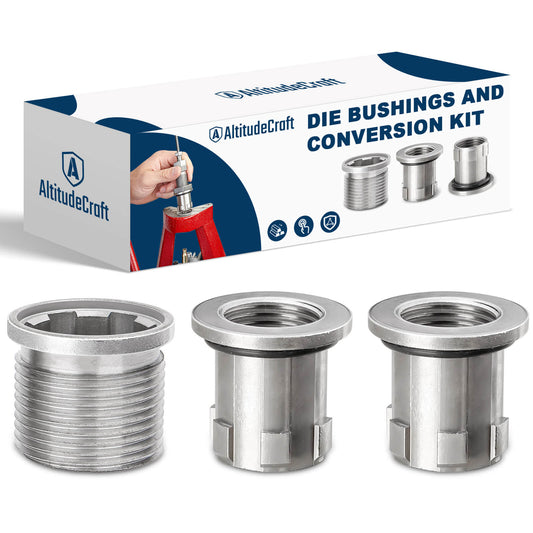
AltitudeCraft Die Bushings and Conversion Kit (2 Pack)
From $25.99
Free shipping & free returns on US orders $25+
View productWhich comparator insert and bushing fit 6.5 Creedmoor?
6.5 Creedmoor takes the .264" bullet insert and the C .375" headspace bushing. The insert diameter matches the bullet, so it touches the ogive at a point just under groove diameter. The bushing diameter falls partway down the 6.5 Creedmoor shoulder, giving the comparator a fixed spot to measure from.
Hornady explains the bushing choice with one rule on its headspace bushing page: add the neck diameter and the shoulder diameter, divide by two, and "use the bushing closest to that number."
For 6.5 Creedmoor the published dimensions are a .2950" neck and a .4620" shoulder (cartridge specification). The math gives .3785", and the closest standard bushing is .375". Hornady also states what the reading is for: the gauge "measures variations in brass before and after firing or re-sizing." That is a comparison, not a chamber measurement.
| Measurement | 6.5 Creedmoor part | What it touches | What the number tells you |
|---|---|---|---|
| Seating depth (CBTO) | .264" bullet insert (item #26 on the AltitudeCraft insert chart) | Bullet ogive | How far the bullet sits from the lands, relative to other rounds |
| Shoulder position (headspace) | C .375" bushing | Case shoulder | How far the die pushed the shoulder back versus a fired case |
| Overall length (COAL) | Bare caliper jaws | Bullet tip | Whether the round fits the magazine (2.825" max per spec) |
Neighboring cartridges are where mix-ups start. Hornady lists .308 Winchester under D .400" and 6.5 PRC under E .420", so a shooter who loads all three needs three different bushings. For every other cartridge, see our full headspace comparator bushing size chart and the matching bullet comparator insert chart.

How much shoulder bump does a 6.5 Creedmoor need?
Most precision shooters bump a 6.5 Creedmoor shoulder .001" to .002" back from a fired case, and many hunters use .003" to .004". The smaller number gives the least brass movement. The larger number gives a margin so a round still chambers if dirt or a grass seed gets into the chamber.
The question comes up often. One forum poster wrote, "It is for a 6.5 creedmoor but I don't know how far I am supposed to bump" (Long Range Hunting). Replies in that thread ranged from "I shoot for a .001"-.002" shoulder bump" with a hard "Max .003"" to 3 to 4 thousandths for hunting rifles.
| Rifle and use | Typical bump from fired case | Why |
|---|---|---|
| Bolt gun, target or PRS | .001"–.002" | Least brass stretch; the bolt still closes freely |
| Bolt gun, hunting | .003"–.004" | Margin for debris or cold, dirty conditions |
| Semi-auto (AR-10 style) | Start at the hunting figure, then confirm with your rifle maker | No bolt handle to cam a tight round closed; follow your rifle maker's sizing guidance |
| Brass fired in a different rifle | Size to a known-good sized case first | Your own fired-case baseline does not exist yet |
Bumping further than you need costs brass life. Each extra thousandth is room the case has to stretch back into on the next firing.
How do you set up a full-length die for 6.5 Creedmoor with a headspace comparator?
You set a 6.5 Creedmoor die by measuring fired cases first, then sizing one case at a time until it reads your bump amount shorter. The fired cases from your own rifle are the baseline. A GO gauge is not.
- Mount the bushing. Fit the C .375" bushing into the comparator body and clamp the body to the caliper's fixed jaw.
- Zero with nothing in the jaws. Close the caliper on the bushing face and zero it, or simply record the reading and work from differences.
- Measure five fired cases. Use cases fired in the rifle you load for, cleaned and with no grit on the shoulder. Measure each one twice, turning it 90° between readings. Write down the average. In this example (illustrative numbers only) it is 1.5605".
- Set your target. Subtract your bump. For a .002" bump, the target in the example is 1.5585".
- Size one case and measure it. Start with the die backed off. Screw it down in small steps, sizing and measuring the same case each time, until it hits the target.
- Lock the die and confirm. Size three more cases. They should land within about .001" of each other on a decent caliper (our working tolerance, not a published spec). Then chamber one in the rifle with the firing pin assembly removed to confirm the bolt closes freely.
Two things make this easier. Size with the same lube and press stroke every time, because both change how far the shoulder moves. And keep a card in the die box with the bushing letter, the fired-case number and the target, so the next session takes two minutes.

How do you measure 6.5 Creedmoor CBTO with a .264 insert?
CBTO is measured by placing the .264" insert over the bullet and closing the caliper on the case head. The insert stops on the ogive, the curved part of the bullet, at a point that stays the same from round to round even when the bullet tips vary.
A load manual lists overall length to the bullet tip, and the 6.5 Creedmoor specification caps that length at 2.825". That figure tells you about magazine fit, not seating depth. Your CBTO number will be shorter, and it will differ from one brand of comparator to the next. Treat it as your own reference: find the length that shoots best, then seat every round to that CBTO with the same insert.
For the full seating-depth routine, including how to find the lands, see how to measure CBTO with a bullet comparator and our OAL gauge guide to distance to the lands.

Why does my headspace comparator give different readings on the same case?
Readings that change on the same case usually come from technique or from the case itself, not from the bushing. A comparator only touches two points, so anything that tilts the case or changes caliper pressure shows up in the last digit.
We see this in our own data. Between October 2024 and October 2026, 119 Amazon returns of our headspace-only and combined comparator kits came with a written comment. Eleven of them, about 9%, said the readings were inaccurate, inconsistent or didn't match another tool. One buyer wrote: "doesn't read accurately, each reading is different on same case." Here are the causes we and other reloaders keep finding:
- Unsized neck touching the bushing. In a Long Range Hunting thread on bump gauge error, a Sinclair gauge read .006"–.007" of setback while a Hornady gauge and a base-to-bullet check both read .002". The cause was "interference from UNSIZED neck of fired case." After neck sizing, "all measurements were consistent."
- Uneven caliper pressure. Close the jaws with the same light thumb pressure every time, or use the caliper's friction thimble if it has one.
- A tilted case. Keep the case head flat on the jaw and turn it 90° for a second reading.
- Dirt or lube on the shoulder. A film of case lube or carbon adds thousandths. Wipe the shoulder and the bushing bore.
- Comparing across tools. As one reloader put it, "It's only a relative measurement so pick one comparator and stick with it."
Why doesn't my comparator match my GO gauge or load manual?
A comparator measures to its own bushing diameter, so its number is not the SAAMI headspace figure and is not supposed to match a GO gauge. Two correct comparators can read the same gauge very differently because they touch the shoulder at different diameters.
Two of our 119 commented returns came from this mix-up. One buyer wrote, "I measured a 2 diffrent go gauge, and it is not accurate." The other said the kit had "completely different datum data than my current one." Neither tool was wrong. The numbers came from different reference points. Industry chamber and cartridge drawings are published by SAAMI and use their own datum, not your bushing.
What the kit won't do for you
A headspace bushing only works on bottleneck cases, and a headspace-only kit does not measure bullets. Our return comments show both mistakes. Three buyers wanted to measure 9mm or other pistol rounds, which have no shoulder for a bushing to touch. Six buyers of the headspace-only kit said they expected bullet inserts too, and two more returned it because they needed "the full kit."
If you load 6.5 Creedmoor and want both measurements, you need both parts: the C bushing and the .264" insert. The headspace-only comparator kit covers the shoulder. The bullet comparator kit covers CBTO. The combined kit has both in one tin.
Common mistakes with a 6.5 Creedmoor comparator setup
Common mistakes with 6.5 Creedmoor comparators come from mixing reference points, not from bad tools. Each one below has a quick fix.
| Mistake | What happens | Fix |
|---|---|---|
| Using the .400" (.308) bushing | Numbers don't match charts or other shooters | Use C .375" for 6.5 Creedmoor |
| Bumping from a GO gauge reading | Shoulder pushed back further than your chamber needs | Measure fired brass from your rifle |
| Measuring lubed or dirty cases | Readings drift by a thousandth or more | Wipe the shoulder and bushing bore first |
| Comparing CBTO to manual COAL | "Wrong" seating depth that isn't wrong | Use COAL for magazine fit, CBTO for seating |
| Switching comparators mid-batch | Sudden jump of several thousandths | Record which tool made each number |
Frequently Asked Questions
Which Hornady headspace bushing is for 6.5 Creedmoor?
Hornady lists 6.5 Creedmoor under the C bushing, which has a .375-inch bore. The same .375-inch diameter works on any comparator body that accepts standard bushings, including the AltitudeCraft kit.
Which bullet comparator insert do I use for 6.5 Creedmoor?
Use the .264-inch insert, which matches 6.5 mm bullet diameter. On the AltitudeCraft insert chart it is item #26. The same insert works for 6.5 PRC, 6.5x47 Lapua, 260 Remington and other 6.5 mm cartridges.
Is the .400 bushing wrong for 6.5 Creedmoor?
The .400-inch D bushing is listed for .308 Winchester, not 6.5 Creedmoor. It may still contact the case, but readings would not match published charts or other 6.5 Creedmoor shooters. Use C .375 for consistency.
Should I bump from a GO gauge or from fired brass?
Bump from fired brass from your own rifle. A fired case shows your actual chamber. A GO gauge shows the minimum chamber, which is usually shorter than a fired case from your chamber.
Can I use one 6.5 Creedmoor die setting for two rifles?
Only if both rifles' fired cases measure the same. If they differ, size to the shorter chamber, or keep the brass for each rifle separate with its own die setting.
Our verdict
For 6.5 Creedmoor, the setup is the .264" insert, the C .375" bushing and a .001"–.002" bump from your own fired brass. Measure five fired cases, size to the target, and keep using the same tool. If your readings wander, check the neck, the shoulder and your thumb pressure before you blame the bushing.

The AltitudeCraft bullet and headspace gauge comparator kit includes the .264" insert and the C .375" bushing, plus 13 other inserts and 5 other bushings, in 6061 aluminum with a tin case. Its limits are real. It measures relative to itself, and it needs a decent caliper and a steady hand to read within .001". One reviewer of our headspace kit noted that because the bushings cover many calibers, "you need to be careful when using them" to get accurate readings. And two buyers reported the .358" insert missing from the tin (one was also missing the comparator body), so count the 14 inserts and check for the body when yours arrives.
Sources
- Hornady: Lock-N-Load headspace comparator bushings
- 6.5mm Creedmoor cartridge specifications
- SAAMI: ANSI/SAAMI standards
- Long Range Hunting: Shoulder bumping question
- Long Range Hunting: Sinclair bump gauge error
Related guides
- Headspace comparator bushing size chart for every cartridge
- Bullet comparator insert chart
- Bullet comparator FAQ: OAL vs CBTO
- AltitudeCraft vs Hornady bullet comparator kit
Disclosure: AltitudeCraft makes and sells the comparator kits linked in this article. The return figures come from our own Amazon sales of the headspace and combined comparator kits. Forum quotes are from public threads, and their authors are not affiliated with AltitudeCraft.
Featured in this guide
AltitudeCraft Die Bushings and Conversion Kit (2 Pack)
From $25.99
Free shipping & free returns on US orders $25+
View productRelated Articles
 Bullet Comparator Insert Chart: Which Insert Fits Your Cartridge (2026)
Aug 31, 2026
Bullet Comparator Insert Chart: Which Insert Fits Your Cartridge (2026)
Aug 31, 2026
 Lock-N-Load Bushing Won't Lock? Diagnose Spin, Slop, and Fitment (2026)
Aug 09, 2026
Lock-N-Load Bushing Won't Lock? Diagnose Spin, Slop, and Fitment (2026)
Aug 09, 2026
 OAL Gauge Guide: How to Measure Distance to the Lands (2026)
Aug 07, 2026
OAL Gauge Guide: How to Measure Distance to the Lands (2026)
Aug 07, 2026
 Headspace Comparator Bushing Size Chart: Which Bushing Fits Your Cartridge (2026)
Aug 02, 2026
Headspace Comparator Bushing Size Chart: Which Bushing Fits Your Cartridge (2026)
Aug 02, 2026
