




Bullet Comparator FAQ: Inserts, OAL vs CBTO, and Caliber Guide (2026)
Bullet comparators are one of those tools that seem simple on the surface — a body, an insert, and your calipers — but the questions that come up once you start using one go deep fast. Which insert do I need for 6.5 Creedmoor? Why does my CBTO reading differ from my friend's? Can I use one comparator across all my calibers? We've compiled the most common questions from reloaders at every experience level and answered them with the specifics that actually help you get better results at the bench.
Key Takeaway: A bullet comparator measures Cartridge Base to Ogive (CBTO) — the distance from the case head to where the bullet's curved ogive section reaches a specific reference diameter. This measurement eliminates bullet tip variation that plagues Overall Length (OAL) readings, typically reducing measurement spread from 0.008–0.015" down to 0.001–0.002". A single 14-insert comparator kit covers every mainstream caliber from .17 to .45, making it the most versatile precision tool a reloader can own. The key to accurate readings is selecting the correct insert by bullet diameter (not cartridge name), maintaining consistent caliper pressure, and always using the same comparator brand throughout a load development series.


The tool for this job
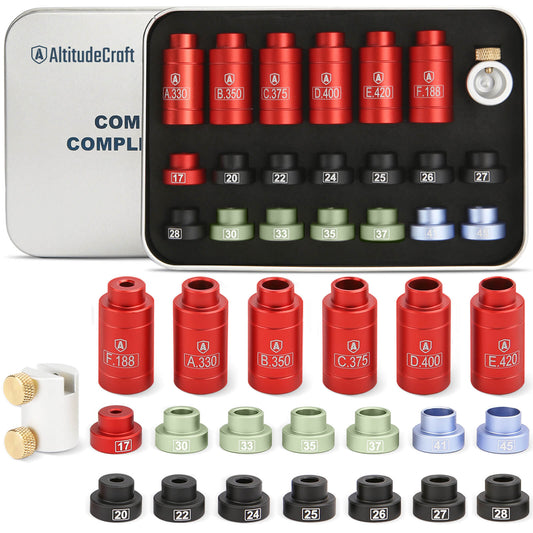
AltitudeCraft Bullet and Headspace Gauge Comparator Kit with 14 Inserts and 6 Bushings
$49.99
Free shipping & free returns on US orders $25+
View productFrequently Asked Questions About Bullet Comparators
What exactly does a bullet comparator measure?
A bullet comparator measures the distance from the cartridge base (case head) to a specific point on the bullet's ogive — the curved portion that transitions from the cylindrical bearing surface to the tip. This measurement is called Cartridge Base to Ogive (CBTO).
The comparator insert has a precisely machined hole that contacts the ogive at a consistent reference diameter. Because this contact point is on the smooth, uniform ogive rather than the variable bullet tip, the measurement is highly repeatable. Where OAL measurements from the same batch of cartridges might vary by 0.008–0.015" (due to tip inconsistencies), CBTO readings from the same batch typically hold within 0.001–0.002".
This matters because the ogive-to-lands relationship directly affects pressure, accuracy, and point of impact. For a complete walkthrough of how to take these measurements, see our guide to using a bullet comparator for precision reloading.
What is the difference between OAL and CBTO?
This is the most fundamental question in precision reloading measurement, so let's be precise:
| Attribute | OAL (Overall Length) | CBTO (Base to Ogive) |
|---|---|---|
| Measures to | Bullet tip (meplat) | Bullet ogive at reference diameter |
| Tool required | Standard calipers only | Calipers + comparator with correct insert |
| Typical batch variation | 0.005"–0.015" | 0.001"–0.002" |
| What it tells you | Whether the cartridge fits the magazine | How far the bullet sits from the rifling lands |
| Affected by bullet tips | Yes — highly sensitive | No — ignores tip entirely |
| Primary use case | Safety check (SAAMI max OAL) | Precision seating depth control |
| Used in competition | Rarely (except for magazine fit) | Always — standard practice |
Bottom line: OAL is a safety measurement for magazine fit. CBTO is a precision measurement for accuracy tuning. Serious reloaders use both, but CBTO is the one they obsess over. According to SAAMI specifications, published cartridge dimensions represent maximum values — your actual chamber dimensions will differ, which is why individual CBTO measurement matters for every rifle.

How do I know which comparator insert to use for my caliber?
Select the insert based on bullet diameter, not the cartridge name. This is the most common source of confusion for new reloaders. Multiple cartridges share the same bullet diameter, so one insert covers all of them.
Here's a complete reference for the 14 inserts included in the AltitudeCraft Bullet Comparator Kit:
| Insert Size | Bullet Diameter | Common Cartridges |
|---|---|---|
| .17 | .172" | .17 HMR, .17 Hornet, .17 WSM |
| .20 | .204" | .204 Ruger |
| .22 | .224" | .223 Rem, 5.56 NATO, .22-250, .224 Valkyrie |
| .243 / 6mm | .243" | .243 Win, 6mm Creedmoor, 6mm BR |
| .257 | .257" | .25-06, .257 Weatherby |
| .264 / 6.5mm | .264" | 6.5 Creedmoor, 6.5 PRC, .260 Rem, 6.5x55 Swedish |
| .277 | .277" | .270 Win, .270 WSM, 6.8 Western |
| .284 / 7mm | .284" | 7mm Rem Mag, 7mm-08, .280 Ackley Improved, 7mm PRC |
| .308 | .308" | .308 Win, .30-06, .300 Win Mag, .300 BLK, .30-30 |
| .338 | .338" | .338 Lapua, .338 Win Mag, .33 Nosler |
| .355 / 9mm | .355" | 9mm Luger, .380 ACP, .357 SIG |
| .357 | .357" | .357 Magnum, .38 Special |
| .40 / 10mm | .400" | .40 S&W, 10mm Auto |
| .45 | .452" | .45 ACP, .45 Colt, .454 Casull |
Quick rule: If you reload for more than two calibers, a 14-insert kit pays for itself compared to buying individual inserts. The 2026 buyer's guide breaks down the cost comparison in detail.
Can I use a bullet comparator with any brand of calipers?
Yes, with one caveat. Most comparator bodies are designed to clamp onto standard caliper jaws (typically 6" digital or dial calipers). The AltitudeCraft comparator body fits all major caliper brands including Mitutoyo, Starrett, iGaging, and Frankford Arsenal. However, miniature 4" calipers or specialty calipers with non-standard jaw profiles may not provide a secure fit. For best results, use a 6" digital caliper with at least 0.001" resolution — 0.0005" resolution is better for serious precision work.

Why do my CBTO readings differ from another reloader using the same bullet?
This is completely normal and expected. CBTO readings vary between comparator brands because each manufacturer machines the insert bore to contact the ogive at a slightly different reference diameter. Your Hornady comparator might contact the ogive at the .30-caliber datum diameter, while the AltitudeCraft insert contacts it at a different point on the ogive curve.
The absolute number doesn't matter — what matters is consistency within your own system. If your CBTO reads 2.195" on your comparator, and you adjust seating depth by 0.010", you should read 2.185" on the same comparator. That 0.010" delta is accurate regardless of brand. Never mix comparator brands mid-load-development — pick one and stick with it.
How do I clean and maintain my comparator inserts?
Comparator inserts accumulate bullet jacket residue, case lube, and fine brass particles over time. Left unchecked, this buildup changes the effective bore diameter and shifts your readings. Here's the maintenance protocol:
- After every session: Wipe inserts with a clean, dry microfiber cloth. This removes surface residue.
- Every 100 measurements: Run a cotton swab lightly dampened with isopropyl alcohol (90%+) through the insert bore. Let it dry completely before measuring.
- Monthly (if used heavily): Inspect the insert bore under magnification for scoring or copper fouling. A scored bore means the insert needs replacing.
- Storage: Keep inserts in the provided case or a compartmented container. Don't toss them loose in a drawer where they'll contact other metal tools.
Never use: abrasives, brass brushes, or solvents containing ammonia on your inserts. These can alter the bore dimensions or damage the anodized finish. The precision-machined inserts in the AltitudeCraft kit are hardened aluminum alloy that resists wear, but proper care extends their accuracy life significantly.

Do I need a comparator for pistol reloading, or just rifle?
Comparators are most commonly associated with rifle reloading, but they're increasingly used in pistol precision work — especially for competitive shooters loading 9mm, .40 S&W, or .45 ACP for bullseye or USPSA matches. Here's when a comparator adds value for pistol reloading:
- Competition accuracy loads: When you're chasing 2" groups at 25 yards from a ransom rest, CBTO consistency matters.
- Bullet profile changes: If you switch between round-nose, flat-point, and hollow-point bullets, OAL becomes meaningless for comparing seating depth. CBTO lets you maintain consistent ogive-to-chamber-throat distance across bullet profiles.
- Case gauge failures: If loaded rounds pass a case gauge check but you're seeing inconsistent chambering, a comparator can reveal ogive-position issues that OAL misses.
For general plinking or self-defense ammo, a comparator is overkill. But if you're loading for accuracy, the .355 (9mm), .400 (10mm/.40), and .452 (.45) inserts included in a 14-insert kit cover all major pistol calibers.
What does "jump to the lands" mean, and how does CBTO help me control it?
"Jump" (also called "freebore") is the distance between the bullet's ogive and the point where the rifling lands begin. This gap directly affects pressure, velocity, and accuracy. A longer jump generally means lower pressure and less precision; a shorter jump means higher pressure and (often) tighter groups — up to a point.
To find your rifle's lands distance, you use a modified case with a long-seated bullet (or a commercial tool like the Hornady OAL gauge) to determine the maximum CBTO where the bullet just touches the lands. From there, you subtract your desired jump distance:
- Lands CBTO: 2.250" (measured with dummy round method)
- Desired jump: 0.020" (a common starting point)
- Target CBTO: 2.230" (set your seating die to this)
Without a comparator, you can't set or verify this dimension with any repeatability. The comparator closes the loop between your lands measurement and your actual loaded rounds. For the complete step-by-step process of finding lands and setting jump, read our precision reloading guide.
Can one comparator body work with inserts from different manufacturers?
Generally, no. Comparator bodies and inserts are proprietary systems — Hornady inserts don't fit in an RCBS body, and vice versa. This is one of the advantages of buying a complete kit: all 14 inserts are machined to the same specifications and fit the included body with consistent press-fit tolerance. Mixing brands introduces variables you can't control and can't measure. If you're investing in a comparator system, commit to one brand for your entire setup.

How accurate does my comparator need to be?
The comparator itself is a reference tool — its accuracy depends on machining tolerances and your technique. For the comparator inserts, bore diameter should be held to ±0.0005" of nominal. For your calipers, 0.001" resolution is the minimum acceptable; 0.0005" is preferred for precision rifle work.
In practical terms, if you can consistently measure the same cartridge and get readings within 0.0005" of each other (five consecutive measurements), your system is performing well. Variation beyond 0.001" on the same cartridge indicates either a technique issue (inconsistent caliper pressure) or a worn/dirty insert. Refer to Hornady's reloading resources for additional calibration guidance from a major manufacturer's perspective.
Is CBTO the same as "headspace to ogive" measurement?
These terms are often used interchangeably in casual conversation, but technically they're different. "Headspace" specifically refers to the distance from the bolt face to the datum line on the cartridge shoulder (for bottleneck cases) or the case mouth (for straight-wall cases). CBTO measures from the case head (base) to the bullet ogive.
The practical difference: headspace measurement involves the chamber and case shoulder; CBTO involves the case base and bullet position. They work together — correct headspace ensures the case positions consistently in the chamber, and correct CBTO ensures the bullet positions consistently relative to the rifling. Both matter for precision, and both are measured with specialized tools. A bullet comparator handles the CBTO side; a headspace comparator (different inserts that reference the case shoulder) handles the headspace side. Browse our full range of precision reloading tools for both measurement systems.

Shop AltitudeCraft Bullet Comparator Kit →
Disclosure: AltitudeCraft manufactures and sells the bullet comparator kit referenced in this article. All technical information is based on our engineering specifications and practical reloading experience. We recommend cross-referencing with your reloading manual and SAAMI specifications for safety-critical dimensions.
Last updated: April 2026
Looking for the caliber-by-caliber lookup table? See the complete bullet comparator insert chart — all 14 sizes from .172" to .458", with the Hornady item-number decode.
Featured in this guide
AltitudeCraft Bullet and Headspace Gauge Comparator Kit with 14 Inserts and 6 Bushings
$49.99
Free shipping & free returns on US orders $25+
View productRelated Articles
 How to Measure Throat Erosion With an OAL Gauge (and Know When Your Barrel Is Done)
Oct 25, 2026
How to Measure Throat Erosion With an OAL Gauge (and Know When Your Barrel Is Done)
Oct 25, 2026
 How to Set Up a Full-Length Sizing Die: Bump .001–.004" by Rifle (2026)
Oct 22, 2026
How to Set Up a Full-Length Sizing Die: Bump .001–.004" by Rifle (2026)
Oct 22, 2026
 Which Hornady Comparator for 6.5 Creedmoor? Insert, Bushing, and Shoulder Bump Setup (2026)
Oct 15, 2026
Which Hornady Comparator for 6.5 Creedmoor? Insert, Bushing, and Shoulder Bump Setup (2026)
Oct 15, 2026
 Bullet Comparator Insert Chart: Which Insert Fits Your Cartridge (2026)
Aug 31, 2026
Bullet Comparator Insert Chart: Which Insert Fits Your Cartridge (2026)
Aug 31, 2026
