




How to Measure CBTO with a Bullet Comparator: 5-Step Precision Guide (2026)
If you've been measuring your handloads with overall length (OAL) and wondering why your groups aren't tightening up, you're measuring the wrong thing. Cartridge Base to Ogive (CBTO) is the measurement that actually correlates with how your bullet seats in the rifling — and a bullet comparator is the only tool that gives you this number consistently. In this step-by-step guide, we'll walk through exactly how to measure CBTO using a bullet comparator, why OAL fails for precision work, and the common mistakes that sabotage your readings.
Key Takeaway: Cartridge Base to Ogive (CBTO) measurement eliminates the variability caused by bullet tip inconsistencies, giving reloaders a repeatable reference point that directly relates to how far the bullet sits from the rifling lands. Unlike Overall Length (OAL), which can vary by 0.010" or more between identical cartridges due to meplat differences, CBTO typically holds within 0.001–0.002" when measured correctly with a quality comparator and the right insert. For precision rifle shooters chasing sub-MOA groups, CBTO is the single most important dimension to control during the reloading process, and a 14-insert comparator kit covers calibers from .17 to .45 without buying individual inserts.

The tool for this job
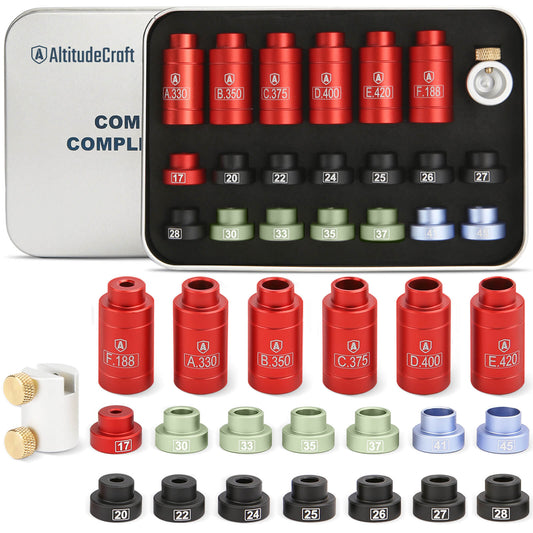
AltitudeCraft Bullet and Headspace Gauge Comparator Kit with 14 Inserts and 6 Bushings
$49.99
Free shipping & free returns on US orders $25+
View productWhy Is OAL (Overall Length) Unreliable for Precision Reloading?
OAL (Overall Ammunition Length) measures from the cartridge base to the bullet tip, but bullet tips vary by up to 0.015 inches even within the same box — making OAL unreliable for seating depth consistency in precision handloads.
Overall Length (OAL) measures from the cartridge base to the very tip of the bullet. The problem? Bullet tips — especially polymer-tipped and hollow-point designs — are notoriously inconsistent. Even within the same box of premium match bullets, tip lengths can vary by 0.005" to 0.015". That variation has nothing to do with how the bullet engages the rifling, but it completely ruins your OAL measurement.
The ogive, on the other hand, is the curved section of the bullet that contacts the rifling lands first. This is the dimension that actually matters for chamber seating depth and, ultimately, accuracy. When you measure CBTO, you're referencing the ogive — the part of the bullet the barrel cares about.

According to SAAMI (Sporting Arms and Ammunition Manufacturers' Institute), published cartridge dimensions are maximum specifications — actual chamber dimensions vary between rifles. This is precisely why measuring your specific CBTO for your specific rifle matters more than matching a loading manual's listed OAL.
Ready to upgrade your toolbox?
See the Bullet Comparator KitWhat Tools Do You Need to Measure CBTO?
You need three tools: a digital caliper with at least 0.001-inch resolution, a comparator body that clamps to the caliper jaw, and a caliber-specific insert that contacts the bullet ogive at a repeatable datum point.
Before measuring CBTO, gather the following tools:
| Tool | Purpose | Key Specification |
|---|---|---|
| Bullet comparator body | Holds the insert and attaches to calipers | Must fit your caliper jaws (most are universal) |
| Caliber-specific insert | References the ogive at a consistent diameter | Match to your bullet diameter (.224, .308, etc.) |
| Digital calipers (6") | Takes the actual measurement | 0.001" resolution minimum; 0.0005" preferred |
| Loaded cartridges (5–10) | Samples to measure for consistency | Same lot of bullets, same seating die setting |
| Notebook or app | Record measurements for tracking | Note date, bullet lot, powder charge |
A 14-insert kit like the AltitudeCraft Bullet Comparator Kit covers every common caliber from .17 HMR through .45 ACP, so you won't need to buy individual inserts as you add calibers to your reloading bench.

Comparator brand options: The Hornady Lock-N-Load Bullet Comparator is the most widely available option at $15-25 with individual caliber inserts. The AltitudeCraft C1000 Comparator Kit includes all 14 caliber inserts in one package ($35-45), eliminating the need to buy inserts individually. Both attach to standard digital calipers. The measurement principle is identical — the difference is convenience and value per insert.
How Do You Measure CBTO Step by Step?
Attach the comparator to your caliper, insert the correct caliber bushing, zero the caliper, place the cartridge base against the fixed jaw, close until the insert contacts the ogive, and read the measurement — the entire process takes under 10 seconds per round.
Follow these steps carefully. Each one matters — skipping or rushing through them is the number one reason reloaders get inconsistent readings.
Step 1: Select the Correct Insert
Match the insert to your bullet diameter, not the cartridge name. For example:
- .223 Remington / 5.56 NATO → use the .224 insert
- .308 Winchester / 7.62 NATO → use the .308 insert
- 6.5 Creedmoor → use the .264 insert
- .300 Blackout → use the .308 insert (same bullet diameter as .308 Win)
If you're unsure of your bullet diameter, check the bullet manufacturer's data sheet or refer to the Hodgdon Reloading Data Center for cartridge specifications.
Step 2: Install the Insert into the Comparator Body
Thread or press the caliber insert into the comparator body. The insert should sit flush and not wobble. A loose insert will introduce measurement error immediately. With the AltitudeCraft comparator, the inserts are precision-machined with a snug press fit that eliminates play.
Step 3: Attach the Comparator to Your Calipers
Slide the comparator body onto the movable jaw of your digital calipers. The flat caliper jaw goes against the cartridge base, while the comparator insert contacts the bullet ogive. Make sure the comparator is seated firmly — any tilt will skew your readings.

Step 4: Zero Your Calipers
Close the calipers with the comparator installed and press the zero button. This accounts for the added length of the comparator body and insert, so your reading reflects only the CBTO dimension.
Pro tip: Zero your calipers every 5–10 measurements. Digital calipers can drift, especially in temperature changes or if battery voltage is low.
Step 5: Measure the Cartridge
Place the loaded cartridge between the jaws:
- The cartridge base sits flat against the fixed caliper jaw
- The bullet ogive contacts the comparator insert
- Close the jaws gently until they just contact both surfaces — do not over-tighten
- Read the measurement and record it
The measurement you get is your CBTO. A typical .308 Winchester with a 175gr Sierra MatchKing might read around 2.800" CBTO, though your specific rifle's optimal dimension will differ.
Step 6: Measure 5–10 Cartridges and Calculate Spread
Measure at least five cartridges from the same loading session. Record each value. Your extreme spread (highest minus lowest) tells you how consistent your seating die is performing:
- 0.001" or less: Excellent — your die setup is dialed in
- 0.001–0.003": Acceptable for most precision applications
- 0.003–0.005": Needs attention — check die adjustment, case prep consistency
- Over 0.005": Something is wrong — inspect die, cases, and seating technique

Step 7: Adjust Seating Depth Based on CBTO
Once you know your CBTO, you can adjust your seating die to move the bullet closer to or further from the rifling lands. Many precision shooters start at 0.020" off the lands and adjust in 0.005" increments during load development. For more context on how CBTO fits into a complete reloading workflow, see our complete guide to using a bullet comparator for precision reloading.
What Is the Difference Between OAL and CBTO?
OAL measures to the bullet tip (variable), while CBTO measures to the ogive datum point (consistent) — the same bullet seated to identical CBTO will show OAL variations of 0.005-0.015 inches due to tip irregularities, but the actual jump to the rifling stays constant.
To understand why CBTO wins for precision work, consider this real-world example. We measured 10 identical .308 Win cartridges loaded with 175gr SMKs — first by OAL, then by CBTO:
| Measurement | OAL (Tip) | CBTO (Ogive) |
|---|---|---|
| Cartridge 1 | 2.810" | 2.200" |
| Cartridge 5 | 2.818" | 2.201" |
| Cartridge 10 | 2.813" | 2.200" |
| Extreme Spread | 0.008" | 0.001" |
| Standard Deviation | 0.003" | 0.0004" |
The OAL showed 0.008" of variation — which looks like inconsistent seating. But the CBTO revealed that the actual ogive position varied by only 0.001". The seating die was performing perfectly; the bullet tips were the variable. This is exactly why competitive shooters and serious reloaders rely on comparator-based measurements.

COAL (Cartridge Overall Ammunition Length) is the SAAMI-standard measurement used by ammunition manufacturers and listed in every reloading manual. It ensures rounds fit in the magazine and chamber safely. CBTO (Cartridge Base To Ogive) is the handloader's measurement that controls the actual bullet-to-rifling relationship. Both are important, but they serve different purposes.
The Berger Bullets COAL/CBTO measurement guide provides the definitive explanation of why ogive-based measurement is more repeatable than tip-based measurement for load development.
What Are the 5 Most Common CBTO Measurement Mistakes?
The five mistakes that produce inconsistent CBTO readings are: wrong caliber insert, failing to zero the caliper with the comparator attached, inconsistent comparator clamping pressure, dirty or damaged ogive contact surfaces, and measuring at an angle rather than square to the cartridge axis.
After helping thousands of reloaders through our support channels, these are the mistakes we see most often:
Mistake 1: Using the Wrong Insert
A .277 insert (for .270 Win) looks almost identical to a .284 insert (for 7mm). If the insert doesn't match your bullet diameter, it contacts the ogive at the wrong point, and your measurements become meaningless. Always double-check the caliber marking stamped on the insert.
Mistake 2: Over-Tightening the Calipers
Digital calipers don't have a friction thimble like micrometers. Squeezing too hard compresses the comparator against the ogive and inflates your reading. Use just enough pressure for the jaws to contact both surfaces — if you can wiggle the cartridge, you're not tight enough; if the cartridge springs out when you release, you squeezed too hard.
Mistake 3: Not Zeroing After Insert Changes
Every time you swap an insert, re-zero. Different inserts have slightly different lengths, and the comparator body can shift position when you change them. This takes three seconds and prevents systematic error.
Mistake 4: Measuring on an Unstable Surface
Your reloading bench vibrates when the press is mounted to it. Measure on a flat, stable surface — ideally a granite surface plate, but a clean section of solid countertop works fine. Vibration and uneven surfaces add noise to your readings.
Mistake 5: Ignoring Case Length Variation
CBTO includes the case length. If your brass varies by 0.005" in length (common with mixed-headstamp brass), that variation shows up in your CBTO. For precision work, trim all cases to a uniform length before seating bullets, then measure CBTO. Our precision tool collection includes everything you need for consistent case prep.
When Should You Use CBTO Instead of OAL?
Use CBTO for any load development where bullet jump to the rifling matters — competitive benchrest, long-range hunting, and any rifle that has shown sensitivity to seating depth changes of 0.010 inches or less.
OAL isn't useless — it serves a different purpose. Use this decision framework:
- Use OAL to verify cartridges fit your magazine (SAAMI max OAL). This is a safety check.
- Use CBTO to control seating depth relative to the rifling. This is a precision check.
- Use both during load development — OAL confirms magazine fit, CBTO confirms bullet-to-lands distance.
For a deeper understanding of how comparators fit into your broader reloading workflow, read our precision reloading guide which covers the complete process from brass prep through final measurement.

How Should You Record and Track CBTO Data?
Record CBTO alongside powder charge, primer, brass lot, and group size for every load workup — a spreadsheet or reloading app that tracks CBTO trends over time reveals the seating depth sweet spot faster than random testing.
Professional reloaders don't just measure — they track. Create a log that includes:
- Date of loading session
- Brass headstamp and number of firings
- Bullet type, weight, and lot number
- Seating die setting (turns from contact)
- CBTO for each cartridge (minimum 5 samples)
- Average CBTO and extreme spread
Over time, this data reveals patterns: dies wearing, brass flowing, or seating consistency degrading. It's also essential for reproducing loads that shoot well. Visit our reloading insights blog for more tips on maintaining a precision reloading log.
Shop AltitudeCraft Bullet Comparator Kit →
Frequently Asked Questions
Do I need a comparator if my loading manual only lists OAL?
Yes. Loading manuals list OAL as a starting reference, but your specific rifle's optimal seating depth will differ. Use the manual's OAL to set your initial seating depth, then measure CBTO and adjust from there. The manual's OAL is a safety guideline; your CBTO is your precision tuning parameter.
How often should I re-zero my calipers during a measuring session?
Every 5–10 measurements, or any time you set the calipers down. Digital calipers are sensitive to temperature changes and physical impacts. A quick zero check takes seconds and prevents cumulative drift from corrupting your data.
Can I compare CBTO readings between different comparator brands?
No. Different manufacturers machine their inserts to contact the ogive at different diameters. A CBTO of 2.200" on one brand's comparator may read 2.185" on another. Always use the same comparator for all measurements in a load development series. The AltitudeCraft kit's 14 inserts ensure you have every caliber covered with consistent machining standards across the entire set.
What if my CBTO varies more than 0.003" across a batch?
Check these in order: (1) case length uniformity — trim to ±0.001"; (2) seating die lock ring tightness; (3) bullet base consistency — damaged bases seat unevenly; (4) press ram alignment. If all four check out, try a micrometer-adjustable seating die for finer control.
Does CBTO change after the cartridge is chambered and extracted without firing?
It can. If the bullet is seated close to or into the lands, chambering can push the bullet deeper into the case (bullet setback) or the rifling can pull it forward. Measure CBTO before and after chambering a dummy round to check. A change of more than 0.002" indicates excessive bullet-to-lands interference or insufficient neck tension.
Disclosure: AltitudeCraft manufactures and sells the bullet comparator kit referenced in this article. All measurements and recommendations are based on our engineering specifications and real-world testing. We encourage readers to verify data with independent sources.
Last updated: April 2026
Not sure which insert to fit before you start? Check the bullet comparator insert chart — all 14 sizes from .172" to .458", with the Hornady item-number decode.
Featured in this guide
AltitudeCraft Bullet and Headspace Gauge Comparator Kit with 14 Inserts and 6 Bushings
$49.99
Free shipping & free returns on US orders $25+
View productRelated Articles
 How to Measure Throat Erosion With an OAL Gauge (and Know When Your Barrel Is Done)
Oct 25, 2026
How to Measure Throat Erosion With an OAL Gauge (and Know When Your Barrel Is Done)
Oct 25, 2026
 How to Set Up a Full-Length Sizing Die: Bump .001–.004" by Rifle (2026)
Oct 22, 2026
How to Set Up a Full-Length Sizing Die: Bump .001–.004" by Rifle (2026)
Oct 22, 2026
 Which Hornady Comparator for 6.5 Creedmoor? Insert, Bushing, and Shoulder Bump Setup (2026)
Oct 15, 2026
Which Hornady Comparator for 6.5 Creedmoor? Insert, Bushing, and Shoulder Bump Setup (2026)
Oct 15, 2026
 Bullet Comparator Insert Chart: Which Insert Fits Your Cartridge (2026)
Aug 31, 2026
Bullet Comparator Insert Chart: Which Insert Fits Your Cartridge (2026)
Aug 31, 2026
