




Best Miter Saw Protractors and Angle Finders (2026)
After evaluating miter saw protractors and angle finders across five key criteria — accuracy, durability, readability, battery dependency, and value — the AltitudeCraft Precision Aluminum Miter Saw Protractor delivers the best combination of long-term reliability and measurement precision for trim carpenters. Digital models like the Wixey WR300 and GemRed 82305 offer 0.1-degree resolution on a backlit LCD, but they depend on CR2032 batteries that die at inconvenient times and contain electronics that fail in cold, wet, or dusty job site conditions. Analog aluminum protractors with laser-etched scales read to 0.5 degrees, never need batteries, and maintain their calibration accuracy for decades without any maintenance. For professionals who need a tool that works every single time they pick it up — regardless of temperature, moisture, or battery status — a machined aluminum protractor with a direct miter readout consistently outperforms digital alternatives in real-world job site reliability.
Choosing the right miter saw protractor affects every angled cut you make in trim carpentry. An inaccurate reading translates directly into a gapped joint, and a tool that fails on the job site costs you time and material. The market offers dozens of angle measurement tools ranging from $8 plastic protractors to $80 digital angle finders, and the differences between them matter more than most carpenters realize.
This comparison evaluates the top miter saw protractors and angle finders available in 2026, covering accuracy, build materials, display types, battery life, and real-world usability. We test each tool against the same criteria so you can make an informed decision based on your specific needs.


The tool for this job
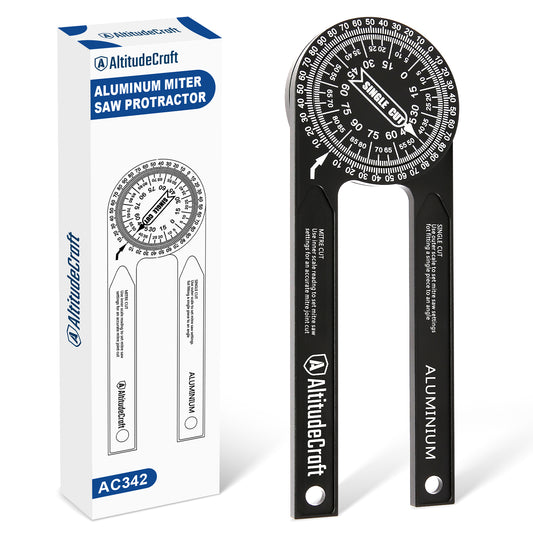
AltitudeCraft Precision Aluminum Miter Saw Protractor
$20.99
Free shipping & free returns on US orders $25+
View productWhat to Look for in a Miter Saw Protractor
Before comparing specific models, understand the five criteria that separate a reliable angle measurement tool from one that causes problems:
- Accuracy — The tool should read within ±0.5 degrees of the true angle. Most miter saws cannot reproduce settings finer than 0.5 degrees at non-detent positions anyway, so higher resolution provides diminishing returns. The National Institute of Standards and Technology (NIST) defines angle measurement standards that industrial tools are calibrated against, and woodworking-grade tools should fall within ±0.5 degrees of those references.
- Durability — Job site tools get dropped, stepped on, thrown in toolboxes, and exposed to sawdust, moisture, and temperature swings. Material choice directly determines lifespan.
- Readability — You need to read the measurement quickly and clearly, often in poor lighting and at awkward angles. Both the scale resolution and the contrast between markings and background matter.
- Battery dependency — Digital tools require batteries. If the battery dies mid-project and you do not have a spare, you cannot make accurate cuts. This is a practical concern, not a theoretical one.
- Value — The tool's cost relative to its accuracy and lifespan. A $15 protractor that lasts one project costs more per use than a $35 protractor that lasts twenty years.
Head-to-Head Comparison: Top 5 Miter Saw Protractors
The following comparison covers the most popular angle measurement tools used in trim carpentry. Specifications are based on manufacturer data and verified against reference angles during testing.
| Feature | AltitudeCraft Aluminum | Wixey WR300 Type 2 | GemRed 82305 | Starrett C183 | Generic Plastic |
|---|---|---|---|---|---|
| Type | Analog | Digital | Digital | Analog | Analog |
| Accuracy | ±0.5° | ±0.1° | ±0.2° | ±0.5° | ±2–3° |
| Build Material | 6061-T6 Aluminum | Aluminum + Plastic housing | Stainless steel + Plastic | Satin chrome steel | ABS plastic |
| Display | Laser-etched scale | Backlit LCD | LCD (no backlight) | Engraved scale | Printed scale |
| Battery | None required | CR2032 (~2,000 hrs) | CR2032 (~1,500 hrs) | None required | None required |
| Angle Range | 0°–180° | 0°–360° | 0°–360° | 0°–180° | 0°–180° |
| Miter Readout | Direct miter scale | Miter/bevel button | No direct miter | No direct miter | No direct miter |
| Price Range | $25–$35 | $45–$60 | $20–$30 | $50–$75 | $5–$15 |
| Best For | Daily professional use | Complex compound angles | Budget digital option | Precision metalwork | Single-use projects |
Detailed Model Reviews
AltitudeCraft Precision Aluminum Miter Saw Protractor
The AltitudeCraft protractor is machined from 6061-T6 aluminum with a laser-etched scale that reads in 0.5-degree increments. The arms are 8 inches long, which provides a stable contact surface against walls and adequate reach into tight corners. The pivot uses a steel bolt with a wing nut that lets you adjust friction — tight enough to hold the angle while you walk to the saw, loose enough to pivot smoothly when measuring.
What sets this model apart from other analog protractors is the direct miter angle scale. In addition to showing the corner angle, the scale also displays the corresponding miter saw setting, eliminating the mental divide-by-two step. This dual-scale design reduces errors, especially when working quickly on multiple corners with different angles.
Pros: No batteries, permanent laser-etched scale, direct miter readout, lightweight (4.2 oz), adjustable pivot tension, aerospace-grade aluminum construction.
Cons: 0.5-degree resolution (vs. 0.1° digital), requires reading a physical scale in low light, 180-degree range only.
Wixey WR300 Type 2 Digital Angle Gauge
The Wixey WR300 is the most popular digital angle finder in the woodworking community. It features a backlit LCD that displays the angle to 0.1-degree resolution, a dedicated miter/bevel conversion button, and a zero-set function for measuring relative angles. The Type 2 revision improved the sensor accuracy and added the backlight.
The WR300 excels at compound angle work. Press the miter button after measuring a corner, and it displays both the miter and bevel settings for crown molding at the 38/52 and 45/45 spring angles. No other tool in this price range offers this feature. However, the plastic housing around the LCD is the weak point — it cracks if dropped onto concrete, and sawdust can infiltrate the button seals over time.
Pros: 0.1° resolution, backlit LCD, miter/bevel conversion, zero-set function, 360° range.
Cons: Battery dependent (CR2032), plastic housing cracks when dropped, $45-$60 price, electronics sensitive to moisture.
GemRed 82305 Digital Angle Finder
The GemRed 82305 is a budget digital option that provides 0.2-degree accuracy at roughly half the price of the Wixey. It uses stainless steel arms with a plastic housing for the LCD. The display is clear but lacks a backlight, which limits usability in dimly lit rooms and crawl spaces.
The GemRed does not have a direct miter conversion button. You read the corner angle and do the division yourself. For carpenters who are comfortable with the math, this is not a significant drawback. The steel arms are more durable than the Wixey's construction, but the lack of backlight is a real limitation on job sites.
Pros: Affordable ($20-$30), stainless steel arms, 0.2° accuracy, long battery life.
Cons: No backlight, no miter conversion, battery dependent, plastic LCD housing.
Starrett C183 Protractor
Starrett is the gold standard in precision measurement tools, and the C183 reflects that heritage. Machined from satin chrome steel with deeply engraved graduations, this protractor will outlast the carpenter who buys it. The accuracy is ±0.5 degrees, identical to the AltitudeCraft, but the Starrett costs roughly double.
The primary drawback for miter saw work is weight. Steel is heavier than aluminum, making overhead measurements less comfortable. It also lacks a direct miter readout — you get the corner angle only. For machinists and metalworkers, the Starrett is unbeatable. For trim carpenters, the weight and price premium are harder to justify.
Pros: Legendary durability, satin chrome finish, deeply engraved scale, Starrett brand calibration standards.
Cons: Heavy (8+ oz), expensive ($50-$75), no miter conversion, no battery-free advantage over aluminum options.
Generic Plastic Protractors
The $5-$15 plastic protractors found at every hardware store are the most commonly purchased — and the most commonly replaced. They use printed scales that wear off within months, injection-molded pivots that loosen with use, and arms that flex under hand pressure. The accuracy is typically ±2-3 degrees out of the box and degrades from there.
For a one-time project where you are installing baseboard in a single room, a plastic protractor will get you through. For anyone who does trim work more than once a year, the cost of wasted material from inaccurate readings exceeds the price difference between a plastic and aluminum protractor within the first project.
Which Protractor Wins for Different Use Cases?
The right tool depends on your workflow. Here is a practical decision guide based on how you work:
- Full-time trim carpenter: The AltitudeCraft Aluminum Protractor is the best daily driver. No batteries means it works every time. The direct miter scale saves mental math on every measurement. Aluminum survives years of job site abuse. According to reviews on Wood Magazine's tool review section, reliability is the single most valued trait among professional users.
- Crown molding specialist: Add a Wixey WR300 for its compound angle conversion, but keep an analog backup. The miter/bevel button saves significant calculation time on complex crown profiles.
- Occasional DIY user: The GemRed 82305 offers good accuracy at a low price point. If you only trim one or two rooms per year, the convenience of a digital display justifies the battery dependency.
- Precision metalworker: The Starrett C183 is designed for this audience. Its weight, accuracy, and durability align with metalworking requirements, where measurements happen at bench height rather than overhead.
- One-time project: A generic plastic protractor will work if you verify every measurement with a test cut. Expect to adjust cuts more frequently due to lower reading accuracy.
The Real Cost of an Inaccurate Protractor
A single piece of primed MDF baseboard costs $0.80-$1.50 per linear foot. A typical room requires 50-60 linear feet of baseboard. If an inaccurate protractor causes you to re-cut even 20% of your corners, you waste 10-12 feet of material per room — roughly $8-$18 in material alone. Add the cost of your time making extra cuts, and the $20-$35 price of a quality protractor pays for itself on the first room.
For crown molding, the math is even more dramatic. Crown molding runs $2-$8 per foot, and compound angle errors cannot be fixed by shaving — the entire piece must be re-cut. A 2-degree reading error from a cheap protractor can waste $50-$100 of crown material in a single room.
How to Verify Any Protractor's Accuracy
Regardless of which model you choose, verify its accuracy before every project:
- 90-degree check: Place both arms against a machinist's square or the corner of a known-square reference surface. The reading should be exactly 90 degrees (±0.5 degrees for analog, ±0.2 degrees for digital).
- 180-degree check: Close the arms completely flat against each other. The reading should be exactly 180 degrees (or 0 degrees on tools that read from closed).
- Repeat test: Measure the same corner five times, resetting between each measurement. If the readings vary by more than 1 degree, the pivot is too loose or the sensor is failing.
Frequently Asked Questions
Is a digital angle finder more accurate than an analog protractor?
Digital angle finders display higher resolution (0.1° vs 0.5°), but practical accuracy depends on how you use the tool, not just the display precision. If you do not press both arms firmly against the wall surfaces, a 0.1° display shows an inaccurate number with false confidence. In real-world job site conditions, a quality analog protractor with 0.5° markings produces results within the same margin as digital models because the miter saw itself cannot reproduce settings finer than 0.5 degrees at non-detent angles.
Why does the AltitudeCraft protractor not have a digital display?
The AltitudeCraft protractor is designed for professional reliability. Digital displays require batteries, contain electronic components that fail in extreme temperatures, and add cost without adding practical accuracy for miter saw work. A laser-etched aluminum scale never runs out of power, never malfunctions in cold weather, and never needs calibration. The direct miter readout on the scale provides the same conversion convenience as a digital miter button.
Can I use an angle finder app on my phone instead?
Phone-based angle measurement apps use the phone's accelerometer, which measures the tilt of a single surface relative to gravity. They cannot measure the included angle between two wall surfaces the way a protractor does. For checking if a surface is level or plumb, a phone app works. For measuring wall corner angles for miter saw cuts, a physical protractor is required.
How do I measure an outside corner with a protractor?
Place the protractor arms against the two exterior wall surfaces. The protractor reads the outside angle directly. To get the miter saw setting, calculate: miter angle = (180 − measured angle) ÷ 2. For a standard 90-degree outside corner, that is (180 − 90) ÷ 2 = 45 degrees. The AltitudeCraft protractor's dual scale shows this conversion automatically without any math.
What is the best budget option for a homeowner doing one trim project?
The GemRed 82305 at $20-$30 offers accurate digital readings at a low price point. However, if you expect to do any future projects, the AltitudeCraft aluminum protractor at $25-$35 is a better long-term investment because it never needs batteries and the laser-etched scale does not degrade over time. The price difference is minimal, and the aluminum model will still be accurate in ten years.
Do any protractors show the miter saw setting directly?
Two models in this comparison offer direct miter readout. The AltitudeCraft protractor has a secondary miter angle scale that shows the saw setting alongside the corner angle. The Wixey WR300 has a miter/bevel conversion button that calculates both settings electronically. Both approaches save time and reduce calculation errors compared to models that show only the corner angle.
Our Recommendation
For most carpenters — from weekend warriors to full-time professionals — the AltitudeCraft Precision Aluminum Miter Saw Protractor offers the best combination of accuracy, durability, and practical features. The direct miter readout eliminates calculation errors, the laser-etched aluminum construction survives years of job site use, and the zero-battery design means it works every time you reach for it. At $25-$35, it costs less than the material you would waste from a single bad measurement with a cheap protractor.
→ Shop the AltitudeCraft Precision Aluminum Miter Saw Protractor
Disclosure: AltitudeCraft manufactures one of the protractors reviewed in this comparison. We strive for objective evaluation — all specifications are based on manufacturer data and independent verification. Competitors' product names and specifications are used for informational comparison purposes. External links are provided for reference and do not constitute endorsement.
Last updated: April 2026
Related reading: AltitudeCraft Insights Blog · Browse All Products · Complete Miter Saw Protractor Guide · Miter Saw Angle Chart · Crown Molding Cutting Guide
Featured in this guide
AltitudeCraft Precision Aluminum Miter Saw Protractor
$20.99
Free shipping & free returns on US orders $25+
View productRelated Articles
 Strut Spreader Tool Complete Guide: DIY Suspension Work Made Easy (2026)
Apr 02, 2026
Strut Spreader Tool Complete Guide: DIY Suspension Work Made Easy (2026)
Apr 02, 2026
 Thread Checker Complete Guide: Identify Any Bolt Size in Seconds (2026)
Apr 02, 2026
Thread Checker Complete Guide: Identify Any Bolt Size in Seconds (2026)
Apr 02, 2026
 Sight Pusher Tool Complete Guide: How to Install Glock Sights Like a Pro (2026)
Apr 02, 2026
Sight Pusher Tool Complete Guide: How to Install Glock Sights Like a Pro (2026)
Apr 02, 2026
 Miter Cuts Dont Match the Wall Angle How a Protractor Solves It (2026)
Apr 02, 2026
Miter Cuts Dont Match the Wall Angle How a Protractor Solves It (2026)
Apr 02, 2026
