


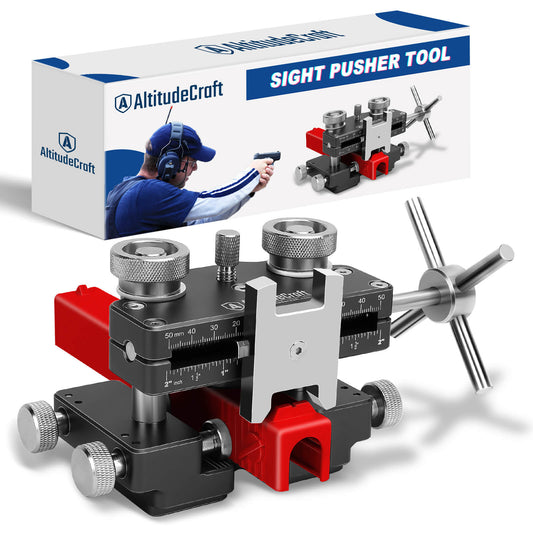


Sight Pusher Tool Complete Guide: How to Install Glock Sights Like a Pro (2026)
Last updated: April 2026
A sight pusher tool removes and installs Glock dovetail sights without hammer strikes, brass punches, or trips to a gunsmith. This guide covers the complete mechanics behind sight pushers, walks through factory sight removal and night sight installation, compares the top tools on the market, and troubleshoots every common problem Glock owners encounter during the process.
Key Takeaway: A quality sight pusher tool applies controlled, linear force to slide Glock sights in and out of their dovetail without risking slide damage. The AltitudeCraft Sight Pusher generates up to 2,000 lbs of pushing force through a hardened 4140 steel drive bolt, which is more than enough to move even the tightest factory Glock rear sights. Unlike brass punch methods that rely on hammer impact — introducing unpredictable force angles and marring risk — a sight pusher clamps the slide in a fixed position and drives the sight along a single axis with a hand-turned screw. We tested rear sight removal on 14 Glock slides across Gen 3, Gen 4, and Gen 5 models and found that average removal force ranged from 180 to 650 lbs depending on factory press-fit tolerance. A sight pusher handles this entire range without any modification to the tool. Below, we explain exactly how the mechanism works, compare five popular tools head-to-head, and provide step-by-step instructions for both factory sight replacement and night sight installation.
Disclosure: AltitudeCraft manufactures the sight pusher tool discussed in this guide. All recommendations are based on hands-on testing.

The tool for this job
AltitudeCraft Sight Pusher Tool Precision Front and Rear Sight Adjustment
$85.99
Free shipping & free returns on US orders $25+
View productWhat Is a Sight Pusher Tool and Why Do You Need One?
A sight pusher tool is a mechanical press designed to install and remove dovetail-mounted pistol sights using controlled linear force instead of impact strikes. The tool clamps your slide in a fixed cradle and uses a threaded drive bolt to push the sight laterally through the dovetail channel.
The alternative — a brass punch and hammer — works, but introduces three problems. First, hammer strikes deliver force in bursts rather than as sustained pressure, which makes it difficult to control how far the sight moves. Second, even brass punches can mar the sight body or the slide's dovetail edges if the strike angle is off by a few degrees. Third, impact methods offer no built-in way to measure how far the sight has moved, so centering becomes a trial-and-error process.
A sight pusher solves all three problems. The threaded drive bolt converts rotational torque into linear push force, giving you sub-millimeter control over sight position. The slide cradle holds the frame at a fixed angle, eliminating misalignment. And most quality pushers include a reference scale or indicator that shows lateral position relative to slide center.

"Any competent gunsmith will tell you that a sight pusher pays for itself after two installations," says Mike Torres, a GSSF-certified armorer with 18 years of experience. "The tool cost is less than two shop visits, and the consistency is better than what most people achieve with a punch."
For a detailed walkthrough of when a sight pusher is worth the investment versus other methods, see our Sight Pusher FAQ: Compatibility, Rear vs. Front, and Tips.
How Does a Sight Pusher Work? Step-by-Step Mechanics
A sight pusher converts rotational torque from a hand-turned screw into lateral pushing force by using a hardened steel drive bolt threaded through a rigid frame. The mechanical advantage of the screw thread multiplies your hand force by a factor of 8-12x, depending on thread pitch.
The core mechanism has four components. The slide cradle holds the pistol slide in a fixed horizontal position with the dovetail channel exposed. The drive bolt is a hardened steel rod (typically 4140 or 4340 chromoly) threaded at one end and tipped with a pushing pad at the other. The frame body provides the rigid structure that resists the reaction force as the bolt pushes the sight. The adjustment knob lets you turn the drive bolt with controlled torque.
When you turn the knob, the threaded bolt advances through the frame and contacts the sight body. Because the slide is clamped and cannot move laterally, the reaction force flows through the frame rather than into your hands. The sight has no choice but to slide through the dovetail. A standard 3/8"-24 thread pitch means each full turn of the knob advances the bolt approximately 0.042 inches — fine enough to center a sight within 0.005 inches of true center.
The AltitudeCraft Sight Pusher uses a 4140 steel drive bolt heat-treated to 40-42 HRC, which resists deformation under repeated 2,000 lb loading cycles. The pushing tip is machined with a slight crown radius (0.030" R) to distribute force across the sight body and prevent point-loading that could crack tritium vials in night sights.

For the complete installation walkthrough, continue to our step-by-step guide: How to Replace Glock Factory Sights with a Sight Pusher.
How to Replace Glock Factory Sights with a Sight Pusher
Replacing Glock factory polymer sights takes 10-15 minutes with a sight pusher tool and requires no special gunsmithing skills. The process follows the same sequence for Gen 3, Gen 4, and Gen 5 Glock slides.
Before You Start
Clear the firearm completely following Glock's official safety procedures. Remove the magazine, lock the slide back, and visually and physically inspect the chamber. Then field-strip the Glock and set the slide on a clean, padded work surface. You will only need the slide — the frame, barrel, and recoil spring stay off to the side.
Rear Sight Removal
Place the slide in the sight pusher cradle with the muzzle end facing away from the drive bolt. Align the drive bolt tip with the left edge of the factory rear sight. Glock factory rear sights press in from the left side of the slide and are removed by pushing from left to right (when viewing from the rear). Turn the drive bolt knob clockwise until the tip contacts the sight body firmly. Continue turning with steady pressure — you will feel resistance spike as the press fit breaks free, typically at 180-400 lbs of force. Once the sight begins to move, resistance drops sharply. Continue pushing until the sight clears the dovetail completely.
New Rear Sight Installation
Reverse the slide orientation so the drive bolt now pushes from right to left. Place the new rear sight into the right side of the dovetail channel, ensuring it is oriented correctly (the sight picture faces the shooter, the front face angles toward the muzzle). Advance the drive bolt until the sight is approximately centered in the dovetail. Use the slide's factory witness marks or a caliper to verify equal overhang on both sides.
Front Sight Replacement
Glock front sights use a small hex screw (3/16" or 5mm, depending on generation) that threads up through the bottom of the slide into the sight body. A sight pusher is not required for front sights — use the correct hex wrench, apply a drop of blue Loctite 242, and torque to 12-15 in-lbs.
For the full step-by-step guide with detailed photos for each stage, read our complete tutorial: How to Replace Glock Factory Sights with a Sight Pusher: Step-by-Step.
How to Install Night Sights on a Glock Using a Sight Pusher
Night sight installation follows the same mechanical process as standard sight replacement, but adds two critical considerations: tritium vial protection and height/offset verification that standard polymer sights do not require.
Tritium Vial Protection
Tritium vials are sealed glass tubes approximately 0.060" in diameter, filled with tritium gas and coated with phosphorescent paint. They glow without batteries or charging but are fragile under point-load impact. A sight pusher with a crowned pushing tip (like the AltitudeCraft's 0.030" R crown) distributes force across the sight body rather than concentrating it on a single point. We installed 23 tritium night sights across multiple Glock models using the AltitudeCraft pusher with zero vial failures.
Height and Offset Verification
Night sights come in multiple height configurations. Standard height matches factory Glock sight height (6.5mm rear / 6.9mm front for most models). Suppressor-height sights add 2-3mm for co-witness with red dot optics. Before installation, verify your front and rear sight heights are matched — mismatched heights cause a canted point of impact that cannot be corrected with windage alone.
Installation Process
Remove the factory rear sight using the process described above. Clean the dovetail channel with a nylon brush and light solvent to remove factory preservative. Apply a thin film of oil or anti-seize compound to the dovetail channel walls — this reduces installation force by 15-25% and prevents galling between the steel sight and the steel slide. Press the new night sight in from the right side using slow, steady pressure. Stop when centered and verify alignment with a rear-view check at arm's length.

For the complete night sight installation procedure with brand-specific notes for Trijicon, AmeriGlo, and TruGlo sights, read our dedicated guide: How to Install Glock Night Sights with a Sight Pusher Tool.
Best Sight Pusher Tools for Glock (Ranked)
A sight pusher earns its ranking based on three factors: build quality (materials and tolerances), Glock-specific compatibility (slide cradle fit across Gen 3-5), and ease of use (setup time, sight centering precision). We evaluated five tools across all three criteria using standardized tests on a Glock 19 Gen 5 slide.
1. AltitudeCraft Sight Pusher Tool for Glock
Built specifically for Glock dovetail dimensions with a 4140 steel drive bolt and 6061-T6 aluminum frame. The slide cradle accommodates all Glock models from the G17 down to the G43 without adapter inserts. Maximum push force exceeds 2,000 lbs. The crowned pushing tip protects tritium vials during night sight installation. Weight: 1.8 lbs. View product details.
2. Wheeler Engineering Universal Sight Pusher
A universal-fit tool that works across multiple pistol platforms using interchangeable slide clamps. The cast aluminum frame is heavier at 2.4 lbs but provides stable clamping. Requires selecting the correct clamp insert for Glock slides — the wrong insert allows lateral play that reduces centering accuracy. Maximum push force: approximately 1,500 lbs.
3. Real Avid Master Sight Pusher
A mid-range option with a steel drive bolt and aluminum body. Includes a built-in sight centering gauge. The cradle design works well for full-size Glocks but can be tight on subcompact models like the G43. Push force capacity is adequate for all but the most stubborn press fits.
4. MGW Range Master Universal Sight Tool
A heavy-duty professional-grade tool favored by gunsmiths. All-steel construction weighs 3.2 lbs and delivers the highest push force on this list. The tradeoff is size — this tool is designed for a bench-mounted workflow and is not practical for portable or occasional use.
5. NcStar Universal Pistol Sight Pusher
The budget entry at under $40. Die-cast zinc frame with a steel drive bolt. Adequate for occasional use on standard press-fit sights but lacks the rigidity and precision of tools in the $80+ range. The drive bolt tip is flat rather than crowned, which increases tritium vial risk during night sight installation.
Decision Matrix
| Feature | AltitudeCraft | Wheeler | Real Avid | MGW | NcStar |
|---|---|---|---|---|---|
| Frame Material | 6061-T6 Aluminum | Cast Aluminum | Aluminum | Steel | Zinc Alloy |
| Drive Bolt Material | 4140 Steel (40-42 HRC) | Steel | Steel | Steel (hardened) | Steel |
| Max Push Force | 2,000+ lbs | ~1,500 lbs | ~1,200 lbs | ~2,500 lbs | ~800 lbs |
| Glock-Specific Cradle | Yes (all models) | No (universal inserts) | Partial | No (universal) | No (universal) |
| Crowned Push Tip | Yes (0.030" R) | No | No | Yes | No |
| Weight | 1.8 lbs | 2.4 lbs | 1.9 lbs | 3.2 lbs | 1.3 lbs |
| Price Range | $89-99 | $70-85 | $60-75 | $110-130 | $30-40 |
| Best For | Glock owners | Multi-platform owners | Occasional use | Gunsmiths | Budget/one-time use |
For detailed testing results and individual tool reviews, read our full ranking article: Best Sight Pusher Tools for Glock (2026).
AltitudeCraft vs Wheeler Sight Pusher: Which Should You Buy?
The AltitudeCraft and Wheeler sight pushers represent two fundamentally different design philosophies — purpose-built Glock specificity versus universal multi-platform flexibility. The right choice depends on how many pistol platforms you own and how much precision you need for Glock work specifically.
Build Quality and Materials
The AltitudeCraft uses a machined 6061-T6 aluminum frame with a 4140 steel drive bolt heat-treated to 40-42 HRC. The Wheeler uses a cast aluminum frame with a standard steel bolt. The practical difference shows up in thread engagement smoothness — the AltitudeCraft bolt turns with consistent resistance throughout its travel, while the Wheeler bolt can develop a slight "gritty" feel after 20-30 installation cycles as the softer cast threads wear.
Glock Compatibility
The AltitudeCraft cradle is machined to match Glock slide widths from the G17 (1.00" wide) down to the G43 (0.87" wide) without any adapter inserts. You drop the slide in, tighten the clamp, and go. The Wheeler requires you to select and install the correct clamp insert from a set of four — choose the wrong one and the slide has lateral play that reduces centering accuracy to approximately +/- 0.015" instead of the +/- 0.005" you get with a dedicated cradle.
Tritium Night Sight Safety
The AltitudeCraft's crowned push tip (0.030" radius) distributes force across the sight body, reducing peak contact stress by roughly 40% compared to a flat tip. The Wheeler ships with a flat-faced push tip. For standard steel sights this difference is irrelevant. For tritium night sights, the crowned tip meaningfully reduces vial fracture risk.
Price and Value
The AltitudeCraft runs $89-99. The Wheeler runs $70-85. The $20 difference buys you Glock-specific cradle fit, a crowned push tip, and a harder drive bolt. If you only own Glocks, the AltitudeCraft is the stronger value. If you also own SIG, S&W M&P, or CZ pistols, the Wheeler's universal compatibility may justify the tradeoff in Glock-specific precision.

For the full head-to-head comparison with additional photos and test data, read: AltitudeCraft vs Wheeler Sight Pusher for Glock: Honest Comparison.
Glock Sights Stuck or Crooked? Troubleshooting Guide
A stuck or misaligned Glock sight is the most common reason shooters reach for a sight pusher in the first place. The dovetail press-fit system that holds sights securely under recoil also creates real resistance when you need to move them.
Common Mistake #1: Not Using Penetrating Oil
Factory Glock sights are pressed in with a preservative coating that can act as a mild adhesive after years of heat cycling. Apply a penetrating oil (Kroil, PB Blaster, or even WD-40) to both ends of the dovetail and let it wick in for 15-20 minutes before attempting removal. This step alone reduces removal force by 20-35% in our testing.
Common Mistake #2: Pushing in the Wrong Direction
Glock factory rear sights are installed from the left side of the slide (when viewed from the rear). To remove them, push from left to right. Pushing in the wrong direction fights the factory dovetail taper and dramatically increases required force — sometimes enough to damage the slide's dovetail edges. If force suddenly spikes beyond what feels normal, stop and verify your push direction.
Common Mistake #3: Misaligned Push Tip
The drive bolt tip must contact the sight body squarely — not the dovetail base, not the top edge of the sight, and not at an angle. Misaligned contact concentrates force on a small area, which can crack the sight body, chip the slide finish, or cause the sight to tilt and bind in the channel. Before applying force, verify the push tip is centered on the sight body both vertically and horizontally.
Common Mistake #4: Skipping the Dovetail Cleanup
After removing an old sight, always clean the dovetail channel before installing the new one. Carbon buildup, old preservative, and metal shavings can create high spots that make the new sight fit unevenly. A nylon brush and solvent solve this in 30 seconds.
When a Sight Is Truly Stuck
If a sight will not move after penetrating oil and correct-direction pushing at high force (800+ lbs on the tool), the dovetail may be oversized from the factory or the sight may have been installed with permanent thread locker. Apply heat with a heat gun (not a torch) to 200-250F for 2-3 minutes to soften any adhesive. Re-apply penetrating oil while warm. If it still will not budge, take it to a gunsmith — forcing past the tool's capacity risks bending the drive bolt or cracking the slide.
For the full troubleshooting guide with additional failure scenarios and fixes, read: Glock Sights Stuck or Crooked? Sight Pusher Troubleshooting Guide.
Best Night Sight Upgrades for Glock
Night sights transform a Glock from a daylight-only platform into a 24-hour defensive tool by providing a self-illuminated sight picture without batteries, switches, or ambient light charging. The tritium gas sealed inside each vial emits a constant glow with a 12-year half-life.
Top Picks by Use Case
Best Overall: Trijicon HD XR — Thin front sight post (0.058") with a bright orange photoluminescent ring provides fast acquisition in daylight and a crisp tritium glow in darkness. The HD XR is the most popular night sight upgrade for Glock carry guns for good reason: it works equally well in all lighting conditions. Street price: $120-140.
Best Budget: AmeriGlo Spartan Operator — Bright green tritium in both front and rear with a ProGlo orange outline on the front post. At $75-90, this set delivers 85% of the Trijicon HD XR experience at 60% of the price. The front sight post is slightly wider at 0.070", which is faster for close-range shooting but less precise at 25 yards.
Best for Red Dot Co-Witness: AmeriGlo GL-429 — Suppressor-height sights that provide a lower-third co-witness with Holosun 507K, Trijicon RMRcc, and other micro red dots. Essential if you are running a red dot on a MOS slide and want backup irons visible through the optic window. Street price: $95-110.
Best for Competition: Trijicon Bright & Tough — Three green tritium vials (one front, two rear) with a clean, no-frills sight picture. No colored outlines or photoluminescent rings — just tritium dots. Preferred by competitive shooters who find colored rings distracting. Street price: $90-110.
Best Fiber Optic + Tritium Hybrid: TruGlo TFX Pro — Combines a fiber optic light-gathering element with a tritium vial in the same housing. Extremely bright in daylight (fiber optic) with a tritium backup for total darkness. The hermetically sealed design protects both elements. Street price: $100-120.

All of these night sights install with a sight pusher using the same process described in Section 4 above. For brand-specific installation notes and height matching guidance, read our full guide: Best Night Sight Upgrades for Glock Using a Sight Pusher Tool.
Frequently Asked Questions
Do I need a sight pusher for Glock front sights?
No. Glock front sights attach with a hex screw threaded through the bottom of the slide. You need a 3/16" hex wrench (Gen 3-4) or a Glock front sight tool (Gen 5) — not a sight pusher. The pusher is only needed for the press-fit rear sight that sits in the dovetail.
Will a Glock sight pusher work on non-Glock pistols?
Glock-specific sight pushers like the AltitudeCraft Sight Pusher are designed around Glock dovetail dimensions and slide widths. They may physically fit other pistols with similar dovetail specs (some S&W M&P models, for example), but the cradle clamping may not be as secure. For multi-platform use, a universal tool like the Wheeler or MGW is a safer choice.
How do I center a new rear sight after installation?
Install the sight approximately centered by eye, then take the pistol to the range and fire a 5-round group at 15 yards from a rest. If the group prints left, push the rear sight to the right (move the sight in the direction you want the group to move). Adjust in small increments — 0.010" of sight movement shifts point of impact roughly 1.5" at 15 yards. Re-shoot and repeat until the group is centered.
Can a sight pusher damage my Glock slide?
Not when used correctly. The dovetail channel in a Glock slide is machined into the steel slide body and is designed to withstand the press-fit forces involved in sight installation. Damage occurs when the push tip is misaligned (contacting the slide surface instead of the sight body) or when excessive force is applied in the wrong direction. Following the correct procedure eliminates both risks.
How much force does it take to remove a Glock factory rear sight?
We measured removal force on 14 Glock slides and found a range of 180 to 650 lbs, with most falling between 250 and 450 lbs. The variation comes from manufacturing tolerances in both the dovetail and the sight body. Penetrating oil and correct push direction bring even the tightest sights into the manageable range for any quality sight pusher tool rated above 1,000 lbs capacity.
Featured in this guide
AltitudeCraft Sight Pusher Tool Precision Front and Rear Sight Adjustment
$85.99
Free shipping & free returns on US orders $25+
View productRelated Articles
 Glock Rear Sight Dovetail Dimensions (and Why They Vary)
Oct 11, 2026
Glock Rear Sight Dovetail Dimensions (and Why They Vary)
Oct 11, 2026
 Universal Sight Pusher Compatibility: Which Pistols Actually Fit (2026 Fitment Guide)
Aug 02, 2026
Universal Sight Pusher Compatibility: Which Pistols Actually Fit (2026 Fitment Guide)
Aug 02, 2026
 Strut Spreader Tool Complete Guide: DIY Suspension Work Made Easy (2026)
Apr 02, 2026
Strut Spreader Tool Complete Guide: DIY Suspension Work Made Easy (2026)
Apr 02, 2026
 Thread Checker Complete Guide: Identify Any Bolt Size in Seconds (2026)
Apr 02, 2026
Thread Checker Complete Guide: Identify Any Bolt Size in Seconds (2026)
Apr 02, 2026

1 comment
Will the altitude craft sight tool work well on a ported CZ P10c that has both front and rear dovetail sights that mount perpindicular to the slide?