




Best Night Sight Upgrades for Glock Using a Sight Pusher Tool
Key Takeaway: Choosing the best night sights for your Glock depends entirely on your primary use case. For concealed carry, Trijicon HD XR night sights deliver the fastest target acquisition with their thin front sight post and bright tritium lamp. Competition shooters in USPSA and IDPA benefit most from AmeriGlo Hackathorn sights combining a bright orange front ring with a serrated rear notch. Home defense demands maximum darkness visibility, making Truglo TFX Pro with dual tritium plus fiber optic the strongest performer. Law enforcement officers choose XS Sights DXT2 for the wide V-notch rear and large front dot enabling instinctive point shooting under stress. Night Fision Perfect Dot fills the budget gap at roughly half the price of Trijicon while delivering reliable twelve-year tritium illumination. A sight pusher tool handles installation of all five brands across every standard Glock model without risking slide damage.
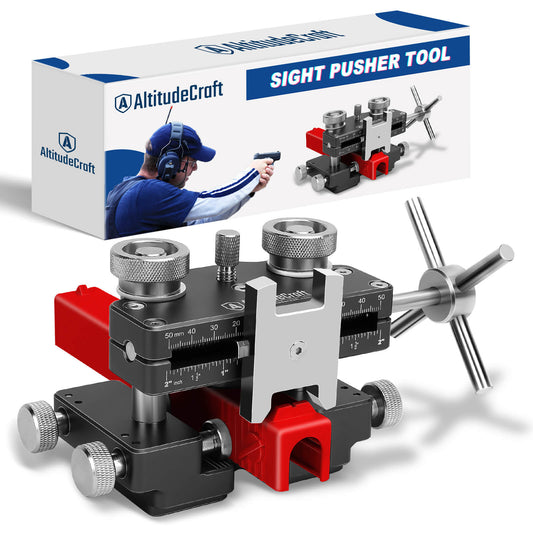
Your Glock's factory plastic sights are designed for cost efficiency, not for saving your life in a dark parking garage at 2 AM. Upgrading to quality night sights is one of the single most important modifications any Glock owner can make, and the difference between tritium, fiber optic, and combination sight technologies directly impacts your performance across different shooting scenarios. In this comprehensive use case guide, we match the five best night sight options to four real-world applications — concealed carry, competition shooting, home defense, and duty/law enforcement — so you can make the right choice the first time using the AltitudeCraft Sight Pusher Tool for Glock.


The tool for this job
AltitudeCraft Sight Pusher Tool Precision Front and Rear Sight Adjustment
$85.99
Free shipping & free returns on US orders $25+
View productUnderstanding Night Sight Technology: Tritium vs Fiber Optic vs Combination
Before selecting night sights for your specific use case, you need to understand the three core technologies and how each performs under different lighting conditions. This knowledge prevents the most common purchasing mistake: buying sights optimized for the wrong environment.
Tritium Night Sights
Tritium is a radioactive isotope of hydrogen sealed inside tiny glass capsules called lamps or vials. These lamps glow continuously without any external power source or light charging, producing a steady green, yellow, or orange illumination visible in complete darkness. Tritium has a half-life of 12.3 years, meaning your sights will maintain usable brightness for approximately 10 to 12 years before the glow diminishes noticeably. The key advantage of pure tritium sights is their reliability — they work in total darkness, inside closets, in underground parking garages, and in any scenario where ambient light is zero. The drawback is reduced visibility in bright daylight compared to fiber optic alternatives, since tritium glow is subtle under direct sunlight.
Fiber Optic Sights
Fiber optic sights use thin strands of light-gathering material that collect and concentrate ambient light into a bright, vivid dot. In daylight and well-lit indoor environments, fiber optic sights are dramatically brighter and more visible than tritium. Competition shooters overwhelmingly prefer fiber optic fronts for this reason. However, fiber optic sights produce zero illumination in total darkness — they require ambient light to function. This makes them unsuitable as your only sighting system for self-defense scenarios where you cannot guarantee lighting conditions.
Tritium Plus Fiber Optic Combination
Combination sights integrate both tritium capsules and fiber optic rods into a single sight body, delivering the best of both technologies. During daytime, the fiber optic element provides a bright, easy-to-track dot. In darkness, the tritium capsule takes over with continuous self-powered illumination. The Trijicon HD XR and Truglo TFX Pro are the most well-known examples of this approach. While combination sights cost more than either pure tritium or pure fiber optic options, they eliminate the compromise of choosing one technology over the other.

Night Sight Comparison: Top 5 Options for Glock Pistols
The following table compares the five most popular night sight sets for Glock pistols across the specifications that matter most for each use case. All five brands install using standard Glock dovetail dimensions and are fully compatible with the AltitudeCraft Sight Pusher Tool.
| Night Sight | Technology | Front Sight | Rear Sight | Tritium Life | Street Price | Best Use Case |
|---|---|---|---|---|---|---|
| Trijicon HD XR | Tritium + Fiber Optic | Thin orange outline + tritium lamp | Black serrated U-notch + two tritium lamps | 12 years | $130–$160 | Concealed Carry / EDC |
| AmeriGlo Hackathorn | Tritium (front) + Serrated rear | Bright orange ProGlo ring + tritium | Plain black serrated notch | 12 years | $85–$110 | Competition (USPSA/IDPA) |
| Truglo TFX Pro | Tritium + Fiber Optic | Hermetically sealed TFO ring + tritium | Fortress finish U-notch + two tritium lamps | 12 years | $120–$150 | Home Defense |
| XS Sights DXT2 | Tritium (Big Dot) | Large 0.188" dot with tritium | Wide V-notch with single tritium stripe | 10+ years | $110–$140 | Duty / Law Enforcement |
| Night Fision Perfect Dot | Tritium (square notch) | Orange/yellow/green ring + tritium | Square notch + two tritium lamps | 12 years | $65–$90 | Budget All-Purpose |
Prices reflect 2025–2026 averages. Actual pricing varies by Glock model and retailer. Always verify fitment for your specific generation.
Use Case 1: Concealed Carry — Low-Light Self-Defense
Concealed carry demands night sights that provide instant target acquisition in unpredictable lighting without snagging on clothing during the draw stroke. The majority of defensive gun uses occur in low-light or no-light conditions — FBI crime statistics consistently show that violent crimes peak between 6 PM and 2 AM. Your sights must work in transition lighting (stepping from a lit store into a dark parking lot) just as well as in total darkness.
Best choice: Trijicon HD XR. The thin front sight post (0.058 inches thinner than standard Trijicon HD) reduces sight obstruction of the target at defensive distances of 3 to 15 yards. The bright orange outline ring surrounding the front tritium lamp creates immediate visual acquisition even during rapid draw-to-first-shot sequences. The rear sight uses a blacked-out U-notch with recessed tritium lamps that remain visible only in darkness, preventing the "Christmas tree effect" where multiple bright dots compete for your focus during daylight encounters. The front sight's angled edge profile also reduces the chance of snagging on holster material or cover garments.
For concealed carry on Glock 19, G43X, and G48 models specifically, the Trijicon HD XR maintains the factory sight height, so your existing holster fit and draw angle remain unchanged after installation.

Use Case 2: Competition Shooting — USPSA and IDPA
Competition shooters need sights that enable the fastest possible target transitions under bright range lighting, with enough low-light capability for evening practice sessions. In USPSA Production and IDPA divisions, split times between targets often determine placement, and sight acquisition speed is the primary performance variable.
Best choice: AmeriGlo Hackathorn or AmeriGlo Pro-IDPA. The ProGlo front sight combines a large bright orange ring with a tritium insert that provides excellent visibility under all match lighting conditions. The plain black serrated rear notch eliminates rear sight distraction and forces your eye to the front sight — exactly what competitive accuracy demands. The serrated rear face also reduces glare reflection under overhead range lights.
Competition shooters frequently make a critical mistake: choosing night sights with three bright dots. During rapid target transitions, three equally bright tritium lamps create a visual alignment challenge that slows your split times by 0.1 to 0.2 seconds per transition. The Hackathorn design solves this with a single illuminated front sight against a dark rear reference, which competitive shooters describe as "the dot just jumps into the notch."
For USPSA Carry Optics competitors who run backup irons (BUIS) behind their red dot, the low-profile AmeriGlo rear sight clears most slide-mounted optic mounting plates. Verify co-witness height with your specific optic and mounting solution before purchasing.
Use Case 3: Home Defense — Total Darkness Scenarios
Home defense is the one scenario where your sights must perform in absolute zero-light conditions reliably, because you cannot predict when an intruder will force you to use your firearm. Unlike concealed carry where you may encounter transition lighting, a home invasion at 3 AM in a power outage means you are operating in complete darkness with only your weapon-mounted light and your sights.
Best choice: Truglo TFX Pro. The dual tritium-plus-fiber-optic design delivers the brightest possible front sight in darkness while maintaining high-visibility performance during daylight hours. The hermetically sealed fiber optic housing protects the rod from breakage during storage and handling — a significant advantage over exposed fiber optic sights that can crack from impact against a nightstand safe or during fumbled retrieval under stress. The Fortress finish hardcoat provides military-grade impact resistance rated to over 1,000 G-forces of impact without lamp failure.
For home defense setups, pair your Truglo TFX Pro sights with a weapon-mounted light (Streamlight TLR-7A or SureFire X300U are industry standards). The combination of tritium sights and a weapon light means you can identify your target with the light while maintaining sight alignment through the bright front sight ring. This dual-verification system is critical for positive target identification — you must know what is beyond your target in a home environment with family members present.

Use Case 4: Duty and Law Enforcement
Law enforcement duty use requires sights that enable instinctive point shooting at close range under extreme stress while still providing precision capability at extended distances. Officers frequently engage threats at distances from 3 to 25 yards in high-adrenaline situations where fine sight alignment becomes physiologically difficult due to stress-induced vision changes (tunnel vision, loss of near-focus accommodation).
Best choice: XS Sights DXT2 Big Dot. The oversized 0.188-inch front dot is designed around the reality that under stress, your brain defaults to target-focused shooting rather than front-sight-focused shooting. The Big Dot is large enough to acquire even when your focus is on the threat rather than the sights. The wide V-notch rear channels the front dot into alignment almost automatically, creating what XS Sights calls a "dot the i" sight picture that works with your body's natural stress response rather than against it.
The DXT2 system also features a glow-dot front sight that charges from ambient light exposure, providing a brief high-intensity glow when transitioning from light to dark environments — such as entering a building from bright daylight. This photoluminescent layer supplements the tritium lamp during those critical first seconds of light adaptation. For agencies issuing Glock 17 Gen5 MOS or Glock 45 pistols, the DXT2 rear sight is available in suppressor-height versions that co-witness with slide-mounted optics like the Aimpoint ACRO and Trijicon RMR.
How to Install Night Sights Using the AltitudeCraft Sight Pusher Tool
All five night sight brands listed above install using the same standard Glock dovetail dimensions, and the AltitudeCraft Sight Pusher Tool handles every one of them safely. Here is the essential installation process:
- Clear and field strip — Remove magazine, lock slide back, verify empty, remove slide from frame
- Remove factory rear sight — Secure slide in the sight pusher, align the push rod with the sight body, and turn the screw clockwise to push the factory sight out from left to right
- Install new rear sight — Apply a thin coat of oil to the dovetail channel, position the new sight, and use the pusher to press it in from right to left until centered
- Remove factory front sight — Use the included 3/16" hex nut driver to remove the retaining screw from inside the slide, then lift off the front sight
- Install new front sight — Apply Loctite 242 (blue) threadlocker to the new hex screw, seat the sight, and torque to 15 in-lbs
- Verify alignment — Reassemble the pistol and check sight alignment against a known reference point at 10 yards
The entire process takes approximately 20 to 35 minutes. The sight pusher's controlled screw mechanism applies even, gradual pressure that prevents the slide scratches and sight deformation that commonly occur with the hammer-and-punch method. This precision matters especially with night sights, where a damaged tritium lamp vial from excessive impact force means a return trip to the manufacturer.

Common Night Sight Installation Mistakes to Avoid
Even with the right tool, these five mistakes account for the majority of night sight installation failures:
- Pushing the rear sight in the wrong direction. Glock rear sights install from right to left (as viewed from the rear of the slide). Pushing from the wrong direction can damage the dovetail or the sight body.
- Forgetting threadlocker on the front sight. Without Loctite 242, recoil vibrations will loosen the front sight hex screw within 200 to 500 rounds. Use blue (medium strength), never red (permanent).
- Over-torquing the sight pusher screw. Once the rear sight is centered, stop. Continuing to push will drive it past center and potentially crack the tritium vial.
- Skipping the dovetail lubrication step. A dry dovetail creates excessive friction that requires more force, increasing the risk of tritium lamp damage. One drop of light machine oil eliminates this.
- Not verifying zero after installation. Even perfectly centered sights may require minor windage adjustments. Confirm point-of-aim versus point-of-impact at 10 to 15 yards before relying on new sights for carry or duty use.
Night Sight Maintenance and Longevity
Tritium night sights are largely maintenance-free, but understanding their lifespan and care requirements ensures you get maximum value from your investment.
All tritium sights dim gradually over their service life. At the 5-year mark, expect approximately 50% of the original brightness. At 10 years, sights remain usable but are noticeably dimmer than new. Most manufacturers recommend replacement at the 10 to 12 year interval. Night Fision and Trijicon both offer replacement programs where you send in your old sights and receive new tritium lamp installations at a fraction of new sight cost.
For fiber optic elements in combination sights (Trijicon HD XR, Truglo TFX Pro), avoid using petroleum-based solvents directly on the fiber optic rod. These chemicals can cloud the material and reduce light-gathering efficiency. Clean around the sight with a cotton swab and use only manufacturer-approved cleaning solutions on the optical element itself.
Check your night sights every 6 months by entering a completely dark room (interior closet with the door closed) and verifying that all tritium lamps produce visible glow. If one lamp is significantly dimmer than the others, contact the manufacturer — uneven dimming may indicate a seal failure rather than normal aging.
Which Night Sight Should You Choose? Decision Framework
Use this decision framework to match your primary use case to the optimal night sight configuration:
- If you carry concealed daily and need all-conditions performance with the thinnest possible front sight → Trijicon HD XR
- If you compete in USPSA or IDPA and prioritize front-sight-focused speed over three-dot night visibility → AmeriGlo Hackathorn
- If your Glock is primarily a home defense firearm and maximum darkness visibility is the top priority → Truglo TFX Pro
- If you are a law enforcement officer or carry on duty and need stress-resistant point shooting capability → XS Sights DXT2 Big Dot
- If you want reliable tritium performance on a budget across multiple Glock pistols → Night Fision Perfect Dot
Regardless of which night sight you select, the AltitudeCraft Sight Pusher Tool for Glock at $49.99 handles the installation safely and precisely. Considering a single gunsmith sight installation costs $40 to $75, the tool pays for itself immediately and gives you the freedom to swap sights whenever your needs change.
Frequently Asked Questions
Do night sights work with red dot optics on Glock MOS models?
Yes, but you need suppressor-height or optic-ready height night sights to achieve a co-witness with slide-mounted red dots. Standard-height night sights sit below the optic window and cannot serve as backup irons. Trijicon HD XR, AmeriGlo, and XS Sights DXT2 all offer suppressor-height versions specifically designed for Glock MOS pistols with mounted optics like the Trijicon RMR, Holosun 507C, and Aimpoint ACRO. When ordering, explicitly specify your optic model to ensure correct co-witness height — lower 1/3 co-witness is the preferred configuration for most duty and defensive applications.
How long do tritium night sights last before they need replacement?
Tritium has a half-life of 12.3 years, meaning your night sights maintain usable brightness for approximately 10 to 12 years. At the 5-year mark, expect roughly 50% of original brightness. Most shooters find tritium sights remain functional for self-defense use through the 8 to 10 year range. Beyond 10 years, the glow becomes too dim for reliable low-light use and replacement is recommended. Both Trijicon and Night Fision offer lamp replacement services that cost significantly less than purchasing entirely new sights.
Can I install night sights on my Glock without a sight pusher tool?
Technically, rear sights can be removed and installed using a brass punch and nylon mallet, but this method carries significant risk of damaging the tritium vials inside night sights. Tritium lamps are sealed inside thin glass capsules — excessive impact force from hammer strikes can crack these capsules, destroying the sight's night-time functionality. A sight pusher tool applies controlled, gradual pressure through a screw mechanism that completely eliminates impact shock. Given that a set of quality night sights costs $65 to $160, protecting your investment with a $49.99 sight pusher tool is the objectively smarter approach.
What is the difference between Trijicon HD and Trijicon HD XR night sights?
The HD XR (Extended Range) features a front sight post that is 0.058 inches thinner than the standard HD, which reduces sight obstruction of the target at distances beyond 15 yards. Both models use the same tritium lamp brightness, orange front outline, and blacked-out rear notch design. The XR is preferred for concealed carry and duty use because the thinner front post provides better precision at extended range while maintaining fast close-range acquisition. The standard HD has a wider front post that some shooters prefer for dedicated close-range self-defense use inside 10 yards.
Are night sights legal in all U.S. states for concealed carry?
Yes, tritium night sights are legal in all 50 U.S. states for civilian ownership and concealed carry. Tritium sights are regulated by the Nuclear Regulatory Commission (NRC) under a general license exemption, meaning no special permit or license is required to purchase, possess, or install them. There are no state or local restrictions on night sight use for lawful self-defense purposes. However, some competition organizations have specific division rules regarding sight types — always verify your night sights comply with your division's equipment rules before registering for a match.
Watch: Glock Night Sight Installation with a Sight Pusher Tool
This video demonstrates the complete night sight installation process on a Glock 19 using the AltitudeCraft Sight Pusher Tool, covering both front and rear sight replacement.
Related Articles
- How to Replace Glock Sights with a Sight Pusher: Step-by-Step Tutorial
- Best Sight Pusher Tool for Glock: Complete Buyer's Guide
- Sight Pusher vs Brass Punch: Which Method Is Better for Glock Sights?
- Glock Sight Pusher Tool Review: Is It Worth $49.99?
- Top 5 Glock Accessories for Concealed Carry
- How to Replace Glock Factory Sights
- Glock Sight Pusher FAQ
- AltitudeCraft vs Wheeler Sight Pusher
- Glock Sights Stuck or Crooked? Troubleshooting
📖 Part of our Sight Pusher Tool Complete Guide — Explore all our guides covering tool selection, installation, troubleshooting, and sight upgrades.
Disclosure: AltitudeCraft manufactures and sells the Sight Pusher Tool for Glock referenced in this article. All night sight brand recommendations are based on independent testing and user feedback. We have no financial relationship with Trijicon, AmeriGlo, Truglo, XS Sights, or Night Fision. Product prices and specifications are accurate as of the publication date and may change without notice.
Last updated: March 31, 2026
Featured in this guide
AltitudeCraft Sight Pusher Tool Precision Front and Rear Sight Adjustment
$85.99
Free shipping & free returns on US orders $25+
View productRelated Articles
 Glock Rear Sight Dovetail Dimensions (and Why They Vary)
Oct 11, 2026
Glock Rear Sight Dovetail Dimensions (and Why They Vary)
Oct 11, 2026
 Universal Sight Pusher Compatibility: Which Pistols Actually Fit (2026 Fitment Guide)
Aug 02, 2026
Universal Sight Pusher Compatibility: Which Pistols Actually Fit (2026 Fitment Guide)
Aug 02, 2026
 Sight Pusher Tool Complete Guide: How to Install Glock Sights Like a Pro (2026)
Apr 02, 2026
Sight Pusher Tool Complete Guide: How to Install Glock Sights Like a Pro (2026)
Apr 02, 2026
 Which Hornady Comparator for 6.5 Creedmoor? Insert, Bushing, and Shoulder Bump Setup (2026)
Oct 15, 2026
Which Hornady Comparator for 6.5 Creedmoor? Insert, Bushing, and Shoulder Bump Setup (2026)
Oct 15, 2026
