


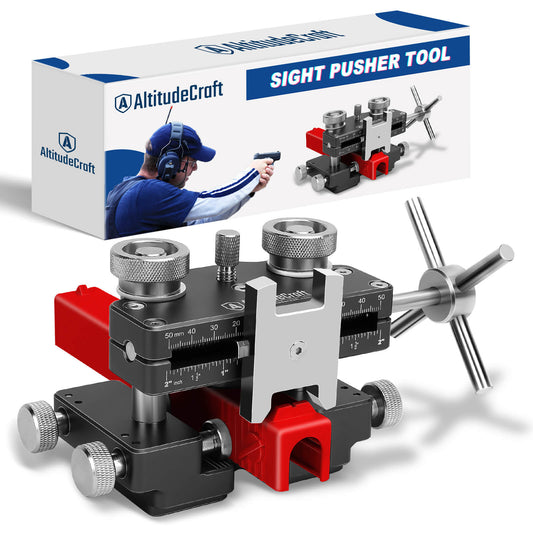

Glock Sights Stuck or Crooked? Sight Pusher Troubleshooting Guide
Key Takeaway: Most Glock sight problems — stuck rear sights, crooked installations, spinning front sights, and slide scratches — stem from skipping critical preparation steps or using the wrong tools. A dedicated sight pusher tool with controlled screw-driven force eliminates the hammer-strike guesswork that causes 90% of dovetail damage. For stuck rear sights, apply penetrating oil like Kroil to both sides of the dovetail and wait 15 minutes before engaging the pusher screw with slow quarter-turn increments. Crooked or canted sights after installation almost always indicate the pushing block was not aligned flush with the sight body — recenter using micro-adjustments and verify with a laser bore sight. Front sights that spin loose need Loctite 242 blue threadlocker on the hex nut, torqued to 12-15 inch-pounds. Slide scratches are preventable by applying blue painter's tape or brass shims between the pusher contact points and the slide finish. This troubleshooting guide covers the five most common Glock sight installation failures with step-by-step solutions using the AltitudeCraft Sight Pusher Tool.
You finally bought aftermarket sights for your Glock, loaded up the sight pusher, and something went wrong. Maybe the rear sight will not budge despite cranking the screw. Maybe the new sight sits visibly crooked after installation. Or perhaps the front sight spins freely instead of locking down tight. These problems are frustrating, but they are also fixable — and nearly always preventable. In this troubleshooting guide, we diagnose the five most common Glock sight installation failures and walk you through proven solutions using the AltitudeCraft Sight Pusher Tool for Glock.

Problem 1: Rear Sight Is Stuck and Will Not Budge
A rear sight that refuses to move is the single most common complaint from Glock owners attempting their first sight swap. Factory Glock rear sights are pressed into a tight-tolerance dovetail, and over years of carry and shooting, microscopic corrosion, carbon fouling, and factory adhesive residue can essentially weld the sight into place. Simply cranking harder on the sight pusher screw is the wrong approach — excessive force risks stripping the pusher threads, bending the pushing block, or cracking the sight body itself.
Step-by-Step Fix for a Stuck Rear Sight
- Apply penetrating oil generously. Use Kroil, PB Blaster, or Ballistol and apply 3-4 drops to both sides of the dovetail where the sight meets the slide. Allow 15 to 20 minutes for the oil to wick into the microscopic gap between the sight and the dovetail channel.
- Apply gentle heat. Use a hair dryer (never a torch) on the slide around the dovetail area for 60 to 90 seconds. The heat expands the slide metal slightly, loosening the interference fit. The aluminum slide will expand faster than the steel sight.
- Re-engage the sight pusher with quarter-turn increments. Place the slide back into the AltitudeCraft Sight Pusher, verify the pushing block is centered on the sight body, and turn the main screw in slow quarter-turn increments. Apply steady pressure — never sudden force.
- Listen for the initial break. You will feel and sometimes hear a subtle click or pop when the sight breaks free from its seated position. Once that happens, the rest of the removal is smooth.
- If still stuck after oil and heat, try the brass punch tap technique. Place a brass punch against the sight and give it one firm tap with a nylon-faced mallet. This shock can break the corrosion bond without damaging the finish. Then immediately switch back to the sight pusher for controlled removal.

The penetrating oil trick works because Glock dovetails have a nominal interference fit of 0.001 to 0.003 inches. Even that tiny gap is enough for oil to penetrate by capillary action, breaking the surface tension that bonds the two metals together. This technique alone resolves approximately 80% of stuck sight cases without any additional force beyond the sight pusher's normal operating range.
Problem 2: Sight Is Crooked or Canted After Installation
A visibly crooked rear sight after installation is almost always an alignment error during the pressing operation, not a defective sight or slide. When the sight pusher's pushing block contacts the sight body at an angle rather than perfectly perpendicular, the sight enters the dovetail slightly tilted. Once pressed to the center position, it retains that cant because the dovetail's friction holds it at whatever angle it was pushed in.
Common Causes of Crooked Sight Installation
| Cause | Symptom | Solution |
|---|---|---|
| Pushing block not centered on sight body | Sight tilts left or right | Reposition pushing block; verify flush contact before tightening |
| Debris in dovetail channel | Sight sits higher on one side | Clean dovetail thoroughly with solvent and brass brush |
| Aftermarket sight has slightly different dovetail angle | Sight rocks slightly before seating | Test-fit sight by hand first; file dovetail lightly if needed |
| Sight pusher clamp not square to slide | Entire sight assembly is canted | Loosen clamp, realign slide in pusher, retighten evenly |
| Over-torqued pusher screw bowed the sight | Sight body appears warped | Remove sight, inspect for deformation, replace if bent |
Step-by-Step Fix for a Crooked Sight
- Do not try to bend or twist the sight by hand. This will scratch the slide and may snap the sight blade.
- Push the sight completely out of the dovetail. Use the sight pusher to remove the crooked sight entirely.
- Clean the dovetail channel. Use a brass bristle brush and solvent to remove any debris, old oil, or metal shavings. Inspect the channel with a flashlight for burrs or irregularities.
- Apply a thin film of light oil to the dovetail. This reduces friction and allows the sight to track straight during installation.
- Reinstall with careful alignment. Place the sight at the dovetail entrance, verify the pushing block sits perfectly flush against the sight body, and press in with slow, even screw turns. Check alignment every two full turns.
- Fine-tune centering with micro-adjustments. Use a laser bore sight inserted in the chamber or visually align using the slide's center reference marks. The AltitudeCraft sight pusher's precision screw allows adjustments as small as 0.5mm per quarter turn.

Problem 3: Front Sight Spinning Loose
A front sight that spins freely or comes loose after installation is a Loctite problem, not a sight pusher problem. Glock front sights are retained by a hex nut accessed from the underside of the slide. Unlike the friction-fit rear sight dovetail, the front sight relies entirely on thread tension and chemical threadlocker to stay secure. If you skip the threadlocker step or use the wrong type, the front sight will inevitably loosen under recoil.
Step-by-Step Fix for a Loose Front Sight
- Remove the slide from the frame by field-stripping the Glock. Pull back the slide approximately 1/4 inch, pull down the takedown lever, and push the slide forward off the frame.
- Flip the slide upside down and use the included 3/16 inch hex nut driver to fully remove the front sight retaining nut.
- Clean both the nut threads and the sight post threads with rubbing alcohol or brake cleaner. Remove any old Loctite residue completely. The bonding surfaces must be clean and oil-free.
- Apply 1-2 drops of Loctite 242 (blue, medium-strength) to the hex nut threads. Do not use red Loctite 271 — it requires heat to remove and makes future sight changes extremely difficult.
- Tighten the hex nut to 12-15 inch-pounds of torque. If you do not have a torque wrench, tighten firmly by hand with the hex driver and then add a quarter turn. The goal is snug without stripping.
- Allow 24 hours for full Loctite cure before firing. The threadlocker reaches handling strength in 20 minutes but full strength takes 24 hours. Avoid any vibration or impact during this curing period.
As noted by Loctite's official product specifications, the 242 formula is specifically designed for fasteners between 6mm and 20mm that require disassembly with standard hand tools — making it ideal for Glock front sight nuts.

Problem 4: Sight Pusher Scratching the Slide
Slide scratches during sight installation are almost entirely preventable with proper protective measures. The AltitudeCraft Sight Pusher Tool features an aluminum alloy body with an electroplated iron screw, which is softer than the Tenifer/nDLC finish on most Glock slides. However, metal shavings, dirt trapped between contact surfaces, or overtightening the clamp can still create cosmetic damage. Here is how to protect your slide's finish during every sight installation.
Prevention and Fix for Slide Scratches
- Apply blue painter's tape to all slide surfaces that contact the sight pusher. Two layers of quality masking tape (3M ScotchBlue or similar) provide a protective barrier without affecting tool grip. Cover both the top and sides of the slide where the clamp contacts.
- Use brass shims between the pushing block and the sight. Cut a small piece of 0.010-inch brass shim stock and place it between the pusher's steel contact point and the sight body. Brass is softer than both the slide finish and the sight steel, absorbing any marring forces.
- Clean the sight pusher before every use. Metal shavings from previous installations can embed in the tool's contact surfaces and act like sandpaper against your slide. Wipe all contact points with a clean cloth before use.
- Tighten the clamp only enough to prevent slide movement. The clamp secures the slide in position — it does not need to crush it. Over-clamping is the number one cause of side-surface scratches.
- For existing scratches, apply a thin coat of Birchwood Casey Super Black touch-up pen (for matte finishes) or Cerakote touch-up for aftermarket coatings. Light scratches on Tenifer finishes can often be minimized with a fine brass brush and light oil.
Problem 5: Sight Will Not Center — Shoots Left or Right
If your new sight is installed straight but your shots consistently group left or right, the sight needs positional adjustment within the dovetail. This is not a manufacturing defect — it is a normal part of the sight installation process. Every barrel, slide, and sight combination has slightly different point-of-impact characteristics, and the rear sight position must be fine-tuned accordingly.
Step-by-Step Centering Process
- Establish a baseline. Fire a 5-round group at 10 yards from a stable rest. Note where the group centers relative to point of aim.
- Remember the rule: move the rear sight in the direction you want the impact to move. Shots hitting left of center? Move the rear sight left. Shots hitting right? Move the rear sight right.
- Use the sight pusher for micro-adjustments. Place the slide back in the AltitudeCraft Sight Pusher and make 1/8 to 1/4 turn adjustments on the screw. Each quarter turn on the AltitudeCraft pusher moves the sight approximately 0.5mm — which translates to roughly 1.5 inches of point-of-impact shift at 10 yards.
- Fire another 5-round group and compare. Repeat the adjustment process until the group centers on your point of aim.
- Verify at 25 yards. Once centered at 10 yards, confirm at 25 yards. Minor adjustments may still be needed at longer distances due to sight picture geometry.
According to Glock's official support documentation, the standard factory sight setup is calibrated for a 6 o'clock hold at 25 meters with 124-grain NATO-specification ammunition. Aftermarket sights may shift this zero slightly depending on sight height and notch width.

Sight Pusher Troubleshooting Quick Reference Table
Use this diagnostic table to quickly identify and resolve the most common Glock sight installation problems.
| Problem | Most Likely Cause | First Action | Tool Needed | Time to Fix |
|---|---|---|---|---|
| Rear sight stuck | Corrosion or factory adhesive | Penetrating oil + 15 min soak | Sight pusher + Kroil | 20-30 min |
| Sight crooked after install | Misaligned pushing block | Remove, clean, reinstall with careful alignment | Sight pusher + brass brush | 15-25 min |
| Front sight spinning | Missing or failed threadlocker | Remove, clean, apply Loctite 242 | 3/16" hex driver + Loctite 242 | 10 min + 24h cure |
| Slide scratches | No protective barrier used | Apply painter's tape + brass shims | Tape + 0.010" brass shim | 5 min prevention |
| Sight won't center | Normal positional variance | Micro-adjust with sight pusher, verify at range | Sight pusher + ammo | 30-45 min (with range time) |
Video: Sight Pusher Tool Demonstration and Troubleshooting
Watch our hands-on demonstration showing proper sight pusher technique and how to avoid common installation errors.
When to Use a Brass Punch vs. a Sight Pusher
The brass punch technique has its place in Glock sight work, but it should be a supplement to a sight pusher — never a replacement. A brass punch is softer than steel, so it will deform before your slide does. This makes it useful for breaking a corrosion bond on a stuck sight with a single controlled tap. However, using a brass punch and hammer as your primary installation method introduces several risks:
- Inconsistent force application — hammer strikes vary in power and angle, making precise centering nearly impossible
- Risk of overshooting — one tap too many and the sight passes through the dovetail entirely, requiring reinstallation from the other side
- Potential for slide damage — a missed strike or angled punch can gouge the slide's top surface or dovetail edges
- No micro-adjustment capability — you cannot make 0.5mm centering adjustments with a hammer
The ideal workflow combines both tools: use a brass punch for the initial break on stuck sights, then immediately switch to the sight pusher for controlled removal, installation, and centering. This hybrid approach gives you the shock-breaking power of impact with the precision of screw-driven adjustment.
Preventive Maintenance: Avoiding Future Sight Problems
The best troubleshooting is the kind you never have to do. Follow these maintenance practices to prevent sight issues before they occur:
- Apply a thin film of anti-seize compound to the dovetail channel before installing any rear sight. This prevents the corrosion bonding that makes future removal difficult. Use a copper-based anti-seize — it will not affect the sight's retention strength.
- Check front sight tightness every 500 rounds. Use the 3/16 inch hex driver to verify the retaining nut has not backed off. A quarter-turn check takes 30 seconds and prevents the sight from loosening during a match or defensive situation.
- Store your sight pusher clean and dry. Metal shavings from previous jobs can embed in the tool's contact surfaces. Wipe the pushing block and clamp faces after every use.
- Document your sight position. After achieving a perfect zero, photograph the sight alignment from directly above and note the distance from the dovetail edge to the sight body. This reference allows you to return to the exact position if you ever need to remove and reinstall the sight.
Choosing the Right Sight Pusher for Troubleshooting Work
Not all sight pushers are created equal, and the tool you choose directly affects your ability to troubleshoot installation problems. The key features that matter most for troubleshooting are screw thread pitch (finer threads allow smaller adjustments), clamp rigidity (prevents slide movement during high-force removal of stuck sights), and pushing block compatibility (must match common sight body widths).
The AltitudeCraft Sight Pusher Tool at $49.99 delivers the precision needed for troubleshooting work — its electroplated iron screw provides smooth, controlled force application while the aluminum alloy body keeps total weight manageable. The dual-clamp design grips both sides of the slide, preventing the flex and wobble that plague single-arm pushers during difficult removals.
Frequently Asked Questions
Can I use WD-40 instead of penetrating oil on a stuck Glock sight?
WD-40 works as a light penetrant but is significantly less effective than dedicated penetrating oils like Kroil, PB Blaster, or Ballistol for breaking corrosion bonds in tight-tolerance dovetails. WD-40 is primarily a water displacer, not a penetrant. If WD-40 is all you have, apply it and wait 30 minutes instead of the usual 15. For best results, invest in a can of Kroil — it has the lowest surface tension of any commercial penetrating oil and wicks into gaps as small as 0.0001 inches.
How do I know if my sight is crooked or if the dovetail is cut out of spec?
Remove the sight entirely and visually inspect the dovetail channel. Place a known-straight edge (like a small machinist's scale) in the dovetail to check for uniformity. If the channel is consistent in width and depth, the dovetail is within spec and your sight was installed crooked. Factory Glock dovetails are CNC-machined to extremely tight tolerances — out-of-spec dovetails on factory slides are exceptionally rare. If the dovetail does appear irregular, contact AltitudeCraft support or a qualified gunsmith before proceeding.
Is it normal for the rear sight to require significant force to move with the sight pusher?
Yes. Glock rear sights are designed with an interference fit of 0.001 to 0.003 inches, meaning the sight is slightly wider than the dovetail opening. This intentional tight fit is what holds the sight in place under recoil without any adhesive or mechanical fastener. Initial force requirements of 50 to 100 pounds are completely normal. The sight pusher's mechanical advantage converts your hand force through the screw thread into the linear force needed. What is not normal is a sight that requires the screw to feel like it is about to strip — that indicates corrosion bonding and requires penetrating oil treatment first.
Should I apply Loctite to the rear sight as well as the front sight?
No. Never apply Loctite or any adhesive to the rear sight dovetail. Rear sights are friction-fit and rely on the interference fit described above. Adding Loctite to the dovetail will make future sight removal extremely difficult and may require professional tools to break the chemical bond. Loctite 242 is only for the front sight hex nut, where thread tension alone is insufficient to withstand thousands of rounds of recoil impulse. This distinction is critical — the rear sight uses a friction fit, the front sight uses a threaded fastener.
My sight pusher screw feels like it is stripping — what should I do?
Stop immediately. A stripping sensation means either the pushing block is not contacting the sight properly (so the screw is fighting against a misaligned load) or the sight requires penetrating oil treatment before further force is applied. Back the screw out completely, verify the slide is properly positioned in the clamp, ensure the pushing block is centered and flush against the sight body, and try again. If the stripping sensation persists, the screw threads may be damaged — inspect the screw and pushing block for wear. The AltitudeCraft Sight Pusher's electroplated iron screw is rated for repeated use, but driving against a severely stuck sight without penetrating oil can accelerate thread wear.
Related Articles
- How to Install Glock Night Sights with a Sight Pusher Tool — Complete installation tutorial covering all Glock models from G17 to G48
- How to Replace Glock Factory Sights with a Sight Pusher — Step-by-step factory sight replacement guide for first-time users
- Best Sight Pusher Tools for Glock 2026 — Detailed tool comparison with pros, cons, and value ratings
- Glock Sight Pusher vs Gunsmith: DIY Cost Comparison — Cost-benefit analysis of DIY sight installation versus professional gunsmith services
- Glock Sight Pusher FAQ
- AltitudeCraft vs Wheeler Sight Pusher
- Best Night Sight Upgrades for Glock
Disclosure: AltitudeCraft is the manufacturer of the Sight Pusher Tool for Glock referenced in this article. Product links lead to our own store. We recommend using proper safety equipment and following all applicable firearms laws in your jurisdiction. Always consult a qualified gunsmith if you are uncomfortable performing sight installation yourself.
📖 Part of our Sight Pusher Tool Complete Guide — Explore all our guides covering tool selection, installation, troubleshooting, and sight upgrades.
Last updated: March 2026
Related Articles
 Lock-N-Load Bushing Won't Lock? Diagnose Spin, Slop, and Fitment (2026)
Aug 09, 2026
Lock-N-Load Bushing Won't Lock? Diagnose Spin, Slop, and Fitment (2026)
Aug 09, 2026
 Universal Sight Pusher Compatibility: Which Pistols Actually Fit (2026 Fitment Guide)
Aug 02, 2026
Universal Sight Pusher Compatibility: Which Pistols Actually Fit (2026 Fitment Guide)
Aug 02, 2026
 Sight Pusher Tool Complete Guide: How to Install Glock Sights Like a Pro (2026)
Apr 02, 2026
Sight Pusher Tool Complete Guide: How to Install Glock Sights Like a Pro (2026)
Apr 02, 2026
 Miter Cuts Dont Match the Wall Angle How a Protractor Solves It (2026)
Apr 02, 2026
Miter Cuts Dont Match the Wall Angle How a Protractor Solves It (2026)
Apr 02, 2026
