




Bullet Comparator Insert Chart: Which Insert Fits Your Cartridge (2026)
You know your cartridge. What you need is the number stamped on the insert — and every chart you find online is either a parts list with no calibers on it, or a caliber list with no part numbers on it.
This page is the cross-reference. All fourteen insert sizes, the bullet diameter each one accepts, the Hornady item number that corresponds to it, and the cartridges that actually use it. Plus the four calibers that no insert fits, which is the single most common reason a comparator kit gets sent back.
Key Takeaway
A bullet comparator insert is selected by bullet diameter, never by cartridge name. The number stamped on an insert is that diameter in thousandths of an inch: a 30 insert accepts .308-inch bullets, a 22 insert accepts .224-inch bullets. Fourteen sizes cover the standard centerfire rifle range from .172 inch through .458 inch. Because the selection key is diameter, one insert serves every cartridge sharing that bullet — the 30 insert measures .308 Winchester, .30-06 Springfield, .300 Winchester Magnum and .300 AAC Blackout alike, despite four different names, cases and metric designations. Hornady part numbers complicate the lookup by prefixing a sequence number to the caliber, so item 830 is the .308 insert and item 1420 is the .204 insert. Straight-wall handgun cartridges fall outside the set entirely: bullet diameters of .355 and .452 inch have no matching insert in any fourteen-piece kit.


The tool for this job
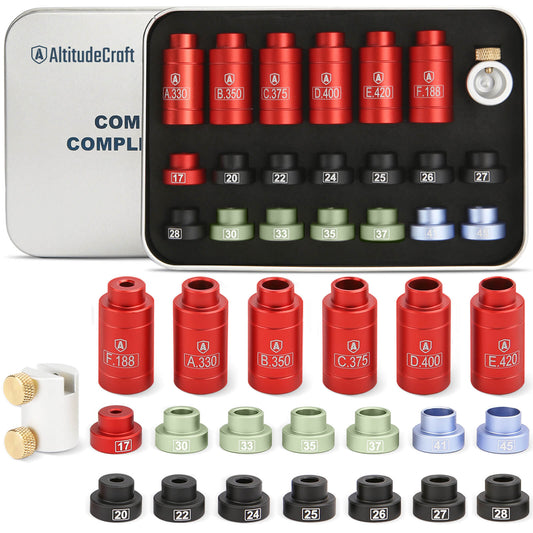
AltitudeCraft Bullet and Headspace Gauge Comparator Kit with 14 Inserts and 6 Bushings
$49.99
Free shipping & free returns on US orders $25+
View productThe Complete Bullet Comparator Insert Chart (.172" to .458")
Find your bullet diameter in column two; the insert stamp in column one is the part you need. If you do not know your bullet's diameter, it is printed on the bullet box — it is not the same as the number in the cartridge name.
| Insert stamp | Bullet diameter | Hornady item # | Cartridges that use it |
|---|---|---|---|
| 17 | .172" | 117 | .17 HMR, .17 Hornet, .17 Remington |
| 20 | .204" | 1420 | .204 Ruger, .20 Practical |
| 22 | .224" | 222 | .223 Rem / 5.56 NATO, .22-250 Rem, .222 Rem, .220 Swift, .224 Valkyrie, 22 ARC |
| 24 | .243" | 324 | .243 Win, 6mm Creedmoor, 6mm ARC, 6mm BR |
| 25 | .257" | 425 | .25-06 Rem, .257 Roberts, .25 Creedmoor, .257 Weatherby Mag |
| 26 | .264" | 526 | 6.5 Creedmoor, 6.5 PRC, .260 Rem, 6.5×55 SE, 6.5 Grendel |
| 27 | .277" | 627 | .270 Win, .270 WSM, 6.8 SPC, 6.8 Western, .277 Fury |
| 28 | .284" | 728 | 7mm Rem Mag, 7mm-08 Rem, .280 Rem, 7mm PRC, 28 Nosler |
| 30 | .308" | 830 | .308 Win, .30-06 Sprg, .300 Win Mag, .300 PRC, .300 AAC Blackout, .30-30 Win |
| 33 | .338" | 933 | .338 Lapua Mag, .338 Win Mag, .338 Federal |
| 35 | .358" | 1035 | .358 Win, .35 Whelen, .35 Remington |
| 37 | .375" | 1137 | .375 H&H Mag, .375 Ruger |
| 41 | .416" | 13-41 | .416 Rigby, .416 Rem Mag, .416 Barrett |
| 45 | .458" | 12-45 | .458 Win Mag, .45-70 Gov't, .458 SOCOM — not .45 ACP |

Why Hornady Bullet Comparator Insert Numbers Look Like Part Numbers
Hornady item numbers concatenate a sequence position with the caliber, which is why the lookup feels impossible. The company's official Lock-N-Load Bullet Comparator page lists all fourteen inserts by item number but publishes no explanation of how those numbers are built. Decode it once and the whole catalogue becomes readable:
| Hornady item # | Sequence position | Caliber portion | Actual bullet diameter |
|---|---|---|---|
| 117 | 1 | 17 | .172" |
| 222 | 2 | 22 | .224" |
| 830 | 8 | 30 | .308" |
| 1035 | 10 | 35 | .358" |
| 1420 | 14 | 20 | .204" |
Two traps follow directly from this scheme. First, item 222 is not for .222 Remington — it is the second insert, .224 caliber. It happens to work for .222 Remington because that cartridge fires a .224-inch bullet, but the coincidence is what makes people trust the wrong pattern. Second, item 1420 looks like a four-digit part number and is actually the .204 insert, the fourteenth in the sequence. Anyone scanning a price list for "204" will not find it.
Kits that stamp only the caliber — 17, 20, 22, 30, 45 — sidestep the whole problem, because the stamp on the part is the same number you look up. That is the practical argument for the two-digit convention, and it is why the chart above leads with the stamp rather than the item number.

Inserts Are Chosen by Bullet Diameter, Not Cartridge Name
The single largest source of wrong-insert confusion is cartridge names that do not contain their own bullet diameter. Across 102 returns of our own bullet and headspace comparator kit, sixteen — 15.7% — were logged as "ordered wrong item," and twelve of the sixty-three written comments describe the same failure: the buyer could not determine whether the tool covered their chambering. One customer wrote simply, "Does not have a 7.62x35 gauge."
It does. 7.62×35mm is the metric designation for .300 AAC Blackout, and its published bullet diameter is .308 inch — the 30 insert, already in every fourteen-piece kit. Nothing was missing. The lookup failed because no chart connected the metric name to the insert stamp.
Here are the cartridge names that most often break the pattern:
| Cartridge as you know it | What the name suggests | Actual bullet diameter | Insert |
|---|---|---|---|
| .300 AAC Blackout / 7.62×35mm | ".300" or a 7.62 metric part | .308" | 30 |
| 6.5 Creedmoor | a 6.5 insert | .264" | 26 |
| .270 Winchester | a 27 insert at .270" | .277" | 27 |
| .223 Rem / 5.56 NATO | a 22 or a metric 5.56 part | .224" | 22 |
| .30-30 Winchester | something other than .308 | .308" | 30 |
| .243 Winchester / 6mm Creedmoor | two different inserts | .243" both | 24 for both |
The rule that resolves all of them: read the bullet box, not the rifle. Bullet manufacturers print diameter on the packaging precisely because cartridge names are unreliable.

Four Calibers Where No Bullet Comparator Insert Properly Fits
Every fourteen-piece insert set stops at the centerfire rifle range; common straight-wall handgun bullets have no matching insert. This is the second-largest theme in our return comments — "Thought it might work for 9mm. I was wrong ?" and "Not for pistols" both appear verbatim.
- 9mm Luger — .355". Falls between the 33 and 35 inserts. No fit. Published bullet diameter is .355 inch.
- .45 ACP — .452". This is the trap the chart above flags in bold. The 45 insert is .458 inch rifle, for .458 Win Mag and .45-70. It is six thousandths oversize for .45 ACP and will not index the ogive consistently.
- .450 Bushmaster — .452". Same diameter as .45 ACP, same answer, despite being a rifle cartridge.
- .350 Legend — .357". The nearest insert is 35 at .358". One thousandth undersize will still give you repeatable relative readings for seating-depth work, but the absolute number is not comparable to a true .358" bullet measured in the same insert.
There is a deeper reason handgun cartridges sit outside this system, and it is worth understanding before you buy anything: rimless straight-wall pistol cases headspace on the case mouth, not on a shoulder. There is no shoulder datum to measure, so the headspace half of a combination kit has nothing to do on those cartridges either. A comparator kit is a bottleneck-rifle tool.
One more numbering collision worth naming: headspace bushings carry decimals too — A.330, B.350, C.375, D.400, E.420 — and those numbers are case-shoulder datum diameters, not bullet calibers. A .40 S&W reloader who spots "D.400" has not found their part.
Bullet Comparator Inserts vs Headspace Bushings: Different Parts, Different Jobs
Inserts measure the bullet; bushings measure the case. They look similar in the tray, they thread into similar bodies, and they are constantly confused — but they answer different questions and are selected off different scales.
| Bullet comparator insert | Headspace bushing | |
|---|---|---|
| Measures | Base to ogive (CBTO) | Base to shoulder datum |
| Selected by | Bullet diameter (.172"–.458") | Shoulder datum diameter (A.330–F.188) |
| Marked | Two-digit caliber: 17–45 | Letter + decimal: A.330, B.350… |
| Answers | "Is my seating depth consistent?" | "How far did I bump the shoulder?" |
| Used on | Loaded rounds and bullets | Fired and resized cases |
For .300 Blackout, the earlier example, you need both halves and they read off different scales: the 30 insert for the bullet, and the A.330 bushing for the case — because the cartridge's published shoulder diameter is .332 inch. If you are working the case side, the full bushing selection logic lives in our headspace comparator bushing size chart, including why a comparator is not a GO/NO-GO gauge.

Will the Comparator Body Fit Your Caliper?
The insert is only half the fitment question — the body has to clamp onto your caliper blade. Our comparator body is 0.73 inch tall with a 0.2 inch blade slot, secured by two knurled brass thumbscrews with 0.15 inch threads, and it ships with a 1/16 inch hex key.
That 0.2 inch slot is the number that matters. Most 6-inch dial and digital calipers have jaw blades comfortably under that thickness, but heavy-duty and some shop-grade calipers do not — which explains return comments like "It doesn't have a suitable clamp system." The tool was not faulty; the caliper blade was too thick. Measure your blade with the caliper itself before ordering, and if you are between calipers entirely, the dual-screw design exists so you do not need a third hand to hold the body square to the blade.

Frequently Asked Questions About Bullet Comparator Inserts
Which bullet comparator insert do I need for .308 Winchester?
The 30 insert, Hornady item 830, sized for .308-inch bullets. The same insert covers .30-06 Springfield, .300 Winchester Magnum, .300 PRC, .30-30 Winchester and .300 AAC Blackout, because all of them fire a .308-inch bullet.
What is the Hornady insert number for .224 caliber?
Item 222 — the second insert in the sequence, .224 caliber. Despite appearances it is not the .222 Remington insert, though it does work for .222 Remington, which fires a .224-inch bullet.
Does a bullet comparator work for .300 Blackout?
Yes. Use the 30 insert for base-to-ogive measurements. For the case side, .300 Blackout's shoulder diameter is .332 inch, so the A.330 bushing is the correct headspace part. Neither is a separate "7.62×35" component — that is only the metric name for the same cartridge.
Can I use a bullet comparator on 9mm or .45 ACP?
No. 9mm Luger bullets are .355 inch and .45 ACP bullets are .452 inch; neither has a matching insert in a fourteen-piece set. The 45 insert is .458 inch for rifle cartridges. Straight-wall pistol cases also headspace on the case mouth rather than a shoulder, so the headspace side does not apply either.
What is the difference between a comparator insert and a headspace bushing?
An insert measures a loaded round from base to bullet ogive and is chosen by bullet diameter. A bushing measures a case from base to shoulder datum and is chosen by shoulder diameter. Different parts, different scales, different jobs — see our bullet comparator FAQ on inserts, OAL and CBTO for the measurement theory.
Will inserts from one brand fit another brand's comparator body?
Treat inserts and bodies as brand-matched sets unless the maker explicitly states cross-compatibility. The insert-to-body interface is not covered by any published industry standard, so thread pitch and seating depth are a manufacturer choice rather than a specification you can rely on.
Why do two people get different CBTO numbers with the same insert?
Because a comparator is a relative instrument. The insert's hole diameter determines where on the ogive it makes contact, so readings are only comparable when taken with the same insert and the same technique. Chasing an absolute number across tools is the wrong use of the tool — the diagnosis walkthrough is in inconsistent CBTO readings.
How many inserts do I actually need?
One per bullet diameter you load — not one per cartridge. A reloader running .223 Rem, .22-250 and .220 Swift needs a single 22 insert. Basic seven-piece sets cover .224 through .308, which is most modern centerfire shooting; the fourteen-piece sets exist for .17, .20 and the .338-and-up magnums.
Related Resources
- How to measure CBTO with a bullet comparator — the five-step procedure once your insert is fitted
- Seating depth tuning for long-range precision — what to do with the numbers
- AltitudeCraft vs Hornady bullet comparator kit — a head-to-head on build and value
- All precision reloading and gunsmithing tools
Need the bullet and case sides in one tin?
The Bullet and Headspace Gauge Comparator Kit carries all 14 inserts (.172"–.458") plus 6 headspace bushings (A.330–F.188) in one anodised 6061 aluminium set, so the .300 Blackout example above — 30 insert plus A.330 bushing — is covered by a single purchase. Case-side only? The 6-bushing headspace kit is the smaller option.
Featured in this guide
AltitudeCraft Bullet and Headspace Gauge Comparator Kit with 14 Inserts and 6 Bushings
$49.99
Free shipping & free returns on US orders $25+
View productRelated Articles
 Which Hornady Comparator for 6.5 Creedmoor? Insert, Bushing, and Shoulder Bump Setup (2026)
Oct 15, 2026
Which Hornady Comparator for 6.5 Creedmoor? Insert, Bushing, and Shoulder Bump Setup (2026)
Oct 15, 2026
 Lock-N-Load Bushing Won't Lock? Diagnose Spin, Slop, and Fitment (2026)
Aug 09, 2026
Lock-N-Load Bushing Won't Lock? Diagnose Spin, Slop, and Fitment (2026)
Aug 09, 2026
 OAL Gauge Guide: How to Measure Distance to the Lands (2026)
Aug 07, 2026
OAL Gauge Guide: How to Measure Distance to the Lands (2026)
Aug 07, 2026
 Headspace Comparator Bushing Size Chart: Which Bushing Fits Your Cartridge (2026)
Aug 02, 2026
Headspace Comparator Bushing Size Chart: Which Bushing Fits Your Cartridge (2026)
Aug 02, 2026
