




Weed Eater Harness Fit Guide: The 4 Adjustments That Decide Whether It Fits You (2026)
Key Takeaway
A weed eater harness fits by torso length, not by your height. Height tells you how tall you are; torso length tells you how far it is from the top of your shoulder to your waistline, and that is the only distance the harness actually spans. Two people who are both 5'10" can differ by three inches in torso length, which is why the same harness comes back described as "too small" by one buyer and "too big" by another. Before you buy, check three numbers: whether the chest buckle slides vertically, whether the hip pad or back plate slides along the torso, and the stated adjustment range in inches rather than a height range. If a listing only claims "adjustable" without saying which parts adjust, it is telling you about the shoulder straps alone.


The tool for this job
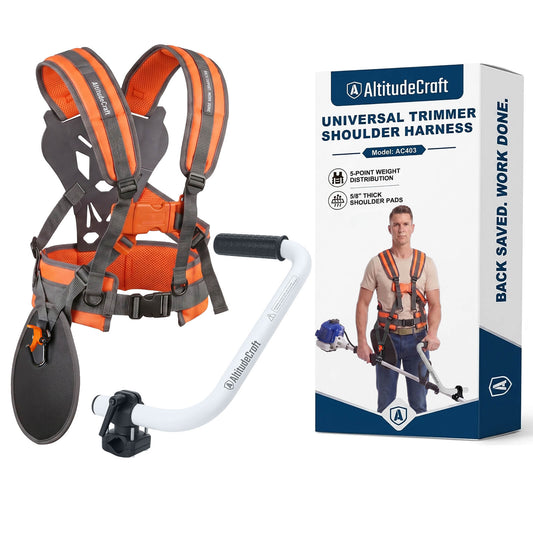
AltitudeCraft 2-in-1 String Trimmer Handle & 5-Point Harness Kit
$59.99
Free shipping & free returns on US orders $25+
View productThe 60-second check before you buy
Run this on any string trimmer harness listing before you add it to the cart. Four yes/no questions, in the order that matters:
- Does the chest buckle slide up and down? If the listing does not say so and no photo shows a vertical track, assume it is fixed — that is the single most common cause of "the clip is at my throat."
- Does the hip pad or back plate slide along the torso? This is what lets one harness cover a wide range of builds. Without it, you are buying one fixed torso length.
- Is there a waist belt that actually cinches? A weed eater shoulder strap with a loose belly band is not a harness; nothing transfers to your hips.
- Does your trimmer have a hang point? Check the shaft before anything else. No hang point, no harness — you would need to add a universal hook clamp first.
Three or four yes answers and the harness will almost certainly fit you. Two or fewer and you are relying on luck.
Why the same harness gets returned as both "too small" and "too big"
We looked at every return filed against our own 2-in-1 trimmer handle and five-point weed eater harness kit since it launched: 60 returns, of which 9 buyers left free-text comments. Five of those nine comments were about fit — and they pointed in opposite directions.
| What the buyer wrote | What it actually describes |
|---|---|
| "Strap harness was to small and fit incorrectly. The chest clip was around my neck… it said it could fit guys over 6ft I'm only 5'10" and the harness was to short length wise" | Chest buckle left at its factory height; torso span too short for this user's build |
| "Harness too small and uncomfortable" | Same failure, described by outcome instead of cause |
| "shoulder size too big and not adjustable" | Shoulder straps splayed outward — a narrow-shouldered fit problem |
| "Too bulky to wear" | Padding volume, not span |
| "To Large for user." | Opposite direction from the first two |
Nine comments is a small sample and we will not pretend otherwise. But the pattern inside it is mechanically coherent: "too small" complaints are almost always vertical (the chest buckle rides up toward the throat because the harness spans a shorter torso than yours), while "too big" complaints are almost always horizontal (the shoulder straps sit wide of your shoulders). Those are two different adjustments. A buyer who only lengthens the shoulder straps — the one adjustment everybody finds immediately — fixes neither.
The buyer who wrote the first comment is the important one. He is 5'10", squarely inside a stated range, and the harness still failed him. That is not a sizing chart problem. It is an adjustment-discovery problem: the chest buckle on that harness does slide vertically, and the hip pad does slide along the torso. He never found either.

The four adjustments, and the order you must set them in
Order matters more than most people expect. Setting the shoulder straps first — the instinctive move — locks in a torso span that then forces the chest buckle into the wrong place. Work top-down instead:
| Step | Adjustment | What it controls | How you know it is right |
|---|---|---|---|
| 1 | Hip pad / back plate position | Torso length — the vertical span from shoulder to waist | The waist belt sits on the top of your hip bones, not on your soft belly and not up on your ribs |
| 2 | Shoulder latch (strap length) | How high the harness rides | Padding covers the top of the shoulder with no gap behind the neck |
| 3 | Chest buckle height | Where the straps are pulled together across the sternum | Roughly a hand's width below the collarbone — never touching the throat |
| 4 | Waist lock | How much load transfers off the shoulders onto the hips | Snug enough that lifting the shoulder straps with your thumbs does not lift the belt |
Only after all four are set should you clip the trimmer on and set hook height. If you find yourself redoing the shoulder straps after hanging the machine, the hip pad in step 1 is in the wrong place.
How to measure your torso in 90 seconds
- Stand upright, relaxed, wearing the clothes you actually work in.
- Find the bony bump at the base of your neck where it meets your shoulders.
- Find the top of your hip bones — put your hands on your hips and press down until you feel bone. The imaginary line between them is your waistline.
- Have someone measure straight down your back from the neck bump to that waistline. That number, not your height, is what the harness has to span.
As a rule of thumb — the same one backpack makers use for torso sizing, not a published statistic — most adults fall somewhere in the mid-teens to low-twenties in inches. What matters is not the exact number but whether you are near an end of that spread. If you are, a harness advertised only by height range is a gamble; look for one that states the span in inches, or one with a sliding hip pad, which is what lets a single harness cover a wide torso range.

Fit symptom, root cause, fix
| Symptom after 10 minutes | Root cause | Fix |
|---|---|---|
| Chest buckle creeping toward your throat | Harness spans a shorter torso than yours | Slide the hip pad down first, then slide the chest buckle down |
| Straps sliding off the points of your shoulders | Chest buckle set too low, so nothing pulls the straps inboard | Raise the chest buckle to mid-sternum and re-snug |
| Burning on one shoulder only | Load never transferred to the hips | Tighten the waist lock until the belt carries weight; loosen shoulders slightly |
| Lower back aching, not shoulders | You are still bending to reach the cut, which a harness cannot fix | Raise the hook, and add a second grip point so you can stand upright |
| Trimmer head nose-diving or tail-heavy | Balance hook in the wrong place on the shaft | Move the hook until the head hangs level with the trimmer released |
| Numb or tingling hands | Vibration exposure, not load | A weed eater harness will not help; see our write-up on weed eater hand-arm vibration |
String trimmer harness, single strap, or handle extension?
These three solve different problems and get confused constantly. A string trimmer harness changes where the weight sits. A handle changes what posture you hold. They are complements, not alternatives.
| Single shoulder strap | Five-point harness | Handle extension | |
|---|---|---|---|
| Fixes shoulder load | Partially — one shoulder | Yes — shoulders, chest, waist, hips | No |
| Fixes hunched-over posture | No | No | Yes |
| Fixes grip fatigue | Slightly | Yes, indirectly | Yes |
| Fit risk | Low | Moderate — torso length matters | Depends on shaft diameter |
| Works on curved-shaft trimmers | Usually | Usually, if there is a hang point | Check clamp range first |
If your complaint is a burning shoulder after 20 minutes, you want the harness. If your complaint is a sore lower back from stooping, no harness will help you — that is a posture problem, and our guide to setting up a string trimmer for zero back pain covers it directly. If you have both, that is exactly why the two get sold as a kit. Fitment rules for the handle half are in our weed eater handle fitment guide, and installation questions are answered in the handle compatibility FAQ.

What the load is actually doing to you
This is not a comfort accessory argument. OSHA lists the ergonomic risk factors that drive musculoskeletal injury as awkward postures, forceful exertions, and repetitive motion — string trimming delivers all three at once, for hours.
The clearest number we could find comes from a 2021 study of landscape workers published in the National Library of Medicine. In that sample of 55 workers, the twelve-month prevalence of work-related musculoskeletal disorders was 85.5%, and the shoulder was the single most affected region at 65.5%, ahead of neck and wrist/hand (23.6% each) and lower back (20.0%). The sample is small and it was conducted in Malaysia, so treat it as directional rather than definitive — but the ranking is what matters here, and the shoulder tops it. You can read the full paper on PubMed Central.
That ranking is the argument for a harness rather than a strap: the shoulder is the joint taking the damage, and a harness is the only one of these accessories that removes weight from it. For a longer look at the shoulder and back side of this, see our piece on shoulder and back pain from string trimming. Crews running trimmers all day should also read the commercial landscaper ROI guide, which puts numbers on downtime.
Worth knowing on the safety side: gas-powered handheld trimmers and brushcutters in the US are covered by the ANSI/OPEI B175.3 standard, maintained by the Outdoor Power Equipment Institute. If you are running a metal blade rather than line, check your machine's manual — blade use frequently carries harness requirements that line trimming does not.

When a harness is the wrong purchase
- Battery trimmers under about 8 lb. The load is low enough that a harness adds bulk without solving much. A second grip point usually does more.
- Short sessions. Under 15 minutes at a time, fatigue rarely gets far enough for the harness to pay for the setup time.
- Trimmers with no hang point. Some consumer curved-shaft models have nothing to clip to. Check before buying.
- Hand numbness as your main symptom. That is vibration, not weight, and it needs a different fix.
Frequently Asked Questions
Does a weed eater harness fit by height or by torso length?
By torso length. Height range claims like "fits 5'2" to 6'6"" are shorthand and they hide the real variable: two people of the same height can differ by several inches between shoulder and waistline. If a harness has a sliding hip pad, it can cover a wide torso range; if it only adjusts at the shoulder straps, it cannot.
Why does the chest clip on my trimmer harness sit at my throat?
Because the harness is spanning a shorter torso than yours. Fix it in this order: slide the hip pad down so the waist belt lands on your hip bones, then slide the chest buckle down to roughly a hand's width below your collarbone. Lengthening the shoulder straps alone will not move the buckle down.
Is a five-point weed eater harness better than a double shoulder strap?
For anything over about 10 lb, yes — the difference is not the number of straps but whether a waist belt exists to transfer load onto your hips. A double shoulder strap still puts all the weight on your shoulders, just on two of them instead of one.
Can I use a string trimmer harness with a curved-shaft weed eater?
Usually, provided the shaft has a hang point or you can add a universal hook clamp. Curved-shaft machines are typically lighter, so the payoff is smaller than on a straight-shaft brush cutter.
Do I need both a harness and a handle extension?
Only if you have both symptoms. Burning shoulders means you need the harness; a sore lower back from stooping means you need the handle. Many operators running heavy gas machines for hours have both, which is why our 2-in-1 trimmer handle and five-point harness kit ships as one package — but either half works on its own.
How tight should the waist belt be?
Snug enough that when you hook your thumbs under the shoulder straps and lift, the waist belt does not lift with them. If it rises, the belt is loose and your shoulders are still doing the work.
Featured in this guide
AltitudeCraft 2-in-1 String Trimmer Handle & 5-Point Harness Kit
$59.99
Free shipping & free returns on US orders $25+
View productRelated Articles
 Weed Eater Hands Going Numb? The Vibration Risk Nobody Warns You About
Aug 02, 2026
Weed Eater Hands Going Numb? The Vibration Risk Nobody Warns You About
Aug 02, 2026
 Silverado A/C Belt: Which GM Truck Belts Are Stretch-Fit, and Which Tool Fits (2026)
Oct 20, 2026
Silverado A/C Belt: Which GM Truck Belts Are Stretch-Fit, and Which Tool Fits (2026)
Oct 20, 2026
 30-30 Overall Length for Lever Actions: How to Find Yours (and When an OAL Gauge Won't Help)
Oct 19, 2026
30-30 Overall Length for Lever Actions: How to Find Yours (and When an OAL Gauge Won't Help)
Oct 19, 2026
 Glock 43X/48 MOS vs MOSK: How to Tell Which Optic Cut You Have (and Whether You Need a Plate)
Oct 19, 2026
Glock 43X/48 MOS vs MOSK: How to Tell Which Optic Cut You Have (and Whether You Need a Plate)
Oct 19, 2026
