




30-30 Overall Length for Lever Actions: How to Find Yours (and When an OAL Gauge Won't Help)
Last updated: October 2026 | By the AltitudeCraft Team
The 30-30 overall length (COAL) limit for factory-spec ammunition is 2.550 inches. In a lever-action rifle, that number matters more than the distance to the rifling. A tube magazine, a cartridge carrier and a crimp groove decide how long a round can be, and they usually stop you before the lands do. This guide shows how to find the right length for your own Marlin 336, Winchester 94 or similar rifle. It also explains when an OAL gauge helps and when it is the wrong tool.
We make overall length gauges, and one of our verified buyers left a two-star review that shaped this article: "Quality is good, however it will not work on level action rifles. At least not Marlin 336 or Winchester 94. Which is why I purchased it." ("level" [sic]) That is a fair complaint, and lever-gun handloaders deserve a straight answer before they spend money on any gauge, ours included.
Disclosure: AltitudeCraft sells the OAL gauges and comparator discussed below. Load dimensions in this guide come from third-party sources linked where they appear. Always work from a published load manual.
Key Takeaway
The industry maximum cartridge overall length for the .30-30 Winchester is 2.550 inches, with a maximum case length of 2.039 inches. In a lever-action rifle, the practical length limit is usually set by feeding, not by the rifling. Rounds must pass through a tubular magazine and the carrier, and the bullet must be crimped into its cannelure so recoil and magazine-spring pressure cannot push it deeper into the case. In one published test, a Winchester Model 94 touched the rifling at 2.553 inches, yet shorter rounds were needed for reliable cycling. For most lever-gun loads, the correct method is to seat the bullet to its cannelure, crimp it, and then cycle inert dummy rounds through the magazine. Measuring the distance to the lands matters only for bullets without a cannelure or for rounds you load one at a time.


The tool for this job
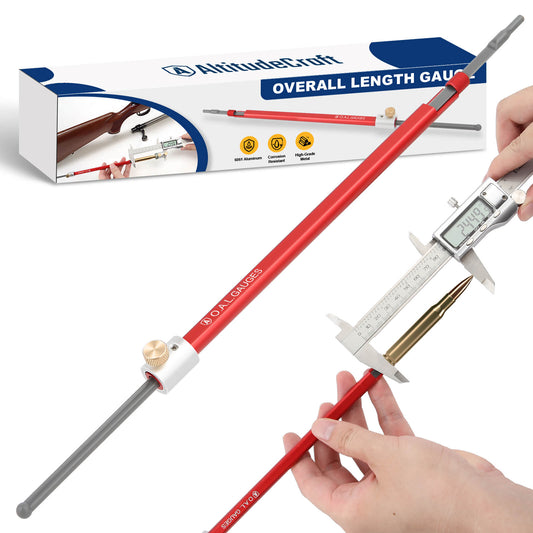
AltitudeCraft Overall Length Gauge Straight, Compatible with Bolt-Action and Single-Shot Firearms
$31.99
Free shipping & free returns on US orders $25+
View productWhat is the correct 30-30 overall length?
The maximum cartridge overall length (COAL) for the .30-30 Winchester is 2.550 inches. Your load manual's listed length for a specific bullet always comes first.
The 2.550-inch figure is the industry maximum listed in the .30-30 Winchester cartridge specifications, alongside a 2.039-inch maximum case length and a 42,000 psi maximum average pressure. Bullet makers list their own COAL for each bullet because nose shape and cannelure position vary. A 150-grain round-nose bullet and a 170-grain flat-nose bullet will not sit at the same length even when both are crimped correctly.
| 30-30 COAL spec | Value | What it controls |
|---|---|---|
| Maximum cartridge overall length | 2.550 in (64.8 mm) | Fits any in-spec magazine and action |
| Maximum case length | 2.039 in (51.8 mm) | Trim length; affects how much crimp each round gets |
| Maximum average pressure | 42,000 psi | Why seating depth changes must follow a manual |
| Published Model 94 length at the lands | 2.553 in (150-gr round nose) | One rifle, one bullet. It did not cycle at this length |
Why is 30-30 COAL different in a lever action? Crimp, cannelure and the tube
A lever action has to feed every round from a tube magazine through a carrier, so the action, not the rifling, usually sets the longest usable length.
Writing for NRA's American Rifleman, John Haviland found that in his Winchester Model 94, "a cartridge length of 2.553" placed Sierra 150-gr. RN Pro-Hunter bullets in contact with the start of the rifling." The next sentence is the important one: "A shorter cartridge length was required for trouble-free cycling through the 94's action."
Three things make lever guns different from bolt guns:
- Tube magazines: Each bullet nose rests on the primer of the round in front of it. That is why lever-gun bullets are traditionally round-nose or flat-nose. Ordinary pointed spitzer bullets are unsafe in a tube. Use flat-nose or round-nose bullets, or polymer-tipped bullets that the maker specifically designs for tubular magazines.
- Crimp: Haviland crimped bullets "to fasten them in place against the tension of a compressed tubular magazine spring and recoil force." A round with no crimp can be pushed deeper into the case by recoil and spring pressure, which shortens it and can raise pressure.
- The cannelure: Lever-gun bullets have a crimp groove. Seating so the case mouth lands in that groove fixes your overall length for you. Haviland trimmed every case to the same length so "the same amount of crimp is applied to the bullets' cannelure."
Touching the lands is a bolt-action precision habit. A writer at GunsAmerica warns that rounds loaded out to the rifling "often will not feed reliably from a magazine." In a lever gun, a round that will not feed is useless.

How do you find the right 30-30 overall length for your rifle?
For cannelured lever-gun bullets, seat to the cannelure, crimp, and prove the length with dummy rounds. You do not need a gauge for this.
- Start from your load manual. Use the listed COAL for your exact bullet and never go past 2.550 inches unless the manual specifically lists a longer length for that bullet.
- Trim cases to one length. Keep every case at or under 2.039 inches and trimmed to the same length so the crimp is the same on every round. An overlength case can jam into the chamber throat and raise pressure, and it also takes excess crimp that can bulge the case.
- Seat to the cannelure. Adjust the seating die until the case mouth sits in the middle of the crimp groove, then apply a firm roll crimp.
- Build two or three dummy rounds. Use no powder and no primer. Mark them clearly so they can never be mixed with live ammunition.
- Cycle them. Load the dummies into the magazine tube and work the lever briskly, the way you would in the field. Every round should feed, chamber and eject without sticking.
- Measure after cycling. Check each dummy with calipers. If the length got shorter after riding in the magazine, the crimp is too light.
If all of this passes, that is your 30-30 overall length for that bullet. Write it down with the bullet type, lot and rifle.
Common mistake: cycling only one dummy round from the chamber. Load at least two into the tube so the round behind is pushed by the magazine spring the way it is in the field.

Does a lever action OAL gauge work on a Marlin 336 or Winchester 94?
It depends on the rifle. A Marlin 336 can be set up for a straight gauge, while a buyer has reported that a curved gauge would not work in either a Marlin 336 or a Winchester 94.
Hornady describes its curved gauge as being for "all autoloader, lever-action, or pump-action rifles" and says it "inserts into chamber through ejection port." It also says the curved model is "not compatible with Adapter "D" or short-bodied cases." On its Modified Cases page, Hornady calls the straight gauge "preferred, as it is most precise and user friendly" and says it suits "any firearm with straight-line access to the chamber." Our buyer's review shows that the general lever-action claim does not hold for every lever rifle. We have not confirmed exactly what blocks the gauge in each model, so we will not guess.
What our own data shows: across 7 Amazon reviews and 11 Amazon returns of our curved gauge through mid-October 2026, this is the only lever-action fit complaint. Of the 6 returns with a written reason, 5 were about ordering or choosing: a duplicate order, two buyers who wanted the Hornady brand or a different one, one who never needed it, and one who ordered both versions and found they "only need the straight one." One was about the tool itself: the buyer felt the uncoated braided push wire made it hard to feel the moment the bullet touched the lands. In this small sample (7 reviews, 11 returns), most problems came from matching the gauge to the rifle, and the push-wire feel is the one hardware point a buyer has raised.
What we can say is how the two rifles differ:
| Method | Marlin 336 | Winchester 94 | Best for |
|---|---|---|---|
| Seat to cannelure + dummy cycle test | Yes | Yes | Almost every lever-gun load |
| Straight OAL gauge | Should work once the bolt is out (straight-line access); not yet tested by us | No easy straight-line access | Non-cannelured bullets, single loading |
| Curved OAL gauge | Reported not to work | Reported not to work | Many autoloaders and pump actions |
| Long-seated dummy round | Possible (rough reading) | Possible (rough reading) | A rough lands reading without a gauge |
Marlin 336: The Marlin can be cleaned from the breech. With the lever screw out, the lever comes off and the bolt slides out the rear of the receiver. That gives you the straight-line access a straight gauge needs, using a 30-30 modified case (Hornady lists it as A3030). If you own a Marlin and want a true lands measurement, this is the most precise route.
Winchester 94: We have not found a simple way to pull the bolt out the back of a Model 94 the way you can on a Marlin, so a straight gauge has no clear path to the chamber. Use the dummy-round method below, or simply stay at the cannelure and the manual's COAL.

How to measure distance to the lands in a lever action without a gauge
Seat a bullet long in an empty, unprimed case with light neck tension, close the action on it gently, and measure how far the rifling pushed it back.
- Size a fired case, then open the neck slightly so the bullet slides with light finger pressure. Use no powder and no primer.
- Seat a bullet well past your planned length.
- Feed it into the chamber by hand and close the lever slowly. The lands will push the bullet back into the case. Do not force the lever; if it binds, stop and seat the bullet shorter.
- Open the action carefully and extract the round. Measure the overall length, and look for faint rifling marks on the bullet.
- Repeat three times and average the readings. If the bullet sticks in the rifling, tap it out from the muzzle with a cleaning rod.
This gives you a rough number, not a 0.001-inch reading, because the bullet can be dragged as you extract it. For a lever gun, rough is enough. You are confirming that your cannelure length sits safely short of the lands, not tuning jump for benchrest groups. For a deeper look at the tools used in bolt guns, see our OAL gauge guide to measuring distance to the lands.
When does an OAL gauge or bullet comparator help a lever-gun handloader?
A gauge earns its place when you load bullets without a cannelure, single-load for accuracy, or own several rifles with different chambers.
For cannelured bullets fed from the tube, the cannelure decides your length and a gauge adds little. A gauge is worth having in three cases:
- Non-cannelured bullets: Without a crimp groove you need another reference, and you will rely on neck tension or a taper crimp. Knowing where the lands are keeps you from seating too long.
- Single-loaded accuracy work: If you load one round at a time from the bench, you can experiment with seating depth the way bolt-gun shooters do.
- Comparing lots: Overall length measured to the bullet tip varies with nose shape. A bullet comparator measurement to the ogive (CBTO) is more consistent, as our OAL vs CBTO explainer shows. For 30-30, pick the .30 insert from our comparator insert chart.
Here is our honest product advice. If you own a Winchester 94, do not buy a curved gauge expecting it to fit. Our curved overall length gauge works best in autoloaders and pump actions with an open path through the ejection port. If you own a Marlin 336 and are willing to pull the bolt, the straight overall length gauge is the better choice, at $31.99 against $41.99 for the curved version. Both need a modified case for 30-30.

Common mistakes when setting 30-30 overall length
Most lever-gun length problems come from treating the rifle like a bolt gun.
- Seating to the lands for "accuracy": The rounds may chamber one at a time but jam in the action. Lever-gun accuracy depends more on bullet choice, consistent crimp and how the barrel band and forend are fitted.
- Skipping the crimp: Bullets set back under recoil and magazine-spring pressure. Check a dummy round after it has been through the magazine.
- Mixed case lengths: Uneven trim gives uneven crimp, which gives uneven bullet release and wider groups.
- Pointed bullets in a tube: Use flat-nose or round-nose bullets, or polymer-tipped bullets the maker designs for tubular magazines. A standard soft point with a sharp nose is still pointed.
- Trusting a single measurement: Measure three dummies, not one, and record the bullet lot.
Frequently Asked Questions About 30-30 Overall Length
What is the max overall length for a 30-30?
The industry maximum cartridge overall length for the .30-30 Winchester is 2.550 inches (64.8 mm). Your load manual may list a shorter length for a particular bullet, and that listed length is the one to follow.
Should I seat 30-30 bullets to the cannelure?
Yes, for cannelured bullets fed from a tube magazine. Seating to the cannelure and applying a roll crimp holds the bullet in place against recoil and magazine-spring pressure, and it also sets a repeatable overall length.
Can I use an OAL gauge on a lever-action rifle?
Sometimes. A Marlin 336 lets you remove the bolt, which allows a straight gauge to reach the chamber. A verified buyer reported that a curved gauge did not work in either a Marlin 336 or a Winchester 94, so check your rifle before buying one.
Do I need to know the distance to the lands for a 30-30?
Usually not. For cannelured bullets the crimp groove sets the length, and the rifle usually stops cycling before a round reaches the lands (see the Model 94 test above). Lands measurements matter mainly for bullets without a cannelure or for single-loaded rounds.
Why do my 30-30 reloads get shorter in the magazine?
Usually the crimp is too light or neck tension is too low. Recoil and the compressed magazine spring push the bullet deeper into the case. Use a firmer roll crimp into the cannelure, and keep every case trimmed to the same length. If a firm crimp does not stop it, check that your expander is not opening the neck too much.
Verdict by rifle: Winchester 94 owners should seat to the cannelure and prove the length with dummy rounds; no gauge is needed. Marlin 336 owners who want a true lands reading should pull the bolt and use a straight gauge. Based on our buyer's report, we do not recommend a curved gauge for either rifle.
Bottom line: for 30-30 lever guns, start at the manual's COAL, never past 2.550 inches, seat to the cannelure, crimp firmly, and prove the length with dummy rounds through the magazine. Reach for a gauge only when the cannelure cannot do the job.
About the author: The AltitudeCraft Team designs reloading measurement tools, including OAL gauges and bullet comparators, and reviews every return and customer review to improve both products and guides. Questions about fit on your rifle? Contact us before you buy.
Featured in this guide
AltitudeCraft Overall Length Gauge Straight, Compatible with Bolt-Action and Single-Shot Firearms
$31.99
Free shipping & free returns on US orders $25+
View productRelated Articles
 Silverado A/C Belt: Which GM Truck Belts Are Stretch-Fit, and Which Tool Fits (2026)
Oct 20, 2026
 Glock 43X/48 MOS vs MOSK: How to Tell Which Optic Cut You Have (and Whether You Need a Plate)
Oct 19, 2026
 Dumbbell Bench to Barbell Bench Conversion: How Much Can You Press? (2026 Chart)
Oct 18, 2026
 Drag Knife vs Oscillating Knife vs Tangential Knife: Which CNC Knife Fits Your Material? (2026)
Oct 17, 2026
