




Bullet Comparator for Long-Range Precision: Seating Depth Tuning Guide (2026)
Bullet Comparator for Long-Range Precision: Seating Depth Tuning Guide (2026)
If you reload for long-range accuracy, you already know that group size at 600+ yards depends on details most shooters never measure. One of the most impacthat details is cartridge base-to-ogive length (CBTO) — and the only reliable way to measure it is with a bullet comparator. Seating depth tuning separates 1 MOA rifles from sub-half-MOA rifles, yet many reloaders skip it because they think overall length (COAL) is "close enough." It isn't. COAL varies with bullet tip irregularities by as much as 0.010–0.015 inches; CBTO measured with a comparator holds to within 0.0005 inches. That single improvement in measurement consistency is the foundation of every seating depth ladder test described in this guide.
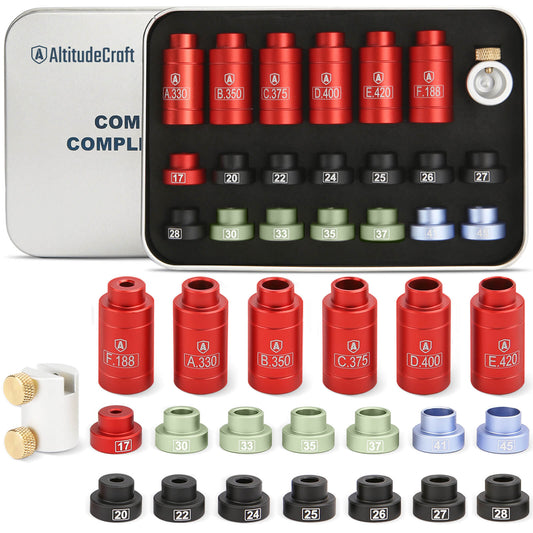
Key Takeaway: A bullet comparator measures cartridge base-to-ogive length (CBTO) instead of overall length (COAL), eliminating bullet tip variation that can exceed 0.010 inches. For long-range precision shooting, CBTO consistency is the single most important factor in seating depth optimization. By using a comparator with 14 caliber-specific inserts covering .17 through .45, you can run systematic ladder tests across multiple rifles and calibers — finding the exact jump-to-lands distance where each load produces its tightest groups. This guide walks through the complete process for .308 Winchester, 6.5 Creedmoor, and .223 Remington, including a step-by-step ladder test protocol, caliber-specific starting points, and common mistakes that sabotage accuracy at extended range.


The tool for this job
AltitudeCraft Bullet and Headspace Gauge Comparator Kit with 14 Inserts and 6 Bushings
$49.99
Free shipping & free returns on US orders $25+
View productWhy CBTO Matters More Than COAL for Long-Range Accuracy
Every factory cartridge is spec'd by COAL — the distance from the case base to the bullet tip. That measurement is fine for ensuring rounds fit in a magazine box, but it tells you almost nothing about where the bullet ogive sits relative to the rifling lands. Here's the problem: bullet tips are formed by swaging, and the very tip is the least consistent part of the projectile. Hornady, Sierra, and Berger all acknowledge tip variation of 0.005–0.015 inches across a box of 100 bullets.
CBTO, by contrast, references the ogive — the curved section of the bullet that actually contacts the rifling. A bullet comparator uses a precision-bored insert that contacts the ogive at a specific diameter, giving you a repeatable datum point. When you sort loaded rounds by CBTO rather than COAL, your ES (extreme spread) in seating depth drops from 0.010+ inches to under 0.001 inches. That consistency directly translates to tighter groups downrange.
If you're new to comparators, our complete guide to using a bullet comparator for precision reloading covers the fundamentals. This article builds on that foundation with an advanced focus on seating depth optimization.
Understanding "Jump to Lands" and Its Effect on Accuracy
The distance between the bullet ogive and the start of the rifling (the "lands") when a round is chambered is called jump or freebore. This distance has a measurable effect on:
- Initial bullet alignment — less jump generally means the bullet enters the rifling more concentrically
- Peak chamber pressure — touching or jammed into the lands raises pressure; more jump lowers it
- Velocity consistency — optimal jump distances often correlate with the lowest standard deviation in muzzle velocity
- Accuracy nodes — most rifles show 2–3 distinct "sweet spots" in jump distance where groups shrink dramatically
The relationship isn't linear. A rifle might shoot 0.8 MOA at 0.010" jump, 0.3 MOA at 0.020" jump, 0.7 MOA at 0.030" jump, and then 0.35 MOA again at 0.050" jump. Finding these nodes is the entire purpose of a seating depth ladder test, and it's impossible to do accurately without a comparator measuring CBTO to the nearest half-thousandth.

How to Find Your Rifle's Lands Distance (CBTO to Lands)
Before you can tune seating depth, you need a baseline: the CBTO measurement at which your specific bullet just touches the rifling lands. There are several methods:
Method 1: Modified Case with Split Neck
- Take a fired case from your rifle and trim the neck so it just holds a bullet with light friction
- Seat a bullet long — protruding well past normal COAL
- Gently chamber the round and close the bolt — the lands will push the bullet back into the case
- Carefully extract the round without disturbing the bullet
- Measure CBTO with your AltitudeCraft Bullet Comparator using the correct caliber insert
- Repeat 3–5 times and average the results
Method 2: Hornady OAL Gauge
A dedicated tool that threads into your chamber and uses a plunger to push the bullet forward until it contacts the lands. You then lock the plunger and measure the resulting cartridge with your comparator. This method is faster and more repeatable for most shooters.
Whichever method you use, record the resulting CBTO measurement as your "lands CBTO" — this is your zero-jump reference point. All seating depth adjustments are expressed as distances off this number.
The Seating Depth Ladder Test: Step-by-Step Protocol
This is the Berger Bullets recommended approach adapted with specific comparator measurement techniques:
Step 1: Prepare Your Test Loads
Start with a load that is already within safe pressure limits and produces reasonable accuracy. You are only varying seating depth — powder charge, primer, and brass prep must remain constant.
Load 5 groups of 5 rounds (25 total) at five different CBTO values. A common starting protocol for most rifle cartridges:
| Group | Jump (off lands) | CBTO Adjustment | Purpose |
|---|---|---|---|
| 1 | 0.010" | Lands CBTO − 0.010" | Close to lands baseline |
| 2 | 0.020" | Lands CBTO − 0.020" | Common accuracy node zone |
| 3 | 0.040" | Lands CBTO − 0.040" | Mid-range jump |
| 4 | 0.060" | Lands CBTO − 0.060" | Extended jump zone |
| 5 | 0.080" | Lands CBTO − 0.080" | Maximum jump reference |
Critical detail: Measure every loaded round with your comparator and confirm the CBTO is within ±0.0005" of your target. Discard any rounds outside this tolerance. This is where a quality comparator kit with precision-machined inserts pays for itself — inconsistent inserts introduce measurement error that defeats the entire purpose of the test.

Step 2: Shoot the Test at 100 Yards
Shoot all five groups at 100 yards from a solid bench rest. Use consistent technique — let the barrel cool between groups if it's a sporter-weight barrel. Shoot in calm conditions; wind at 100 yards shouldn't be a significant factor, but mirage can be.
Step 3: Analyze Results and Narrow Down
Identify the 1–2 best groups. Then load a second round of test groups in 0.005" increments around your best performers. For example, if 0.020" jump produced the tightest group, your refinement test would be: 0.015", 0.017", 0.020", 0.023", 0.025".
Step 4: Confirm at Distance
Once you've identified the optimal CBTO, shoot a 20-round group at your intended competition or hunting distance (300–1,000 yards). This confirms that the accuracy node holds at range and isn't just a 100-yard artifact.
Caliber-Specific Seating Depth Recommendations
While every rifle is an individual, decades of collective reloading data reveal patterns. Here are starting points for three of the most popular long-range calibers, along with the correct comparator insert to use from the AltitudeCraft 14-insert kit:
| Caliber | Comparator Insert | Typical Sweet Spot (Jump) | Pressure Sensitivity | Notes |
|---|---|---|---|---|
| .308 Winchester | .308 insert | 0.020"–0.040" | Moderate | Forgiving cartridge; 175gr SMK often prefers 0.020"–0.030" jump. Works well with both short and long jump. |
| 6.5 Creedmoor | .264 insert | 0.015"–0.030" | Low–Moderate | 140gr ELD-M and Berger Hybrids are jump-tolerant. Many rifles shoot best at 0.020" off lands. Factory SAAMI spec has generous freebore. |
| .223 Remington | .224 insert | 0.010"–0.030" | High | Small case volume makes pressure spikes more pronounced at short jump. 77gr SMK in 1:8 twist tends to prefer 0.015"–0.025". Never jam into lands with max charges. |
| 6mm Creedmoor | .243 insert | 0.015"–0.030" | Moderate | 105–108gr bullets often find nodes around 0.020". Similar behavior to 6.5 Creedmoor due to shared case design. |
| .300 Win Mag | .308 insert | 0.030"–0.060" | Moderate–High | Belted magnum benefits from more jump. 215gr Berger Hybrids often prefer 0.040"–0.060" off lands for best accuracy and velocity consistency. |
These are starting points, not gospel. Your barrel's throat geometry, the specific bullet lot, and your powder charge all influence where your accuracy nodes land. The comparator is your tool for finding the truth in your rifle.

5 Common Mistakes That Ruin Seating Depth Tests
After helping hundreds of reloaders troubleshoot accuracy problems, these are the errors we see most often:
Mistake 1: Using COAL Instead of CBTO
We've covered this, but it bears repeating: if your seating depth test is based on COAL measurements, you're introducing 0.005–0.015" of random variation into every data point. Your "results" are noise, not signal. Always measure CBTO with a comparator.
Mistake 2: Changing Multiple Variables
A seating depth test must isolate seating depth. If you're also varying powder charge, brass brand, or primer type, you cannot attribute group size changes to seating depth. Standardize everything else first.
Mistake 3: Not Verifying Every Round
Seating dies drift. Bullets seat slightly differently depending on neck tension and case condition. Measure every single loaded round with your comparator and verify it hits your target CBTO ±0.0005". Remove outliers from your test.
Mistake 4: Shooting in Poor Conditions
Wind and mirage at 100 yards can open groups enough to mask seating depth effects. Pick a calm morning. If you can't get calm conditions, shoot at 50 yards — the relative group size differences will still reveal the accuracy nodes.
Mistake 5: Not Re-Testing After Throat Erosion
Your barrel's throat erodes with every shot. After 500–1,000 rounds (depending on cartridge), your lands measurement will have changed. Re-measure CBTO to lands periodically and adjust your seating depth to maintain the same jump distance. For reference on how throat erosion varies by caliber, see this barrel life and erosion reference from External Ballistics.
Advanced Technique: The Satterlee Method for Seating Depth
Scott Satterlee's method — originally designed for charge weight testing — can be adapted for seating depth. Instead of shooting groups, you fire single shots at each seating depth and measure muzzle velocity with a chronograph. The theory: optimal seating depths correlate with velocity nodes where small changes in jump don't significantly change velocity.
This approach requires only 10–15 rounds instead of 25–50, making it especially valuable for expensive magnum cartridges or limited barrel-life calibers. The trade-off is that you're relying on velocity as a proxy for accuracy, which doesn't always hold. Most experienced competitors use the Satterlee method as a rough filter, then confirm with traditional group testing at the top 2–3 candidates.
Maintaining Measurement Consistency: Comparator Best Practices
Your comparator is a precision measurement instrument. Treat it like one:
- Zero your calipers with the comparator attached before every session — thermal expansion changes zero
- Use the same insert for all measurements in a test series — different inserts of the same caliber can have micro-variations
- Clean the insert bore between measurements — carbon and copper fouling from bullet contact affects readings
- Record temperature — steel comparators expand approximately 0.0001" per 10°F change. In a temperature-controlled shop this is negligible; in a garage that swings 40°F between morning and afternoon, it matters
- Replace worn inserts — after thousands of measurements, the bore edge rounds off. The AltitudeCraft kit's hardened steel inserts resist this, but all tools have a service life
For a detailed comparison of comparator kits and what to look for when buying, see our 2026 buyer's guide to bullet comparator kits.

Real-World Results: What to Expect
Seating depth tuning isn't magic — it won't turn a bad load into a great one. But for a load that's already in the right ballpark, it's consistently the single biggest accuracy improvement available. Here's what we typically see:
- Before seating depth optimization: 0.7–1.2 MOA 5-shot groups at 100 yards
- After finding the accuracy node: 0.3–0.6 MOA with the same components
- At 600 yards: The improvement multiplies — a 0.3 MOA advantage at 100 translates to roughly 1.8" tighter groups at 600
For competitive F-Class and PRS shooters, seating depth tuning with a comparator is non-negotiable. It's the standard, not the exception.
Shop AltitudeCraft Bullet Comparator Kit →
Frequently Asked Questions
What is the difference between COAL and CBTO?
COAL (Cartridge Overall Length) measures from the case base to the bullet tip. CBTO (Cartridge Base-To-Ogive) measures from the case base to a specific point on the bullet's curved ogive section using a comparator insert. CBTO is far more consistent because bullet tips vary by 0.005–0.015" while the ogive is machined to much tighter tolerances. For seating depth work, CBTO is the only measurement that matters.
How many rounds do I need for a seating depth ladder test?
A standard test uses 25 rounds (5 groups of 5) for the initial screening, then 15–25 more for refinement around the best node. Budget 40–50 rounds total. The Satterlee single-shot method can reduce this to 10–15 rounds for initial screening, but you should still confirm with group shooting.
Can I use the same seating depth for different bullet weights in the same caliber?
No. Different bullet profiles have different ogive shapes, so the optimal jump distance changes with each bullet. You need to find CBTO to lands for each specific bullet and then tune seating depth independently. The AltitudeCraft comparator kit uses the same caliber insert regardless of bullet weight, but the lands measurement and optimal jump will differ.
How often should I re-measure my lands distance?
For hot cartridges like .300 Win Mag or 6.5 PRC, re-measure every 300–500 rounds. For moderate cartridges like .308 Win and 6.5 Creedmoor, every 800–1,000 rounds is sufficient. For low-pressure rounds like .223 Rem, you can often go 2,000+ rounds before significant throat erosion. Track your lands CBTO in a log alongside round count.
Does seating depth matter for hunting ammunition?
Yes, but to a lesser degree than for competition. Hunting accuracy requirements are typically 1–1.5 MOA, which most properly developed loads achieve without extensive seating depth work. However, if you're building a long-range hunting load for shots beyond 400 yards, seating depth optimization with a comparator is absolutely worthwhile.
What if my magazine doesn't allow my optimal CBTO?
This is common, especially with long, high-BC bullets in short-action cartridges. You have two options: (1) find a secondary accuracy node at a shorter CBTO that fits the magazine, or (2) single-feed from the port for competition. Most rifles have multiple accuracy nodes, so magazine-length restrictions don't mean you can't find an excellent seating depth.
Conclusion: The Comparator Is Your Precision Foundation
Seating depth tuning is the single most impactful accuracy optimization for a handloaded cartridge, and a bullet comparator is the tool that makes it possible. Without one, you're guessing. With one — and the systematic approach outlined in this guide — you're making data-driven decisions that translate directly to smaller groups at distance.
The AltitudeCraft Bullet Comparator Kit with 14 inserts covers every common caliber from .17 to .45, so whether you're tuning a .223 varmint rifle or a .300 Win Mag elk gun, you have the right insert ready. Combined with quality calipers and the ladder test protocol above, you have everything needed to unlock your rifle's accuracy potential.
Shop AltitudeCraft Bullet Comparator Kit →
Disclosure: AltitudeCraft manufactures and sells the bullet comparator kit discussed in this article. All seating depth recommendations are based on widely accepted reloading practices and published data from bullet manufacturers. Always consult your reloading manual and follow safe reloading procedures.
Last updated: April 2026
Featured in this guide
AltitudeCraft Bullet and Headspace Gauge Comparator Kit with 14 Inserts and 6 Bushings
$49.99
Free shipping & free returns on US orders $25+
View productRelated Articles
 Which Hornady Comparator for 6.5 Creedmoor? Insert, Bushing, and Shoulder Bump Setup (2026)
Oct 15, 2026
Which Hornady Comparator for 6.5 Creedmoor? Insert, Bushing, and Shoulder Bump Setup (2026)
Oct 15, 2026
 Bullet Comparator Insert Chart: Which Insert Fits Your Cartridge (2026)
Aug 31, 2026
Bullet Comparator Insert Chart: Which Insert Fits Your Cartridge (2026)
Aug 31, 2026
 OAL Gauge Guide: How to Measure Distance to the Lands (2026)
Aug 07, 2026
OAL Gauge Guide: How to Measure Distance to the Lands (2026)
Aug 07, 2026
 Strut Spreader Tool Complete Guide: DIY Suspension Work Made Easy (2026)
Apr 02, 2026
Strut Spreader Tool Complete Guide: DIY Suspension Work Made Easy (2026)
Apr 02, 2026
