




How to Drill a Hole Through a Pipe So Both Sides Line Up (2026)
Last updated: October 2026 | By AltitudeCraft Team
To drill a hole through a pipe so both sides line up, you need three things. Mark the top centerline. Hold the pipe so it can't roll. Then keep the drill square to the pipe for the whole cut, ideally in one pass through both walls. Most crooked holes don't come from a bad mark. They come from the bit walking off the curve on entry, or tilting a few degrees on the way through. This guide explains why the exit hole drifts and how to drill aligned holes in pipe, round tube and solid round stock. It also covers which method suits which pipe size.
Disclosure: AltitudeCraft makes a pipe center finder punch. We say below where a V-block or a cheap drill guide is the better choice.
Key Takeaway
A hole drilled through a pipe lines up on both sides only if the drill axis passes through the pipe's center and stays perpendicular to it. Two errors cause most misses. The first is walking: a drill point slides off a curved surface before it bites, so the hole starts beside your mark. The second is tilt. On the way through, every degree of tilt moves the exit hole by roughly the outside diameter times 0.017. On a 4-inch pipe, a 2-degree tilt puts the exit about 0.14 inch off. The fix is a supported workpiece, a center punch mark at top dead center, a small pilot hole drilled through both walls in one pass, then the full-size bit. Drilling from both sides and meeting in the middle doubles any offset, so drill straight through whenever the bit is long enough.

The tool for this job
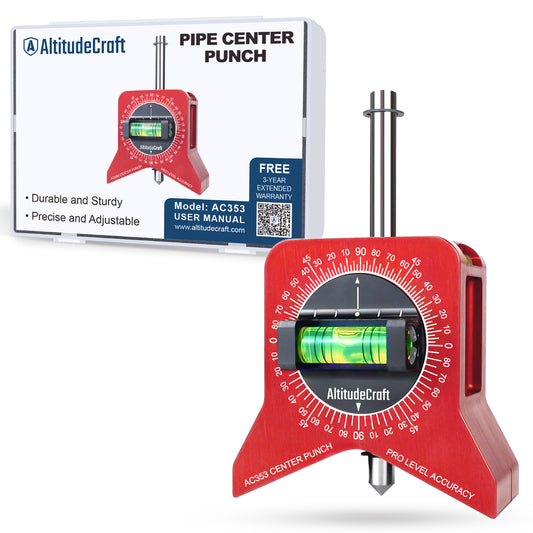
AltitudeCraft Precise Pipe Center Finder Punch Tool
$89.99
Free shipping & free returns on US orders $25+
View productWhy does the hole come out off-center on the other side?
The exit hole drifts because small entry and angle errors grow with the pipe's diameter. Start with entry. A twist drill's point has nothing flat to grip on a round surface, so it skids toward the low side before it cuts. In a Practical Sailor piece on drilling boat rails, Drew Frye put it plainly: "Starting the first hole, the bit walks off to the side" (Practical Sailor).
Then there's tilt. If the drill leans even slightly, the error keeps growing all the way across the pipe. The far wall is a full diameter away, so a larger pipe magnifies the same lean. The table below is plain trigonometry (exit offset ≈ OD × tan of the tilt angle). It's a geometry estimate, not a shop test, but it shows why "close enough" on a 1-inch tube can become a visible miss on a 6-inch pipe.
| Pipe OD | 1° tilt | 2° tilt | 3° tilt |
|---|---|---|---|
| 1 in. | 0.017 in. | 0.035 in. | 0.052 in. |
| 2 in. | 0.035 in. | 0.070 in. | 0.105 in. |
| 4 in. | 0.070 in. | 0.140 in. | 0.210 in. |
| 6 in. | 0.105 in. | 0.210 in. | 0.314 in. |
For scale: 1/16 inch is 0.0625. A 2-degree lean on a hand drill is hard to see, and on a 2-inch tube it already moves the exit more than 1/16 inch. A maker who built a drill-press center finder warned that on larger tubes "you can miss by 1/16" and not realize it until you've already drilled the hole" (Instructables).
Before you drill: mark top dead center
Your drill can only follow the mark you give it, so the centerline has to be right first. Common ways to find it include a paper wrap, a square and level, a V-block with a height gauge, or a dedicated center finder. We compare seven of them in How to Find the Center of a Pipe: 7 Methods Compared, so here is just the short version.
On a Model Engineer forum thread about drilling 10 mm holes through 50 mm steel tube, one member laid the tube on V-blocks and lowered a height gauge scriber by half the outside diameter to scribe both sides: "The scribe lines will be diametrically opposite." Another chucked the tube in a lathe and scribed the far side by swinging the compound, adding, "These two marks will be diametrically opposite each other" (Model Engineer forum).

If the pipe is already installed, or too big for a V-block, a center finder with a level is the practical option. Once the bubble is centered, the punch sits on the vertical centerline.
Before you drill: hold the pipe so it cannot roll or flex
A center punch only works on a pipe that is supported directly under the mark. Frye's warning applies to any thin-wall tube: "You can't use a center punch because it is unsupported and won't respond well to a hammer blow." A tube hanging in the air springs back, dents, or rolls, and the dimple ends up shallow or off the line.
Clamp the pipe in a V-block, a pipe vise, or a drill-press vise with V-jaws. Make sure the support is right under the punch point. For small parts, a Hobby-Machinist member suggested drilling a snug-fitting hole in a block of scrap wood and using it as a holder, with tape or hot glue if it tries to rotate (Hobby-Machinist forum).

How do you drill a hole through a pipe? The 7-step method
Use a deep punch mark, a small pilot drilled straight through, then the final size. This sequence works on a drill press and, with a guide, on a hand drill.
- Mark the centerline and hole position. Scribe or chalk a line along the top of the pipe and cross it where the hole goes.
- Support and clamp. V-block or vise jaws under the mark, pipe clamped so it can't roll.
- Center punch hard. A deep dimple gives the drill point something to seat in, so it can't skid off the curve.
- Align the drill. On a drill press, bring the bit down to the punch mark with the spindle off and check it drops straight into the dimple. On a hand drill, use a V-drill guide or a center-finding jig.
- Spot drill or start small. A short, stiff center drill or spot drill flexes less than a long jobber bit. Start the hole with it.
- Drill a pilot through both walls in one pass. Frye's method for larger holes is to drill a 1/8-inch pilot through both sides, then re-drill to size. Let the bit find the far wall on its own. Don't push hard as it breaks through the near wall.
- Open up to final size and deburr. Follow the pilot with the finished bit (or a step drill on thin wall). Clear the chips and deburr both holes inside and out, so a pin or bolt slides through.
Use cutting oil on steel and stainless. Run larger bits at a lower speed. In thin-wall tube, ease off as the bit breaks through the far wall, or it can grab and tear an oval exit.
Drill straight through or flip 180 degrees? Drilling holes in round stock
Drill straight through in one pass whenever the bit is long enough. It's the only method that can't create a mismatch between the two holes. On the Hobby-Machinist thread, a member building a solid rear axle asked how to drill two holes 180 degrees apart in round stock. One reply was simply: "I usually drill straight through." Model Engineer member JasonB described the same approach: drill right through "so opposite side does not need marking out."
Flipping the part is the backup when the bit is too short or the far wall is out of reach. One Hobby-Machinist member's version: "clamp it in a V block, drill first hole, flip 180 degrees and drill the other side." The catch is that any sideways offset of the drill from the pipe's center is mirrored when you rotate. If the first hole is 0.010 inch left of center, the second ends up 0.010 inch to the other side. That leaves the two holes 0.020 inch apart, which is double the original error.
If you must work from both sides, index off the first hole. As another member put it: "If you can't drill through, put a pin into the first hole and use that to index." Drop a snug pin or drill blank into the first hole, rotate until it reads plumb against a square, and drill the second hole from there.
Which tool should you use for drilling aligned holes in pipe?
Match the method to the pipe size and hole size, because most drill guides only cover small tube and small bits. Many guides fit only a narrow range of tube sizes and bit sizes. Sailrite's clamp-on Drill Steady Guide, described by Practical Sailor, takes 1/8-inch bits on 1/2 to 1-1/8 inch tube. The Drill Rite guide is listed for 1/2 to 2-1/2 inch OD with 3/16 and 1/4 inch bushings (Trick-Tools video).
| Situation | Best method | Why | Limit |
|---|---|---|---|
| Small tube (under 1 in.), small hole, hand drill | V-drill guide or clamp-on drill guide | Bushing holds the bit square, so you don't need a punch | Usually 1/4 in. bits or smaller |
| Loose round stock or tube that fits under a drill press | V-block in a drill press vise, drill straight through | Press keeps the bit perpendicular; V-block self-centers | Spindle must be aligned with the V-block groove |
| Repeat holes on many parts | Drilled block or sleeve jig | Every part lands in the same spot | One jig per pipe size |
| Large pipe (1 to 10 in.), installed pipe, or field work | Center finder with level and punch, then pilot through | Finds top dead center on pipe too big for a V-block | Magnetic bases need steel or iron pipe |
| Cross drilling round bar or solid shaft to tight tolerance | Mill with collet block, dividing head or rotary table | Can index exactly 180° | Needs a mill and setup time |

Be honest about what a center finder does. It finds and marks the center. It doesn't hold the drill square. On big pipe it gives you a correct start, and the pilot-through-both-walls step does the rest. On small tube under a hand drill, a V-guide with a bushing will usually do better than any marking tool.
How do you drill a hole through the center of round tube with a guide?
A bushing guide drills through the center of round tube by holding the bit square in a hardened drill bushing, so the bit can't walk or lean on the curve. As Frye put it, a "V-drill guide solves both problems." This Trick-Tools demo shows the Drill Rite guide, which fits 1/2 to 2-1/2 inch OD tube with 3/16 and 1/4 inch bushings, used with a hand drill.
Why does a drill bit walk on pipe? Five mistakes to avoid
Almost every miss traces back to support, the punch mark, or bit length.
- Punching an unsupported pipe. The tube flexes and the dimple ends up shallow. Support it directly under the mark.
- Starting with a long, flexible bit. Jobber-length bits bend before they bite. Start with a spot drill or a short, stiff bit.
- Pushing hard at breakthrough. Once the near wall gives way, the bit can lurch and tilt before it reaches the far wall.
- Drilling halfway from each side. Any offset is doubled when the two halves meet.
- Trusting a magnet on the wrong metal. Magnetic tools won't grip aluminum, copper, PVC or most austenitic stainless (304/316), so the finder can slide off. In our own Amazon return data for the pipe center finder, 5 of 14 returns were logged as not as described, poor fit or ordered wrong item, which points to expectation problems rather than defects. Few buyers left comments, so the cause is our inference, but the likeliest gaps are the magnet on non-ferrous pipe and pipe under 1 inch.

Frequently Asked Questions About Drilling Holes Through Pipe
How do you keep a drill bit from walking on a round pipe?
Support the pipe, center punch deeply at top dead center, and start with a short, stiff spot drill or a small pilot bit. A V-drill guide or bushing jig does the same job without a punch on small tube.
Should I drill a pilot hole when drilling through pipe?
Yes for anything over about 1/4 inch. A small pilot drilled through both walls in one pass sets the line, and the larger bit follows it. Frye's method uses a 1/8-inch pilot.
Can you drill a straight hole through a pipe with a hand drill?
Yes, with a guide. A V-guide or clamp-on jig holds the bit perpendicular. Without one, expect a few degrees of lean, which shows up clearly on the exit side of larger pipe.
How do you drill opposite holes in round stock without drilling through?
Drill the first hole, put a snug pin in it, rotate the part until the pin is plumb, and drill the second hole. On a mill, a collet block or dividing head indexes 180 degrees exactly.
How far off will the exit hole be if the drill is tilted?
Roughly the pipe's outside diameter times the tangent of the tilt angle, about 0.017 × OD per degree. A 2-degree lean puts the exit about 0.07 inch off on a 2-inch tube and 0.14 inch off on a 4-inch pipe.
Related reading
- How to Find the Center of a Pipe: 7 Methods Compared
- Metric to SAE Bolt Conversion Chart (M3-M24)
- How to Center Work in a 4-Jaw Chuck With a Dial Indicator
- How to Tram a CNC Router Spindle
- Table Saw Alignment: Blade-to-Slot Parallelism
The bottom line
To drill a hole through a pipe that lines up on both sides, mark top dead center and support the pipe under the mark. Punch deep, drill a small pilot through both walls in one pass, then open it up to size. Flip the part only when you have to, and index off a pin in the first hole when you do. For pipe from 1 to 10 inches, where a V-block won't fit, our pipe center finder punch marks top dead center with a dual bubble level and a hardened steel punch.

About the author
The AltitudeCraft Team designs and supports layout and measuring tools for metalworking and fabrication, including pipe center finders, tramming tools and lathe indicator holders. This guide combines attributed advice from machinist forums and Practical Sailor with simple geometry for the exit-offset table. We did not run new shop tests for it.
Featured in this guide
AltitudeCraft Precise Pipe Center Finder Punch Tool
$89.99
Free shipping & free returns on US orders $25+
View productRelated Articles
 The 5 Cut Method: Square a Crosscut Sled (Formula + Worked Example)
Oct 26, 2026
 How to Measure Throat Erosion With an OAL Gauge (and Know When Your Barrel Is Done)
Oct 25, 2026
 How to Disconnect a Fuel Injector Connector Without Breaking the Clip (2026)
Oct 23, 2026
 How to Set Up a Full-Length Sizing Die: Bump .001–.004" by Rifle (2026)
Oct 22, 2026
