




Low Profile Socket Adapters: Sizes, Stack Height, and Why Sockets Fall Off (2026)
A low profile socket adapter connects a ratchet or impact wrench of one drive size to a socket of a different drive size, while adding as little height as possible to the tool stack. That is the easy part. The hard part — the part that sends these sets back to the seller — is knowing which direction the adapter converts, what actually holds the socket on, and how many pieces are really in the box.
This guide answers those questions using our own return records for the AltitudeCraft AC296 set (108 returns all-time, 60 of them with written comments, retrieved 11 September 2026) rather than marketing copy. Where our own product and our own listing fall short, we say so — including one specification our product page still has printed backwards.


The tool for this job
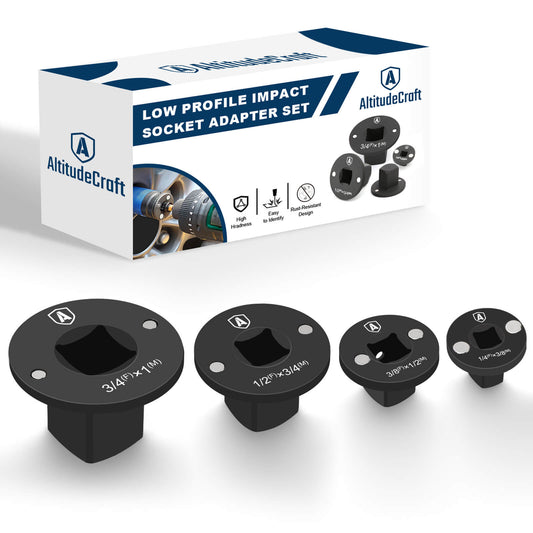
Low Profile Impact Socket Adapter Set, Drive Ratchet Adapter Set
$39.99
Free shipping & free returns on US orders $25+
View productKey Takeaway
Every adapter in a typical "low profile impact adapter set" steps drive size up — a small drive tool turning a larger socket. None of them steps down. Stepping up does not give you more torque; the adapter becomes the weakest link and caps what you can safely apply. "Low profile" is not defined by any standard, so the only meaningful number is the stack height in inches, and most sellers — ours included — do not publish one. And on magnetic adapters there is no ball detent in the square drive: the magnet holds the socket face, so an inverted or vibrating socket can still drop off. Those two expectation gaps, direction and retention, account for the largest clusters of returns we see.
Which Low Profile Socket Adapter Sizes Do You Actually Need?
Adapter sizes are written as a pair, and almost every listing uses the same notation without ever explaining it:
- (F) = female — the square recess. This is the end your ratchet or impact wrench anvil plugs into.
- (M) = male — the square post. This is the end that plugs into your socket.
So 3/8"(F) → 1/2"(M) means: a 3/8" drive tool turning a 1/2" drive socket. Read the female size as "what tool do I own," and the male size as "what socket am I trying to turn." Get that backwards and the part is useless to you — which is exactly what happens. From our AC296 return records, verbatim:
"I thought they were reducers that were low profile, not to go from a smaller size drive to larger drive socket."
"Does not go from 1/2 inch anvil to 3/8 anvil."
"I needed a 1/2 to 1/4 — was wrong."
Step-up (increaser) vs step-down (reducer)
| Type | What it does | Why you would want it | Torque behaviour |
|---|---|---|---|
|
Step-up / increaser e.g. 1/2"(F) → 3/4"(M) |
Small tool, big socket | You need to turn a large fastener and only own a 1/2" drive tool | Your 1/2" tool's output is unchanged — you gain reach, not power |
|
Step-down / reducer e.g. 1/2"(F) → 3/8"(M) |
Big tool, small socket | You own a 1/2" impact but the fastener needs a 3/8" socket you already have | The 3/8" socket and the adapter's small male post are now the limit — easy to twist off |
What is actually in the AltitudeCraft AC296 set
Four pieces, and all four are increasers:
| Adapter | Your tool (female) | Your socket (male) | Direction |
|---|---|---|---|
| 1/4"(F) → 3/8"(M) | 1/4" drive | 3/8" drive socket | Step up |
| 3/8"(F) → 1/2"(M) | 3/8" drive | 1/2" drive socket | Step up |
| 1/2"(F) → 3/4"(M) | 1/2" drive | 3/4" drive socket | Step up |
| 3/4"(F) → 1"(M) | 3/4" drive | 1" drive socket | Step up |
A correction we owe you. Our own product page currently lists this set as containing 1/2"(F) to 3/8"(M). That is printed backwards. The laser etching on the parts, the manufacturer's dimension artwork, and two separate customers holding the product all say the piece is 3/8"(F) × 1/2"(M) — one of them describing it by name in a return note: "1/2x3/4 adapter feels loose. 3/8x1/2 adapter is too tight. 1/4x3/8 adapter is the only adapter that's fits snug." The listing text is being corrected; we are not going to quietly fix it here and leave the error standing where it does the damage.

Looking for a Reducer? This Set Does Not Have One
If you searched for a reducer, a step down socket adapter, or specifically a 1/2" to 3/8" impact adapter, stop here: this set will not do that job, and neither will most sets sold as "low profile impact adapter sets." The category is built around increasers, because the market for them is bigger — people own a 1/2" impact and occasionally meet a fastener bigger than their socket range.
That mismatch is our single largest avoidable return cluster: 7 of 60 written comments (11.7%) are somebody who wanted a reducer or a size that is not in the box. So, plainly:
-
You own a 1/2" impact and want to run your 3/8" sockets. You need a
1/2"(F) → 3/8"(M)reducer. Not in this set. Buy a single impact-rated reducer, or better, buy the 3/8" sockets in a 1/2" drive if you use them often — a reducer plus a small socket on a big gun is the classic way to snap a socket. -
You own a 3/8" ratchet and want to turn a 1/2" socket. That is
3/8"(F) → 1/2"(M)— in the set, and the most useful piece in it for hand-tool work. - You want to reach a recessed fastener your socket cannot clear. An adapter makes the stack taller, not shorter. What you want is a low-profile or shallow socket, or a crowfoot — not an adapter of any direction.
The one-line test before you order anything: say the female size out loud as your tool, and the male size as your socket. If that sentence does not describe your problem, the part is wrong regardless of how low profile it is.
How Low Is "Low Profile"? Nobody Has to Tell You — Including Us
There is no controlled definition of "low profile." ASME B107.110, Socket Wrenches, Handles, and Attachments — the consolidated US standard that covers sockets, handles and attachments — sets performance and safety requirements, but it does not reserve the phrase "low profile," "slim," "shallow" or "thin." Any manufacturer can print any of them on any adapter.
We are not going to pretend we are the exception. Our own listing does not publish a stack height in inches either, and we are not going to invent one here from a photograph. Two customers told us exactly what that costs them:
"Not low enough for what I need them."
"Needed lower profile than this."
Until sellers publish the number, the only reliable method is to work it out from your side of the problem, which takes about a minute:
- Measure your actual clearance. Put a tape or caliper between the fastener face and whatever is above it — the hose, bracket or subframe rail that is in your way.
- Subtract your socket height. The socket itself is usually the tallest single element in the stack, and it is the one dimension you can measure directly on your bench.
- What is left is your adapter budget. If a seller will not give you a number in inches for the adapter alone, treat the remaining budget as if it will be consumed entirely.
A useful rule from the shop floor: if you are counting millimetres, an adapter is the wrong answer. A socket in the correct drive size, a shallow socket, or a low-profile crowfoot will nearly always be shorter than any tool-plus-adapter stack, because the adapter adds a whole extra joint that a single socket does not have.

Why Sockets Fall Off Adapters: Magnet vs Ball Detent vs Pin-and-Ring
This is the single largest complaint cluster in our AC296 return data — 9 of 60 written comments (15.0%) — and almost no buying guide covers it. Three different mechanisms can hold a socket on a square drive, and they are not interchangeable:
| Retention type | How it works | Holds when inverted? | Typical failure mode |
|---|---|---|---|
| Ball detent | A spring-loaded ball in the male square snaps into a dimple inside the socket | Yes — mechanical lock | Loosens with wear; harder to seat and remove by hand |
| Pin-and-ring | A retaining pin through a cross-hole plus an O-ring positively locks the socket (standard on impact drives) | Yes | Ring perishes; needs a tool to change sockets |
| Magnet | Magnets in the shoulder attract the steel socket face | Not reliably | Vibration or a knock walks the socket off; no mechanical lock at all |
The AC296 adapters use magnetic retention: two magnets set into the female flange, and no ball detent anywhere. That is a legitimate trade-off — magnets let you swap sockets one-handed and there is nothing to wear out — but it is not a mechanical lock, and our listing has historically described it as if it were ("strong magnets keep tools firmly in place"). Customers read that as a lock, and then:
"The adapters don't have a detent in the square drive, and will fall off my tool easily."
"It doesn't hold sockets on at all. Don't stay on the impact or ratchet."
"Magnets are too weak to hold socket in place."
This is not unique to us, and it is not only a magnet problem. A 2025 impact-tooling patent describes the same failure for a far more elaborate ball-locking adapter: the mechanism "is susceptible to unintentional sliding due to vibration during tightening operation or contact with an obstacle, causing a likelihood of the manipulator ring unlocking" — the whole point of the invention being to stop the socket being "unintentionally detached from the adapter" (US 12,246,415 B2, Socket adapter for impact wrench). If a sprung-ball design needs a patent to stay locked under impact vibration, a magnet was never going to manage it.
The fix most owners miss: the cross-hole is already there
Look closely at the male post of a magnetic impact adapter, ours included. In the manufacturer's own product photography there is a through-hole across the male square — the same cross-hole an impact anvil uses for a retaining pin. Two customers have referred to it directly, one complaining that "multiple retaining-pin holes are off-center."
That means the adapter ships without a pin and O-ring, but is drilled to take one. A standard impact retaining pin and O-ring kit turns the magnet into a genuine mechanical lock for impact sockets. We have not published a pin diameter for this set and we have not measured it, so match the pin to the hole rather than to the drive size — but if your complaint is "the socket falls off," that hole is the proper answer, not tape.
What to do about it, by job
- Working overhead or inverted? Insist on a ball detent or pin-and-ring adapter. A magnet is not enough.
- Using an impact wrench? Vibration is the enemy of every retention type. A retaining pin and O-ring is the only mechanism designed for it — fit one to the cross-hole.
- Bench and engine-bay work, socket facing down? Magnetic retention is genuinely convenient and the trade-off is reasonable.
- Need a stopgap right now? A single wrap of PTFE tape on the male square adds enough friction to stop casual drop-off without permanently modifying anything.

Open the Box Before You Judge the Count
This one is not in any other buying guide, because it only shows up if you read your own returns. 6 of 60 written comments (10.0%) — plus three MISSING_PARTS and two SWITCHEROO claims at the reason-code level — are people who believed the set arrived incomplete:
"I ordered a 4 piece kit and received only one attachment."
"Only received one adaptor. No kit received."
"Two of them were stuck together, got them apart and now they don't fit back together."
The cause is the stackable design itself. Each adapter's male post fits the next size up's female recess, so the four pieces assemble into a single tower — which is exactly what "stackable storage" means in the marketing, and what the storage photography shows. On the evidence of those returns, that is also how they reach some buyers. Opened quickly, a four-piece set looks like one chunky adapter. Twist the stack apart before you conclude anything is missing.
Two practical notes follow from the same geometry. First, the nested fit can be tight enough that separating the pieces takes a firm twist — which is what the customer above ran into. Second, there is only one order that nests, because each post only fits the next size up; if the pieces will not go back together, you are trying to assemble them out of sequence rather than looking at a defect. And if you are buying a set specifically so it stores as one unit, understand that you are buying the confusion along with it: a tray or a labelled pouch beats a nested tower for anyone who might open the box in a hurry.

Stepping Up Drive Size Does Not Give You More Torque
Because every adapter in this set steps up, this deserves its own section. Fitting a 3/4" socket to a 1/2" impact wrench does not turn it into a 3/4" impact wrench. Two mechanisms are at work. First, the adapter's smaller square is now the narrowest cross-section in the load path, so it fails before your tool reaches its rating. Second, the extra joint absorbs and scatters the hammer blows of an impact wrench, so less of the tool's output reaches the fastener.
What working mechanics actually conclude from that is more specific than "don't do it." In a Garage Journal thread on exactly this question — running 3/4" sockets off a 1/2" high-torque gun — the useful split is between breaking a fastener loose and running it off:
"You loose alot of power with the adapter, usually enough that you cannot break torque on a fastener that large. They usually work to spin things off after the torque is broken."
"Yes, you can use an adapter but there is a loss of power in doing so and if you're trying to screw with a bolt or nut that big you need all of the power you can get with minimum losses."
"There is nothing wrong with using an adapter to stick a 3/4" drive socket on a 1/2" drive impact. I do it on the daily in an automotive setting."
Those are not contradictory. The practical rule they converge on is: break the joint loose with something that has the leverage — a 3/4" breaker bar is cheap — then put the adapter on to spin the fastener off. That is where a step-up adapter earns its place, and it is why the piece count of a set matters far less than whether you understand what job you are giving it.
Where a step-up adapter is reasonable: moderate-torque, large-diameter fasteners, and removal after the joint is already broken. Where it is not: seized suspension bolts, semi-truck lug nuts, or anything you would normally reach for a 3/4" gun to break loose in the first place.
Impact-Rated vs Chrome: The One Safety Rule
This distinction is genuinely about safety, not tool life:
- Chrome (hand-tool rated) — chrome vanadium steel, polished finish. Hardened for strength, which makes it brittle. Under impact hammering it can shatter and throw fragments. Hand tools only.
- Impact-rated — chrome molybdenum (Cr-Mo) steel, black phosphate or black oxide finish. Formulated to be tougher and more ductile so it deforms rather than shatters.
Rule of thumb: shiny chrome means hand tools only; a black finish means impact-rated. The AC296 set is Cr-Mo with a black phosphate coating, so it is safe on impact wrenches — subject to the torque limits described above.
There is a regulatory floor under this on a jobsite. 29 CFR 1926.301 states at (a) that "Employers shall not issue or permit the use of unsafe hand tools," and at (b) that "Wrenches, including adjustable, pipe, end, and socket wrenches shall not be used when jaws are sprung to the point that slippage occurs." That second clause is the one people forget applies to adapters: a rounded-out square drive that slips under load is a tool to retire, not to keep using. It is also the standard to keep in mind when an adapter arrives noticeably loose. Six of our 60 written comments (10.0%) report fit or compatibility problems, four of them unambiguously about how the square drive meets the tool — from "too tough to push onto ratchet anvils" and "my half inch drive doesn't fit in the half inch adapter" to "1/2x3/4 adapter feels loose." A stiff fit that eases after a few cycles is normal. A slack square drive on a new part will not tighten up with use.

When Stacking Adapters Defeats the Whole Purpose
The same nesting geometry that causes the "missing pieces" confusion is also marketed as a capability. Buyers reasonably read it as meaning any drive size can reach any other. It cannot, in one step.
With the AC296 set, getting from a 1/2" drive tool to a 1" socket requires two adapters in series: 1/2"→3/4", then 3/4"→1". One customer put it precisely: "Pictures did not show that if I want to use the 1 inch adapter, I'll have to use all of them."
A two-adapter stack has three consequences, all bad: the combined height is no longer low profile, you have added a second potential failure point, and each joint sheds more of an impact wrench's output. If your work regularly needs that jump, buy the socket in your tool's native drive size instead.
Which Set Should You Buy?
| Your situation | What to look for | Why |
|---|---|---|
| General automotive DIY, hand tools and occasional impact | Impact-rated Cr-Mo set covering 1/4"–1" | One safe set for everything; direction matters more than piece count |
| You need to run smaller sockets on a bigger tool | A single impact-rated reducer, bought individually | Increaser sets do not contain reducers — check before you order a set |
| Overhead or inverted work | Ball detent or pin-and-ring retention, not magnetic | A magnet will not hold an inverted socket under vibration |
| Genuinely tight clearance (recessed bolts, packed bays) | A published stack height in inches, or a shallow socket instead | "Low profile" is unregulated; only a number is meaningful |
| High-torque breaking (seized suspension, lug nuts) | No adapter — buy the correct drive socket | The adapter caps your tool and will eventually fail |
| Occasional large fastener, moderate torque | A step-up adapter is a fair compromise | Cheaper than a second tool for a job you do twice a year |
The AltitudeCraft Low Profile Impact Socket Adapter Set ($39.99) is a four-piece, impact-rated Cr-Mo set with magnetic retention and laser-etched markings, and every piece steps up. It suits the first, fourth and sixth rows above. If you need detent retention, a reducer, or a guaranteed height in inches, buy something else — we would rather you did than send ours back. For a spec-by-spec cross-shop, see our best low profile socket adapter sets comparison and our head-to-head against Sunex. Sellers who publish full dimensional data — McMaster-Carr lists overall length and square-drive gender as filterable specs — are worth checking even if you buy elsewhere, simply to learn what the numbers should look like.
Common Mistakes with Socket Adapters
- Buying a set when you needed a reducer. The most common and most expensive mistake. Increaser sets do not contain step-down pieces.
- Using a chrome adapter on an impact gun. The most dangerous mistake on this list. Chrome vanadium can fracture under hammering.
- Assuming a magnet is a lock. Check for a detent ball or a cross-hole in the male square before you rely on it overhead.
- Concluding pieces are missing before separating the stack. A nested four-piece set looks like one adapter.
- Using an adapter in a torque-wrench chain for a critical spec. Any added joint introduces error and flex. Fine for general assembly, not for cylinder head or wheel-bearing specs.
- Stacking two adapters to reach an unusual size. You lose the low profile, add a failure point, and lose impact energy.
- Treating a step-up adapter as a torque upgrade. It is a reach tool.
Frequently Asked Questions
What does 3/8"(F) to 1/2"(M) actually mean?
Female (F) is the square recess that accepts your ratchet or impact wrench anvil; male (M) is the square post that goes into your socket. So 3/8"(F) → 1/2"(M) is a 3/8" drive tool turning a 1/2" drive socket — a step up, or increaser. Reverse the reading and you will order the opposite of what you need.
Does this set include a 1/2" to 3/8" reducer?
No. All four pieces in the AC296 set step up: 1/4"→3/8", 3/8"→1/2", 1/2"→3/4" and 3/4"→1". If you need to run 3/8" sockets from a 1/2" impact, buy a single impact-rated reducer separately — and think twice about doing it at high torque, because the small male post becomes the weakest link.
Why does my socket keep falling off the adapter?
Almost certainly because the adapter uses magnetic retention rather than a mechanical lock. The magnets hold the socket by attraction to its steel face; vibration from an impact wrench, or simply inverting the tool, can overcome that. Check the male post for a cross-hole — most impact-style adapters including ours have one, and a standard retaining pin and O-ring fitted to it gives you the positive lock the magnet cannot.
I only found one adapter in the box. Is the set incomplete?
Almost certainly not. The four adapters nest into each other for storage and ship as a single tower. Twist them apart, largest first. This accounts for a tenth of the written complaints we receive on this product, so it is worth checking before requesting a replacement.
Does a 1/2" to 3/4" adapter give my impact wrench more torque?
No. It lets a 1/2" drive tool turn a 3/4" drive socket, nothing more. Your tool's output is unchanged, the adapter's smaller square becomes the weakest link, and the extra joint absorbs impact energy. For high-torque work, use a tool with the correct native drive size.
How low is a "low profile" socket adapter?
There is no standard definition — ASME B107.110 covers socket wrenches and attachments but does not reserve the term, and many sellers including us do not publish a height in inches. Measure your available clearance, subtract your socket height, and treat whatever is left as your adapter budget. If a seller will not state the height, assume it will use all of it.
My new adapter feels loose on the tool. Is that normal?
No. A square drive that is slack when new will not tighten with use, and 29 CFR 1926.301(b) explicitly bars using wrenches sprung to the point of slippage. A slightly stiff fit that eases after a few cycles is fine; visible rock or a socket that will not stay seated square is not.
Can I use a low profile adapter with a torque wrench?
For general assembly, yes — an in-line adapter that does not change the effective lever length introduces minimal error. Avoid it for critical specifications such as cylinder head bolts, where the added joint's flex and any misalignment matter. See our companion piece on using low profile adapters with impact wrenches for the powered-tool version of the same question.
Are impact adapters and chrome adapters interchangeable?
No, and this is a safety issue rather than a durability one. Chrome vanadium adapters are hardened and brittle, and can shatter under an impact wrench. Impact-rated Cr-Mo adapters are formulated to deform instead. Shiny chrome means hand tools only; a black phosphate or black oxide finish means impact-rated. More detail in our socket adapter FAQ on impact ratings, sizes and drive types.
Which adapter size is worth owning first?
For most home and automotive work it is 3/8"(F) → 1/2"(M): it lets a 3/8" ratchet drive the 1/2" sockets that cover most suspension and brake fasteners, and it is the piece in this set that gets used. The larger increasers earn their place only if you occasionally meet fasteners beyond your socket range.
Related Articles
- Best Low Profile Socket Adapter Sets (2026): Direction First
- Low Profile Socket Adapters for Brake Caliper and Spark Plug Jobs
- Can't Reach Bolts in Tight Engine Bays? Low Profile Adapter Solution
Return data cited in this article is drawn from AltitudeCraft's own Amazon FBA return records for SKU AC296 (108 returns all-time, 60 with written comments, retrieved 11 September 2026). Customer quotations are reproduced verbatim apart from spelling normalisation. Drive-size directions were verified against the laser etching on the parts and the manufacturer's dimension artwork, not against our own listing text.
Featured in this guide
Low Profile Impact Socket Adapter Set, Drive Ratchet Adapter Set
$39.99
Free shipping & free returns on US orders $25+
View productRelated Articles
 Drag Knife vs Oscillating Knife vs Tangential Knife: Which CNC Knife Fits Your Material? (2026)
Oct 17, 2026
Drag Knife vs Oscillating Knife vs Tangential Knife: Which CNC Knife Fits Your Material? (2026)
Oct 17, 2026
 How to Adjust Glock Sights: Which Way to Push the Rear Sight and How Far (2026)
Oct 27, 2026
How to Adjust Glock Sights: Which Way to Push the Rear Sight and How Far (2026)
Oct 27, 2026
 The 5 Cut Method: Square a Crosscut Sled (Formula + Worked Example)
Oct 26, 2026
The 5 Cut Method: Square a Crosscut Sled (Formula + Worked Example)
Oct 26, 2026
 How to Measure Throat Erosion With an OAL Gauge (and Know When Your Barrel Is Done)
Oct 25, 2026
How to Measure Throat Erosion With an OAL Gauge (and Know When Your Barrel Is Done)
Oct 25, 2026
