


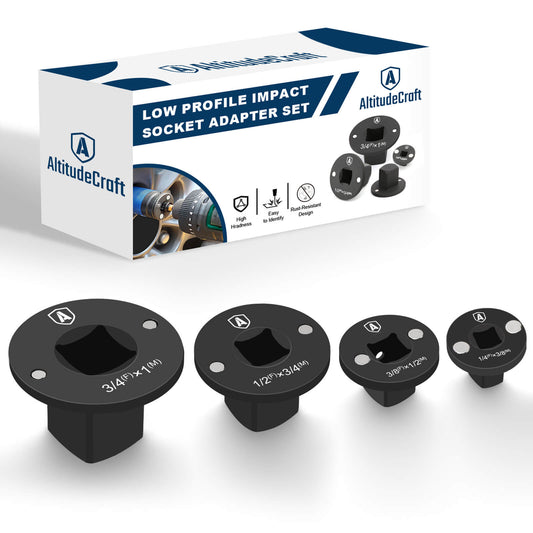


Low Profile Socket Adapters for Brake Caliper and Spark Plug Jobs
Key Takeaway: Low profile socket adapters excel in two of the most common automotive repair tasks: brake caliper replacement and spark plug changes. Brake caliper bracket bolts require 80-150 ft-lbs of torque in recessed locations behind rotors and dust shields, where standard socket setups often cannot fit. A 1/2" to 3/8" low profile adapter with a shallow 14mm or 15mm impact socket recovers enough clearance to access these bolts without removing the dust shield. For spark plugs on modern coil-on-plug engines, the rear cylinders sit buried under intake manifolds and wiring harnesses — a 3/8" to 1/4" adapter with a thin-wall spark plug socket provides the compact profile needed to reach plugs in wells as narrow as 25mm. Both applications benefit from the adapter's reduced height (8-12mm less than standard) and impact-rated Cr-Mo steel construction that withstands the torque demands of these critical fasteners without deformation.

The tool for this job
Low Profile Impact Socket Adapter Set, Drive Ratchet Adapter Set
$39.99
Free shipping & free returns on US orders $25+
View productWhy Brake Caliper and Spark Plug Jobs Need Low Profile Adapters
Brake calipers and spark plugs share the same frustrating access problem: the fasteners are recessed in tight spaces designed by engineers who apparently never held a wrench. Both jobs are among the most common DIY maintenance tasks, and both frequently stall when the socket-wrench assembly is too tall or too bulky to fit on the bolt.
This guide covers the exact adapter configurations, socket sizes, and techniques for both jobs — based on the most common vehicles in North American driveways. For general adapter selection, see our complete buying guide.

Ready to upgrade your toolbox?
See the Low Profile Socket Adapter SetBrake Caliper Replacement with Low Profile Socket Adapters
Brake caliper bracket bolts are the most common "impossible bolt" in DIY brake jobs — they sit recessed behind the rotor and dust shield with clearances under 25mm.
Common Brake Caliper Bolt Specifications
| Vehicle Type | Bracket Bolt Size | Torque Spec | Guide Pin Torque |
|---|---|---|---|
| Compact sedans (Civic, Corolla) | 14mm or 17mm | 80-90 ft-lbs | 25-35 ft-lbs |
| Mid-size sedans (Camry, Accord) | 14mm or 17mm | 80-105 ft-lbs | 25-40 ft-lbs |
| Trucks/SUVs (F-150, Silverado) | 18mm or 21mm | 125-200 ft-lbs | 30-50 ft-lbs |
| Minivans (Pacifica, Sienna) | 14mm or 15mm | 75-125 ft-lbs | 19-27 ft-lbs |
Always verify the exact torque specification for your make, model, and year. The values above are typical ranges from common OEM specifications.
The Adapter Setup for Brake Work
For most passenger vehicles, the winning combination is a 1/2" impact wrench → 1/2" to 3/8" low profile adapter → shallow 14mm or 15mm impact socket. This setup reduces the tool stack height by 8-12mm compared to a standard adapter, allowing access to bracket bolts behind the dust shield without removing it.
For trucks and SUVs with larger bracket bolts (18mm+), keep the 1/2" drive direct — no adapter needed for the bracket bolts, but use a 1/2" to 3/8" adapter for the smaller guide pin bolts. The AltitudeCraft set covers both configurations.

Pro Tips for Brake Caliper Access
- Rear calipers are tighter than fronts — the parking brake mechanism adds bulk behind the piston. Approach rear bracket bolts from below for better angle.
- Penetrating oil first — spray bracket bolts 10 minutes before attempting removal. These bolts seize from road salt and moisture exposure.
- Do not use an impact wrench on guide pins — guide pin bolts only need 25-40 ft-lbs. Use a hand ratchet with the adapter to avoid overtightening and damaging the rubber boot.
- Anti-seize on reinstallation — apply a thin coat of copper anti-seize to bracket bolt threads to prevent future seizure. Do not apply to guide pin threads.
Spark Plug Replacement with Socket Adapters on Modern Engines
Modern coil-on-plug engines bury spark plugs in deep wells under intake manifolds, wiring harnesses, and coolant lines — the rear bank plugs on V6 and V8 engines are notoriously difficult to reach.
Why Spark Plugs Are Hard to Reach
The switch from distributor ignition to coil-on-plug (COP) systems placed individual coils directly over each spark plug, which eliminated spark plug wires but created deep wells (typically 100-150mm) with narrow openings (25-30mm). Add the transverse engine mounting used in most modern front-wheel-drive vehicles, and the rear bank plugs sit millimeters from the firewall.
The Adapter Setup for Spark Plug Work
The ideal configuration: 3/8" ratchet → 3/8" to 1/4" low profile adapter → thin-wall spark plug socket. The smaller drive reduces the overall diameter of the tool assembly, allowing it to drop into narrow spark plug wells. A standard 3/8" drive spark plug socket may not fit in the well opening, but stepping down to 1/4" drive provides the clearance needed.
Key specifications for spark plug sockets:
- 14mm socket: Most modern 4-cylinder engines (Honda, Toyota, Hyundai)
- 16mm socket: Many European vehicles (BMW, VW, Mercedes)
- 5/8" (16mm) socket: Older domestic V6/V8 engines (Ford, GM, Chrysler)


Pro Tips for Spark Plug Access
- Never use an impact wrench on spark plugs — spark plugs require only 12-18 ft-lbs for most vehicles. Impact force will crack the ceramic insulator or strip aluminum head threads.
- Thread by hand first — cross-threading a spark plug in an aluminum head is a $500-2,000 repair. Start the plug by hand (or with a rubber hose pressed on the top) for at least 2 full turns before using a tool.
- Warm engine, but not hot — change plugs when the engine is warm (not hot). Warm aluminum allows easier thread engagement. Hot engines risk burns.
- Magnetic socket insert — use a spark plug socket with a magnetic or rubber insert to grip the plug as you lower it into the well. Without it, the plug can drop and cross-thread.
Other Common Use Cases for Low Profile Socket Adapters
Beyond brake calipers and spark plugs, low profile adapters solve access problems in a dozen common repair scenarios.
| Job | Adapter Needed | Why Standard Tools Fail |
|---|---|---|
| Alternator bolts | 1/2" → 3/8" | Power steering line blocks standard adapter |
| Water pump bolts | 1/2" → 3/8" | Pulley and belt routing restrict clearance |
| Starter motor bolts | 1/2" → 3/8" | Buried between engine and transmission |
| Exhaust manifold studs | 1/2" → 3/4" | Heat shield and catalytic converter obstruct |
| Interior trim panels | 1/4" → 3/8" | 8mm and 10mm bolts in recessed plastic housings |
| HVAC blower motor | 1/4" → 3/8" | Located behind glove box with minimal clearance |
For a systematic approach to solving any tight-access problem, see our tight engine bay bolt access guide. For comparing adapter brands, check our AltitudeCraft vs Sunex comparison.

Frequently Asked Questions
What socket size do I need for brake caliper bolts?
Most passenger vehicles use 14mm or 15mm for caliper guide pin bolts and 17mm or 18mm for bracket bolts. Trucks and SUVs often use 18mm or 21mm bracket bolts. Some vehicles use Torx (T55) or hex drive fasteners instead of standard hex bolts. Always verify for your specific vehicle before starting work.
Can I use an impact wrench on spark plugs?
No. Spark plugs require only 12-18 ft-lbs of torque for most vehicles. Impact wrench forces will crack the ceramic insulator, strip aluminum cylinder head threads, or break the plug inside the head. Use a hand ratchet or low-torque electric ratchet. According to spark plug installation guidelines, hand-threading first is critical to prevent cross-threading in aluminum heads.
Do I need different adapters for brake and spark plug work?
Typically yes: brake caliper work usually needs a 1/2" to 3/8" step-down adapter (for using a 1/2" impact wrench with smaller sockets), while spark plug work benefits from a 3/8" to 1/4" step-down (for compact clearance in plug wells). A complete four-piece adapter set like the AltitudeCraft set covers both applications.
Should I use anti-seize on caliper bracket bolts?
Yes, a thin application of copper anti-seize on bracket bolt threads prevents seizure from road salt and moisture. Do NOT apply anti-seize to guide pin bolts — these require specific silicone-based caliper grease on the pin body, not on the threads. Using the wrong lubricant on guide pins causes caliper sticking and uneven brake wear.
How do I access rear bank spark plugs on a transverse V6?
The rear bank plugs on transverse V6 engines (like the Honda J-series or Toyota 2GR-FE) are the most challenging common spark plug access scenario. The adapter approach: 3/8" ratchet with a 3/8" to 1/4" low profile adapter, a short 1/4" wobble extension, and a thin-wall 14mm spark plug socket. Work from above, reaching over the intake manifold. If access remains blocked, removing the upper intake plenum (4-6 bolts, 15 minutes) opens a clear path to all rear plugs.
Disclosure: AltitudeCraft manufactures the low profile socket adapter set referenced in this article. We recommend the tool configurations that work best for each application regardless of adapter brand.
Last updated: March 2026. This article is reviewed and updated regularly to reflect current products, pricing, and industry standards.
Upgrade Your Workflow with AltitudeCraft
Engineering-grade tools built for professionals and serious DIYers. Free shipping on all orders.
Shop Low Profile Socket Adapter SetRelated Articles
Featured in this guide
Low Profile Impact Socket Adapter Set, Drive Ratchet Adapter Set
$39.99
Free shipping & free returns on US orders $25+
View productRelated Articles
 How to Adjust Glock Sights: Which Way to Push the Rear Sight and How Far (2026)
Oct 27, 2026
How to Adjust Glock Sights: Which Way to Push the Rear Sight and How Far (2026)
Oct 27, 2026
 The 5 Cut Method: Square a Crosscut Sled (Formula + Worked Example)
Oct 26, 2026
The 5 Cut Method: Square a Crosscut Sled (Formula + Worked Example)
Oct 26, 2026
 How to Measure Throat Erosion With an OAL Gauge (and Know When Your Barrel Is Done)
Oct 25, 2026
How to Measure Throat Erosion With an OAL Gauge (and Know When Your Barrel Is Done)
Oct 25, 2026
 How to Drill a Hole Through a Pipe So Both Sides Line Up (2026)
Oct 24, 2026
How to Drill a Hole Through a Pipe So Both Sides Line Up (2026)
Oct 24, 2026
