




Can't Reach Bolts in Tight Engine Bays? Low Profile Adapter Solution
Key Takeaway: When a socket wrench cannot reach a bolt due to clearance limitations in tight engine bays, the fix is usually a tool geometry problem rather than a strength problem. Low profile socket adapters recover 8-12mm of critical clearance by reducing the height between wrench and socket by approximately 40% compared to standard adapters. Combined with shallow impact sockets, they handle 80% of tight-access situations without removing surrounding components. For the remaining 20%, wobble extensions (up to 15-degree deflection), flex-head ratchets, and universal joints provide angular access around obstructions. The systematic approach: first try a low profile adapter with a shallow socket, then add a short wobble extension if angle is the problem, and only remove surrounding parts as a last resort. Each additional tool in the chain reduces torque delivery by 10-15%, so minimizing the tool stack is both a performance and safety priority.

The tool for this job
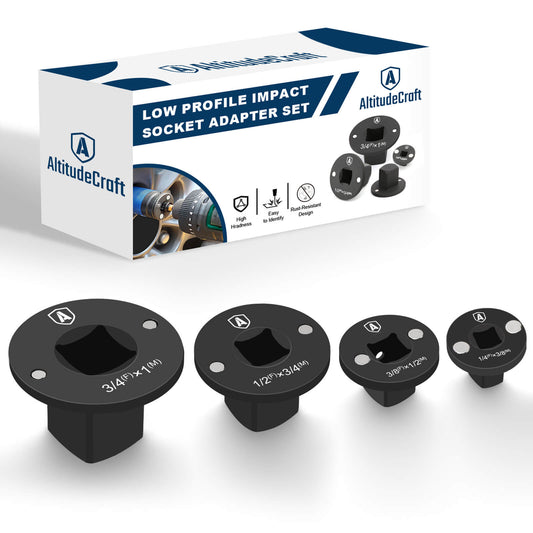
Low Profile Impact Socket Adapter Set, Drive Ratchet Adapter Set
$39.99
Free shipping & free returns on US orders $25+
View productWhy Your Socket Wrench Cannot Reach That Bolt
The bolt you cannot reach is almost always a clearance problem, an angle problem, or both — and each requires a different tool solution. Modern engine bays pack more components into less space than ever. A 2005 Honda Civic had roughly 20% more clearance around the alternator mounting bolts than a 2020 model. That lost space means standard socket adapters and extensions no longer fit where they once did.
Before reaching for specialty tools or removing parts, diagnose which type of access problem you face:
| Problem Type | Symptom | Solution |
|---|---|---|
| Height clearance | Socket fits on bolt but wrench/adapter hits surrounding components | Low profile adapter + shallow socket |
| Angle obstruction | Cannot align wrench straight onto bolt due to nearby parts | Wobble extension or universal joint |
| Reach distance | Bolt is recessed deep behind other components | Extension bar (shortest possible) |
| Combined | Both tight height and awkward angle | Low profile adapter + wobble socket |
For a complete guide to adapter materials and safety, see our socket adapter buying guide.

Solution 1: Low Profile Adapters for Height Clearance Problems
A low profile socket adapter reduces the stack height between your wrench and the fastener by 8-12mm — often enough to clear the obstruction without removing any surrounding components.
Step 1: Identify the Drive Size Mismatch
Determine your impact wrench output (commonly 1/2") and the socket size you need. If they match, no adapter is needed — switch to a shallow socket instead. If they do not match, select the correct drive size conversion.
Step 2: Swap to a Shallow Impact Socket
Deep sockets add 15-25mm of unnecessary height. A shallow (standard-depth) impact socket combined with a low profile adapter recovers maximum clearance. Ensure the socket is impact-rated (Cr-Mo steel, black finish) if using power tools.
Step 3: Test the Fit Before Applying Torque
Slide the adapter-socket assembly onto the bolt by hand. Verify the wrench clears all surrounding components with at least 2-3mm of gap. If it barely fits, any wobble under torque could damage adjacent parts.
Step 4: Apply Torque with Short Bursts
Use short 1-2 second trigger pulls rather than sustained force. In tight spaces, if the socket slips off the bolt, the wrench can strike surrounding components. Short bursts give you control to stop immediately if something shifts.

Solution 2: Wobble Extensions and Universal Joints for Angle Problems
When the bolt is accessible but you cannot align your wrench straight onto it, a wobble extension deflects up to 15 degrees to work around obstructions. This is common when working around exhaust manifolds, power steering pumps, and AC compressor mounting bolts.
Key differences between angular access tools:
- Wobble extension: Built-in ball joint allows slight angular deflection (10-15°). Best for minor angle corrections. Maintains good torque transfer.
- Universal joint (U-joint): Swivels up to 30-45°. For severe angle requirements. Significant torque loss (~25-30%) at high angles.
- Flex-head ratchet: Pivoting head eliminates the need for extensions. Best when both clearance and angle are tight.
Pro tip from experienced mechanics: A wobble socket (socket with built-in wobble) saves height compared to adding a separate wobble extension. For the tightest spaces, combine a low profile adapter with a wobble impact socket — this handles both clearance and angle in the shortest possible stack.
Solution 3: The "Remove Nothing" Systematic Approach
Professional mechanics follow a specific escalation sequence to avoid unnecessary disassembly — removing parts costs time and creates reassembly risk.
- Try the shallow socket alone — sometimes a deep socket was the only problem
- Add a low profile adapter — recovers 8-12mm clearance, handles 80% of tight-access situations
- Switch to a wobble socket — if angle is the issue, not height
- Add the shortest extension possible — only if reach is the problem (each inch of extension increases wobble)
- Try from a different angle — access from below, from the side, or through a wheel well opening
- Remove the obstructing part only as a last resort — note torque specs and routing before removal
This sequence minimizes tool stack complexity. Remember: each additional component in the chain reduces torque delivery by 10-15% and adds a failure point. For safe adapter usage steps, see our step-by-step impact wrench adapter guide.

Real-World Tight Access Scenarios and Fixes
These five common automotive repair scenarios demonstrate where low profile adapters save hours of unnecessary labor.
Scenario 1: Alternator Mounting Bolts
The alternator sits between the engine block and firewall. Standard 1/2" drive sockets hit the power steering line. Fix: 1/2" to 3/8" low profile adapter + shallow 14mm impact socket. The reduced stack height clears the power steering line by approximately 5mm.
Scenario 2: Rear Brake Caliper Bolts
The caliper bracket bolts sit recessed behind the rotor and dust shield. Fix: 1/2" drive with low profile adapter to 3/8" + shallow socket approaches from the rear. No need to remove the dust shield.
Scenario 3: Transmission Bell Housing Bolts
The top bell housing bolts are buried between the engine and firewall with less than 20mm of clearance. Fix: Low profile adapter + wobble extension from above, or access from below on a lift. This is one of the most common "impossible bolt" complaints in automotive forums.
Scenario 4: Intake Manifold Bolts
The rear manifold bolts sit below the throttle body and wiring harness. Fix: 3/8" ratchet with low profile adapter to 1/4" + wobble socket. The smaller drive size allows working around the wiring harness without disconnecting sensors.
Scenario 5: Water Pump Bolts Behind the Pulley
The lower water pump bolts hide behind the serpentine belt pulley. Fix: Remove the belt (you should replace it anyway during a water pump job), then use a low profile adapter for the remaining clearance issue between the pump housing and engine block.

Tools That Solve Tight Access Problems: Decision Matrix
| Tool | Problem Solved | Torque Loss | Cost |
|---|---|---|---|
| Low profile adapter | Height clearance | 10-15% | $8-15 individual / $30-40 set |
| Shallow impact socket | Height clearance | 0% | $5-12 per socket |
| Wobble extension | Angle (up to 15°) | 10-20% | $10-20 |
| Universal joint | Severe angle (up to 45°) | 25-30% | $8-15 |
| Flex-head ratchet | Height + angle combo | 5-10% | $25-60 |
| Crow's foot wrench | No socket clearance at all | Varies | $15-30 |
The AltitudeCraft Low Profile Adapter Set covers the most common clearance problems with four drive conversions (1/4" through 1") for $39.99. For tighter budgets, start with a single 1/2" to 3/8" adapter — it handles the majority of passenger vehicle access issues. For a brand comparison, see our AltitudeCraft vs Sunex comparison.

Frequently Asked Questions
What if the low profile adapter still does not provide enough clearance?
If a low profile adapter with a shallow socket still cannot reach the bolt, try approaching from a different angle — from below on a lift, through the wheel well, or from the opposite side of the engine bay. If physical access is truly impossible without disassembly, remove the single component that blocks access (usually an air intake tube, coolant hose, or wiring bracket) rather than multiple parts.
Can I use extensions to reach deep bolts in tight spaces?
Yes, but use the shortest extension that reaches. Every inch of extension increases wobble and reduces torque accuracy. For critical fasteners (head bolts, brake calipers), minimize the tool stack. A 3-inch extension is almost always sufficient — if you need longer, reconsider your access angle. As OnAllCylinders recommends, wobble extensions combined with short lengths solve most angular access problems.
Is it safe to use socket adapters on torque-critical bolts?
Yes, with caveats. Use the adapter for access during loosening and initial tightening, then switch to a direct-fit socket and torque wrench for the final torque pass when possible. Each adapter reduces delivered torque by 10-15%, so adjust your technique accordingly. For more details, see our adapter FAQ on torque effects.
What about ratcheting box wrenches for tight spaces?
Ratcheting box wrenches (recommended by Family Handyman for stuck fasteners) work well when you cannot swing a ratchet handle. They require as little as 5 degrees of arc to advance. The trade-off: they deliver less torque than a socket wrench, so they are best for fasteners under 60 ft-lbs. For higher torque, the low profile adapter approach with an impact wrench provides more force in a compact package.
Should I remove parts to gain access or keep trying with tools?
The "remove nothing" approach saves time 80% of the time. However, if you spend more than 15 minutes fighting access with tool combinations, removing one part is faster than continuing to struggle. The key: photograph the routing of any hoses, wires, or brackets before removal, and note torque specs for reinstallation.
Disclosure: AltitudeCraft manufactures the low profile socket adapter set referenced in this article. We have included multiple solution approaches — including tools from other manufacturers — to help you solve tight-access problems regardless of which tools you own.
Last updated: March 2026. This article is reviewed and updated regularly to reflect current products, pricing, and industry standards.
Related Articles
Featured in this guide
Low Profile Impact Socket Adapter Set, Drive Ratchet Adapter Set
$39.99
Free shipping & free returns on US orders $25+
View productRelated Articles
 How to Adjust Glock Sights: Which Way to Push the Rear Sight and How Far (2026)
Oct 27, 2026
How to Adjust Glock Sights: Which Way to Push the Rear Sight and How Far (2026)
Oct 27, 2026
 The 5 Cut Method: Square a Crosscut Sled (Formula + Worked Example)
Oct 26, 2026
The 5 Cut Method: Square a Crosscut Sled (Formula + Worked Example)
Oct 26, 2026
 How to Measure Throat Erosion With an OAL Gauge (and Know When Your Barrel Is Done)
Oct 25, 2026
How to Measure Throat Erosion With an OAL Gauge (and Know When Your Barrel Is Done)
Oct 25, 2026
 How to Drill a Hole Through a Pipe So Both Sides Line Up (2026)
Oct 24, 2026
How to Drill a Hole Through a Pipe So Both Sides Line Up (2026)
Oct 24, 2026
