




How to Adjust Glock Sights: Which Way to Push the Rear Sight and How Far (2026)
Last updated: October 2026 | By AltitudeCraft Team
To adjust Glock sights, move the rear sight in the direction you want your shots to go. If your group lands left, push the rear sight right. Glock front sights are fixed into a hole in the slide and can't be drifted, so all windage correction happens at the rear. Elevation is different: you can't push a Glock sight up or down. You change it by fitting a taller or shorter rear sight. Most people get the direction right and the distance wrong. On a Glock 19, a rear-sight move of half a millimeter shifts your group about 1.8 inches at 15 yards.
Disclosure: AltitudeCraft makes two pistol sight pushers. You can drift a sight with a brass punch, and we say below where a pusher helps and where it doesn't.
Key Takeaway
Glock sight adjustment has two separate jobs. Windage, meaning left and right, is fixed by drifting the rear sight sideways in its dovetail, in the same direction you want the bullets to move. Elevation, meaning up and down, is fixed by swapping the rear sight for a different height, because Glock rear sights come in 6.1, 6.5, 6.9 and 7.3 mm versions. To work out how far to move anything, multiply the sight radius by the group's error and divide by the target distance, using the same units throughout. On a Glock 19 with a 6.02 in. sight radius, a group 2 in. left at 15 yards needs the rear sight moved about 0.022 in., or 0.57 mm, to the right. Confirm the error comes from the gun and not your grip before you move anything.


The tool for this job
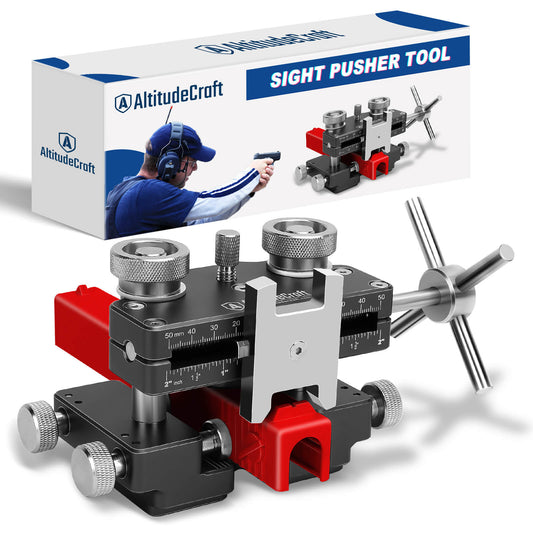
AltitudeCraft Sight Pusher Tool Precision Front and Rear Sight Adjustment
$85.99
Free shipping & free returns on US orders $25+
View productWhich way do you move a Glock rear sight to adjust windage?
Move the rear sight the same way you want the bullets to go. Move the front sight the opposite way. Shooters shorten this to "front opposite, rear same" (Liberal Gun Club forum). The reason is simple. When you line the sights up again after the move, the muzzle has to swing to follow the rear sight, so the bullet goes where the rear sight went.
On a Glock, only the rear half of that rule applies to windage. The front sight sits in a hole in the top of the slide, not a dovetail. Steel and most night sights are held by a small screw from inside the slide, while the factory polymer sight is pressed in. Either way, it can't be drifted sideways. That leaves the rear sight, which is a press fit in a dovetail and can be pushed left or right.
| Where your group lands | What to change on a Glock | Direction |
|---|---|---|
| Left of the aim point | Drift the rear sight | Right |
| Right of the aim point | Drift the rear sight | Left |
| Low | Fit a taller rear sight, or a shorter front sight | Up one or more height steps |
| High | Fit a shorter rear sight, or a taller front sight | Down one or more height steps |
Directions are as seen from behind the gun, looking down the slide the way you aim it.
Is it the sights or your grip? Check this before adjusting Glock sights
Move the sights only after the error repeats from a steady rest, at more than one distance, with more than one shooter. A low-left group from a right-handed shooter is usually grip or trigger, not sights. One shooter on a gun forum grouped low-left with a Glock 17 but centered a Beretta 92FS with the same ammo (Liberal Gun Club forum). Shooting Illustrated also warns that a gun fired from a sandbag can print differently from the same gun held normally (Shooting Illustrated).
A quick test sequence:
- Shoot two five-shot groups from a rest at 7 yards, then two at 15 yards. Use the ammo you actually carry or compete with.
- Look at where the error grows. A real sight error grows in proportion to distance. If your group is 1 in. left at 7 yards and about 2 in. left at 15, the sights are off. If it is 2 in. left at both, look at your grip and trigger press.
- Have a second, steady shooter fire one group. If their group lands in the same place, the gun is the cause.
- Check the sights aren't loose. Push the rear sight with your thumb and look for a front sight that moves. A loose sight wanders, so adjusting it won't hold.
How far should you move a Glock rear sight? The formula
Sight movement equals sight radius times the group's error, divided by the distance to the target. Use the same unit for all three. Wilson Combat's FAQ puts it as "(Sight Radius * Impact Distance) / Target Distance In Inches = Sight Height Change." Their example is a gun that shoots 2 in. low at 15 yards with a 6.9 in. sight radius, which needs a front sight about 0.026 in. shorter (Wilson Combat). Windage and elevation use the same formula, but you work them out separately.
Sight radius is the distance between the front and rear sights. Glock publishes it as "line of sight." The Glock 19 Gen5 is listed at 153 mm, or 6.02 in., with polymer sights. Steel sights are 152 mm and Glock Night Sights 151 mm (GLOCK USA). Glock's European site lists the Glock 17 Gen5 at 165 mm, or 6.50 in. (GLOCK Europe). MOS slides differ, so check your exact model's spec page.
Worked example: Glock 19, group 2 inches left at 15 yards
- Sight radius: 6.02 in.
- Error: 2.0 in. left
- Distance: 15 yards = 540 in.
- Movement = 6.02 × 2.0 ÷ 540 = 0.0223 in. (0.57 mm), rear sight to the right
That is less than the thickness of a credit card, which is why people overshoot with a punch and hammer.
Rear sight movement per inch of group error
We calculated these from Glock's published sight radius and the formula above. They are not range-test results, so confirm each change on paper.
| Model (sight radius) | At 7 yd | At 15 yd | At 25 yd |
|---|---|---|---|
| Glock 19 Gen5 (6.02 in.) | 0.024 in. / 0.61 mm | 0.011 in. / 0.28 mm | 0.0067 in. / 0.17 mm |
| Glock 17 Gen5 (6.50 in.) | 0.026 in. / 0.66 mm | 0.012 in. / 0.31 mm | 0.0072 in. / 0.18 mm |
Read it as: for every inch your group is off, move the rear sight this much. A Glock 17 group 3 in. right at 25 yards needs about 3 × 0.183 = 0.55 mm of rear-sight movement to the left.
How do you measure a half-millimeter sight move?
Use calipers on the sight, not the tool's scale, and measure both sides before you push. This is the step most how-to guides skip, and it's what keeps you from overshooting.
- Clamp the slide and measure from the left edge of the slide to the left edge of the rear sight. Then measure the right side. Write both numbers down.
- Work out the target. For the Glock 19 example, the right-side gap should shrink by 0.57 mm and the left-side gap should grow by the same amount.
- Push in small steps. Re-measure after each turn of the handle until the number matches.
- Draw a thin marker line across the sight and slide when you finish. If the line breaks later, the sight has moved under recoil.

How do you adjust Glock sights for elevation?
Change the height of the rear sight. A taller rear sight raises your group, and a shorter one lowers it. Glock sells factory rear sights in 6.1, 6.5, 6.9 and 7.3 mm heights, and front sights in 4.1 and 4.9 mm. Slimline models such as the 43X use their own SLIM rear sights, which stop at 6.9 mm. Suppressor-height sights run from 11.1 to 11.9 mm at the rear (GLOCK Europe, Steel Sights 2.0). The NRA's guide to factory sights gives the same rule: raise the rear or lower the front to move impact up (NRA Family).
Glock rear sight height chart: how much each step moves your group
Each rear height step is 0.4 mm. We ran that step through the same formula:
| Change | Glock 19 at 15 yd | Glock 19 at 25 yd | Glock 17 at 25 yd |
|---|---|---|---|
| Rear sight +0.4 mm (e.g. 6.5 to 6.9) | About 1.4 in. higher | About 2.4 in. higher | About 2.2 in. higher |
| Rear sight +0.8 mm (e.g. 6.1 to 6.9) | About 2.8 in. higher | About 4.7 in. higher | About 4.4 in. higher |
| Front sight 4.9 to 4.1 mm (0.8 mm shorter) | About 2.8 in. higher | About 4.7 in. higher | About 4.4 in. higher |
So a Glock 19 printing 2 in. low at 15 yards needs about 0.57 mm more rear height. One step (0.4 mm) gets you to about 0.6 in. low. Two steps (0.8 mm, such as 6.1 to 6.9) take you about 0.8 in. high. Pick the step that leaves the smaller error at the distance you shoot most. Ammunition matters too. A heavier, slower bullet usually prints higher, so test with the load you'll actually use before you buy a new sight.
Step-by-step: drifting a Glock rear sight with a sight pusher
Clamp the slide, protect the finish, push in small steps, and test fire after each change.
- Unload the pistol and remove the slide. Wilson Combat's FAQ says to take sight measurements with the gun unloaded and no ammunition nearby.
- Wrap the slide with masking tape where the clamp jaws and pusher block touch it. Pushers can mark a slide. Two of our own customers returned a pusher over marks on the slide or sight, and one wrote: "Indents left in slide from using."
- Seat the slide flat and level in the clamp. A slide that rocks will roll under load and the block can slip off the sight.
- Put the pusher block against the base of the rear sight, not against the top edge or the blade. Pushing high on the sight can tip it in the dovetail.
- Measure, push, and re-measure as described above. Stop at your calculated distance.
- Check the set screw if your sight has one. Many aftermarket rear sights use a set screw. Loosen it before the move and tighten it after.
- Shoot two groups at the same distance. Use your notes to make a second, smaller correction if needed.

Sight pusher, punch, or gunsmith: which should you use?
| Method | Control over a 0.5 mm move | Risk to finish | Best for |
|---|---|---|---|
| Brass punch and hammer | Low. Each blow moves the sight an unknown amount | Medium. Missed blows dent sights | Loose sights that move with light taps |
| Sight pusher | High. Turn the handle a fraction at a time | Low if the slide is taped | Repeat adjustments, tight dovetails, night sights |
| Gunsmith | High | Low | One-time zeroing or a seized sight |
Our sight pusher for Glock holds slides up to 31 mm (1.22 in.) wide and is not made for the Sig P320. One customer returned it because the block sat too high on an H&K VP9SK. If you own more than one pistol brand, our universal sight pusher accepts slides up to 36 mm and has a flip block for Glock sights. Before buying any pusher, check your slide against our sight pusher compatibility guide.

Common Glock sight adjustment mistakes
- Moving the rear sight the wrong way. Remember "rear same": the rear sight follows the bullets you want to move.
- Moving it too far. Measure the move with calipers; don't guess.
- Correcting a grip problem with the sights. If the group is the same size and offset at 7 and 15 yards, the sights aren't the cause.
- Pushing on the top of the sight. The block belongs at the base. Pushing high can tip the sight and leave it crooked. If that has already happened, see our guide to Glock sights that are stuck or crooked.
- Ignoring dovetail fit. A sight that slides with finger pressure won't hold zero. Our article on Glock rear sight dovetail dimensions explains why fit varies.
- Leaving an optic or rear-dovetail plate installed. Our pusher's instructions say red dots, and red dot plates that use the rear sight dovetail, must come off before you move an iron sight.

Frequently Asked Questions About Adjusting Glock Sights
Can you adjust Glock factory sights?
Yes, within limits. The rear sight can be drifted left or right for windage. Elevation needs a rear sight of a different height. Many owners swap the polymer factory sights for steel or night sights at the same time, since the sight comes out anyway.
Can you adjust a Glock front sight?
Not for windage. The front sight is fixed into a hole in the slide, with a screw or a press-fit post, and has no dovetail. You can change elevation by fitting a 4.1 or 4.9 mm front sight. A shorter front sight raises the group.
How far do I move a Glock rear sight for 1 inch at 25 yards?
About 0.17 mm (0.0067 in.) on a Glock 19 and 0.18 mm on a Glock 17. That comes from sight radius × error ÷ distance.
Why does my Glock shoot low and left?
For right-handed shooters, the most common cause is grip tension or jerking the trigger, not the sights. Test from a rest at two distances and have another shooter fire a group before you move the sights.
Do I need a sight pusher to adjust Glock sights?
No. A brass punch works for small moves on a loose sight. A pusher makes sub-millimeter moves easier to control and is less likely to mark the sight or slide.
The bottom line
To adjust Glock sights, drift the rear sight the way you want your shots to move, and change rear sight height for elevation. On a Glock 19 at 15 yards, plan on about 0.28 mm per inch of error. Rule out grip problems before you touch the sights, measure the move with calipers, and test fire after every change. If you're also replacing the sights, follow our step-by-step guide to replacing Glock factory sights.
Related Reading
- How to Install Glock Night Sights With a Sight Pusher Tool
- Glock Rear Sight Dovetail Dimensions (and Why They Vary)
- Universal Sight Pusher Compatibility: Which Pistols Actually Fit
About the author
The AltitudeCraft Team designs and supports pistol sight pushers for Glock and other flat-sided slides. This guide uses Glock's published specifications, attributed sources, and return notes from our own customers. The movement tables are calculated from Glock's published sight radius figures, not from a new range test.
Featured in this guide
AltitudeCraft Sight Pusher Tool Precision Front and Rear Sight Adjustment
$85.99
Free shipping & free returns on US orders $25+
View productRelated Articles
 The 5 Cut Method: Square a Crosscut Sled (Formula + Worked Example)
Oct 26, 2026
 How to Measure Throat Erosion With an OAL Gauge (and Know When Your Barrel Is Done)
Oct 25, 2026
 How to Drill a Hole Through a Pipe So Both Sides Line Up (2026)
Oct 24, 2026
 How to Disconnect a Fuel Injector Connector Without Breaking the Clip (2026)
Oct 23, 2026
