


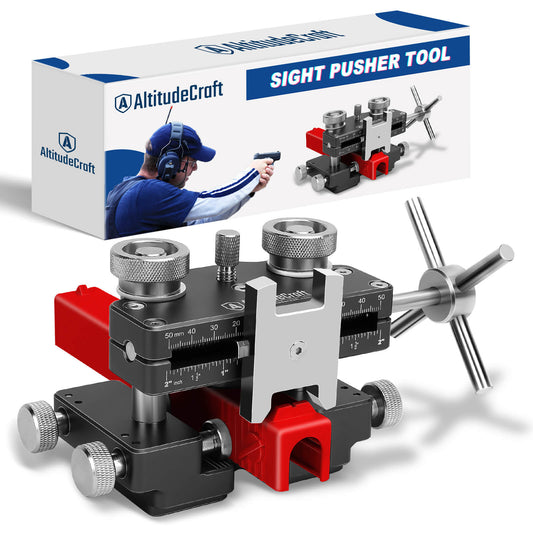

Universal Sight Pusher Compatibility: Which Pistols Actually Fit (2026 Fitment Guide)
Every "universal" sight pusher on the market makes the same promise: it fits your pistol. Our own return records say otherwise — and they say it loudly enough that we decided to publish the numbers instead of the marketing copy.
Across our sight pusher line on Amazon between August 2024 and June 2026, we logged 277 returns. Of the 210 returns that came with a written customer comment, 51 — 24.3% — were not about quality at all. They were about fitment. The tool arrived, the customer put their slide in it, and the slide did not fit, would not stay square, or the pusher could not reach the sight. That is the single largest reason a sight pusher comes back to us, and it is entirely preventable with information you can check in about sixty seconds.
This guide is that information. It is built from our own first-party return comments and reviews, cross-checked against what professional-grade tool makers publish about their own limits. If you already know your pistol is a Glock, our complete Glock sight pusher guide covers that platform in more depth. This article is for everyone else — the 1911, M&P, SIG, Springfield, HK, FN, Beretta and Walther owners who keep getting burned by the word "universal."

The 60-second universal sight pusher compatibility check
Before you buy any universal sight pusher, run these four checks against your own pistol. They take longer to read than to perform, and they resolve the overwhelming majority of the fitment failures we see.
- Measure your slide width with calipers. This tool's cradle accepts up to 1.45 in (36 mm). Most striker-fired duty and compact slides land between 0.90 in and 1.10 in, so width is rarely the blocker — but oversized competition and 10 mm slides can exceed it.
- Look at your slide in cross-section: is it flat-sided? Set the pistol on a table and look at it from the muzzle. If the sides of the slide are two flat, parallel, vertical faces, a clamp-style pusher has something to grip. If the slide is rounded, bevelled or scalloped, it does not.
- Look at the dovetail cut: is it square or angled? Glock, 1911, SIG and Shield-pattern slides use a conventional square dovetail. Springfield XD/XDM, S&W M&P and Canik use angled or notched rails that need a matched pusher face.
- Check what is already on the slide. An optic, an optic adapter plate, or a suppressor-height sight changes the height the pusher block has to clear. This is a newer failure mode and it is growing fast.
If you pass all four, a universal pusher will almost certainly work for you. If you fail check 2 or 3, you need either a model-specific tool or a different method entirely — and no amount of tightening will fix it.

Why "universal" fails: four geometry problems, not four quality problems
The most useful thing our return data revealed is that customers and sellers are arguing past each other. Customers file returns as "defective." We read the comment and find a geometry mismatch. Of the 71 returns filed under DEFECTIVE, a large share carry comments like "Doesn't work on mine" or "Item is not big enough for what I need" — descriptions of fit, not of failure.
There are four distinct geometry problems behind almost all of it.
1. Rounded slides have nothing to clamp — the 1911 problem
The 1911 was the single most frequently named pistol in our fitment-related return comments. One customer explained the mechanism better than our own spec sheet does:
"A 1911 is oval. Does not hold a 1911 slide well enough and does not reach the sights over that rounded frame. It simply does not work. I'm not going to risk tightening this tool any tighter."
That last sentence matters. The customer correctly identified that more clamping force is not the answer. A clamp needs two parallel flat faces to develop grip. A rounded 1911 slide gives it two tangent lines instead, so the slide rolls under load — and a slide that rolls while you push a front sight will wedge the dovetail and mar the finish. Other comments in the same cluster: "Not enough clearance for a 1911," "Would not fit the slide of SW 1911."
Note the honest tension here: some 1911 patterns do work. Commercial Colt and Kimber slides with flatter sides are listed as compatible, and one of our five-star reviewers reported success across a mixed bag of pistols. "1911" describes a design lineage, not a single slide profile. Measure yours; do not trust the label.
2. Angled and notched dovetail rails need a matched pusher face
Square-dovetail platforms (Glock, most SIG, Shield-pattern) and angled-rail platforms (Springfield XD/XDM, S&W M&P, Canik) are not interchangeable, and the better listings in this category now say so outright. Competing products state plainly that they fit "most square slide pistols … not compatible with angled/notched slides (XD, XDM, M&P, Caniks)."
Our return comments match exactly: "Doesn't work for S&W M&P 2.0 sights," "Says it works with m&p but wasn't able to fit," and a particularly instructive one — "The sight pusher will not remove the rear sight of my M&P Shield 2.0. YES, the set screw was removed BEFORE using the removal tool."
The M&P platform carries a second trap that has nothing to do with the tool. Experienced armorers on the M&P Pistol Forum point out that M&P sight channels are tapered and directional: sights come out left to right and go in right to left. Push the wrong way and you will fight the taper the entire time. They also warn that a striker block plate and spring sit under the rear sight and will launch across the room if the sight leaves in a hurry.

3. Compact and sub-compact slides are too short to sit square
Small slides fail for the opposite reason large ones do: there is not enough length for the cradle to hold them level. Our comments name the S&W Bodyguard 2.0 ("my firearm is to small, does not hold firearm in place properly") and the HK VP9SK ("the pusher was too high to push the sights without engaging a section that may be damaged"). A SIG P365X owner reported the same on the front sight.
This limitation is industry-wide, not brand-specific. Real Avid's own Master Sight Pusher documentation instructs owners to measure slide height and width before use and notes that compact slides may require an expansion plate. The same manual also states that the tool is not compatible with most hammer-fired slides carrying an external safety — a candid admission that "universal" always has an asterisk.
4. An installed optic or adapter plate changes the clearance envelope
This is the newest failure mode in our data and it is growing with red dot adoption. Three separate customers returned tools because of it:
"Trying to remove a dovetail plate that a red dot attaches to. Plate is too big to fit in the sight pusher." · "Wouldn't fit for putting Doctor plate. Need a longer pusher." · "Pusher mars sight and doesn't work with red dots attached to gun."
Optic adapter plates and suppressor-height sights are taller and wider than the factory rear sight the tool was dimensioned around. One five-star reviewer got a Glock 19X MOS with suppressor sights apart, but only by putting a pipe wrench on the Allen key for leverage. If you are working around an optic cut, remove the optic first, and read our adapter plate fitment and torque FAQ before you reassemble.
Universal sight pusher compatibility table (from first-party data)
The table below combines confirmed successes and confirmed failures from our own Amazon reviews and return comments. "Confirmed" means a real customer told us in writing. Treat conditional entries as "measure first."
| Platform | Verdict | Evidence from our first-party data |
|---|---|---|
| Glock G17 / G19 / G26 / G43X / G45 (Gen 3–5) | Confirmed fit | Repeatedly reported successful, including multi-pistol sessions |
| Glock MOS with suppressor-height sights | Conditional | Works, but "a pain" — needed extra leverage on the drive |
| S&W M&P M2.0 (Compact / Full) | Conditional | Both successes and failures reported on the same family; angled rail is the variable |
| S&W M&P Shield 2.0 | Reported failure | "Will not remove the rear sight," set screw already removed |
| 1911 (rounded commercial slides) | Reported failure | Five separate comments: rolls in the cradle, pusher cannot reach over the radius |
| 1911 (Colt / Kimber flat-sided) | Conditional | Listed as compatible; verify your specific slide profile |
| SIG P365 (standard) | Confirmed fit | Reported working in review |
| SIG P365X / P226 / P320 | Reported failure | P365X front sight failed; P226 and P320 explicitly called out as non-fitting |
| HK VP9 / USP .45 | Confirmed fit | Suppressor sights installed successfully on VP9 |
| HK VP9SK (sub-compact) | Reported failure | Pusher sat too high relative to the short slide |
| FN Five-seven Mk II | Conditional | Worked, but required an extension bar for leverage |
| FN 509 | Reported failure | "Not compatible with FN509" |
| Beretta 90 series | Reported failure | "The slide doesn't fit and when trying it just slides off" |
| Springfield XDM Elite / Hellcat Pro | Reported failure | Angled rail platform; both named in return comments |
| S&W Bodyguard 2.0 | Reported failure | Slide too short to be held square |
| Walther PPS M2 | Listed compatible | Listed by the manufacturer; no first-party confirmation yet in our data |
| Any slide with optic or adapter plate installed | Remove optic first | Three returns caused specifically by installed plates |
Front sights are harder than rear sights — and here is the physics
If your fitment check passes but you still struggle, odds are you are working a front sight. One of our most technically literate reviewers described the failure precisely:
"It worked without issue on the rear sight but not so much on the front sight. When pressure was applied the 'pusher' part deflected upward which put more cantilever force on the blade … more susceptible to snapping the blade off. I had to keep adjusting the height to keep the pusher as low on the blade as possible."
Front sight blades are tall and narrow at the root. The higher on the blade you apply force, the longer the moment arm and the greater the bending load at the base. The fix is exactly what that customer discovered on his own: set the pusher block as low on the blade as it will go, and re-check it every quarter turn. Front-sight width is a known constraint industry-wide — S&W Forum members documented a professional-grade pusher being redesigned specifically because its front sight slot was too narrow for wider blades.

How to not destroy your slide finish
The most expensive comment in our entire dataset was one sentence long: "It completely destroyed the cerakote on my slide. This little thing cost me $150 in damages." Finish damage showed up across the rating spectrum — even satisfied four-star customers reported light marring.
There are two causes, and one of them is fully under your control.
- Soft pusher material leaving indents. Interpose a shim: a strip of brass, leather or thick polymer between the pusher face and the sight. Several customers do exactly this and specifically asked us to include it.
- The slide rolling in the cradle. This is the avoidable one. As one four-star reviewer put it: "Do not allow the slide to roll when pushing your front sight or you will mar your slide like I did because the dovetail will wedge." Clamp down fully, verify the slide is level before applying load, and stop the moment you feel the tool shift.
One more field-proven tip from a customer who reverse-engineered the mechanism: if the drive feels gritty or the threads bind under load, disassemble and grease the acme threads and the carrier track before first use. He reported the tool "performed much better" afterwards. If your sights are already stuck or crooked, our sight pusher troubleshooting guide walks through the recovery sequence.

What professional shops do differently
Gunsmiths who work across many platforms all day do not use one universal tool. They use a frame plus a library of model-specific inserts. MGW's Range Master system is the clearest example: the tool body accepts make- and model-specific "shoes" sold separately, ships with both flat and 30-degree angled pusher blocks, and publishes a specific reach figure (.750 in) — with a note that slides with a long under-lug need the longer-reach model instead.
That architecture is the honest answer to the compatibility problem, and it is also why it costs several times more once you buy the shoes you need. Forum users describe hunting for the right shoe number for their exact variant and grinding one down when nothing matched.
So the real decision is not "universal versus professional." It is how many different slide profiles you will service. One or two flat-sided pistols, a handful of times in your life? A well-built universal pusher is the right economic answer — one customer noted he saved more than the tool cost by doing two sight swaps himself instead of paying a gunsmith. Ten platforms across a working bench? Buy the frame-and-shoe system.
Universal sight pusher vs. brass punch: an honest comparison
| Factor | Universal sight pusher | Brass drift & hammer |
|---|---|---|
| Precision | Graduated, repeatable (0.001 in increments) | Impact-based; "very imprecise" per customer report |
| Finish risk | Low if the slide is clamped square; real if it rolls | High — the most cited reason people switch |
| Platform coverage | Flat-sided, square-dovetail slides only | Any slide, including rounded 1911s |
| Requires a vise | No on self-supporting designs (this one weighs 4 lb) | Yes — a heavy, stable vise is effectively mandatory |
| Cost | One-time tool purchase | Cheapest to buy, most expensive to get wrong |
| Best for | Zeroing, night sight swaps, repeat use | One-off jobs on incompatible slide geometry |
For platform-specific walkthroughs, see our step-by-step guides on replacing factory sights and choosing night sight upgrades, or compare build quality in our head-to-head against Wheeler.
Frequently Asked Questions
Does a universal sight pusher really fit all pistols?
No, and no reputable manufacturer claims it without qualification. "Universal" in this category means flat-sided slides with conventional square dovetails. Our own return data shows 24.3% of commented returns were fitment failures, concentrated on rounded 1911 slides, angled-rail platforms (M&P, XD/XDM, Canik) and sub-compact slides. Measure your slide width and check whether its sides are flat before buying.
What is the maximum slide width a universal sight pusher accepts?
For this tool, 1.45 in (36 mm) in both clamping directions. Most duty and compact striker-fired slides are well under that, so width alone rarely blocks fitment — slide shape is the usual culprit. Professional frame-and-shoe systems publish a reach figure instead; MGW's Range Master specifies .750 in of reach.
Why won't my sight pusher work on my 1911?
Most commercial 1911 slides are rounded in cross-section. A clamp needs two parallel flat faces to develop grip, so a rounded slide rolls under load and the pusher often cannot reach over the radius to contact the sight. This is a geometry limit, not a torque limit — tightening harder increases the risk of marring without improving grip. Flat-sided 1911 variants such as some Colt and Kimber slides can work; verify yours before assuming.
Can I use a sight pusher with a red dot or adapter plate installed?
Remove the optic and the adapter plate first. Plates and suppressor-height sights sit taller and wider than the factory rear sight the tool was dimensioned around, and this accounted for three separate returns in our data. Reinstall the optic afterwards to the correct torque spec.
Why is the front sight so much harder than the rear sight?
Front sight blades are tall with a narrow root, so force applied high on the blade creates a long moment arm and heavy bending load at the base — with a real risk of snapping the blade. Keep the pusher block as low on the blade as possible and re-verify its position every quarter turn.
Will a sight pusher damage my slide finish?
It can, and one customer reported $150 in cerakote damage. The two causes are a soft pusher face leaving indents and the slide rolling in the cradle so the dovetail wedges. Use a brass, leather or polymer shim at the contact point, clamp the slide fully square, and stop immediately if the tool shifts under load.
Do I need a vise to use a sight pusher?
Not with a self-supporting design. This tool weighs about 4 lb with an aircraft aluminium frame and steel components, and customers report using it on a bench without clamping it down. Frame-and-shoe professional systems and all punch-based methods do effectively require a heavy, stable vise.
The bottom line
"Universal" is a shape claim, not a brand claim. Flat-sided slide, square dovetail, nothing tall bolted on top, under 1.45 in wide — pass those four and a universal sight pusher will serve you for years and pay for itself in the first two sight swaps. Fail check 2 or 3 and the honest answer is that you need a model-specific shoe system or a brass punch, and no tool in this class will change that.
We published our own return numbers because the alternative is another customer discovering the limit with their slide already in the cradle. If your pistol clears the checklist, the AltitudeCraft Sight Pusher Tool gives you a reversible prong for Glock-pattern sights, adjustable three-side slide support and 0.001 in graduated adjustment for zeroing. If it doesn't, we would rather tell you now — and our sight pusher compatibility FAQ covers the remaining edge cases.

Related Articles
 Sight Pusher Tool Complete Guide: How to Install Glock Sights Like a Pro (2026)
Apr 02, 2026
Sight Pusher Tool Complete Guide: How to Install Glock Sights Like a Pro (2026)
Apr 02, 2026
 Miter Saw Crown Stops FAQ: Compatibility Angles and Setup Tips (2026)
Apr 02, 2026
Miter Saw Crown Stops FAQ: Compatibility Angles and Setup Tips (2026)
Apr 02, 2026
 Dumbbell to Barbell Converter FAQ: Weight Limits, Fit, and Safety (2026)
Apr 02, 2026
Dumbbell to Barbell Converter FAQ: Weight Limits, Fit, and Safety (2026)
Apr 02, 2026
 Table Saw Alignment: How to Check Blade-to-Slot Parallelism (and When Your Saw Can't Be Fixed)
Sep 18, 2026
Table Saw Alignment: How to Check Blade-to-Slot Parallelism (and When Your Saw Can't Be Fixed)
Sep 18, 2026
