



Glock Rear Sight Dovetail Dimensions (and Why They Vary)
Last updated: October 2026
If you are about to order a new rear sight, cut a slide, or buy a sight pusher, you want one number: how big is the Glock rear sight dovetail? The honest answer is that the figure everyone quotes is a gunsmith consensus, not a published Glock drawing — and the slides themselves vary. This guide gives you the commonly used dimensions, shows where each number comes from, corrects three conflicting claims we previously published on this blog, and explains what the variation means when a sight goes in too tight or too loose.
Key Takeaway
The Glock rear sight dovetail is most often described as about .250 inch (6.4 mm) wide with a 74-degree included angle and roughly .079 inch (2.0 mm) deep. Glock does not publish an engineering drawing for the cut, so treat these figures as a working reference rather than a specification. At least one gunsmith tooling maker sells a 74-degree cutter specifically for Glock slides, which is a different geometry from the 65-degree Novak cut used on many 1911 pistols. One Glock sight maker states that Glock slide dovetails have varied significantly during production, which is why identical aftermarket sights can slide in by hand on one pistol and need fitting on another. The Glock front sight is not dovetailed: it is held by a small screw with a 3/16-inch hex head, so on a factory Glock slide a sight pusher is only needed for the rear sight.
How big is the Glock rear sight dovetail? The short answer
The working numbers are .250 inch wide, 74 degrees, about .079 inch deep — and every one of them should carry an asterisk. They circulate on gunsmithing forums such as the AR15.com Armory dovetail thread, and the angle is supported by commercial tooling: Long Rifles Inc. sells a carbide 74-degree dovetail mill marketed for Glock pistols with a .237-inch effective diameter.
| Dimension | Commonly cited value | Metric | How solid is it? |
|---|---|---|---|
| Width | about .250 in | about 6.4 mm | Forum consensus; one hand measurement put the bottom of the cut nearer .275 in |
| Included angle | 74° | 74° | Strongest of the three: matches tooling sold specifically for Glock slides |
| Depth | about .079 in | about 2.0 mm | Forum consensus; the same hand measurement read .070–.075 in |
| Same across models? | Glock-pattern rear sights are sold to fit all Glock slides, including MOS | — | Sight makers design for one pattern, but one maker says slide dovetails "have varied significantly during production" |
Notice that the width row is the weakest. "Width" on a dovetail can mean the opening at the top of the slide or the wider base at the bottom of the cut, and people quoting a number rarely say which one they mean. If you are cutting or fitting, measure the actual slide in front of you.

Why do sources disagree? Including on this blog
Before writing this guide we audited our own sight articles and found four unsourced claims that contradict each other and the sources above. We are correcting them here rather than quietly hoping nobody noticed.
| What we previously wrote | Where | What the evidence supports |
|---|---|---|
| Glock slides use "typically 65° dovetails" | Our sight pusher comparison article | 65° is the Novak 1911 angle. The Glock cut is usually given as 74°. |
| Glock rear dovetail is "6.5 mm wide × 1.2 mm deep" | Our best sight pushers roundup | Width is close to the 6.4 mm figure; the 1.2 mm depth has no source we could find and is well below the 2.0 mm usually quoted. |
| Glock kept a "remarkably consistent" dovetail from Gen 3 to Gen 5 | Our Glock sight pusher FAQ | The design is shared, but a Glock sight maker says the dovetails "have varied significantly during production." |
| Glock dovetails "vary by 0.001-0.003 inches between production runs" | Our best sight pushers roundup | We could not find a source for that range. The one manufacturer statement we found says the variation is significant, without giving a number. |
None of those claims had a source attached, and that is exactly how bad dimensions spread: one article states a number confidently, the next one repeats it, and after a year it looks like common knowledge. If a page gives you a Glock dovetail figure to a tenth of a millimetre with no source, assume it is somebody's guess.
Glock dovetails vary in production — and that explains most "tight" and "loose" sights
The most useful fact about Glock dovetails comes from a company that sells sights for them. 10-8 Performance, which makes Glock rear sights, writes on its rear sight product page: "Fitting is usually not required, but Glock slide dovetails have varied significantly during production." The same page notes that sometimes "the sight won't drift in without some fitting."
That single sentence explains a pattern you will see in any shooting forum. One member of a USCCA community thread on sight tools put it well: some sights "slide off like a hot knife through butter. And others feel like they are welded on." Both experiences are normal, because neither the slide nor the aftermarket sight is machined to an identical size every time.
- Sight too tight: the sight base is slightly larger than your particular slide's cut. Forcing it can gall the dovetail, and on night sights it puts load near the tritium vial.
- Sight too loose: the base is slightly smaller than the cut. Some aftermarket rear sights have a set screw to lock them; if yours does not and the sight moves with finger pressure, ask the sight maker or a gunsmith before shooting it.
- Sight starts, then stops halfway: usually a burr, debris or a slightly tapered cut. Stop, clean both parts, and check rather than adding force.
If a sight genuinely needs fitting, remove material from the sight base, never from the slide. 10-8 recommends a diamond file or hone because hard sight finishes make ordinary files "slide right off the surface." The slide side is just as unfriendly: LRI notes that "Glock's Tennifer coating and heat treat is known to be tough on conventional HSS tools," which is why they offer the Glock cutter in carbide.

Is the Glock front sight a dovetail? No
On a factory Glock slide, only the rear sight sits in a dovetail. The front sight is held by a small screw with a 3/16-inch hex head, as shown in retailer front sight screw listings for Glock. You remove it with a thin 3/16-inch hex driver, not a pusher.
This matters because it shows up in our own returns. On our universal pusher, comments such as "The sight pusher tool head is too wide for front sight dovetail" and "Too big for front-sight" most likely come from owners of pistols with dovetailed front sights — the comments do not say which pistol — and on 1911-style guns the front cut is much narrower than the rear (see the table below). On a factory Glock, a pusher has no front sight job to do.
How does the Glock dovetail compare with other pistol cuts?
Glock's 74-degree cut is not interchangeable with the 65- and 60-degree cuts used elsewhere. A sight made for one profile will not seat correctly in another even if the width looks close, because the angled walls can bear in the wrong place.
| Cut | Width | Depth | Angle | Source and confidence |
|---|---|---|---|---|
| Glock rear | about .250 in | about .079 in | 74° | Angle: Glock-specific tooling, medium. Width and depth: forum consensus, low to medium |
| Novak rear (1911) | .495 in | .275 in | 65° | Fusion Firearms sight cut guide; medium |
| Novak front (1911) | .330 in | .075 in | 65° | Fusion Firearms; medium |
| Mil-Spec 1911 rear | about .330 in | not stated | 65° | Fusion Firearms; medium |
| Bomar rear | about .359 in | not stated | 60° | Fusion Firearms; medium |
Two things stand out. First, a Novak rear cut is roughly twice as wide as a Glock rear cut, so "Novak-cut" and "Glock-cut" sights are not alternatives for the same slide. Second, front dovetails on 1911-style pistols are narrower than their rear dovetails, which is why a pusher blade sized for rear sights can be too wide for front work on those guns.

What 50 written return comments taught us about pushers and dovetails
Of 50 written return comments on our universal sight pusher between July 2024 and March 2026, 11 were about fit rather than build quality. These are Amazon returns of our own tool (93 returns in that window, 50 with a written comment), so they are real buyers describing real pistols.
- Front sight and dovetail width: "The sight pusher tool head is too wide for front sight dovetail."
- Glock alignment: "Says it works for Glock but did not line up for Glock sights" — one possible cause is the reversible blade being left on its non-Glock side; the comment does not say.
- Optics and steel sights: "Did not work well with metal sights or slides with red dots."
- Non-Glock slides: "Was unable to remove rear sight on a Springfield XD. Was difficult to apply significant pressure."
Two further comments describe the pusher deflecting or its thread backing out while the sight stayed put — the classic symptom of a sight that is tighter than the tool can push square. Our interpretation, not something the buyers stated, is that this is the production variation from the previous section showing up at the bench, and it is the reason to stop and check fit instead of adding torque.

How to check your own dovetail before you buy or push
Five minutes with a pair of calipers tells you more than any chart. You do not need to measure the angle; you need to know whether the new sight and your slide are close enough to go together without force.
Safety first: unload the pistol, remove the magazine, visually and physically confirm the chamber is empty, and take the slide off the frame before any sight work. Wear eye protection when pushing or filing.
- Measure the old sight base. With the factory rear sight out, measure the width of its base at the widest point and its height from the slide surface. That is the best single reference for your slide.
- Measure the new sight base the same way. If it is noticeably wider than the old one, expect to fit it.
- Inspect the cut. Clean it with solvent and a brush, and look for burrs or debris at the entry edge.
- Test-start by hand. A sight that enters the first few thousandths of an inch with finger pressure is usually a good fit; one that will not start at all needs fitting first.
- Push slowly and square. Seat the slide level in the pusher, use the correct blade side, and advance in small turns while watching that the sight moves rather than the slide.
Common mistake: filing the slide's dovetail to make a tight sight fit. The slide is the expensive, hard-to-replace part and its finish is difficult to cut cleanly; fit the sight instead.
Common mistake: pushing a Glock rear sight with the pusher blade on its non-Glock side, so the blade bears on the slide or only one corner of the sight.
Common mistake: trusting a dimension from a product listing or blog without a source — including, as shown above, some of our own older articles. Measure the parts you actually have.

Frequently Asked Questions
Are all Glock rear sight dovetails the same size?
Glock-pattern rear sights are sold to fit Glock slides across the lineup, so the design is shared. They are not all identical in size: a Glock sight maker states that Glock slide dovetails have varied significantly during production, so some sights need fitting on some slides.
What is the angle of a Glock dovetail?
It is usually given as 74 degrees included angle, and at least one tooling maker (Long Rifles Inc.) sells a 74-degree dovetail cutter for Glock pistols. That is different from the 65-degree Novak cut found on many 1911 pistols.
Is a Glock dovetail the same as a Novak dovetail?
No. A Novak rear cut is about .495 inch wide at 65 degrees, while the Glock rear is about .250 inch at 74 degrees. Sights are not interchangeable between them.
Do Glock MOS slides use the same rear dovetail?
Generally yes. 10-8 Performance, for example, says its Glock rear sight is designed to fit all Glock slides without interfering with the factory MOS cut. Check the listing for your specific sight if you run an optic or adapter plate.
What size is the Glock front sight screw?
The front sight is held by a small screw with a 3/16-inch hex head. It is not a dovetail, so you need a thin 3/16-inch hex driver rather than a sight pusher.
Which direction does a Glock rear sight come out?
Direction and reference point are covered step by step in our Glock sight removal and replacement guide.
Can I file a tight Glock rear sight to fit?
Yes, carefully, and only on the sight base. Use a diamond file or hone, take a few strokes at a time, and test-fit often. Do not file the slide.
Related guides
- Glock sights stuck or crooked: troubleshooting guide
- Universal sight pusher compatibility: which pistols actually fit
- Glock sight pusher FAQ: rear vs front and tips
- Best sight pusher tools for Glock
- All sight pusher tools
The bottom line
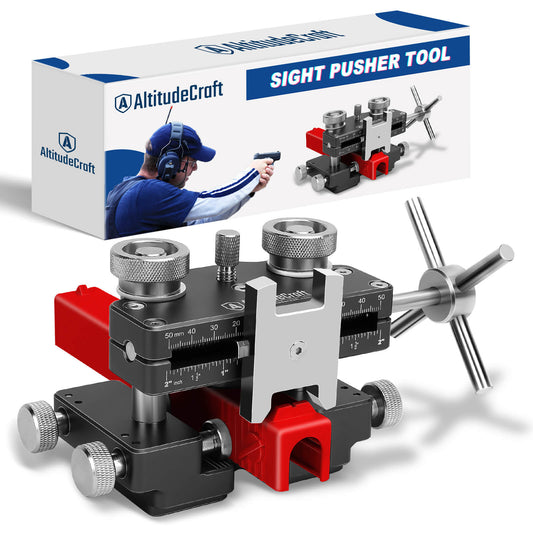
Use .250 inch, 74 degrees and about .079 inch deep as a reference for the Glock rear sight dovetail, not as a guarantee. Expect some sights to need fitting because Glock slides vary, fit the sight rather than the slide, and remember that the Glock front sight is a screw, not a dovetail. If you are changing rear sights at home, a screw-driven pusher with a Glock-side blade, such as the AltitudeCraft universal sight pusher, lets you move a tight sight in controlled steps and stop the moment something does not feel right.

Disclosure: AltitudeCraft makes and sells the sight pusher linked in this article. The return data quoted above comes from our own Amazon sales of that tool.
Related Articles
 Universal Sight Pusher Compatibility: Which Pistols Actually Fit (2026 Fitment Guide)
Aug 02, 2026
Universal Sight Pusher Compatibility: Which Pistols Actually Fit (2026 Fitment Guide)
Aug 02, 2026
 Sight Pusher Tool Complete Guide: How to Install Glock Sights Like a Pro (2026)
Apr 02, 2026
Sight Pusher Tool Complete Guide: How to Install Glock Sights Like a Pro (2026)
Apr 02, 2026
 Which Hornady Comparator for 6.5 Creedmoor? Insert, Bushing, and Shoulder Bump Setup (2026)
Oct 15, 2026
Which Hornady Comparator for 6.5 Creedmoor? Insert, Bushing, and Shoulder Bump Setup (2026)
Oct 15, 2026
 How to Center Work in a 4-Jaw Chuck With a Dial Indicator (2026)
Oct 14, 2026
How to Center Work in a 4-Jaw Chuck With a Dial Indicator (2026)
Oct 14, 2026
