


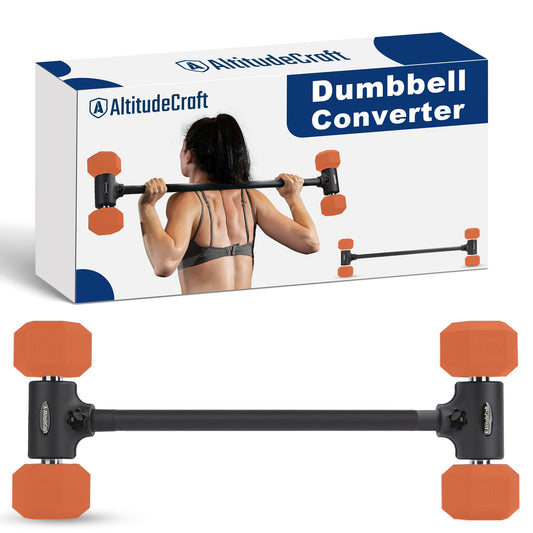


How to Convert Dumbbells to a Barbell: Setup and Exercises Guide (2026)
Converting dumbbells to a barbell takes under two minutes with a converter bar and unlocks compound exercises like bench press, barbell rows, and overhead press without buying a separate barbell set. The critical setup step most people skip is verifying dumbbell handle diameter — standard 1-inch handles fit most converters, while 2-inch Olympic handles do not. For safe assembly, seat each dumbbell fully into the sleeve until it contacts the internal stop, then tighten threaded collars until they cannot rotate by hand. Start with 50% of your target weight for the first set to verify stability before loading heavier. This guide walks through complete assembly, five proven barbell exercises, progressive weight loading, and the safety precautions that prevent the most common converter bar injuries.
Disclosure: AltitudeCraft manufactures the converter bar featured in this tutorial. All exercise recommendations follow established strength training principles. This article contains affiliate links.
Last updated: April 2026

The tool for this job
AltitudeCraft Dumbbell Barbell Converter Bar
$69.99
Free shipping & free returns on US orders $25+
View productWhat You Need Before Starting
Before assembling your dumbbell barbell converter, gather these items and verify compatibility:
- A dumbbell barbell converter bar — This tutorial uses the AltitudeCraft Dumbbell Barbell Converter Bar, but the assembly steps apply to most converter designs.
- Two dumbbells of equal weight — Both must have the same handle diameter. Mismatched weights create an unbalanced bar that is dangerous during pressing movements.
- A caliper or ruler — To measure your dumbbell handle diameter. This is the single most important pre-check.
- A flat, stable surface — Assemble on a rubber gym mat or flat floor. Never assemble on carpet, which can hide whether the bar is truly level.

Step 1: Check Dumbbell Compatibility
This is where most setup problems originate. Dumbbell handles come in two standard sizes, and using the wrong one with your converter bar is the number one reason for returns and safety incidents.
Standard vs. Olympic Dumbbell Handles
| Specification | Standard Dumbbells | Olympic Dumbbells |
|---|---|---|
| Handle Diameter | 1 inch (25.4mm) | 2 inches (50mm) |
| Converter Bar Compatible? | Yes (most converters) | No (requires specialty adapter) |
| Common Brands | CAP, Yes4All, traditional spin-lock | Rogue, Rep Fitness, Eleiko |
| Weight Plate Hole Size | 1.05 inch (26.7mm) | 2.0 inches (50.6mm) |
| Typical Use | Home gyms, adjustable sets | Commercial gyms, powerlifting |
How to measure: Wrap a measuring tape around the handle (circumference), then divide by 3.14 to get the diameter. A standard handle measures approximately 3.14 inches around (1-inch diameter). An Olympic handle measures approximately 6.28 inches around (2-inch diameter). If you have a caliper, measure directly across the handle — this is more accurate.
What about selectorized dumbbells? Adjustable systems like Bowflex SelectTech, PowerBlock, and NordicTrack use proprietary handle shapes that do not fit any converter bar. Only dumbbells with straight, cylindrical handles extending beyond the weight plates will work.

Step 2: Assemble the Converter Bar
Assembly takes 60-90 seconds once you have done it once. Follow this exact sequence for the most secure connection:
- Place the converter bar on a flat surface with both sleeve openings facing up or horizontally accessible.
- Loosen both locking collars on the converter bar by turning them counterclockwise until the sleeve opening is fully clear.
- Insert the first dumbbell handle into the left sleeve. Push it in straight — do not angle it — until the handle contacts the internal stop. You should feel a firm seat. If the handle slides in loosely with visible gap, the dumbbell handle may be undersized. Wrap one layer of athletic tape around the handle to fill the gap.
- Tighten the left locking collar by turning it clockwise until hand-tight. Then give it an additional quarter-turn. The dumbbell should not rotate or slide when you grip the bar and twist.
- Repeat with the second dumbbell on the right sleeve. Use the same insertion and tightening procedure.
- Lift the assembled bar by gripping the center knurled section. Give it a gentle shake. There should be zero wobble or clicking sounds. If either dumbbell moves, set the bar down and retighten.

Pro tip from our workshop: If you frequently change weights between exercises, leave the converter bar assembled with your lightest dumbbells and swap only one dumbbell at a time. This is faster than disassembling completely and reduces the chance of cross-threading the locking collar.
Step 3: Weight Loading Guidelines
A converter bar is only as safe as how you load it. The American Council on Exercise (ACE) recommends starting any new exercise variation with a load that allows 12-15 controlled repetitions. For a converter bar specifically, follow these additional guidelines:
- First session: Use 50% of what you would normally lift for that exercise. The different feel of a converter bar compared to a solid barbell requires adjustment time.
- Progressive loading: Add 5-10 lbs per session (2.5-5 lbs per dumbbell) once you can complete all planned sets and reps with good form.
- Maximum working load: Stay at 70-80% of your converter bar's rated capacity. The AltitudeCraft bar is rated for 200 lbs, so your working ceiling is 140-160 lbs.
- Balance check: Always use two dumbbells of identical weight. Even a 5 lb difference between sides creates a torque imbalance that stresses the converter joints and throws off your movement pattern.
5 Essential Barbell Exercises With Your Converter Bar
These five exercises cover all major muscle groups and represent the highest-value movements you can perform with a converted dumbbell barbell. Each one is a compound exercise that recruits multiple joint actions simultaneously, making your training more time-efficient.
Exercise 1: Barbell Bench Press
Muscles worked: Chest, front deltoids, triceps
Setup: Lie on a flat bench with the converter bar at arm's length above your chest. Grip the knurled section with hands slightly wider than shoulder width. Lower the bar to mid-chest, pause briefly, then press up to full arm extension.
Converter-specific tip: Because a converter bar is shorter than a standard barbell, your grip width options are limited. Focus on a shoulder-width or slightly wider grip. Very wide grips may place your hands too close to the dumbbell weight, reducing leverage and comfort.
Recommended load: Start with two 15-25 lb dumbbells (30-50 lbs total) and progress from there.

Exercise 2: Bent-Over Barbell Rows
Muscles worked: Upper back (lats, rhomboids, traps), biceps, rear deltoids
Setup: Stand with feet hip-width apart, knees slightly bent. Hinge at the hips until your torso is roughly 45 degrees from the floor. Let the bar hang at arm's length below your shoulders. Pull the bar toward your lower ribcage, squeezing your shoulder blades together at the top. Lower under control.
Converter-specific tip: Rows create less lateral stress on the converter joints than pressing movements, making this an excellent exercise for higher loads on a converter bar. The bar's shorter length actually helps maintain a more upright torso position.
Recommended load: Start with two 20-30 lb dumbbells (40-60 lbs total).
Exercise 3: Standing Overhead Press
Muscles worked: Shoulders (all three heads), triceps, upper chest, core
Setup: Stand with feet shoulder-width apart. Clean the bar to shoulder height or lift it from a rack. Press the bar overhead until your arms are fully extended, then lower back to shoulder level.
Converter-specific tip: This exercise places the most stress on the converter joints because the weight is directly overhead. Verify collar tightness before every set. Keep the load moderate — most people overhead press 60-70% of what they bench press, so use correspondingly lighter dumbbells.
Recommended load: Start with two 10-20 lb dumbbells (20-40 lbs total).
Exercise 4: Barbell Curls
Muscles worked: Biceps, forearms
Setup: Stand upright with the bar at arm's length, palms facing forward (supinated grip). Curl the bar toward your shoulders by bending only at the elbows. Squeeze at the top, then lower slowly (3-4 seconds on the descent for maximum muscle tension).
Converter-specific tip: Curls use relatively light loads, so even budget converter bars handle this exercise well. The shorter bar length encourages a narrower grip that targets the outer biceps head more effectively than a wide-grip curl on a standard barbell.
Recommended load: Start with two 10-15 lb dumbbells (20-30 lbs total).
Exercise 5: Romanian Deadlifts (RDLs)
Muscles worked: Hamstrings, glutes, lower back, grip
Setup: Stand with the bar at hip height (either deadlift it from the floor or lift from a rack). With a slight bend in your knees, hinge at the hips and lower the bar along the front of your legs until you feel a strong stretch in your hamstrings (typically mid-shin level). Drive your hips forward to return to standing.
Converter-specific tip: RDLs are excellent on a converter bar because the movement is slow and controlled with no ballistic force on the joints. You can load this exercise heavier than overhead press — hamstrings and glutes are strong muscles. Use chalk or lifting straps if your grip fails before your legs do.
Recommended load: Start with two 25-35 lb dumbbells (50-70 lbs total).

Safety Precautions You Cannot Skip
A converter bar introduces connection points that a solid barbell does not have. Respect these safety rules to prevent injury:
- Inspect before every session: Check both locking collars for tightness. Check the bar for any bending or cracks near the sleeve junction. If the chrome plating is flaking at stress points, replace the bar.
- Never use over a spotter-less bench without safety pins: If a dumbbell comes loose during bench press, you need a way to dump the weight. Either use a bench with safety catches or train with a spotter. According to ISSA's gym safety guidelines, unracked pressing without safety equipment is the leading cause of home gym crushing injuries.
- Do not drop or slam the bar: Unlike a solid Olympic bar designed for drops, a converter bar's joints are not built to absorb impact. Lower the weight under control for every rep. If you need to bail, guide the bar to the safety pins — do not release it.
- Retighten collars every 2-3 sets: Vibration from repeated reps gradually loosens threaded connections. This takes five seconds and could prevent a serious accident.
- Keep the bar level during exercises: An uneven bar indicates one dumbbell has shifted. Stop the set immediately, set the bar down, and re-seat both dumbbells before continuing.
Sample Beginner Workout Routine
This three-day-per-week program uses only a converter bar and two adjustable dumbbells. It covers all major muscle groups with progressive overload built in.
Day A (Push):
- Bench Press — 3 sets of 8-10 reps
- Overhead Press — 3 sets of 8-10 reps
- Close-Grip Bench Press (hands 6 inches apart) — 2 sets of 10-12 reps
Day B (Pull):
- Bent-Over Rows — 3 sets of 8-10 reps
- Barbell Curls — 3 sets of 10-12 reps
- Reverse Curls (palms facing down) — 2 sets of 12-15 reps
Day C (Legs):
- Romanian Deadlifts — 3 sets of 8-10 reps
- Front Squats (bar at shoulder height) — 3 sets of 10-12 reps
- Barbell Calf Raises — 3 sets of 15-20 reps
Progression: When you can complete all prescribed sets and reps with good form, add 5 lbs total (2.5 lbs per dumbbell) the next session. This linear progression works reliably for the first 8-12 weeks of training.
For more detail on building a complete home gym around your converter bar, read our comprehensive home gym setup guide.

Frequently Asked Questions
How long does it take to assemble a dumbbell barbell converter?
First-time assembly takes 2-3 minutes as you familiarize yourself with the locking mechanism. After that, swapping dumbbells in and out takes 60-90 seconds. The AltitudeCraft threaded collar design is slightly faster than spin-lock collars because it requires fewer turns to secure. If you train multiple exercises at different weights, expect to spend about 1-2 minutes between exercises changing dumbbells.
Can I do squats with a converter bar?
Yes, but with limitations. Front squats work well because the bar rests on your front deltoids and the shorter bar length is not a disadvantage. Back squats are more challenging because a converter bar is shorter than a standard barbell and may not sit as securely across your upper back. If you attempt back squats, use lighter weight and position the bar on your traps (high bar position), not across your rear deltoids (low bar position). The reduced bar length actually sits more naturally in the high bar position.
What if my dumbbells have rubber-coated handles?
Rubber-coated handles typically work fine with converter bars. The rubber actually provides a tighter friction fit inside the metal sleeve, which can reduce wobble. However, check that the rubber coating has not increased the handle diameter beyond 1 inch. Some brands apply thick coatings that push the diameter to 1.1 or 1.2 inches, which may create a too-tight fit or prevent insertion entirely. Measure with a caliper before forcing the dumbbell into the sleeve.
How do I know when to increase weight?
Use the "2 for 2" rule: if you can perform 2 extra reps beyond your target on the last set for 2 consecutive workouts, increase the load by 5 lbs total (2.5 lbs per dumbbell). For example, if your target is 3 sets of 10 reps on bench press and you complete 10, 10, and 12 reps for two sessions in a row, add weight. This systematic approach prevents premature loading while ensuring consistent progress.
Is a converter bar safe for training alone without a spotter?
For pressing movements (bench press, overhead press), only train alone if you have safety pins, a power rack, or saw horses that can catch the bar at chest level. For pulling and leg exercises (rows, curls, RDLs), a spotter is not necessary because you can safely set the bar on the floor if needed. Never bench press to failure without a safety mechanism — this applies to any barbell, but is especially important with a converter bar where joint failure is an additional risk factor.
Can I use the converter bar for deadlifts from the floor?
Conventional deadlifts from the floor are possible but awkward because the converter bar positions the weight closer to your body than a standard barbell would. The dumbbell plates may contact your shins. Romanian deadlifts (starting from standing position) work much better with a converter bar. If you want to pull from the floor, elevate the starting position by placing the dumbbells on blocks or stacked plates to create clearance.
Related Resources
Featured in this guide
AltitudeCraft Dumbbell Barbell Converter Bar
$69.99
Free shipping & free returns on US orders $25+
View productRelated Articles
 Strut Spreader Tool Complete Guide: DIY Suspension Work Made Easy (2026)
Apr 02, 2026
Strut Spreader Tool Complete Guide: DIY Suspension Work Made Easy (2026)
Apr 02, 2026
 Thread Checker Complete Guide: Identify Any Bolt Size in Seconds (2026)
Apr 02, 2026
Thread Checker Complete Guide: Identify Any Bolt Size in Seconds (2026)
Apr 02, 2026
 Sight Pusher Tool Complete Guide: How to Install Glock Sights Like a Pro (2026)
Apr 02, 2026
Sight Pusher Tool Complete Guide: How to Install Glock Sights Like a Pro (2026)
Apr 02, 2026
 Miter Cuts Dont Match the Wall Angle How a Protractor Solves It (2026)
Apr 02, 2026
Miter Cuts Dont Match the Wall Angle How a Protractor Solves It (2026)
Apr 02, 2026
