


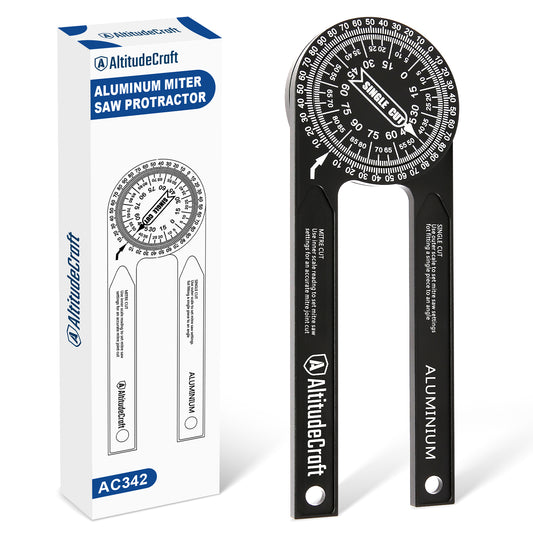


Miter Saw Protractor FAQ Reading Angles Accuracy and Calibration (2026)
Disclosure: AltitudeCraft manufactures the Precision Aluminum Miter Saw Protractor discussed in this FAQ. All accuracy specifications and testing data are from our in-house quality control process. This article contains links to our products. Last updated: April 2026.

The tool for this job
AltitudeCraft Precision Aluminum Miter Saw Protractor
$20.99
Free shipping & free returns on US orders $25+
View productUnderstanding Your Miter Saw Protractor
A miter saw protractor is a specialized angle-measuring tool designed to read the exact angle between two surfaces and transfer that measurement to a miter saw. Unlike a standard school protractor that measures angles on paper, a miter saw protractor has two articulating arms that physically conform to the surfaces being measured. This direct-contact method eliminates the guesswork of estimating angles by eye.

The tool serves carpenters, trim installers, woodworkers, and DIY homeowners who need to cut accurate miter joints. Every time you cut baseboard, crown molding, door casing, picture frames, or deck railings, the quality of the joint depends on measuring the actual angle—not assuming it is 90 degrees.
Protractor Accuracy: What the Numbers Mean
Not all protractors deliver the same precision. Understanding accuracy ratings helps you choose the right tool for your application and set realistic expectations for your cuts.
| Protractor Type | Typical Accuracy | Best For | Limitations |
|---|---|---|---|
| Stamped plastic | ±2° to ±3° | Rough framing layout | Flexes under pressure, markings fade |
| Molded plastic (quality) | ±1° to ±1.5° | Basic trim work with caulk | Can warp in heat, limited durability |
| Aluminum analog (laser-engraved) | ±0.5° | Finish carpentry, furniture joinery | Requires visual reading of scale |
| Digital angle finder | ±0.1° to ±0.3° | Precision machining, repeated setups | Battery dependent, electronics sensitive to dust |
For context, the National Institute of Standards and Technology (NIST) defines angle measurement standards that industrial tools reference. For residential trim carpentry, ±0.5° accuracy meets or exceeds the precision needed for tight-fitting joints, since wood movement and installation variables typically introduce more variation than the measurement itself.
Frequently Asked Questions
How do I read a miter saw protractor correctly?
Place both arms of the protractor flat against the two surfaces forming the angle. Press firmly so there is no gap between either arm and its wall surface. Look directly at the degree scale where the indicator line or pointer crosses the numbered markings—do not read at an angle, as this creates parallax error.
Most protractors have two scales: an inner scale and an outer scale. The inner scale typically reads the actual angle between the arms (the corner angle), while the outer scale reads the supplementary angle (180° minus the corner angle). For miter saw work, you want the actual corner angle. Confirm which scale your specific protractor uses by placing it against a known square corner—it should read 90°.
Reading tip: The AltitudeCraft Precision Aluminum Protractor uses deep laser-engraved markings at every half degree with bold numbering at every 5 degrees. The engraved lines cast slight shadows that make them easier to read in low workshop lighting compared to printed markings on plastic models.
What is the difference between ±0.5° and ±0.1° accuracy—and does it matter?
The accuracy specification tells you the maximum deviation from the true angle. A protractor rated at ±0.5° that reads 90° means the actual angle is somewhere between 89.5° and 90.5°. A ±0.1° digital finder narrows that to 89.9° to 90.1°.
In practical terms, ±0.5° translates to a gap of approximately 0.009 inches (0.23mm) per inch of joint length on a miter cut. For a 3.5-inch baseboard, the maximum gap from a 0.5-degree error is about 0.03 inches—less than 1/32 of an inch, which is invisible after caulking and painting. For hardwood furniture joints where no filler is used, ±0.1° tightens the gap to under 0.006 inches per inch.
Bottom line: ±0.5° is more than adequate for all residential trim work. ±0.1° matters for fine furniture, musical instrument construction, and precision metalwork.
How do I calibrate a miter saw protractor?
Calibration verifies that your protractor reads the correct angle. Here is the process:
- Get a reference: Use a machinist's combination square or a known 90-degree corner. Machinist squares are manufactured to tolerances of ±0.001 inches per inch, making them reliable references.
- Test at 90°: Place the protractor against the square corner. Both arms should sit flat. The reading should show exactly 90°.
- Test at 180°: Open the protractor flat against a straightedge. The reading should show exactly 180°.
- Test at 45°: If you have a 45-degree reference (a combination square set to 45°), verify that reading as well.
- Note any deviation: If your protractor consistently reads 0.5° high, you can compensate by subtracting 0.5° from every reading. However, consistent deviation usually indicates the pivot joint has loosened, and the tool should be replaced or repaired.
Aluminum protractors with machined pivot joints hold calibration significantly longer than plastic protractors with pressed-in pivot pins. The AltitudeCraft protractor uses a precision-machined brass pivot that maintains consistent tension through thousands of open-close cycles.
Should I buy a digital angle finder or an analog protractor?
Both tools measure angles. The choice depends on your work environment and priorities:
| Factor | Digital Angle Finder | Analog Aluminum Protractor |
|---|---|---|
| Reading ease | Instant LCD number | Visual scale reading |
| Accuracy | ±0.1° to ±0.3° | ±0.5° (laser-engraved) |
| Power source | CR2032 battery (6-12 months) | None required |
| Durability | LCD can crack; electronics fail in moisture | All-metal; virtually indestructible |
| Dust resistance | Buttons clog; display fogs | No moving electronics |
| Price range | $25 - $80 | $15 - $40 |
| Best for | Repeated precision setups, low-dust environments | Jobsite use, all conditions |
For a dedicated workshop with controlled conditions, a digital finder offers convenience. For jobsite use where the tool gets tossed in a tool bag, exposed to sawdust, and occasionally dropped, an aluminum analog protractor is the more reliable long-term choice. Many professional carpenters carry both—digital for shop work, analog for field work.
Do digital protractors need frequent battery replacement?
Most digital angle finders use a CR2032 coin cell battery that lasts 6 to 12 months with typical use. The battery drains even when the tool is off because most digital finders have a standby circuit. If you leave a digital finder in your toolbox for three months without use, expect the battery to be partially depleted.
The practical risk is not the battery cost (under $3) but the scenario: you arrive at a job, pull out your digital finder, and the display is blank. With an analog protractor, this situation never occurs. As noted by Wood Magazine's measuring tools guide, keeping a spare battery taped to the inside of your tool case eliminates this risk if you prefer digital.
Can I use a miter saw protractor for compound angles like crown molding?
Yes, but with an important distinction. The protractor measures the wall corner angle, which is one of two angles you need. Crown molding sits at an angle between the wall and ceiling (the "spring angle"), which creates a three-dimensional joint requiring both a miter setting and a bevel setting on your saw.
The process works like this:
- Measure the wall corner angle with the protractor (for example, 92°).
- Determine the crown molding's spring angle (usually 38° or 45°, stated by the manufacturer).
- Use a compound miter chart or online calculator to find the miter and bevel settings for your specific combination of wall angle and spring angle.
The protractor gives you the essential first input. Without an accurate wall angle measurement, the compound angle calculation starts with bad data and produces a poor-fitting joint.
How do I measure angles on surfaces that are not flat?
Textured walls, stone surfaces, and rough lumber create challenges because the protractor arms cannot make full contact. Use these approaches:
- Textured drywall: Press the arms firmly—the texture is thin enough that the reading is accurate within tolerance.
- Stone or brick: Place thin strips of painter's tape on the measurement areas to create flat contact points.
- Rough lumber: Sand two small flat spots at the measurement location, or use a hand plane to create reference flats.
- Round surfaces: A miter saw protractor is designed for flat surfaces. For curved surfaces, use a digital inclinometer or bevel gauge instead.
What should I do if my protractor gives inconsistent readings?
If you measure the same corner three times and get three different readings, the issue is almost always technique, not the tool. Diagnose systematically:
- Check arm contact: Hold the protractor up to a light source. Any gap between an arm and the wall means incomplete contact. Apply more pressure or clean debris from the wall surface.
- Check the pivot: If the pivot joint is loose, the arms shift after you remove the tool from the corner. A quality protractor with a machined pivot (brass or stainless steel) maintains position. A loose plastic pivot needs replacement.
- Check your reading angle: Read the scale from directly above, not from the side. Parallax from a 30-degree viewing angle can shift your reading by a full degree on a small scale.
- Check the surface: Drywall mud buildup, paint drips, or debris in the corner will skew the measurement. Scrape the corner clean before measuring.
If the protractor gives consistent but incorrect readings (verified against a known square), the tool itself may be damaged. Aluminum protractors can be recalibrated if the pivot is adjustable. Plastic protractors that read incorrectly should be discarded and replaced.
Can I use a miter saw protractor for metalwork and welding?
Yes. Aluminum protractors work on any flat surface including steel, aluminum, and stainless steel. The tool measures angles the same way regardless of the material. For welding preparation, a protractor helps set the bevel angle on pipe and plate joints. The key consideration is that metal surfaces must be clean—mill scale, slag, and weld spatter prevent full arm contact and introduce measurement error.
For high-temperature environments near active welding, remove the protractor before striking an arc. Aluminum softens at temperatures above 400°F (204°C), and weld spatter permanently damages the engraved scale.
Choosing the Right Protractor for Your Work
Your choice depends on what you build and where you build it. Here is a decision framework:
- Occasional DIY trim work: A quality analog aluminum protractor covers all your needs at the lowest cost with zero maintenance.
- Professional finish carpentry: An aluminum protractor for field work plus a digital finder for shop setups gives you the best of both worlds.
- Precision furniture making: A digital angle finder with ±0.1° accuracy justifies its cost when visible joint quality is paramount.
- General construction: An aluminum protractor survives the abuse of jobsite conditions where digital tools fail.
The AltitudeCraft Precision Aluminum Miter Saw Protractor is built for the first three categories. Its CNC-machined aluminum body, laser-engraved markings, and brass pivot deliver reliable ±0.5° accuracy in any environment without batteries, calibration resets, or electronic fragility.
More Resources
For step-by-step angle transfer techniques, read our complete tutorial library on the AltitudeCraft blog. Browse the full product catalog for precision measuring and cutting tools built for professionals and serious DIYers.
Featured in this guide
AltitudeCraft Precision Aluminum Miter Saw Protractor
$20.99
Free shipping & free returns on US orders $25+
View productRelated Articles
 Strut Spreader Tool Complete Guide: DIY Suspension Work Made Easy (2026)
Apr 02, 2026
Strut Spreader Tool Complete Guide: DIY Suspension Work Made Easy (2026)
Apr 02, 2026
 Thread Checker Complete Guide: Identify Any Bolt Size in Seconds (2026)
Apr 02, 2026
Thread Checker Complete Guide: Identify Any Bolt Size in Seconds (2026)
Apr 02, 2026
 Sight Pusher Tool Complete Guide: How to Install Glock Sights Like a Pro (2026)
Apr 02, 2026
Sight Pusher Tool Complete Guide: How to Install Glock Sights Like a Pro (2026)
Apr 02, 2026
 Glock 43X MOS Complete Red Dot Guide: Optics, Adapter Plates, and Setup (2026)
Apr 02, 2026
Glock 43X MOS Complete Red Dot Guide: Optics, Adapter Plates, and Setup (2026)
Apr 02, 2026
