




AltitudeCraft Protractor vs Wixey Digital Angle Finder (2026)
Disclosure: AltitudeCraft manufactures the Precision Aluminum Miter Saw Protractor reviewed in this comparison. We purchased the Wixey WR300 Type 2 Digital Angle Gauge at retail price for this evaluation. All test results are from our in-house measurements. This article contains links to our products and to third-party sites. Last updated: April 2026.

The tool for this job
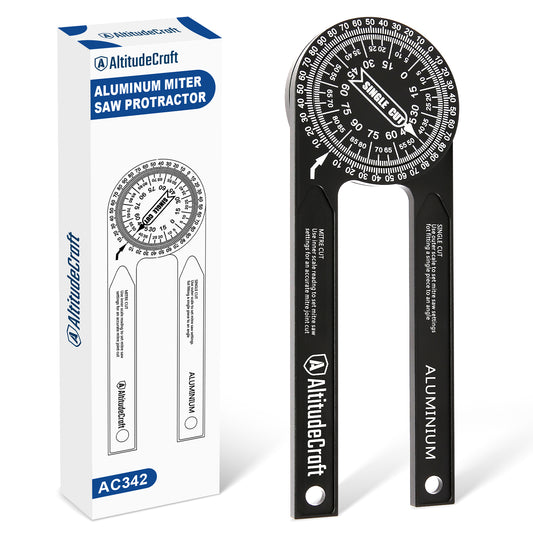
AltitudeCraft Precision Aluminum Miter Saw Protractor
$20.99
Free shipping & free returns on US orders $25+
View productWhy This Comparison Matters
When you search for a miter saw angle measuring tool, the AltitudeCraft Precision Aluminum Protractor and the Wixey Digital Angle Finder consistently appear as the top two options across woodworking forums, YouTube reviews, and retail search results. They represent the two dominant approaches to the same problem: analog versus digital angle measurement.
Rather than declare one universally superior, this comparison breaks down where each tool excels and where it falls short. Your best choice depends on where you work, what you build, and how much tolerance you have for battery management and electronic fragility.

Ready to upgrade your toolbox?
See the Miter Saw ProtractorHead-to-Head Specification Comparison
| Specification | AltitudeCraft Precision Protractor | Wixey WR300 Digital Angle Finder |
|---|---|---|
| Type | Analog, two-arm protractor | Digital, two-arm with LCD |
| Material | CNC-machined 6061 aluminum | Aluminum arms with plastic LCD housing |
| Accuracy | ±0.5° | ±0.1° (manufacturer rated) |
| Resolution | 0.5° (laser-engraved markings) | 0.1° (digital display) |
| Measurement Range | 0° to 360° | 0° to 360° |
| Power Source | None | CR2032 battery (6-12 month life) |
| Pivot Type | Machined brass with locking mechanism | Metal pivot with friction lock |
| Weight | Approx. 5 oz | Approx. 4.5 oz |
| Water/Dust Resistance | Fully resistant (no electronics) | Limited (LCD and button openings) |
| Price Range | $18 - $25 | $30 - $45 |
Accuracy: The ±0.1° vs ±0.5° Reality Check
On paper, the Wixey's ±0.1° accuracy specification sounds dramatically better than the AltitudeCraft's ±0.5°. But accuracy specifications only tell part of the story. What matters is practical accuracy—the actual precision you achieve when measuring a real corner in a real room.
Several factors degrade any protractor's theoretical accuracy in practice:
- Surface contact quality: A speck of drywall dust or a paint drip under one arm introduces 0.5° to 1° of error regardless of the tool's specification.
- User reading consistency: Studies on human angle estimation show that most people can consistently read an analog scale to ±0.25° with practice, which is within the AltitudeCraft's 0.5° markings.
- Material compliance: Wood expands and contracts with humidity. A joint cut at exactly 45.0° in the shop may become 44.8° or 45.2° after installation as the wood acclimates.
- Saw accuracy: Most consumer miter saws have angle stops accurate to ±0.5° at best. Measuring an angle to ±0.1° and then cutting it on a saw with ±0.5° tolerance provides no net benefit.
Honest assessment: The Wixey's ±0.1° accuracy is real and verifiable. However, for miter saw work specifically, that extra precision rarely translates to a better-fitting joint because the saw itself and the wood material are the limiting factors. The ±0.5° accuracy of the AltitudeCraft matches the practical precision ceiling of miter saw cutting.
Where ±0.1° genuinely matters: precision metalwork, CNC machine setup, scientific instrument alignment, and any application where the cutting or forming tool matches the measurement tool's precision.
Durability and Jobsite Survival
This is where the two tools diverge most dramatically. Construction and renovation environments are hostile to precision tools. Sawdust, concrete dust, rain, temperature swings, and the inevitable drop from a sawhorse test every tool's construction quality.
AltitudeCraft: Built for Abuse
The entire tool is CNC-machined from 6061 aluminum with a machined brass pivot. There are no electronics, no LCD screens, no battery compartments, and no plastic housings. Sawdust fills the engraved markings (blow it out), water hits the surface (wipe it dry), the tool falls on concrete (check for arm straightness and continue working). The laser-engraved markings are cut into the metal surface—they cannot fade, peel, or rub off.
We have spoken with carpenters who have used the same aluminum protractor daily for over five years. The pivot eventually develops slight play, which is corrected by tightening the lock mechanism. The markings remain fully legible.
Wixey: Protected Workshop Tool
The Wixey arms are aluminum, which provides good structural durability. However, the LCD display housing is plastic, and the display itself is glass. A direct impact on the display housing can crack the screen. Fine sawdust works into the button mechanism over time, causing intermittent button failure. Moisture exposure can fog the display or corrode internal connections.
As noted on the Wixey official product page, the tool is designed for precision measurement applications. It performs excellently in a clean workshop. For rough jobsite conditions, protect it in a hard case between uses.
Ease of Use: Digital Convenience vs. Analog Simplicity
The Wixey offers a genuine usability advantage in one specific scenario: rapid repeated measurements. Press the power button, place the tool, read the number. There is no scale interpretation, no parallax concern, and no ambiguity about which line the indicator crosses. For a trim installer measuring 30 corners in a day, the digital readout saves approximately 5 seconds per measurement—about 2.5 minutes total over a full day.
The AltitudeCraft requires the user to read a physical scale, which takes slightly longer but involves no startup sequence, no button presses, and no waiting for a display to initialize. Pick up the tool, place it in the corner, read the angle. For intermittent measurements (one or two per hour), the analog workflow is equally fast because there is no power-on step.
The Zero-Reference Advantage
One feature where the Wixey clearly excels is zero-referencing. You can place the tool on any surface, press the zero button, and all subsequent readings are relative to that reference surface. This is useful when checking how far a surface deviates from a known reference—for example, verifying that a table saw blade is exactly 90° to the table surface.
Analog protractors measure absolute angles between their two arms. They do not zero-reference against a surface. For relative measurements, you would need to note the initial reading and subtract it from subsequent readings manually.
Battery Dependency: The Hidden Cost
The Wixey uses a CR2032 coin cell battery. The cost is trivial—under $3 per battery. The real cost is reliability risk. Digital tools fail silently: the display dims gradually, readings drift as voltage drops, and one morning the tool simply does not turn on. If you discover a dead battery at the start of a job with no replacement on hand, you have a paperweight until you can get to a store.
According to reviews aggregated by Popular Mechanics' tool testing coverage, battery life complaints are among the most common issues reported for digital angle finders across all brands. The standby circuit drains power even when the tool is off, which surprises users who expect it to last indefinitely between uses.
The AltitudeCraft has no battery. It works every time you pick it up, whether that is five minutes or five months after last use. For professionals who cannot afford downtime, this zero-maintenance reliability is a significant practical advantage.
Price and Value Analysis
At approximately $18-25, the AltitudeCraft Precision Aluminum Protractor costs roughly half the price of the Wixey WR300 ($30-45). Over five years of use, the total cost of ownership comparison looks like this:
| Cost Factor | AltitudeCraft (5-Year) | Wixey (5-Year) |
|---|---|---|
| Purchase price | $22 (average) | $38 (average) |
| Batteries | $0 | $10 - $15 (5-8 batteries) |
| Replacement probability | Low (all-metal construction) | Moderate (LCD failure, button wear) |
| Estimated 5-year cost | $22 | $48 - $90 (if replaced once) |
If the Wixey survives five years without LCD or button failure, the total cost difference is modest (~$26). If it needs replacement—a common outcome for tools used in dusty environments—the Wixey's total cost roughly quadruples the AltitudeCraft's.
When to Choose the AltitudeCraft Protractor
- Jobsite and field work: Dust, moisture, drops, and temperature swings will not affect it.
- Budget-conscious projects: Lower purchase price with zero ongoing costs.
- Infrequent use: No battery drain during storage. Ready instantly after months in a toolbox.
- Backup tool: Even if you prefer digital, an analog protractor is invaluable insurance against dead batteries.
- All residential trim work: ±0.5° accuracy matches the precision ceiling of miter saw cutting.
When to Choose the Wixey Digital Finder
- High-volume measurement: Measuring dozens of angles per day where the instant digital readout saves cumulative time.
- Precision shop work: CNC setups, machine alignment, and furniture joinery where ±0.1° matters.
- Zero-reference applications: Checking deviation from a reference surface without manual subtraction.
- Low-light workshops: Backlit LCD is easier to read in dim conditions than engraved markings.
- Users who struggle with analog scales: The digital display eliminates scale reading interpretation entirely.
The Professional Approach: Own Both
Many professional carpenters and serious woodworkers carry both tools. The combined cost of an AltitudeCraft protractor and a Wixey finder is under $65—less than a single premium saw blade. The analog protractor goes in the field tool bag for reliability. The digital finder stays in the shop for precision setups. When the digital tool's battery dies mid-project, the analog protractor prevents any work stoppage.
This approach mirrors how professionals handle other tool categories: a digital caliper for the shop and a steel ruler for the field, a laser level for indoors and a spirit level for outdoors. The best tool depends on the environment, and having options eliminates compromise.
Our Honest Verdict
The Wixey WR300 is a well-made digital tool that delivers genuine ±0.1° precision and convenient LCD readout. If you work exclusively in a clean workshop and value digital convenience, it is a solid investment.
The AltitudeCraft Precision Aluminum Protractor is the tool that works every time in every condition without maintenance, power, or fragile components. For the broadest range of real-world applications—from rough framing to finish trim, from jobsite to workshop—it is the more versatile and dependable choice at half the price.
Neither tool is perfect for every situation. Both are excellent at what they were designed to do. Choose based on your primary work environment and let the tool serve the task.
Frequently Asked Questions
Can the AltitudeCraft protractor match the Wixey's ±0.1° accuracy?
No. The AltitudeCraft's laser-engraved markings resolve to ±0.5°, which is a fundamental limitation of analog scale reading. For applications requiring ±0.1° or better, a digital tool is the correct choice. For miter saw work, ±0.5° is practically equivalent because the saw itself introduces ±0.5° of its own tolerance.
Does the Wixey work in cold weather?
LCD displays slow down below 32°F (0°C), and battery output drops in cold temperatures. The Wixey will function but may display sluggishly and have reduced battery life. The AltitudeCraft is unaffected by temperature within the range where its user can physically work.
Which tool holds its resale value better?
Analog aluminum tools retain value well because they do not become obsolete or degrade from age. A five-year-old AltitudeCraft protractor in good condition functions identically to a new one. Digital tools depreciate faster as newer models with better displays and features are released, and aged electronics carry reliability concerns.
Can I use either tool to set miter saw angles directly?
Both tools measure the corner angle, which you then divide by two to get the miter saw setting. Neither tool attaches to the miter saw itself to set angles. Wixey does make separate products (the WR365 and WR700) that mount directly to miter saws for angle setting, but those are different tools from the WR300 angle finder compared here.
More Comparisons and Guides
Explore more tool comparisons and woodworking guides on the AltitudeCraft Insights blog, and browse the complete tool collection for precision instruments designed for demanding professionals.
Featured in this guide
AltitudeCraft Precision Aluminum Miter Saw Protractor
$20.99
Free shipping & free returns on US orders $25+
View productRelated Articles
 Strut Spreader Tool Complete Guide: DIY Suspension Work Made Easy (2026)
Apr 02, 2026
Strut Spreader Tool Complete Guide: DIY Suspension Work Made Easy (2026)
Apr 02, 2026
 Thread Checker Complete Guide: Identify Any Bolt Size in Seconds (2026)
Apr 02, 2026
Thread Checker Complete Guide: Identify Any Bolt Size in Seconds (2026)
Apr 02, 2026
 Sight Pusher Tool Complete Guide: How to Install Glock Sights Like a Pro (2026)
Apr 02, 2026
Sight Pusher Tool Complete Guide: How to Install Glock Sights Like a Pro (2026)
Apr 02, 2026
 Miter Cuts Dont Match the Wall Angle How a Protractor Solves It (2026)
Apr 02, 2026
Miter Cuts Dont Match the Wall Angle How a Protractor Solves It (2026)
Apr 02, 2026
