




Complete Guide to Die Bushings for Precision Reloading
Last updated: March 25, 2026 | By AltitudeCraft Team
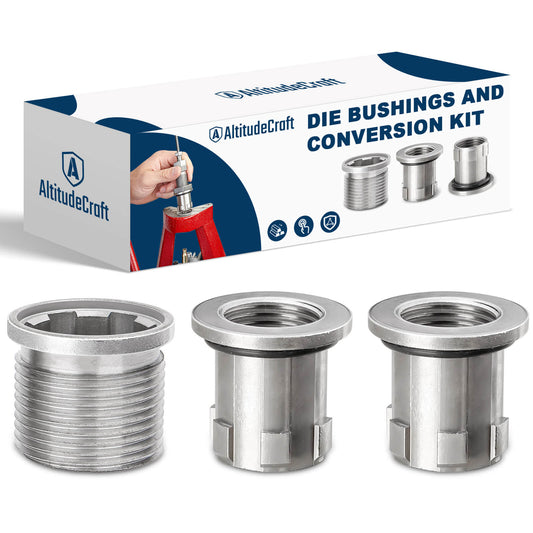
Die bushings are precision-machined cylindrical inserts that control neck tension during the resizing step of cartridge reloading. If your groups are inconsistent despite careful powder charges and bullet seating, die bushings may be the single highest-impact upgrade you can make to your reloading process. This guide explains what die bushings do, how to select the right size, and how the AltitudeCraft Die Bushing and Conversion Kit makes bushing dies accessible to reloaders using standard press systems.


The tool for this job
AltitudeCraft Die Bushings and Conversion Kit (2 Pack)
From $25.99
Free shipping & free returns on US orders $25+
View productWhat Are Die Bushings and Why Do They Matter?
In standard reloading dies, the sizing die squeezes the entire cartridge neck down to a fixed diameter determined by the die's internal dimensions. This works adequately for plinking and general shooting, but it applies more neck tension than necessary for many cartridges. Excess neck tension creates inconsistent bullet release pressure, which translates directly to vertical dispersion at distance.
Die bushings replace this one-size-fits-all approach with precision control. Each bushing has a specific internal diameter, typically measured in thousandths of an inch (for example, 0.330 inches for a .308 Winchester). By selecting a bushing that sizes the neck to exactly the diameter you need, you control neck tension to within 0.001 to 0.002 inches of your target. This level of control is why competitive shooters and long-range precision reloaders consider bushing dies essential equipment. Our guide to the best reloading tools covers complementary equipment for precision ammunition.
The practical difference is measurable. Reloaders who switch from standard full-length sizing dies to bushing dies commonly report group size reductions of 0.25 to 0.5 MOA, particularly at distances beyond 300 yards where consistent bullet release becomes critical. For measuring bullet seating consistency, pair die bushings with a bullet comparator kit. The Sporting Arms and Ammunition Manufacturers' Institute (SAAMI) publishes the chamber and cartridge specifications that define these critical dimensions.

How Do Die Bushings Work?
Die bushings operate on a simple mechanical principle. The bushing sits inside the sizing die body and acts as the surface that contacts the cartridge neck during resizing. When you run a fired case into the die, the neck passes through the bushing and is squeezed down to the bushing's internal diameter.
The key advantage is interchangeability. Instead of being locked into one neck diameter per die, you can swap bushings in seconds to achieve different levels of neck tension. This is valuable when you change bullet brands (which may have slightly different diameters), switch between new and fire-formed brass, or want to experiment with different tension levels for accuracy testing.
Neck Tension: The Critical Variable
Neck tension is the interference fit between the inside of the cartridge neck and the bullet. It is measured as the difference between the sized neck diameter and the bullet diameter. For most precision rifle cartridges, optimal neck tension falls between 0.001 and 0.003 inches.
| Neck Tension | Effect | Best For |
|---|---|---|
| 0.001" | Light tension, easy bullet seating | Benchrest, single-feed rifles |
| 0.002" | Moderate tension, good accuracy + reliable feeding | Most precision rifle applications |
| 0.003" | Firm tension, higher bullet pull | Semi-auto rifles, magazine-fed hunting |
| 0.004"+ | Very firm, may deform soft bullets | Rarely recommended |
How to Choose the Right Bushing Size
Selecting the correct bushing requires one measurement and simple arithmetic. Here is the process used by competitive reloaders:
Measure your loaded round neck diameter. Using a micrometer or caliper, measure the outside diameter of a loaded cartridge neck (with the bullet seated). For a .308 Winchester with a 0.308-inch bullet, this is typically around 0.332 to 0.334 inches depending on your brass.
Subtract your desired neck tension. If you want 0.002 inches of neck tension, subtract 0.002 from the loaded neck diameter. Example: 0.334 - 0.002 = 0.332 inches.
Select the nearest bushing size. Bushings are sold in 0.001-inch increments. Choose the bushing closest to your calculated diameter. In this example, you would select a 0.332 bushing.
Common mistake: Many new reloaders measure the neck diameter of a fired case instead of a loaded round. This gives the wrong starting point because fired brass has already expanded. Always measure a loaded round with the bullet seated.
Pro tip: Buy bushings in a set of 2-3 adjacent sizes (for example, 0.331, 0.332, and 0.333). This lets you experiment with different tension levels using the same brass lot and bullet combination. The AltitudeCraft Die Bushing Kit is available in 2-pack ($25.99), 4-pack ($35.99), and 10-pack ($65.99) configurations for exactly this purpose.

Die Bushings vs Standard Sizing Dies: When to Upgrade
| Feature | Standard Sizing Die | Bushing Die |
|---|---|---|
| Neck tension control | Fixed by die manufacturer | Adjustable in 0.001" increments |
| Brass life | More working, shorter life | Less working, longer brass life |
| Setup complexity | Simple, no selection needed | Requires measurement + bushing selection |
| Cost per caliber | $30-50 (die only) | $40-80 (die + bushing set) |
| Accuracy potential | Adequate for most uses | Superior for precision work |
| Flexibility | One setting per die | Swap bushings for different needs |
When to stay with standard dies: If you reload for casual target shooting or hunting at moderate distances (under 200 yards), standard sizing dies are perfectly adequate and simpler to set up.
When to upgrade to bushing dies: If you compete in precision rifle matches, shoot beyond 300 yards regularly, notice inconsistent groups despite good shooting fundamentals, or reload for multiple rifles in the same caliber with different chamber dimensions.
The AltitudeCraft Die Bushing Advantage
Most die bushing systems require purchasing a complete bushing die body from the die manufacturer (Redding, Forster, Wilson, etc.), which typically costs $60 to $120 per caliber on top of the bushings themselves. The AltitudeCraft Die Bushing and Conversion Kit takes a different approach.

Our kit includes both the precision die bushings and a press conversion bushing, allowing you to use bushing-style neck sizing with your existing press and die setup. The twist-lock quick-change system lets you swap between calibers or tension levels in seconds, without tools.
Compatible with Hornady Lock-N-Load presses and standard 7/8-14 threaded dies
Precision-machined to 卤0.0005" tolerance for consistent neck sizing
Hardened steel construction for durability across thousands of sizing cycles
Available in 2-pack, 4-pack, and 10-pack to match your reloading needs
Step-by-Step: Installing and Using Die Bushings
Select your bushing size using the measurement method described above. Start with a bushing that gives 0.002" neck tension as a baseline.
Insert the bushing into the die body. For AltitudeCraft bushings, align the bushing with the die opening and twist to lock. You should feel a positive click.
Set the die in your press according to your die manufacturer's instructions. Adjust the die body for your desired shoulder bump (typically 0.001-0.002" setback for bolt-action rifles).
Size a test case. Run one case through the die, then measure the neck diameter with a micrometer. It should match your bushing size 卤0.0005".
Seat a bullet and verify neck tension. Measure the loaded round neck diameter and subtract the bushing diameter. The difference is your actual neck tension. Adjust by swapping to a larger or smaller bushing as needed.

Common Mistakes When Using Die Bushings
Even experienced reloaders make these errors when transitioning to bushing dies:
Using a bushing that is too tight. If your groups get worse after switching to bushing dies, your bushing is probably too small. Excessive sizing work-hardens the brass neck and creates uneven tension. Start with a bushing that gives 0.001-0.002" tension and work down only if needed.
Not sorting brass by brand. Different brass manufacturers use different wall thicknesses. A bushing that gives perfect tension with Lapua brass may give too much or too little tension with Winchester brass. Always sort by brand and measure a sample from each lot.
Skipping the expander ball. Some reloaders remove the expander ball when using bushing dies, assuming the bushing alone controls neck diameter. This works for turned necks but can cause inconsistent tension with unturned brass because wall thickness variation translates directly to interior neck diameter variation.
Not lubricating the case neck. Bushing dies require light neck lubrication to prevent galling. A dry case neck running through a tight bushing can score both the bushing and the brass. Use a light application of Imperial Sizing Die Wax or similar on the neck. The Sniper's Hide community has extensive discussions on bushing die techniques for long-range shooting.
Which Reloaders Benefit Most from Die Bushings?
F-Class and benchrest competitors who need every tenth of an MOA. At 1,000 yards, a 0.1 MOA improvement equals approximately 1 inch tighter groups.
Long-range hunters who take shots beyond 300 yards where consistent velocity (driven by consistent neck tension) matters for accurate drop prediction.
Precision rifle competitors (PRS/NRL) who reload in volume and need consistent ammunition across multiple matches and conditions.
Reloaders with multiple rifles in the same caliber who need different neck tension for different chamber dimensions.
Anyone experiencing unexplained vertical dispersion after ruling out other variables like powder charge variation and bullet seating depth consistency.

Frequently Asked Questions
What is the difference between a bushing die and a standard sizing die?
A standard sizing die uses a fixed internal diameter to resize the cartridge neck. A bushing die uses a removable, interchangeable bushing insert that lets you choose the exact neck diameter. This gives you precise control over neck tension in 0.001-inch increments, which directly affects accuracy and brass longevity.
How do I know what bushing size to buy?
Measure the outside neck diameter of a loaded round (bullet seated), then subtract your desired neck tension (typically 0.002 inches for most applications). The result is your bushing size. For a .308 Winchester with a 0.334-inch loaded neck diameter and 0.002-inch desired tension, you would buy a 0.332 bushing.
Can I use die bushings with my existing reloading press?
Yes. The AltitudeCraft Die Bushing and Conversion Kit includes a press conversion bushing that works with Hornady Lock-N-Load presses and standard 7/8-14 threaded dies. You do not need to buy a complete new die set.
How many bushings do I need?
For each caliber, start with 2-3 adjacent sizes to find your optimal tension. Once you know your preferred size, a single bushing per caliber is sufficient for ongoing use. Our 4-pack covers two calibers comfortably.
Do die bushings work for all calibers?
Die bushings are most beneficial for bottleneck rifle cartridges where neck tension significantly affects accuracy. They are less commonly used for straight-wall pistol cartridges, though some competitive pistol reloaders do use them for consistent bullet pull.
Will die bushings extend my brass life?
Yes. Bushing dies typically work the brass neck less aggressively than standard sizing dies because they only size the neck to the diameter you specify, rather than sizing it down further and then opening it back up with an expander ball. Less brass working means longer case life before neck splits develop.
What is the difference between Redding, Forster, and AltitudeCraft die bushings?
Redding and Forster sell complete bushing die systems where you must buy their specific die body plus compatible bushings. AltitudeCraft bushings work as a conversion kit that adds bushing functionality to your existing press and dies, making it the most cost-effective entry point into bushing-style neck sizing. See also our Bullet and Headspace Gauge Comparator Kit for complementary precision measurement tools.

Build Your Precision Reloading Setup
Die bushings work best as part of a complete precision reloading workflow. Here is the recommended equipment progression:
Start with measurement tools. A bullet comparator kit lets you measure bullet seating depth relative to the ogive, not the tip. This eliminates tip variation from your measurements.
Add headspace gauges. The headspace gauge comparator kit measures shoulder bump to ensure consistent cartridge length after sizing. This works hand-in-hand with bushing dies for complete dimensional control.
Control neck tension with die bushings. The AltitudeCraft Die Bushing Kit gives you the third dimension of control: neck tension consistency.
Measure overall cartridge length. An overall length gauge helps you find the optimal seating depth for your specific rifle and bullet combination.
Together, these tools give you control over the four variables that matter most for precision ammunition: headspace, neck tension, bullet seating depth, and overall cartridge length. Browse our complete precision reloading tool collection.
Related Reading
- How to Use a Bullet Comparator for Precise Reloading
- Bullet Ogive Measuring Tool: Precision Reloading with AltitudeCraft
- Maximize Precision with Primer Tools for Reloading
Related Resources
- Headspace Comparator Bushing Size Chart: Which Bushing Fits Your Cartridge — A different component entirely: headspace comparator bushings, and which one fits your cartridge
Disclosure: AltitudeCraft manufactures some of the products referenced in this article. Product recommendations and comparisons reflect honest assessment based on hands-on testing. Specifications and pricing were accurate at time of publication.
Featured in this guide
AltitudeCraft Die Bushings and Conversion Kit (2 Pack)
From $25.99
Free shipping & free returns on US orders $25+
View productRelated Articles
 How to Measure Throat Erosion With an OAL Gauge (and Know When Your Barrel Is Done)
Oct 25, 2026
How to Measure Throat Erosion With an OAL Gauge (and Know When Your Barrel Is Done)
Oct 25, 2026
 How to Set Up a Full-Length Sizing Die: Bump .001–.004" by Rifle (2026)
Oct 22, 2026
How to Set Up a Full-Length Sizing Die: Bump .001–.004" by Rifle (2026)
Oct 22, 2026
 Which Hornady Comparator for 6.5 Creedmoor? Insert, Bushing, and Shoulder Bump Setup (2026)
Oct 15, 2026
Which Hornady Comparator for 6.5 Creedmoor? Insert, Bushing, and Shoulder Bump Setup (2026)
Oct 15, 2026
 Bullet Comparator Insert Chart: Which Insert Fits Your Cartridge (2026)
Aug 31, 2026
Bullet Comparator Insert Chart: Which Insert Fits Your Cartridge (2026)
Aug 31, 2026
