




How to Use a Bullet Comparator for Precision Reloading
A bullet comparator measures what actually matters for accuracy — the distance from the cartridge base to the bullet's ogive (CBTO), not the tip. This single measurement is the difference between 1 MOA groups and sub-half-MOA groups at 100 yards. If you're seating bullets based on Cartridge Overall Length (COAL) alone, you're ignoring the variable that controls how your bullet engages the rifling.
Key Takeaway: A bullet comparator measures Cartridge Base to Ogive Length (CBTO) — the distance from the case head to the bullet’s ogive contact point — which is the single most accuracy-sensitive variable in handloading. Unlike Overall Length (OAL), which measures to the bullet tip and varies with tip imperfections, CBTO measures to a consistent datum point on the ogive, giving readings repeatable to ±0.001 inches. The tool attaches to standard calipers and uses caliber-specific inserts with precision bore holes. A 14-insert kit ($45.99) covers calibers from .17 to .45, handling virtually all common rifle cartridges. During load development, measure every round; for production runs, spot-check every 10th. The most common beginner mistake is inconsistent caliper jaw pressure — practice achieving the same reading 10 consecutive times within ±0.001 inches before trusting your data for seating depth decisions.
This guide explains exactly how to use a bullet comparator with your calipers, why CBTO matters more than COAL, and how to develop a consistent seating depth that tightens your groups.


The tool for this job
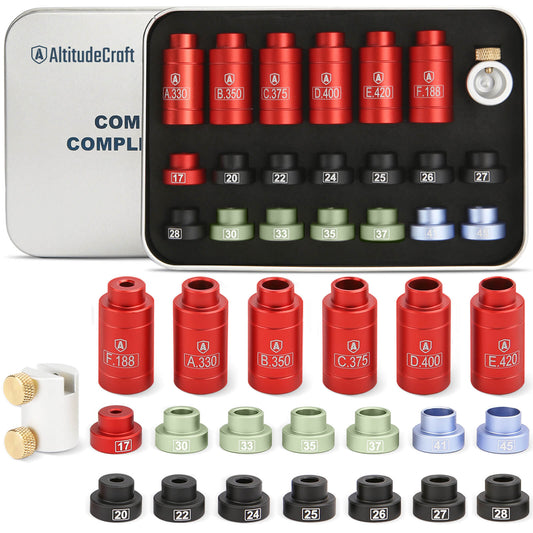
AltitudeCraft Bullet and Headspace Gauge Comparator Kit with 14 Inserts and 6 Bushings
$49.99
Free shipping & free returns on US orders $25+
View productWhy CBTO Matters More Than COAL
Every reloading manual lists a Cartridge Overall Length (COAL) for each load. This is the measurement from the base of the cartridge to the very tip of the bullet. The problem? Bullet tips are inconsistent.
Even within the same box of premium bullets, tip-to-tip length varies by 0.005"-0.015". This means if you seat bullets to a consistent COAL, the actual distance between the bullet ogive and the rifling lands varies by that same amount — and that's the distance that controls pressure, velocity, and accuracy.
| Measurement | What It Measures | Typical Variation (Same Box) | Effect on Accuracy |
|---|---|---|---|
| COAL | Base to bullet tip | ±0.005"-0.015" | Unreliable — tip shape varies |
| CBTO | Base to bullet ogive | ±0.001"-0.003" | Directly controls rifling engagement |
As Berger Bullets' Bryan Litz explains, SAAMI uses COAL as a standard because it's easy to measure with basic tools, but CBTO is what actually determines how the bullet interacts with the chamber throat. A bullet comparator gives you the CBTO measurement.

What Is a Bullet Comparator and How It Works
A bullet comparator is a precision insert that attaches to your calipers. It has a caliber-specific hole that contacts the bullet at its ogive — the curved section where the bullet body transitions to the nose. By measuring from the cartridge base to this consistent reference point, you get CBTO instead of COAL.
Components of a Comparator Kit
- Body/holder — Clamps onto your caliper jaw
- Caliber inserts — Precision-machined discs with caliber-specific bore holes (e.g., .224, .243, .264, .277, .284, .308, .338)
- Calipers — Your existing digital or dial calipers (6" minimum)
The insert hole diameter is sized so the bullet enters until the ogive contacts the edge of the hole. This contact point is consistent across bullets of the same caliber and design, regardless of tip shape or tip length variation.
How to Use a Bullet Comparator: Step-by-Step
Step 1: Select the Correct Insert
Choose the insert that matches your bullet caliber. Common inserts and their calibers:
| Insert Size | Bullet Caliber | Common Cartridges |
|---|---|---|
| .224 | .224" / 5.56mm | .223 Rem, 5.56 NATO, .22-250 |
| .243 | .243" / 6mm | 6mm Creedmoor, .243 Win |
| .264 | .264" / 6.5mm | 6.5 Creedmoor, .260 Rem, 6.5 PRC |
| .284 | .284" / 7mm | 7mm Rem Mag, .284 Win |
| .308 | .308" / 7.62mm | .308 Win, .30-06, .300 Win Mag |
| .338 | .338" | .338 Lapua Mag, .338 Win Mag |
| .452 | .452" / .45 | .45 ACP, .45 Colt |

Step 2: Attach the Comparator to Your Calipers
- Slide the comparator body onto one jaw of your calipers
- Insert the correct caliber disc into the body
- Ensure the insert sits flat and doesn't wobble — a loose insert gives inconsistent readings
Step 3: Zero Your Calipers
Close the caliper jaws with the comparator attached and press zero. This accounts for the comparator body thickness so your reading shows only the cartridge measurement.
Step 4: Measure CBTO
- Open the calipers and place a loaded cartridge between the jaws
- The cartridge base sits against the flat jaw; the bullet enters the comparator insert until the ogive contacts the insert bore edge
- Close the calipers gently until snug — do not overtighten. Let the ogive contact naturally.
- Read the measurement. This is your CBTO.
Critical technique: Apply consistent, light pressure every time. Squeezing harder pushes the ogive further into the insert, giving a shorter reading. Develop a feel for "snug contact" and use it consistently.

Step 5: Record and Compare
Measure 5-10 rounds from your batch. Calculate the spread (max minus min). For precision reloading:
- Excellent: CBTO spread of 0.001" or less
- Good: 0.002"-0.003" spread
- Needs work: 0.004"+ spread — check your seating die adjustment and bullet sorting
Finding Your Rifle's Optimal Seating Depth
The real power of a bullet comparator is developing a load specific to your rifle's chamber. Here's the process:
Step 1: Find the Lands (Maximum CBTO)
Use a modified case with a long-seated bullet (or a Hornady OAL gauge) to determine the maximum CBTO where the bullet just touches the rifling lands. This is your "jam" length.
Step 2: Test Seating Depths in 0.010" Increments
Load 3-5 round groups at the following CBTO offsets from the lands:
- -0.010" (10 thou off the lands)
- -0.020"
- -0.030"
- -0.050"
- -0.080" (typical magazine-length loads)
Step 3: Evaluate Groups
Shoot each group at 100 yards from a stable bench. The CBTO that produces the smallest group is your rifle's sweet spot for that bullet and powder combination. Most bolt-action rifles prefer 0.010"-0.030" off the lands, but every chamber is different.
Safety note: Seating bullets closer to the lands increases pressure. When testing jump distances under 0.020", reduce your powder charge by 0.5-1.0 grains and work up. Always reference SAAMI pressure standards and your reloading manual's maximum charges.

Common Mistakes When Using a Bullet Comparator
1. Using the Wrong Insert Size
A .308 insert on a .264 caliber bullet gives a meaningless reading — the bullet drops through the bore without contacting the ogive. Always match the insert to your bullet diameter exactly. When in doubt, check the bullet manufacturer's specifications for actual bullet diameter (not cartridge name — ".30-06" bullets are .308" diameter).
2. Inconsistent Caliper Pressure
This is the #1 source of measurement variation for beginners. If you squeeze the calipers firmly on one round and lightly on the next, your CBTO readings will vary by 0.003"-0.005" — not because the cartridges are different, but because your technique changed. Practice until you get repeatable readings within 0.001" on the same cartridge.
3. Measuring COAL Instead of CBTO and Thinking They're Interchangeable
A reloading manual says "COAL: 2.800"" for your load. You measure your rounds at COAL 2.800" and call it done. But if the bullet tips vary by 0.010", your actual seating depth relative to the lands also varies by 0.010" — enough to produce 1-2 MOA accuracy differences. Use the manual's COAL as a starting point, then dial in with CBTO for precision.
4. Not Accounting for Ogive Profile Differences Between Bullet Brands
A Hornady 168gr BTHP and a Sierra 168gr MatchKing have different ogive profiles. Even at the same CBTO reading, they contact the comparator insert at slightly different points. Don't compare CBTO numbers between different bullet designs — each bullet brand/model gets its own seating depth development.
5. Ignoring Comparator Insert Wear
Over thousands of measurements, the insert bore edge wears slightly, changing your reference point. If you notice your readings drifting over time with the same loads, inspect the insert for wear. High-quality inserts last longer, but all should be checked periodically against a known reference.

Bullet Comparator vs Other Measuring Tools
| Tool | Measures | Precision | Best For |
|---|---|---|---|
| Bullet Comparator | CBTO (ogive to base) | ±0.001" | Seating depth consistency, load development |
| Calipers (bare) | COAL (tip to base) | ±0.001" but tip varies | Magazine fit, SAAMI spec check |
| Hornady OAL Gauge | Max CBTO (lands contact) | ±0.002" | Finding your chamber's max CBTO |
| Concentricity Gauge | Bullet runout (TIR) | ±0.0005" | Diagnosing alignment issues |
For a complete precision reloading setup, a bullet comparator works alongside these tools — it doesn't replace your calipers, it extends their capability. The AltitudeCraft Bullet Comparator Kit includes 14 inserts covering .17 to .45 caliber, fitting on any standard 6" caliper.
If you're also working on bolt identification for your reloading bench, our bolt thread identification guide and metric vs SAE conversion chart cover the fastener side of workshop precision.
Browse our full range of precision tools for reloading and workshop use.

Frequently Asked Questions
Do I need a bullet comparator if I'm not a competitive shooter?
If you reload at all and care about consistency, yes. Even hunters benefit from tighter groups. For a detailed kit comparison, see our best bullet comparator kits buyer’s guide — a 1 MOA load vs a 2 MOA load is the difference between a clean harvest and a wounded animal at 300 yards. A comparator takes 5 seconds per round to use and costs less than a box of premium bullets.
Can I use a bullet comparator with any brand of calipers?
Yes. Comparator bodies are designed to fit standard caliper jaws (both digital and dial). The AltitudeCraft kit uses a universal-fit body compatible with Mitutoyo, Starrett, iGaging, and other major brands.
What's the difference between a bullet comparator and a headspace comparator?
A bullet comparator measures CBTO — bullet seating depth relative to the ogive. A headspace comparator measures the datum line on the cartridge case shoulder. They serve different purposes: bullet comparators optimize accuracy, headspace comparators ensure proper chamber fit and case sizing. Serious reloaders use both.
How often should I check CBTO on my reloads?
Measure every round during load development. Once you've established a proven load, spot-check every 10th round during production runs. If your seating die gets bumped or you change bullet lots, re-measure the entire batch.
Why do my CBTO readings vary even with careful seating?
Common causes: (1) inconsistent caliper pressure — practice your technique, (2) bullet lot variation — different lots of the same bullet can have slight ogive profile differences, (3) seating die stem wear — a worn stem doesn't align the bullet consistently, (4) case neck tension variation — inconsistent neck tension allows the bullet to shift during handling. Address these in order; caliper technique is usually the biggest factor for beginners.
Is CBTO the same thing as "jump" distance?
No, but they're related. CBTO is a measurement of your loaded cartridge. "Jump" is the distance between the bullet ogive and the rifling lands in your specific chamber. Jump = (maximum CBTO at lands) - (your loaded CBTO). A 0.020" jump means your bullet travels 0.020" before engaging the rifling. The comparator measures CBTO; you calculate jump by subtracting from your known max CBTO.
Related Resources
- Headspace Comparator Bushing Size Chart: Which Bushing Fits Your Cartridge — The shoulder-datum equivalent of this guide, with the full bushing chart
Disclosure: AltitudeCraft manufactures the Bullet Comparator Kit referenced in this guide. CBTO measurement principles follow SAAMI cartridge specifications. Competing products (Hornady, Sinclair, L.E. Wilson) are mentioned for educational context. Prices were accurate at time of publication.
Last updated: March 2026. This article is reviewed and updated regularly to reflect current products, pricing, and industry standards.
Featured in this guide
AltitudeCraft Bullet and Headspace Gauge Comparator Kit with 14 Inserts and 6 Bushings
$49.99
Free shipping & free returns on US orders $25+
View productRelated Articles
 Which Hornady Comparator for 6.5 Creedmoor? Insert, Bushing, and Shoulder Bump Setup (2026)
Oct 15, 2026
Which Hornady Comparator for 6.5 Creedmoor? Insert, Bushing, and Shoulder Bump Setup (2026)
Oct 15, 2026
 Bullet Comparator Insert Chart: Which Insert Fits Your Cartridge (2026)
Aug 31, 2026
Bullet Comparator Insert Chart: Which Insert Fits Your Cartridge (2026)
Aug 31, 2026
 OAL Gauge Guide: How to Measure Distance to the Lands (2026)
Aug 07, 2026
OAL Gauge Guide: How to Measure Distance to the Lands (2026)
Aug 07, 2026
 Headspace Comparator Bushing Size Chart: Which Bushing Fits Your Cartridge (2026)
Aug 02, 2026
Headspace Comparator Bushing Size Chart: Which Bushing Fits Your Cartridge (2026)
Aug 02, 2026
