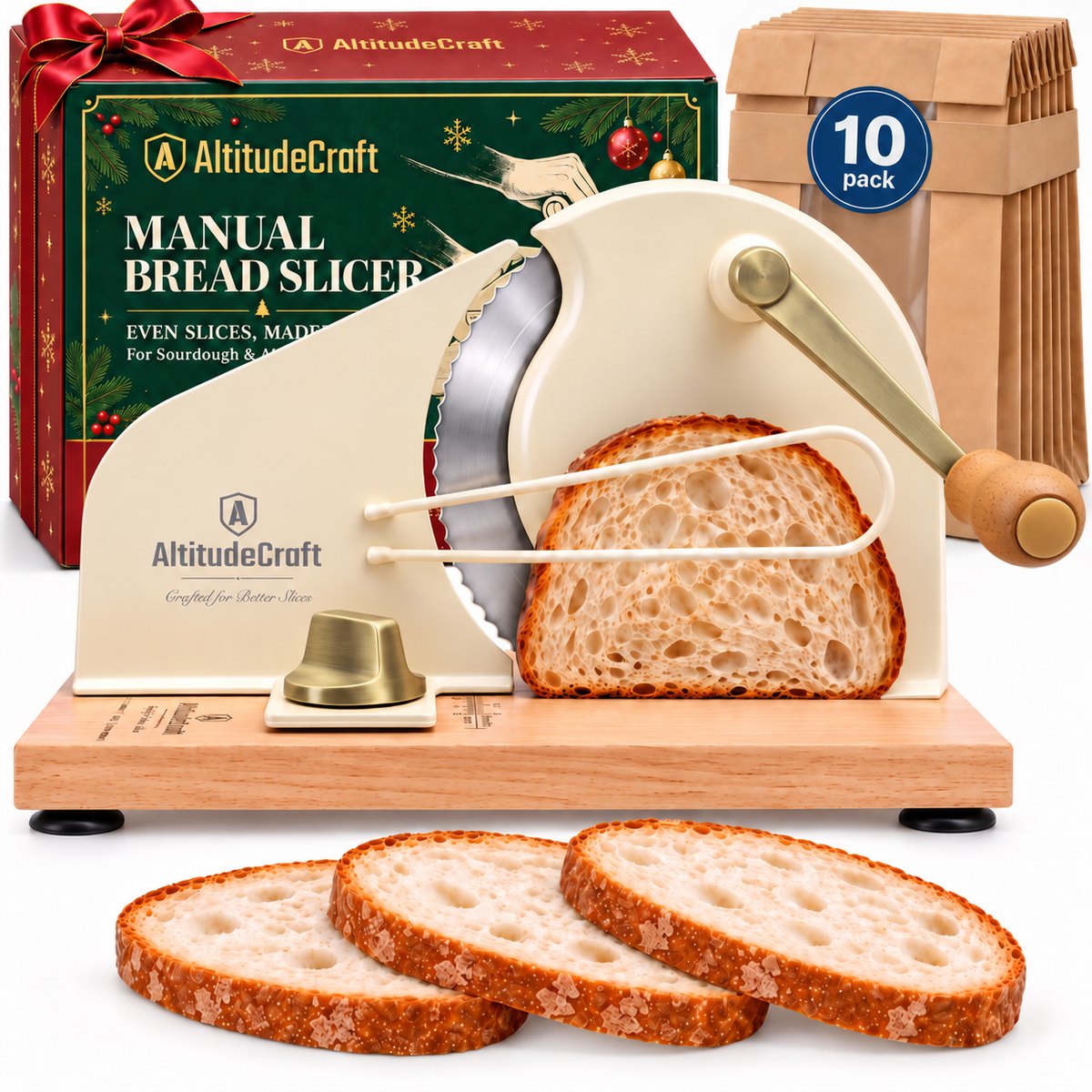





Where to store a bread slicer: on a smooth, clean stretch of counter near your cooling rack, with room to turn the crank and a clear run in front for the loaf, or on a reachable shelf, brushed clean and fully dry. Either way, lift it by the wood base and keep the blade out of reach of children.
For the bigger picture, see our complete guide to bread slicers. This page is for the day after the box arrives: where the slicer goes, how to move it and how to put it away.
Key takeaways
Store a bread slicer on a smooth, clean counter spot or a reachable shelf, carry it by the wood base, and keep the blade out of reach of children. Leave it out if you slice often; put it away if you slice now and then.
- Choose a smooth, clean stretch of counter with room for the crank to turn and a clear run in front of the guide.
- The slicer does not fold. It measures about 30 cm long (not counting the crank), 20 cm wide and 19.5 cm tall and weighs about 1.9 kg, so measure the spot or shelf first.
- Our suggestion for moving it: hold the wood base with both hands and lift one corner slowly to release the suction. Never pull the crank.
- The blade is sharp. The manual says: "Keep out of reach of children."
- Before it goes into a cabinet, brush off crumbs and flour, wipe the base and let it dry fully.
Where on the Counter Does a Bread Slicer Work Best?
A bread slicer works best on a smooth, clean stretch of counter with open space in front of the guide and around the crank. The manual's first step is: "Clean the counter and press the suction base firmly into place." Our suggestion is to choose the spot before you press the base down.
The suction feet hold on a smooth, clean countertop, so start from the flattest spot that is easy to wipe. Our guide on why a bread slicer slides covers the surface in detail.
Then think about the loaf. The slicer takes loaves up to 5.5 in tall and 10 in wide, and length is unlimited because you push the loaf forward. Our reasoning is that a long loaf extends in front of the guide, so keep the counter there clear. Feeding is covered in how to cut sourdough without squishing it.
- Near the cooling rack. Our reasoning: bread should cool before it goes on the slicer, so a spot beside the rack saves carrying a loaf across the kitchen.
- A little back from the edge. Our suggestion: set the base a little back from the counter edge so a bump does not push it over.
- Away from the sink. Our reasoning: the base is solid wood, and wood does not like standing water.
How Much Counter Space Does a Bread Slicer Need?
The AltitudeCraft Manual Bread Slicer measures about 30 cm long (not counting the crank, which sticks out past the base), 20 cm wide and 19.5 cm tall, or about 11.8 x 7.9 x 7.7 in. It weighs about 1.9 kg (4.2 lb). Leave extra room around it to turn the crank, and check a full turn on your own counter.
Height matters if the spot sits under a cabinet. One cabinet retailer says: "Upper cabinets are typically installed about 18 inches above the countertop." At about 7.7 in tall, the slicer is well under that, but your own gap is the number that matters, and the crank still has to turn all the way round.

| What to measure | Why | What to check |
|---|---|---|
| Counter width and depth | The body is about 30 x 20 cm, and the crank sticks out past the base | Tape out the spot and add room for the crank to turn |
| Clear run in front of the guide | A loaf is pushed forward, and length is unlimited | Picture your longest loaf lying in front of the guide |
| Height above the spot | The slicer is about 7.7 in tall | Measure up to the cabinet or shelf above, with the crank turning |
Should You Leave It on the Counter or Put It Away?
If you slice often, leave the slicer on the counter; if you slice now and then, store it on a shelf. It does not fold, so it is one or the other, and your habit should decide.
Whether it deserves a permanent spot is a different question: see whether it is worth the space or the guide on choosing a type of bread slicer. This table is our reasoning, not test data.
| Counter, all the time | Shelf, between uses | |
|---|---|---|
| Best for | Someone who slices often | Someone who slices now and then |
| Getting it ready | Wipe the counter and the feet, then slice | Carry it over, wipe the spot, press it down, then slice |
| Counter space | Held all the time | Free between uses |
| Flour and splashes | Brush it off after use so it does not build up | Less exposed, but brush it clean before it goes away |
| Blade out of reach | Depends on where your counter is | Easier, if the shelf is out of reach |
Will It Fit in a Cabinet or on a Pantry Shelf?
Whether the slicer fits a shelf depends on three measurements: the clear height, the depth and whether the door lets you get your hands in. The slicer is about 7.7 in tall, so the shelf needs more than that, plus room to lift it in and out.
Measure the depth in the longest direction, since the base and the crank both need space. Our suggestion is a height you can reach without stretching, because the slicer weighs about 4.2 lb. We do not say it fits in a drawer; drawer height varies, so measure yours first.

How Do You Carry a Bread Slicer Safely?
Our suggestion is to carry the slicer by the wood base with both hands, never by the crank. The manual does not cover carrying, so this is our own guidance.
- Stop turning, and take any loaf off the guide.
- Hold the wood base with both hands, one on each side, with the blade and guide side turned away from you.
- Lift one corner of the base slowly to release the suction. Never pull the crank, and do not lift it by the thickness knob or the blade cover either.
- Set it down in the new spot before you let go, then wipe the counter and press the base down again.
The manual says: "Keep hands and fingers clear of the blade." Once it is in its new place, press it back into place and check each corner.

How Do You Keep the Blade Out of Reach?
The slicer is an adult kitchen tool with a sharp 6.7-inch serrated circular blade, so keep it where children cannot reach. The manual says: "Keep out of reach of children."
The American Academy of Pediatrics gives general advice on sharp kitchen appliances. Its kitchen safety page says: "Store sharp cutting appliances such as food processors out of reach and/or in a locked cupboard." That line is about food processors, not our slicer, but it is a sensible rule for any sharp kitchen tool.
It also says: "Keep knives, forks, scissors, and other sharp instruments separate from "safe" kitchen utensils." Our suggestion is not to store the slicer in the same place as everyday spoons and mixing bowls. Whether that means a high shelf, a cabinet with a door or a locked cupboard is your decision.
What Should You Do Before You Store a Bread Slicer?
Before you store the slicer, brush off the crumbs, wipe the base and let everything dry. Our cleaning guide says never to store it damp, since moisture helps mold grow.
- Brush it dry. Use the cleaning brush from the box on the base and the guard, keeping your hands clear of the blade.
- Wipe and dry. Use a barely damp cloth on the wood and dry it straight away. The full cleaning routine has the details.
- Air it out. Our suggestion: leave it on the counter for a while so the wood base can air before it goes into a closed cabinet.
The Maine Department of Agriculture, Conservation and Forestry writes: "Keep food storage areas clean and do not allow crumbs or food particles to accumulate, as exposed food will attract insects." That is advice for food in a pantry pests factsheet, not for a slicer. Our reasoning is that crumbs and flour left on the slicer end up on your shelf, so brush them off first.
Last, check that the knob and blade are not loose. The manual says: "Do not use if any part is loose or damaged." Our suggestion is to leave the blade on for storage; the L-shaped tool in the box is for taking it off to clean it.

How Do You Look After the Suction Feet in Storage?
The suction feet need a clean rim to hold, so wipe them before you store the slicer and again before you use it. Flour or an oily film under the rim is one reason a foot may not hold next time.
Our reasoning: a foot that is scratched or cut holds less well, so do not let tools or heavy items press on or scrape the rims while it is stored. Do not add oil or water to the feet.
When you bring it back out, wipe the counter and the feet, press the wood base down and give it a gentle push to check it holds. If a foot looks torn, cracked or worn, stop using the slicer and email support@altitudecraft.com. The manual says: "Always secure the slicer before use."
What Are the Most Common Storage Mistakes?
- Lifting it by the crank. Hold the wood base with both hands instead.
- Putting it away damp or crumby. Brush, wipe and dry first.
- Pressing it down on a crumby counter. Wipe the counter and the feet every time you move it.
- Storing it where the blade can be reached. The manual says: "Keep out of reach of children."

AltitudeCraft Manual Bread Slicer: a hand-crank slicer for sourdough and artisan loaves, with a stainless steel serrated blade and a solid wood base on suction cup feet. No electricity needed.
See the Manual Bread Slicer: see the current price on the product page.
Frequently Asked Questions About Storing a Bread Slicer
Can I leave a bread slicer on the counter all the time?
Yes, if you have the room. Choose a smooth, clean spot, brush the crumbs off after each use, and keep the blade out of reach of children.
Does the slicer fold or come apart for storage?
No, it does not fold. The blade can be removed with the L-shaped tool in the box, but that is for cleaning, and you do not need to remove it to store the slicer.
Will it fit in a drawer?
That depends on the drawer. The slicer is about 7.7 in tall and about 30 cm long, not counting the crank. Measure your drawer first, since we do not promise a fit.
How heavy is the slicer?
The net weight is about 1.9 kg (4.2 lb), so use both hands when you move it.
Should I wipe the counter before I press it down again?
Yes. The manual's first step is: "Clean the counter and press the suction base firmly into place." See how to keep a bread slicer from sliding if the base moves.
Is a bread slicer worth the space?
That depends on how often you slice. Our guide to whether a hand-crank bread slicer is worth it walks through the question.
The Bottom Line
To store a bread slicer, pick a smooth, clean stretch of counter with room for the crank and the loaf, or a reachable shelf, and keep the blade out of reach of children. Carry it by the wood base with both hands, lift one corner slowly to release the suction, and brush, wipe and dry it before it goes away.
Still choosing? See bread slicer vs bread knife or the AltitudeCraft Manual Bread Slicer. More guides are on the AltitudeCraft Kitchen blog, and the kitchen and baking collection has more tools.
How We Put This Guide Together
Setup and safety lines come from the AltitudeCraft AC422 user manual, and product details from our product records. Quotes come from the sources below. This is a usage and storage guide, not a test report. The carrying steps, the counter-versus-shelf table and the points labeled as suggestions or reasoning are our own guidance, not test results, and the manual does not cover carrying or storing the slicer. Images marked Illustration are AI-generated. Last updated: October 2026.
Sources
- AltitudeCraft AC422 user manual: operating instructions and safety warnings.
- American Academy of Pediatrics, HealthyChildren.org: Kitchen Safety (accessed 2026-10-13)
- Maine Department of Agriculture, Conservation and Forestry: Pantry Pests (IPM factsheet) (accessed 2026-10-13)
- RTI Cabinets: Clearances and space guidelines (a cabinet retailer, accessed 2026-10-13)