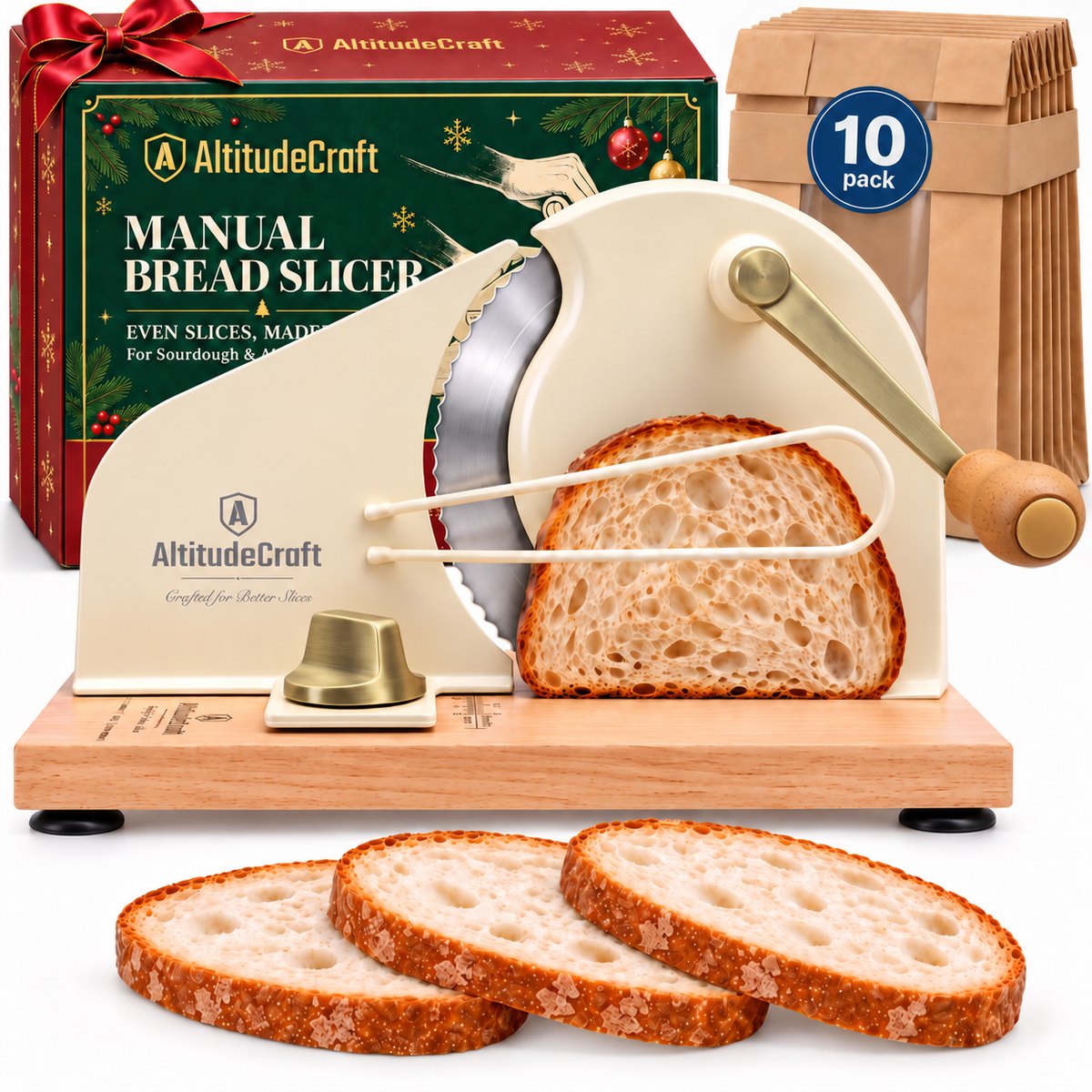




For a bread slicer for large sourdough loaves, the AltitudeCraft Manual Bread Slicer takes loaves up to 5.5 in tall and 10 in wide, and there is no limit on length. That covers many home-baked boules and pan loaves, but not every giant round. Measure your loaf's height and widest width, compare both, and halve anything over.
For the bigger picture on choosing a slicer, see our complete guide to bread slicers.
Our hand-crank bread slicer fits loaves up to 5.5 in tall and 10 in wide; measure your loaf against those two numbers below.
Key takeaways
- Only two loaf numbers decide fit: up to 5.5 in (about 14 cm) tall and up to 10 in (about 25 cm) wide, measured across the cut face. The loaf's length is not limited.
- Both numbers have to pass. A loaf that is narrow enough but too tall still needs cutting down first, and the reverse is also true.
- Measure the baked, cooled loaf at its tallest point and its widest point. A banneton label or a pot size does not tell you how wide or tall the loaf came out.
- Readings of 5.5 in or less tall and 10 in or less wide mean the loaf is within the slicer's stated limit. If either is over, cut the loaf in half and lay the flat cut side down.
- If a round loaf is still too wide after halving, cut it into quarters and measure the pieces. Our reasoning is that halving may not narrow a round loaf.
What Size Loaf Does a Hand-Crank Bread Slicer Take?
The AltitudeCraft hand-crank slicer takes loaves up to 5.5 in (about 14 cm) tall and 10 in (about 25 cm) wide, measured across the cut face. There is no limit on loaf length, because it is pushed forward as you slice. Height and width are the whole fit test.
The slicer has a 6.7 in stainless steel serrated circular blade and needs no electricity. Its limit is stated as loaf height and width, so those are the two numbers to compare. The blade's diameter is not a loaf measurement.
The machine itself is about 30 cm (11.8 in) long, not counting the crank, about 20 cm (7.9 in) wide and about 19.5 cm (7.7 in) tall. A long loaf extends out in front of the slicer, so leave counter space there. The suction feet need a smooth, clean spot, covered in our guide to keeping a bread slicer from sliding.
How Do You Measure a Loaf for a Bread Slicer?
Measure the baked, fully cooled loaf in two places: its tallest point and its widest point across the cut face. The loaf passes only if the height is 5.5 in or less and the width is 10 in or less. This is our suggested method, not a step from the manual.
- Let the loaf cool. Measure and slice once it is cool, not straight from the oven.
- Measure the tallest point. Stand a ruler or tape measure beside the loaf on the counter and read up to the highest point of the crown. On a domed loaf, rest a straight edge flat across the top and measure from the counter to it.
- Measure the widest point of the cut face. The cut face is the cross-section the blade makes. Lay a straight edge across the loaf where it is widest and measure along it. A round loaf is about the same every way across. On an oval loaf, measure the short way across.
- Pick the end that meets the blade. Either end of a round loaf can meet the blade first. On an oval loaf, the long direction is the length.
If your tape is in centimetres, the targets are about 14 cm tall and about 25 cm wide.


Will My Large Sourdough Loaf Fit? A Quick Chart
The chart below is a starting point, not a promise. It reads from our product notes and common loaf shapes. For a bread slicer for large sourdough loaves, the deciding numbers are always the height and widest width you measured.
| Loaf | What to expect | What to check |
|---|---|---|
| Round loaf from an 8 to 10 in banneton | Often within the limit, but the banneton size is only a starting point (see the next section). | Width at the widest point and height at the crown. Measure yours. |
| Very large round (about 1 kg of dough) | May reach the 10 in width limit. | Width first. If it is over 10 in, cut it before slicing. |
| Batard or other oval loaf | Width is the short way across. Length is not limited. | The short axis and the height. Measure yours. |
| 9×5 pan loaf | Can reach about 5 to 5.5 in tall, so height is the number to watch. | The top of the crown against 5.5 in. |
| Anything wider than 10 in or taller than 5.5 in | Over the limit. | Cut it down first (see below). Measure the pieces. |

Why Don't Banneton and Pot Sizes Tell You the Loaf Size?
Banneton and pot sizes describe the container, not the baked loaf. Sellers and guides may list inner or outer diameter, and the dough bakes into its own shape. A loaf baked in a pot is limited by the pot's inside width, so measure the finished loaf instead.
King Arthur Baking explains that bannetons come in two shapes: "The round shape is for boules, or circular loaves." and "The oval shape is used to make a bâtard, or an elongated oblong loaf." (King Arthur Baking). That tells you the shape, not the size you will bake.
Sizes are also listed in different ways. A banneton size guide says: "The measurements are inner measurement." (Pantry Mama). One baker on The Fresh Loaf wrote: "my bannetons are 8.5" outer/8.0 inner diameter, and 9.6" outer/9.0 inner diameter." and added: "Amazon sellers advertise by outside dimension, not inside dimension." (The Fresh Loaf).
So a "9 inch banneton" can mean different things, and we give no pot sizes here because listings vary. Our reasoning: how far the dough spreads or rises in the oven also changes the finished width, so the tape measure beats the label.
What If My Loaf Is Too Big?
If either number is over the limit, cut the loaf in half with a knife and lay the flat cut side down. If it is still too wide, cut it into quarters. Our reasoning is that halving a round loaf may not narrow it, so measure the pieces before you slice.
Cutting a round loaf straight through the middle lowers its height, but each half can stay as wide as the original circle. Quarters are narrower. This is geometry, so measure again after you cut.
One baker describes this approach on another slicer: "Loaves too large to fit in it I just cut crosswise in two with a large knife and then slice at the right angle to the cut" (The Fresh Loaf). For the knife technique, see our guide to slicing sourdough bread evenly. If you are weighing a slicer against a knife for big rounds, read bread slicer vs bread knife.

Why Do Wide Boule Slices Need Care?
A slice from a wide boule is large, so let the loaf cool and keep the motion steady. The manual says: "Guide the loaf gently and let the blade do the work." The box says the slicer "helps prevent squashed loaves".
Slice thickness matters more on a big round, because a thin wide slice can flop. We cover that in how thick to slice sourdough bread, and the soft-crumb side in how to cut sourdough without squishing.
What Mistakes Should You Avoid When Checking Fit?
- Measuring the banneton. Measure the baked loaf, because the label describes the basket.
- Checking only the width. A tall, narrow loaf can pass on width and fail on height.
- Measuring a warm loaf. Let it cool first, then measure and slice.
- Cutting a long loaf for no reason. A long batard does not need halving just because it is long.

AltitudeCraft Manual Bread Slicer: a hand-crank slicer for sourdough and artisan loaves, with a stainless steel serrated blade and a solid wood base on suction cup feet. No electricity needed.
See the Manual Bread Slicer: see the current price on the product page.
Frequently Asked Questions About Loaf Size and a Bread Slicer
Will a bread slicer fit a large sourdough boule?
The AltitudeCraft Manual Bread Slicer takes loaves up to 5.5 in (about 14 cm) tall and 10 in (about 25 cm) wide, with no limit on length. A boule within both numbers fits. Measure your loaf's height and widest width, and cut it down first if either is over.
Does the length of the loaf matter?
No. The AltitudeCraft slicer limits loaf height and width, not length, because the loaf is pushed forward as you slice. A long loaf does extend out in front of the slicer, so leave counter space there.
My loaf is exactly 10 in wide. Will it fit?
A width of 10 in is within the stated limit of up to 10 in. The height has to pass too, at 5.5 in or less. Measure the loaf at its widest point, because a loaf that looks like 10 in can run wider.
Can I slice a loaf that is a little too tall?
We do not suggest it. The limit is up to 5.5 in tall, so cut a taller loaf in half, lay the flat side down, and measure the half before you slice.
Does the 6.7 in blade limit how wide a loaf can be?
The slicer's loaf limit is given as height and width: up to 5.5 in tall and 10 in wide. Compare your loaf to those two numbers. The blade's diameter is not the loaf measurement.
Will a banneton size tell me if my loaf fits?
No. Banneton sizes describe the basket and may be listed as inner or outer diameter. Measure the baked, cooled loaf at its tallest point and its widest point, then compare both to 5.5 in and 10 in.
The Bottom Line
To check a large sourdough boule, measure the cooled loaf's height and widest width and compare them to 5.5 in and 10 in. Over the limit, cut the loaf in half and lay it flat side down, or in quarters if it is very wide.
If your loaves fit, the slicer ships free with 30-day returns. Still deciding? See is a hand-crank bread slicer worth it or the bread slicer buying guide, then see the AltitudeCraft Manual Bread Slicer. More guides are on the AltitudeCraft Kitchen blog, and more baking tools are in the kitchen and baking collection.
How We Put This Guide Together
The loaf limit, the machine size and the box wording come from our product records and packaging, and the quoted manual line from the AltitudeCraft AC422 user manual. Other quotes come from the sources below. This is a measuring guide, not a test report. The measuring steps, the chart and the points marked as our reasoning are general suggestions, not test results for our slicer. Images marked Illustration are AI-generated illustrations.
Sources
- AltitudeCraft AC422 user manual and product records: loaf limit, blade, machine size and packaging wording.
- King Arthur Baking: Bannetons, brotforms and proofing baskets (accessed 2026-10-14)
- Pantry Mama: Banneton size guide (accessed 2026-10-14)
- The Fresh Loaf: combo-cooker thread, banneton inner and outer sizes (accessed 2026-10-14)
- The Fresh Loaf: Sourdough slicer recommendations (accessed 2026-10-14)