




Sourdough is hard to cut cleanly when the loaf is not ready or the knife pushes instead of saws: let it cool completely, saw with a long serrated knife using almost no downward pressure, and hold the loaf lightly instead of squeezing it. If the crumb stays flat after you lift the knife, the problem is the bread (still warm, under-baked or under-proofed), not your technique. This page is about fixing squashed, gummy or torn slices; for step-by-step slicing at an even thickness, see how to slice sourdough bread evenly.
The Takeout describes a moment most home bakers know: "you may have also squished it by accident when you pressed in with the knife and the whole loaf sank."
Key takeaways
- Squished slices have two kinds of causes: the bread itself (warm, under-baked or under-proofed) or the cut (pressing down, squeezing the loaf, a dull blade).
- Press the cut crumb gently: if it springs back, change your technique; if it stays flat and damp, the loaf needed more cooling or baking, and a sharper knife will not change that.
- A sourdough loaf is still setting as it cools; one baker's guide says to wait until it reaches 95–100°F, which can take 2 to 6 hours.
- Saw with long, light strokes and let the serrations break the crust first; hold the loaf lightly on a board that does not slide.
- Soft sandwich bread and brioche squash more easily than crusty sourdough, because a thin crust gives the crumb little support; a knife is still the better tool for them.
Why Does Sourdough Squish When You Cut It?
Sourdough squishes for one of two reasons: the bread is not ready to cut (still warm, under-baked or under-proofed), or the cut puts too much force into the crumb (pressing down, squeezing the loaf, a dull blade).
| What you see | Likely cause | What to change | See |
|---|---|---|---|
| Crumb dents but springs back; ragged cut face | Pressing down, or a dull blade | Saw lightly; check the knife | Pressing; knife |
| Crumb stays flat; cut face shiny or sticky | Loaf still warm or under-baked | Wait longer; check the bake | Cooling; baking |
| Damp crumb sticks to the blade | Cut too soon, steam still inside | Let it cool fully first | Cooling |
| Top crust caves in before the blade bites | Downward force on a hard crust | Let the serrations open the crust; try it on its side | Pressing; on its side |
| Crust shatters, crumb tears into strips | A dull or short blade forced through | Sharpen or replace; halve a wide loaf | Knife |
| A whole soft sandwich loaf flattens | Thin crust, little support, sometimes over-proofing | Cool completely, near-zero pressure, cut on its side | Soft bread |

How Long Should Sourdough Cool Before You Cut It?
Sourdough should cool until the inside is near body temperature, because the crumb is still setting and releasing steam until then.
Busby's Bakery writes: "Sourdough bread should cool until it reaches 35-38C (95-100F) before slicing, which can take between 2 and 6 hours." That is one bakery's guideline; a large loaf takes longer.
Laura Kasavan, a cookbook author and baking blogger quoted by HuffPost: "As the bread cools, the crumb structure sets up." She adds, "Slicing into soft bread too early will squish the loaf and result in a gummy texture."
Want it warm? Tear off a piece and save the knife for later. Once it is fully cool and sliced, you can freeze the slices.

Is Your Sourdough Gummy Because It's Under-Baked or Under-Proofed?
If a fully cooled loaf still fails the spring-back test, the cause is the bake or the fermentation, and a different knife will not fix it.
King Arthur Baking's Easy Everyday Sourdough recipe says the finished loaf's "internal temperature will read about 204°F." That number belongs to that recipe. King Arthur's Classic Sandwich Bread recipe, for comparison, says "it should register 190°F at the center of the loaf."
Fermentation matters too. Pantry Mama's troubleshooting guide: "More often than not, gumminess is a result of under fermentation (cutting the bulk fermentation time too short)."
Light is not under-baked. In a Fresh Loaf thread on a too-soft rustic loaf, the baker reported 205°F and 207°F bakes, fully cooled, and wrote, "I wouldn't actually call the crumb gummy." If it springs back, change how you cut.
Why Does Pressing Down Crush the Crumb?
Pressing down crushes the crumb because the force lands on the soft interior before the blade has cut through the crust. To slice bread without crushing it, saw lightly and let the serrations open the crust first.
HuffPost's advice is to saw gently back and forth with limited downward pressure; Martin Philip, head bread baker at King Arthur Baking, told HuffPost, "This will keep the crumb and loaf from compressing."
A hard grip on the loaf flattens it too. The Takeout suggests a non-slip surface, "which won't require you to grip the bread so firmly." For stance and keeping the blade upright, follow our step-by-step guide to even slices.

Does Your Knife Make Sourdough Squish?
A knife makes sourdough squish when it cannot cut the crust cleanly: a dull serrated edge drags, and a short blade leaves you pushing down instead of sawing.
A knifemaking expert quoted by The Takeout describes a serrated edge that "breaks through the hard crust before the soft interior gets compressed." A dull serrated knife is worth sharpening or replacing. Halve any loaf wider than your blade.
Should You Cut Sourdough on Its Side?
Cutting sourdough on its side often reduces crushing, because the side crust spreads the knife's pressure across the loaf. It helps most with tall, soft or very open loaves.
The knifemaking expert quoted by The Takeout explains: "Slicing bread on its side can reduce crushing because the pressure from the knife is distributed across the loaf rather than driven straight down into the soft crumb. The side crust provides extra structure while you cut."
Flipping the loaf upside down is a different move, for a straight cut; our even-slicing guide explains why starting from the bottom keeps the knife straight.

Why Is Soft Sandwich Bread Harder to Cut Than Crusty Sourdough?
Soft sandwich bread is harder to cut because its thin crust gives the crumb almost no support, so any downward force flattens the loaf. Crusty sourdough has a firm shell that holds its shape.
hamletcat, baking soft tin loaves, reached that conclusion on The Fresh Loaf: "I realize that the crust needs to be tougher because it is the force of the knife that squishes the bread down." Talking about sandwiches in HuffPost, Martin Philip made a similar point: "Brioche is too tender for some sandwiches, whereas crusty sourdough or a demi-baguette can offer a more substantial backbone."
Over-proofing makes it worse; Mini Oven replied in that thread: "The dough is too soft to cut because it rose a lot (too much?) then baked and set, it can not support itself well. It is on the edge of over-proofing." So does a wet dough: zubo baked one in a tin for 45 minutes and still found "STILL the same softness snagging cutting with bread knife."
Can a Hand-Crank Slicer Help Prevent Squashed Loaves?
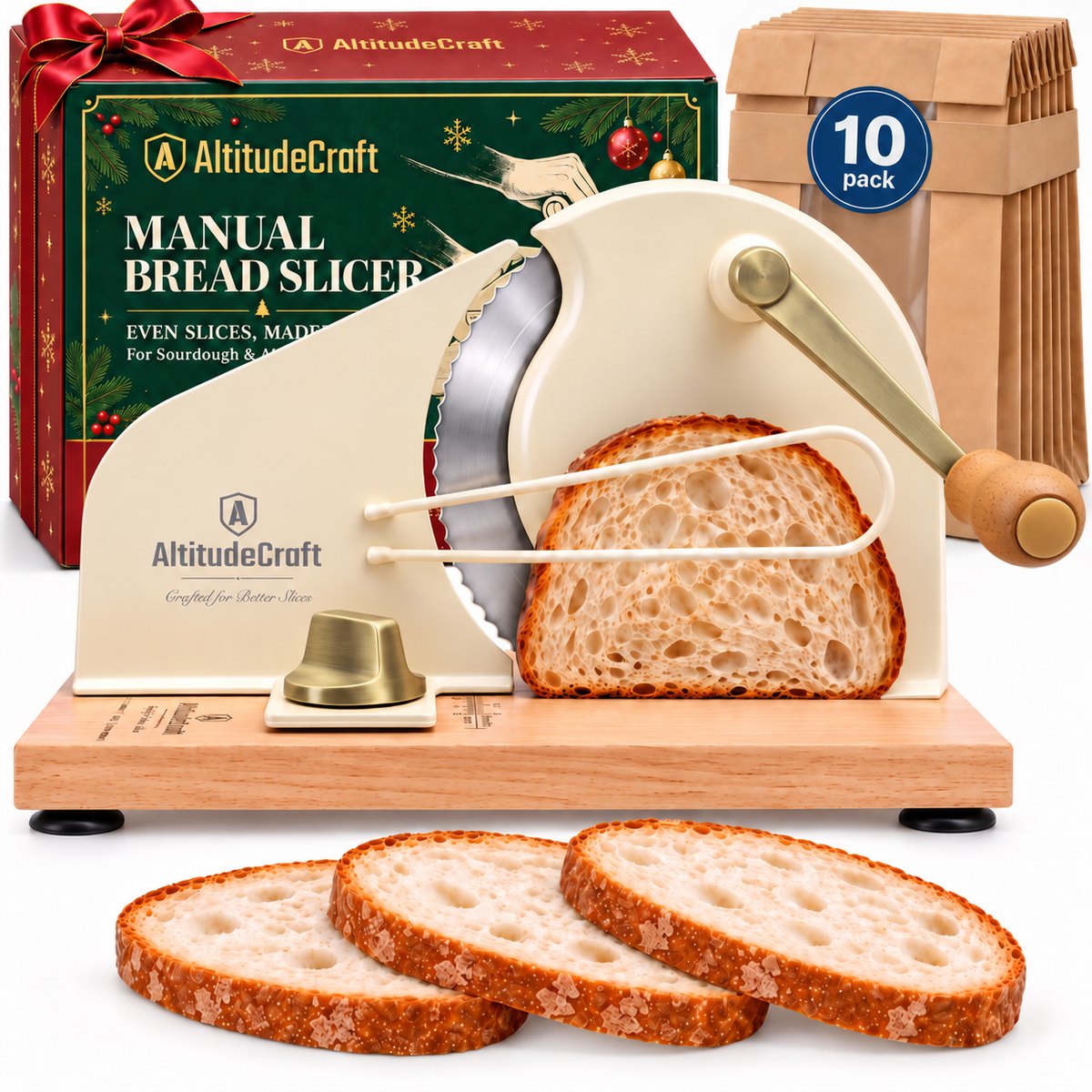
A hand-crank slicer can help with a fully cooled, crusty sourdough loaf, but it does not fix a warm, under-baked or very soft one. Ours is the AltitudeCraft Manual Bread Slicer, which AltitudeCraft sells; its box says it "helps prevent squashed loaves", a claim we have not tested yet, and it is not designed for soft bread, so use a knife for that.

AltitudeCraft Manual Bread Slicer: made for cooled, crusty sourdough. Sets slice thickness once, up to 0.9 in; fits loaves up to 5.5 in tall and 10 in wide.
See the Manual Bread Slicer: see the current price on the product page.
How We Put This Guide Together
The spring-back test, cooling window and bake temperatures here come from the sources quoted, not yet from our own kitchen. Quotes were checked against the originals in October 2026. We have not run the warm-versus-cooled or press-versus-saw comparisons yet, so images marked "Illustration" are drawings. The size limit on the product card is our own measurement.
Frequently Asked Questions About Cutting Sourdough Without Squishing
Can you cut sourdough while it's still warm?
You can, but the crumb is still setting, so it tends to compress and turn gummy. Wait until it is near body temperature.
Why is my sourdough gummy even after it cooled?
It is usually under-baked or under-fermented. Check the internal temperature at the end of the bake and lengthen bulk fermentation.
What knife cuts sourdough without crushing it?
A long, sharp serrated bread knife, used with light sawing strokes and almost no downward pressure. Our comparison explains when a bread knife is the better tool.
How do you cut soft homemade bread without squishing it?
Cool it completely, lay it on its side and saw with almost no pressure.
Is a hand-crank slicer a good choice for brioche or sandwich bread?
Not really. Ours is designed for cooled, crusty sourdough and artisan loaves; use a long serrated knife for soft bread.
The Bottom Line on Cutting Sourdough Without Squishing
Most squished sourdough is either a loaf cut too soon or a knife pushed too hard. The six fixes:
- Cool it fully.
- Bake and proof it fully.
- Saw, don't press.
- Hold it lightly on a non-slip board.
- Use a long, sharp serrated knife.
- Cut tall or soft loaves on their side.
If most of what you bake is cooled, crusty sourdough, the AltitudeCraft Manual Bread Slicer is built for that kind of loaf. Browse our Kitchen & Baking collection or the AltitudeCraft Kitchen blog.
Sources
- The Takeout, Jonathan Kesh: The Best Way To Slice Bread Without Crushing It (2025-12-30)
- HuffPost, Krissy Brady: How To Cut Soft Bread Without Absolutely Destroying Your Sandwich (2020-07-06)
- Busby's Bakery, Gareth Busby: Cooling Sourdough Bread (updated 2022-12-17)
- King Arthur Baking: Easy Everyday Sourdough Bread
- King Arthur Baking: Classic Sandwich Bread
- Pantry Mama, Kate Freebairn: Troubleshooting Sourdough Bread Problems (2020-07-13)
- The Fresh Loaf forum: Rustic Loaf Too Soft (2017)
- The Fresh Loaf forum: My bread is too soft to cut! (2014)
- The Fresh Loaf forum: Struggling to slice bread without snagging (2018)