



Is a hand-crank bread slicer worth it? It is if you slice a whole loaf most weeks, your loaves fit the opening, and you can spare a permanent spot on the counter. If you bake once or twice a month, or your kitchen is short on space, a sharp serrated knife is the better buy.
This guide gives you a five-question self-test, the trade-offs you would live with, a cost-per-loaf table and the mistakes to avoid. For a wider look at the tool types, see our complete guide to bread slicers.
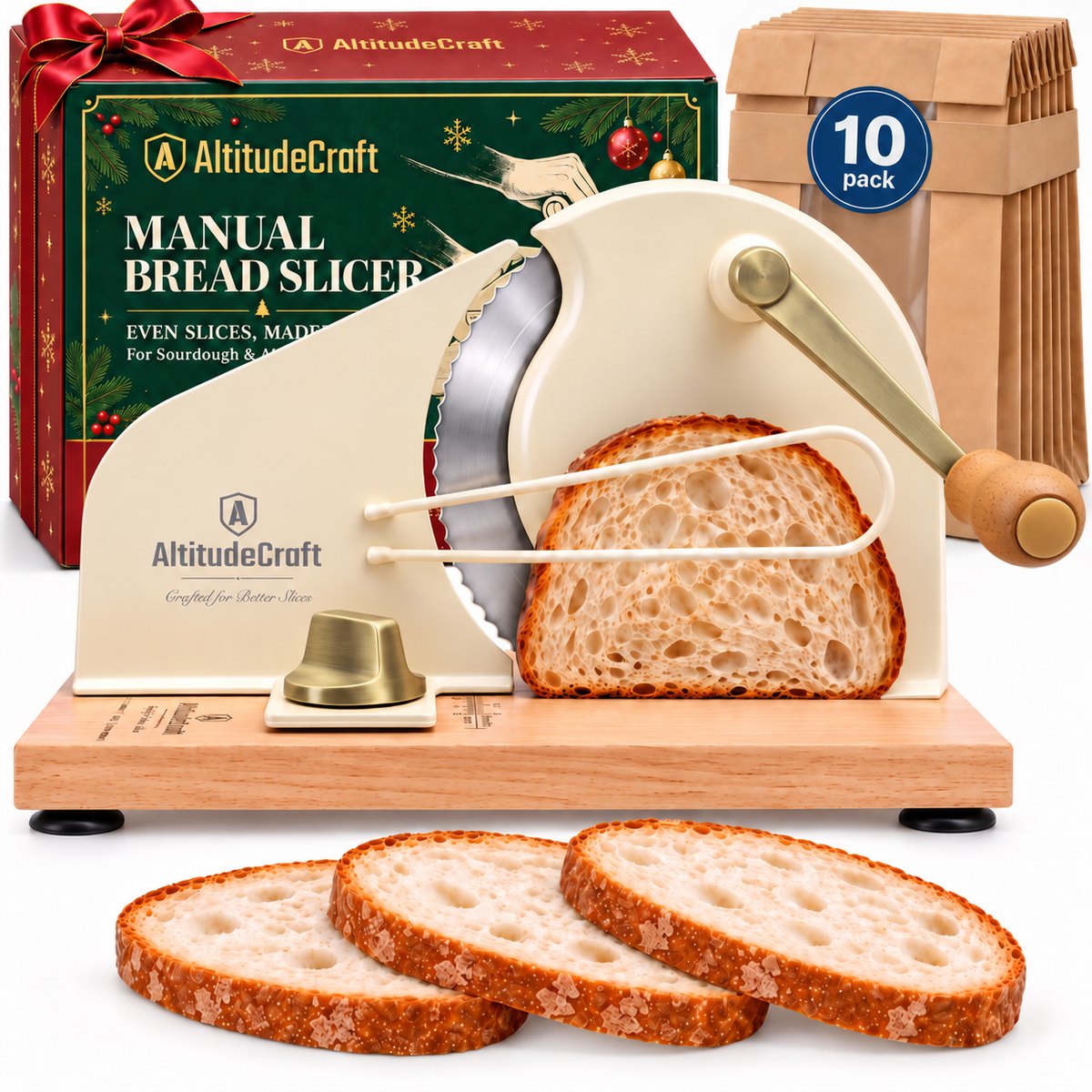
If you want to see the one we make, here is our hand-crank sourdough bread slicer with thickness adjustable up to 0.9 in.
Key takeaways
- A hand-crank slicer is worth it when you pass three gates: you sliced about one whole loaf a week over the last 8 weeks, your loaves fit the 5.5 in tall by 10 in wide opening, and you have a fixed spot for it. Miss one and a serrated knife is the better buy.
- Two tie-breakers decide the rest: whether you are tired of re-cutting uneven slices, and whether you like slicing a whole loaf in one sitting.
- Cost per loaf is arithmetic. Divide the current price on the product page by the loaves you slice in a year.
- The real costs are a permanent footprint, one more tool to clean, and soft or warm bread that can compress.
- A slicer sets thickness once with a knob and scale. It does not replace your knife for large rounds, cake or focaccia.
Do You Need a Bread Slicer? A Five-Question Self-Test
Questions 1 to 3 are gates: whole loaves you actually sliced, loaves that fit the opening, and a spot where it can stay. A "no" on any one means keep your knife. If all three are "yes," two tie-breakers settle whether a slicer is likely worth it.
| # | Question | Type | A "yes" looks like |
|---|---|---|---|
| 1 | How many whole loaves did you actually slice in the last 8 weeks? | Gate | 8 or more, which is about one a week. Find your yearly rate in the cost table below |
| 2 | Do your usual loaves fit 5.5 in tall by 10 in wide? | Gate | You measured your biggest loaf and it clears the opening |
| 3 | Do you have a spot where it can stay put? | Gate | A stretch of counter, or a cabinet shelf you can reach without moving anything |
| 4 | Are you tired of re-cutting or wasting slices that came out uneven or too thick? | Tie-breaker | You have trimmed, patched or thrown out slices that missed the mark |
| 5 | Are you happy to slice the whole loaf in one sitting, rather than cutting a slice at a time as you need it? | Tie-breaker | You portion, pack or freeze the slices the same day |
How to score it: a "no" on any gate means keep the knife. For question 2 that means halving large loaves with a knife, as our bread slicer vs bread knife guide covers. With all three gates "yes," two "yes" answers on questions 4 and 5 mean it is likely worth it, one means it depends on your habits, and none means your knife is probably enough.
For question 3, clear a spot on your counter before you order and mark it. For question 5, see how to slice and freeze sourdough bread. King Arthur Baking suggests "dividing slices into groups of two or four (or however many you may use at one time), so you don't have to thaw the entire loaf."

What Actually Changes if You Already Own a Bread Knife?
Three things change: thickness is set once on a knob instead of by eye on every slice, a crank turns the blade instead of your arm sawing, and the whole loaf is cut in one sitting. A good knife is not made obsolete.
The AltitudeCraft Manual Bread Slicer sets thickness once with a knob and a scale on the base. The crank does the cutting motion, so you are not sawing through the crust. Both points are covered in our guides to slicing sourdough evenly and choosing a slice thickness.
Preferring a knife is a fair position. A Fresh Loaf member writes: "Personally, I like the slightly non-uniform hand-sliced bread over machine precision." If that is you, the knife you own may be the right tool.

What Are the Real Trade-Offs? Space, Cleaning and Size
The trade-offs are a permanent footprint because it does not fold, one more tool to clean, a loaf-size limit of 5.5 in tall by 10 in wide, and a sharp blade. Soft bread is not where it shines, so weigh each one against your kitchen.
Tasting Table, an editorial site, notes that some dedicated sourdough bakers initially doubted the tool, with this objection: "It takes up valuable space on the kitchen counter, can only perform one function, and honestly, it's not the cheapest."
- It needs a fixed spot. The slicer does not fold. Measure your counter or cabinet shelf against your own loaves, not against a guess, and mark the spot before you order.
- Its suction feet need a smooth, clean counter. Press the wood base down before you slice; our guide covers how to keep a bread slicer from sliding.
- It is one more thing to clean. The box includes a cleaning brush, and the blade comes off with the included L-shaped tool. Our guide to cleaning a bread slicer walks through it.
- There is a size limit. It takes loaves up to 5.5 in tall by 10 in wide. Larger rounds need halving with a knife first.
- The base needs a smooth, clean counter. The suction-cup feet press onto the surface, so wipe the spot before you set it down.
- Soft bread is not its strength. Our packaging says only that it "helps prevent squashed loaves." Very soft bread can still compress.
- The blade is sharp. It is a 6.7 in stainless steel serrated circular blade, so keep your fingers clear.

Is It Worth the Price? A Cost-Per-Use Check
Divide the current price on the product page by the loaves you slice in a year: by 52 at one loaf a week, by 24 at two a month, by 12 at one a month.
| How often you slice a whole loaf | Loaves per year | First-year cost per loaf |
|---|---|---|
| Once a month | 12 | price ÷ 12 |
| Twice a month | 24 | price ÷ 24 |
| Once a week | 52 | price ÷ 52 |
| Twice a week | 104 | price ÷ 104 |
This is plain arithmetic on our own price, not a savings claim, and it says nothing about how long a slicer lasts. The slicer carries a 1-year warranty, extended to 3 years when you register it.

What Are the Most Common Mistakes Before Buying a Bread Slicer?
The most common mistakes are buying without measuring your largest loaf, expecting the slicer to replace your knife, and slicing a warm loaf. Each is easy to avoid with a tape measure, a clear view of what the tool does, and a little patience.
- Buying without measuring. Measure your largest loaf against the 5.5 in by 10 in opening, and measure the spot where the slicer will sit.
- Expecting it to replace your knife. Large rounds, cake and focaccia still need a knife, so keep a good one.
- Slicing a warm loaf. Warm bread is soft and can squash, so let it cool completely before you slice.
Our Verdict: Is a Hand-Crank Bread Slicer Worth It?
Yes, if you pass all three gates and the tie-breakers fit: weekly whole loaves, loaves that fit, a fixed spot. If you bake occasionally or have little room, a sharp bread knife is the better buy, and it still handles large rounds, soft bread and cake.
Tasting Table, an editorial site, says the tool "simply makes sense in households that bake a lot of fresh bread." A Fresh Loaf member who slices and freezes at home agrees: "I think some kind of slicer would be worth the investment." For the full list of who benefits and who should skip, see the pillar section on who should buy a bread slicer and who should skip it.
For the right baker, here is the AltitudeCraft Manual Bread Slicer: a hand-crank slicer with no electricity, a stainless steel serrated blade and a solid oiled wood base. The bronze version has a cream enamel body, an antique-bronze crank arm and knob, and a dark-brown wood handle with a bronze end cap. The box holds the slicer, an L-shaped tool, a cleaning brush and 10 paper bread bags, which also suits gifting a baker.


Frequently Asked Questions About Bread Slicers
Is a manual bread slicer worth it if I already have a bread knife?
It is worth it if you pass the three gates in the self-test and want the thickness set once instead of by eye. If you bake once or twice a month, keep the knife.
Does a bread slicer take up a lot of counter space?
It does not fold, so it needs a fixed spot on a counter or a shelf you can reach without moving anything. It takes loaves up to 5.5 in tall by 10 in wide, and the suction-cup feet press onto a smooth, clean counter. Before you order, measure your largest loaf and the spot where the slicer would sit, and mark the spot with tape. If you would have to dig it out of the back of a cupboard each time, a knife is the better fit.
What if I only bake a few loaves a year?
Keep the knife. A few loaves a year costs more per loaf than the once-a-month figure in the table.
How do I know if I will actually use a bread slicer?
Count the whole loaves you sliced over the last two months and find that rate in the cost table. If the cost per loaf looks reasonable and you have a spot picked out, you are likely to use it.
How long is the warranty?
The AltitudeCraft Manual Bread Slicer carries a 1-year warranty, extended to 3 years when you register it.
The Bottom Line
Before you decide, do four things: count the whole loaves you sliced in the last 8 weeks, measure your largest loaf, mark the counter spot, and divide the current price by your loaves per year.
If a gate fails, you have your answer. If all three pass, see the AltitudeCraft Manual Bread Slicer, our Kitchen & Baking collection, or more guides on the AltitudeCraft Kitchen blog.
How We Put This Guide Together
Quotes come from the sources below. The self-test and cost table are our own framework and arithmetic, and product details come from our product records. We have not run a testing trial, and images marked Illustration are AI-generated illustrations, not photos of our product.
Sources
- Tasting Table: The Vintage Kitchen Tool Home Cooks Are Using Again (accessed 2026-10-11)
- King Arthur Baking: How to freeze bread (accessed 2026-10-11)
- The Fresh Loaf: Slicing bread - manual or electric? (community thread, accessed 2026-10-11)
- The Fresh Loaf: slicer (community thread, accessed 2026-10-11)