




Gummy sourdough almost always comes from one of three things: the dough was under-fermented, the loaf came out of the oven too early, or you sliced it before it cooled. The Perfect Loaf's Maurizio Leo gives exactly that list. Work through them in reverse order. The slicing question is easiest to rule out, the bake is next, and fermentation takes the most practice to fix.
The 3 causes, and how to tell which one is yours
Look at when you cut the loaf, what the inside temperature was, and how the crumb looks. Each cause leaves a different clue. This table puts them side by side so you can find yours, check it, and know what to change next time.
| What you see | Most likely cause | How to check | Fix next time | Source |
|---|---|---|---|---|
| Good dark crust, but the inside is wet and sticky, and the loaf was still warm when you cut it | Sliced too soon | Think back: how long did it cool? | Cool at least 1–2 hours, ideally until completely cool (about 3 hours) | The Perfect Loaf; America's Test Kitchen |
| Pale crust, or the center reads low on a thermometer | Underbaked | Probe the center with an instant-read thermometer | Bake to about 205–208°F inside, and to a deep brown crust | The Perfect Loaf; America's Test Kitchen |
| Tight, dense crumb with few holes, gummy all the way through, often a flat loaf | Under-fermented | Did the dough rise 20–50% in bulk (The Perfect Loaf recipe)? Does a poke spring straight back? | End bulk when the dough has risen 20–50%, looks puffy, and pushes back. If loaves come out flat and gummy, wait for 30–50%, as Maurizio Leo advised a reader | The Perfect Loaf; King Arthur Baking |
If more than one row fits, fix them in this order: cooling first (it costs nothing), then the bake, then fermentation.
Cause 1: You sliced it too soon
A loaf is still setting when it comes out of the oven, so cutting it hot gives you a gummy, compressed crumb. America's Test Kitchen explains the mechanism: "As the loaf cools, its gelled starch sets, becoming firmer and drier." Cut before that happens, and the soft starch smears under the knife.
How long to wait:
- Crusty sourdough: at least 1 to 2 hours on a wire rack (The Perfect Loaf). America's Test Kitchen says it "can take 3 hours for a loaf to cool."
- High-rye loaves: much longer. King Arthur notes that rye breads with a high percentage of rye flour "often benefit from up to 24 hours of cooling time."
The Perfect Loaf says it plainly: "Slicing a warm loaf of bread too early will result in a gummy and sticky interior." King Arthur agrees: "Unless you want to end up with a gummy interior, let your bread cool completely before slicing into it."
For the full cooling timeline by bread type, see when to slice sourdough bread after baking.
Cause 2: It came out of the oven too early
An underbaked loaf has a gummy center even after it cools, so check both the inside temperature and the crust color. King Arthur Baking says underbaking results in "a gummy, dense crumb." For a crusty sourdough, aim for about 205–208°F in the center. The Perfect Loaf targets around 208°F, and America's Test Kitchen aims for 205°F for lean breads.
Temperature alone can fool you, so use both checks:
- Color counts. ATK says that if the bread is still pale, keep baking it, "even if it's at or above the recommended temperature." And if it looks good, it can come out "even if it is 5 to 10 degrees below temperature on the inside."
- The center finishes early. King Arthur notes that the center of a loaf can reach its finished temperature "several minutes before the end of baking time."
- Check the bottom too. King Arthur suggests knocking on the bottom of a crusty loaf. If it sounds hollow, it's fully baked.
The Perfect Loaf's target is a deep mahogany crust that crackles when squeezed, with about 208°F inside.
Cause 3: The dough was under-fermented
Dough that didn't ferment long enough bakes into a tight, dense, gummy loaf, and no amount of cooling or extra baking fixes it. When a reader's loaves came out "flat and gummy" with two different starters, Maurizio Leo of The Perfect Loaf said it "points to one thing: underfermentation, and that's fixable."
What to watch:
- Bulk fermentation: The Perfect Loaf's recipe says that at the end of bulk, "your dough should have risen by 20% to 50%." For the reader whose loaves were flat and gummy, Maurizio Leo's reply was more specific: end bulk only "when the dough has risen 30-50%, looks puffy with bubbles on the sides, and pushes back when you tug it." Judge the dough, not the clock.
- The poke test: before the bake, King Arthur says to lightly flour your finger and poke the dough down about 1 inch. "If the indent stays, it's ready to bake. If it pops back out, give it a bit more time."
- Your starter: King Arthur's benchmark for a new starter is that it "should at least double in volume in about 6 to 8 hours" after feeding. A starter that rises less than that will ferment your dough more slowly.
One more contributor: Maurizio Leo says that too much high-protein flour can lead to "a slightly chewier, gummy interior."
A bake-day checklist to prevent gummy sourdough
Run through these checks in order on your next bake. Each one rules out one of the three causes before you cut the loaf. Every number below comes from the sources cited above. Keep the list next to your oven until the checks become habit.
| Stage | Check | Target | Rules out | Source |
|---|---|---|---|---|
| Before mixing | Starter rise after feeding | Rises predictably and vigorously within 6–8 hours of a feeding | Weak fermentation | The Perfect Loaf |
| End of bulk | Dough rise and feel | Risen 20–50% (30–50% if loaves have been flat and gummy), puffy, bubbles on sides, pushes back | Under-fermentation | The Perfect Loaf (recipe; Maurizio Leo's reply to a reader) |
| Before baking | Poke test, about 1 inch deep | Indent stays (not springing straight back) | Under-proofing | King Arthur |
| End of bake | Center temperature | About 205–208°F | Underbaking | The Perfect Loaf; America's Test Kitchen |
| End of bake | Crust color and sound | Deep brown; hollow knock on the bottom | Underbaking | America's Test Kitchen; King Arthur |
| After baking | Time on the rack | At least 1–2 hours; fully cool is best (about 3 hours) | Slicing too soon | The Perfect Loaf; America's Test Kitchen |
Write down the actual result of each check, not just a tick. If the next loaf is still gummy, your notes show which stage moved. For example, if you ended bulk at the low end of a 20–50% rise and the loaf still came out flat and gummy, that row tells you to wait for 30–50% next time.
Gummy and dense at the same time
When a loaf is both gummy and dense, under-fermentation is the most likely cause, often made worse by slicing it warm. Underbaking also produces "a gummy, dense crumb" (King Arthur), so check your thermometer reading before you change your fermentation. If the bake and cooling were both right, ferment longer next time and use the poke test above.
A quick way to tell them apart:
- Dense and gummy, with good color and 205°F+ inside: fermentation is the likely cause.
- Dense and gummy, with a pale crust or low reading: bake longer first, then reassess.
- Open crumb that only looks gummy where you cut it warm: it's the cooling. Wait longer next time.
Slice only after it cools
Once the loaf is completely cool, the crumb has set and it slices cleanly. This is the cheapest fix of the three. It is also the one you control right at the cutting board.
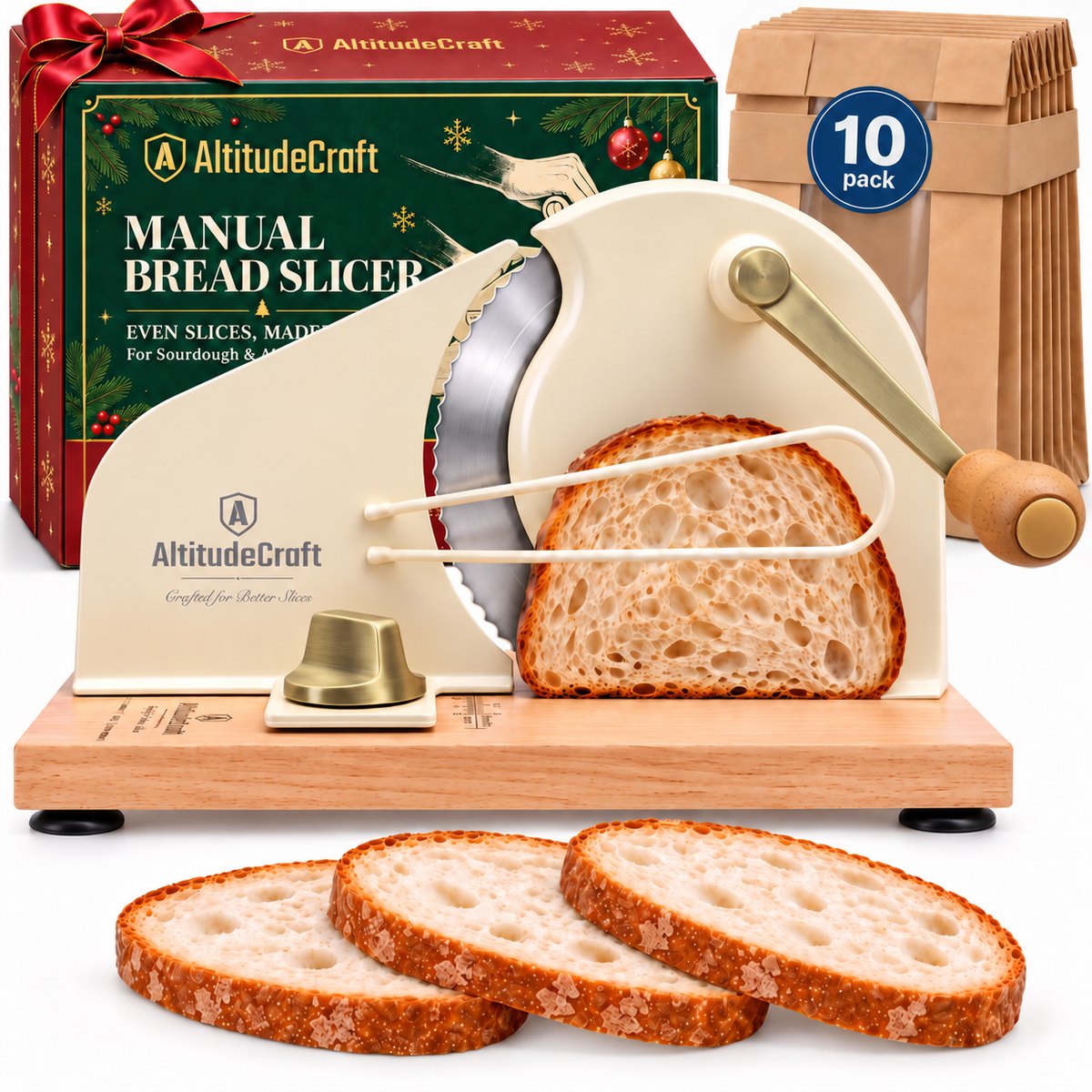
With a knife, press lightly and let the serrations do the work. See how to cut sourdough without squishing it. If you bake crusty sourdough every week, a manual slicer can make this step more consistent. The AltitudeCraft Manual Bread Slicer holds a cooled crusty loaf up to 5.5 inches tall and 10 inches wide. It cuts even slices up to 0.9 inch thick with a crank-turned serrated blade.
One honest caveat: no slicer or knife fixes a loaf that was cut warm, underbaked, or under-fermented. Slicing a cooled loaf only shows you a crumb that has already set properly.
Frequently Asked Questions
Why is my sourdough gummy inside even though the crust is dark?
Most often it was sliced too soon, or the dough was under-fermented. A dark crust means the outside baked well. Check how long the loaf cooled (at least 1–2 hours, per The Perfect Loaf), then whether bulk fermentation reached a 20–50% rise (The Perfect Loaf recipe). If your loaves are flat and gummy, Maurizio Leo's advice to a reader was to wait for 30–50%.
How do I make sure the loaf is done before it starts cooling?
Check the center with a fast instant-read thermometer as soon as the loaf comes out. King Arthur says a quick reading means that "if bread isn't done, it can quickly be returned to the oven, before it starts to cool." America's Test Kitchen adds that a pale loaf should keep baking even if it reads at or above the target temperature.
What internal temperature should sourdough reach?
About 205–208°F for a crusty sourdough. The Perfect Loaf targets about 208°F, and America's Test Kitchen aims for 205°F for lean breads. Enriched breads are done lower, around 190°F (America's Test Kitchen).
Does gummy sourdough mean my starter is bad?
Not necessarily. Gummy crumb usually comes from fermentation timing, the bake, or slicing warm. Maurizio Leo of The Perfect Loaf says that before you bake, a starter "should rise predictably and vigorously within 6-8 hours of a feeding, every time." If yours is slower, he suggests feeding it daily somewhere warm (75–78°F) until it gets there, before your next bake.
Sources: The Perfect Loaf ("Beginner's Sourdough Bread," including Maurizio Leo's replies to readers, October 2026; "The Best Way to Store Bread"); King Arthur Baking ("How to tell if bread is done," 2023; "How to tell if bread dough has risen enough," 2022; "5 tips for homemade sandwich bread," 2015; "Sourdough Starter" recipe); America's Test Kitchen ("Your Top Bread Baking Questions Answered"). Full links are in the source table for this draft.