




When to slice sourdough bread: once the base and the middle no longer feel warm, which is our own check. Published sources range from 45 minutes to six hours, depending on loaf size and flour, with rye taking longest. The crumb is still setting and releasing steam while it cools, so a loaf cut early can turn gummy and squash.
For the bigger picture on cutting homemade bread, see our complete guide to bread slicers.
Key takeaways
- Check by touch: rest the back of your hand on the base and the middle of the top. Neither should feel warm. This is our suggestion, because published times differ too much to rely on.
- Cooling is when starch hardens into a sliceable structure and steam leaves the loaf. Cut early and that steam escapes at once, which can leave the crumb damp or dry.
- Larger, denser and rye loaves take longer. One baking school's chart runs from 30 minutes for small rolls to 6 hours for a large rye loaf, with whole-grain loaves in between.
- Cool the loaf uncovered on a wire rack with space around it, and skip the fridge and the freezer.
- If you cannot wait, tear a piece off, or cool the loaf fully and toast a slice. The AltitudeCraft manual's slicing step starts with a cooled loaf.
Why Does Sourdough Need to Cool Before You Slice It?
Sourdough needs to cool because its structure is still forming. As the loaf cools, its starch hardens and gains the structure that makes it sliceable, and steam is still leaving the crumb. Cut too soon and the steam escapes at once, which can leave a damp, gummy slice or a dry loaf.
Tasting Table explains that "Retrogradation is the part where starch products harden and gain their structure." It adds that "Cutting into bread fresh out of the oven creates a massive hole through which steam can quickly escape."
Busby's Bakery School says: "Not allowing the steam to exit is a likely cause of a damp and gummy loaf."

How Long Should Sourdough Cool Before You Slice It?
Published sources do not agree on one number: 45 minutes, 1 to 2 hours and 2 to 6 hours all appear. Loaf size, flour and kitchen temperature change the answer, so the table shows each source's own figure. These are their hours, not ours.
| Source | Loaf | Time given |
|---|---|---|
| Tasting Table | "most standard-sized loaves" | 45 minutes, though "this might not be a one-size-fits-all standard"; the same page says a thorough cool-down can take "anywhere from two hours for crusty breads to six hours for denser whole grain loaves" |
| The Perfect Loaf | One beginner sourdough recipe | "Cool for 1 to 2 hours before slicing" |
| One baking school's chart (Busby's) | Small rolls | 30 minutes |
| One baking school's chart (Busby's) | Small white loaf (1 lb) | 2 hours |
| One baking school's chart (Busby's) | Large white loaf (1.5 lb) | 3 hours |
| One baking school's chart (Busby's) | Small whole-grain loaf (1 lb) | 3 hours |
| One baking school's chart (Busby's) | Large whole-grain loaf (1.5 lb) | 4 hours |
| One baking school's chart (Busby's) | Small rye loaf (at least 25% rye) | 4 hours |
| One baking school's chart (Busby's) | Large rye loaf (at least 25% rye) | 6 hours |
| A baker on The Fresh Loaf (forum) | Round 3 lb rye | "as long as 4 to 5 hours depending on the density of the crumb" |
| Pan sandwich loaf or soft bread | No source we found gives a time | Use the touch check below |
Busby's says: "Rye flour retains more moisture", and "Denser bread, in general, will need a longer time to cool." Direction is the one point every source shares: bigger, denser and rye loaves take longer.
How Do You Cool Sourdough and Know It's Cool Enough to Slice?
Cool the loaf uncovered on a wire rack with space around it, then check it by touch. Busby's says cooling on a rack "is the best way to cool bread at home." Our own three checks for readiness are below; they are our suggestions, not findings from the sources.
Busby's names four ways cooling goes wrong. Avoid these:
- Crowding. "Leave a 3” gap between loaves as they cool."
- Covering. Covering loaves "with a towel stops the moisture migrating out of the crust, leading to bread that has a damp and soggy crust."
- Chilling. In the freezer, "The outside of the loaf will cool quicker than the core, which can lead to a gummy crumb."
- Waiting too long. "For most sourdough bread, cooling over eight hours will dry it out too much."

With no thermometer, our suggestion is to try these in order:
- Touch. Rest the back of your hand on the base and on the middle of the top. Neither should feel warm. This matches the "no longer warm to the touch" test in our guide to slicing and freezing sourdough bread.
- Look. Watch the rack for a minute. A loaf still giving off visible steam is not ready.
- Tap. Knock on the base. This is a weaker clue than the first two, so use it only alongside them.
If you own a probe, Busby's target is a reading of "35-38C (95-100F) before slicing, which can take between 2 and 6 hours." That is one baking school's guideline, not a standard. Once the loaf is cool, our guide to slicing sourdough bread evenly covers the knife-and-board method.
Can You Cut Sourdough While It's Still Warm?
You can, but a warm loaf tends to cut gummy and squashed, and Tasting Table adds that cutting too soon can "dry out your bread." If you cannot wait, tear a piece off and leave the rest whole, cool the loaf fully and toast a slice, or reheat a cooled loaf briefly in the oven.
King Arthur Baking's sandwich-bread post, about a pan loaf rather than sourdough, says slicing compresses soft bread a little: "It'll set in this compressed/compromised state, never regaining its full height."
- Eat it warm, unsliced. A Fresh Loaf baker says: "if warm bread is a must have, then eat away." Our suggestion is to tear a piece off and let the rest finish cooling.
- Cool, slice, then toast. King Arthur Baking suggests you "Pop it into the toaster very briefly, just to warm."
- Reheat a cooled loaf. One Fresh Loaf baker's method: "we heat the oven to 400F then turn the oven OFF and put the already baked and cooled bread into the hot oven for 10 minutes." That is one baker's method, not our instruction.
If a loaf that has fully cooled still squashes, the cause may lie in the bake or the cut rather than the cooling.

Does a Cooled Loaf Slice Better in a Hand-Crank Bread Slicer?
The AltitudeCraft AC422 user manual's slicing step starts with a cooled loaf: "Place the cooled loaf against the guide and turn the crank smoothly." Our reasoning is that a loaf that has set holds its shape against the guide, while a warm one is still soft.
The next step reads "Guide the loaf gently and let the blade do the work." The box says the slicer "helps prevent squashed loaves", and we make no promise about warm bread. Very soft sandwich bread is still better cut with a knife, as our bread slicer vs bread knife comparison explains. Our bread slicer guide says "Crank-style slicers often struggle with very soft, fresh sandwich bread…" Before the first loaf, see how to keep a bread slicer from sliding.


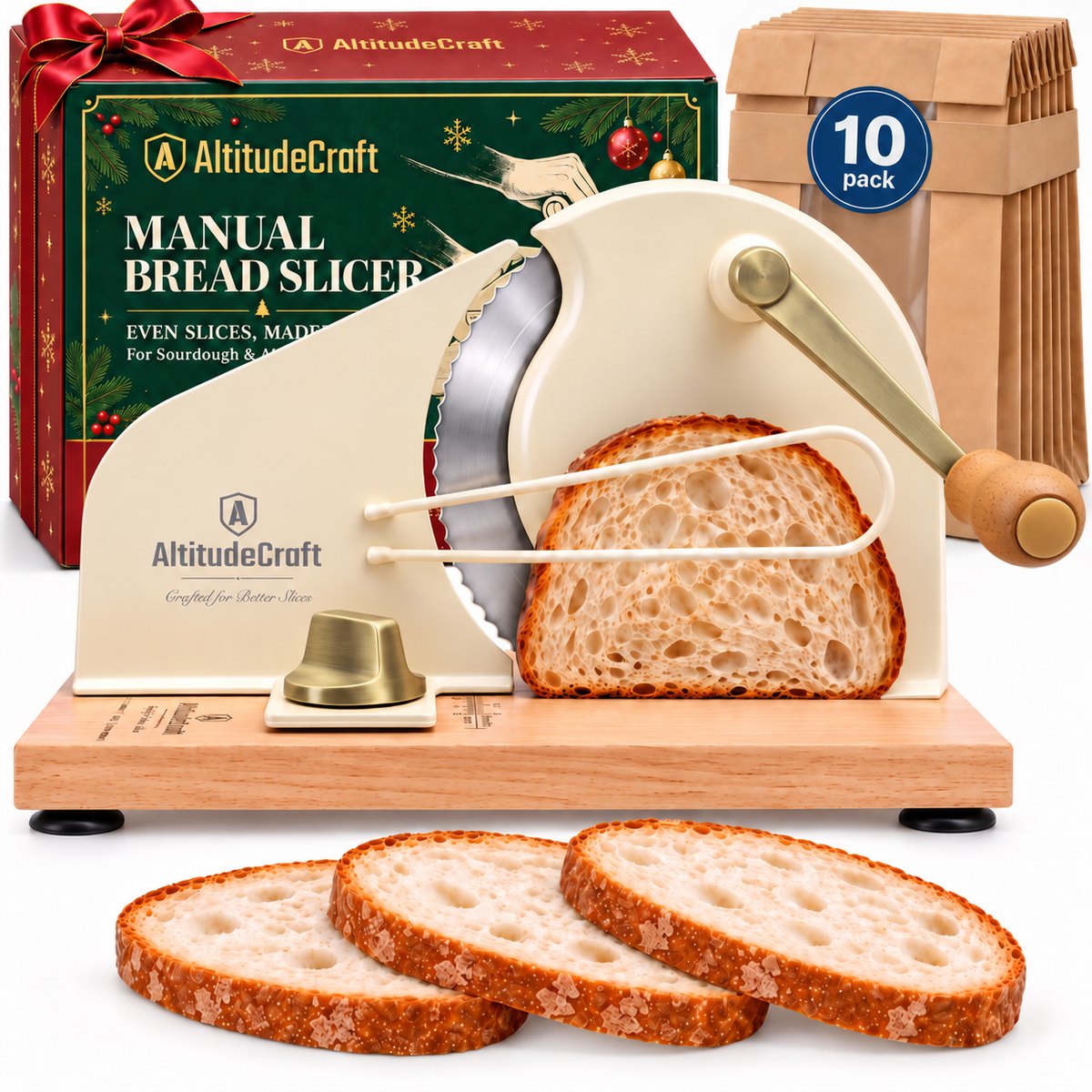
AltitudeCraft Manual Bread Slicer: a hand-crank slicer for sourdough and artisan loaves, with a stainless steel serrated blade and a solid wood base on suction cup feet. No electricity needed.
See the Manual Bread Slicer: see the current price on the product page.
Frequently Asked Questions About Slicing Sourdough After Baking
Can I slice sourdough after 1 hour?
Sometimes. One baking school's chart gives 2 hours for a 1 lb white loaf and 3 for a 1.5 lb one, and more for whole-grain and rye, while one recipe says 1 to 2 hours. Larger loaves need longer, so use the touch check.
How long should rye sourdough cool?
Longer than white sourdough. One baking school's chart lists 4 hours for a small rye loaf and 6 hours for a large one, and a Fresh Loaf baker says a round 3 lb rye can need 4 to 5 hours. Rye holds more moisture, so check by touch.
Is it okay to eat sourdough warm?
Yes. Tear a piece off and leave the rest whole to finish cooling. Slicing the whole loaf is what tends to give a gummy crumb.
Why is my sourdough gummy even after cooling?
If a loaf has fully cooled and is still gummy, the cause may lie in the bake or the fermentation rather than the cooling. Cooling explains a gummy slice only when the loaf was cut while still warm.
For the other causes of a gummy crumb and how to tell them apart, see why is my sourdough gummy.
Should I cover sourdough or chill it to cool faster?
No. Busby's says a towel leads to a damp, soggy crust and does not recommend the freezer, where the outside cools faster than the core.
The Bottom Line
Verdict: cool the loaf uncovered on a rack and cut when the base and middle no longer feel warm. Expect the longer end of the sources' ranges for rye and large loaves. If you cannot wait, tear a piece off.
The slicer comes with free shipping and 30-day returns. Still deciding? See is a hand-crank bread slicer worth it, browse the kitchen and baking collection, or open the AltitudeCraft Manual Bread Slicer. More guides are on the AltitudeCraft Kitchen blog.
Sources and How We Wrote This Guide
The cooling times and the reasons for cooling come from the sources below; the table compiles their statements and is not an AltitudeCraft test. The three readiness checks, the advice to tear off a piece and the point about a set loaf holding its shape are our suggestions and reasoning. The slicer section quotes only the AltitudeCraft AC422 user manual and the box. Images marked Illustration are AI-generated.
- AltitudeCraft AC422 user manual: slicing steps and safety warning.
- Busby's Bakery School: Cooling Sourdough Bread (accessed 2026-10-12)
- Tasting Table: Why You Shouldn't Slice Into Fresh-Baked Bread Before It's Cool (accessed 2026-10-12)
- The Perfect Loaf: Beginner's Sourdough Bread (accessed 2026-10-12)
- King Arthur Baking: Homemade sandwich bread, a pan sandwich loaf rather than sourdough (accessed 2026-10-12)
- The Fresh Loaf (forum threads, individual bakers' views): why do i have let bread cool i cut it and Cooling bread - how long to wait? (accessed 2026-10-12)