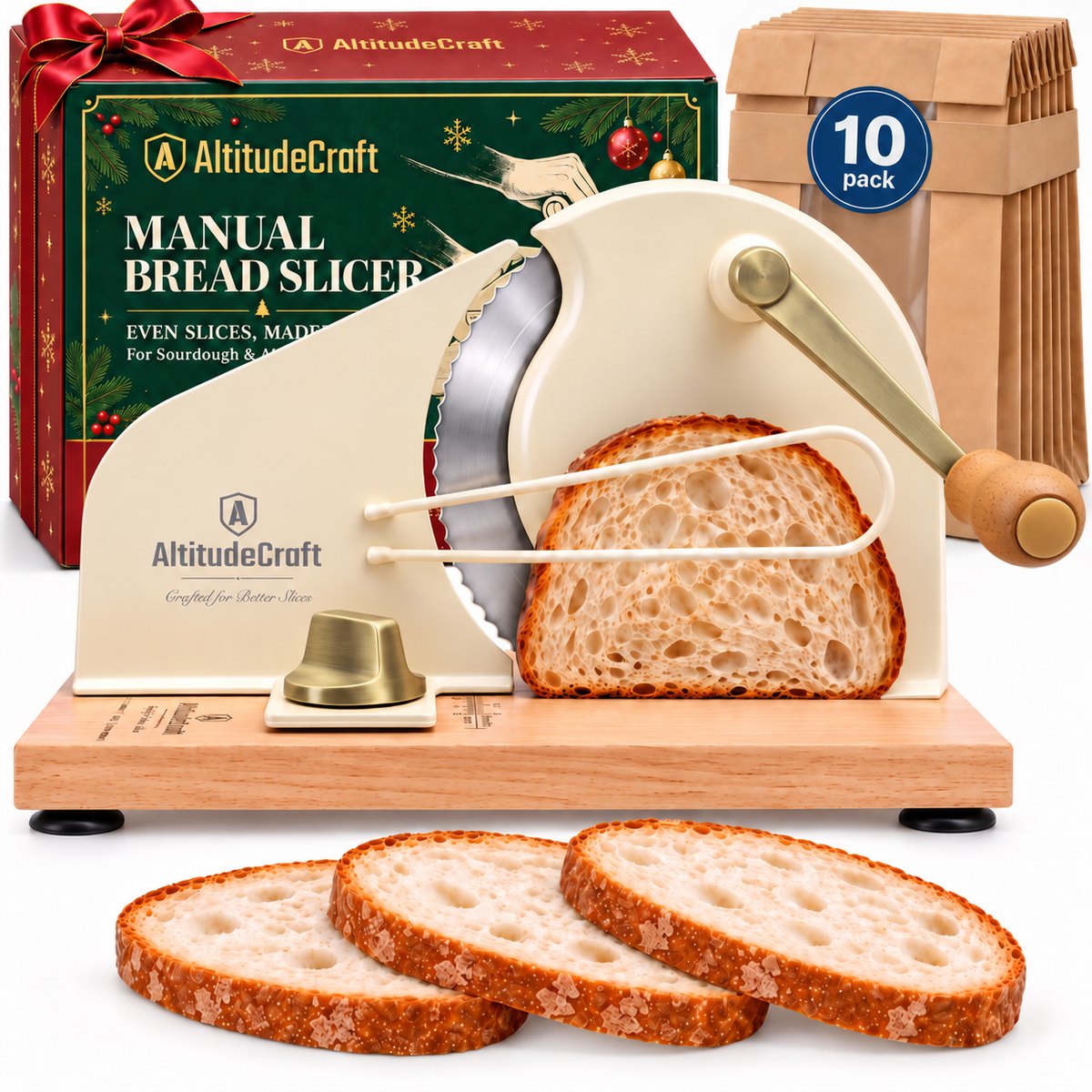





A hand-crank slicer works best on cooled, crusty sourdough and artisan loaves, which the AltitudeCraft Manual Bread Slicer is built for. Very soft, fresh bread can compress under any blade, so we do not promise soft sandwich bread or enriched loaves. The box says it "helps prevent squashed loaves," nothing more.
For the bigger picture, see our complete guide to bread slicers.
The slicer discussed here is our hand-crank sourdough bread slicer with a 6.7 in serrated blade.
Key takeaways
- The slicer is made for cooled, crusty sourdough and artisan loaves. For soft bread the only claim is the box wording, "helps prevent squashed loaves," and it is not a guarantee.
- Sources explain why bread that has not cooled tears or squashes. None compares soft and crusty loaves in a crank slicer, so that comparison here is our reasoning.
- The slicer takes loaves up to 5.5 in tall and 10 in wide, and length is not limited. Halve anything bigger first. Rye, baguettes, brioche and challah are untested.
- If you try a softer loaf, cool it completely, press the base down, guide the loaf lightly and let the blade do the work. Do not force it.
- If the first slice flattens, stop. For a very soft, fresh sandwich loaf, a bread knife is the better choice.
Can You Slice Soft Bread With a Manual Bread Slicer?
You can put a soft loaf in the slicer, but we do not promise a clean result. The AltitudeCraft slicer is built for crusty sourdough and artisan loaves, and the box says only that it "helps prevent squashed loaves." Very soft, fresh bread can compress under any blade.
That wording matches our product page, which says to let every loaf cool completely before slicing. It is the limit of the claim. If you mostly bake tender sandwich bread, read whether a hand-crank bread slicer is worth it before you buy.
Why Does Soft Bread Squash More Easily Than Crusty Sourdough?
Sources explain why bread that has not set squashes or tears: the American Society of Baking says cooling lets a loaf hold its shape "without collapsing under the cutter's mechanical action." No source we found compares soft and crusty loaves in a crank slicer, so that part is our reasoning.
For commercial bakeries, the American Society of Baking says insufficient cooling means "Slices will be ragged and may tear due to excessive moisture remaining in the loaf and the crumb being too soft." America's Test Kitchen says the interior of a warm loaf "is likely to be soft and gummy, making that warm loaf impossible to slice cleanly." Both describe commercial lines and knives, not hand-crank slicers.
Freshness is a second cause. Chowhound calls sandwich bread fresh from the oven "simply too squishy to cleanly slide a knife through." King Arthur Baking describes its brioche as "delightfully tender," which describes the eating, not the slicing.
Here is our reasoning, which no source has tested on a crank slicer. You push the loaf toward the guide while the blade turns, so that push goes into the crumb. A crusty loaf has a firm shell to carry it. A soft loaf with a thin crust has much less.

What Should You Expect From Each Type of Loaf?
Expect the most from cooled, crusty loaves, which the slicer is built for. Pan loaves, brioche and challah are not promised, and rye and baguettes are untested. Each row below shows its basis, so you can tell what the box and product page say from what is our reasoning.
The slicer takes loaves up to 5.5 in tall and 10 in wide, and length is not limited. Rows marked "untested" are not results.
| Loaf type | What to expect from this slicer | What to adjust | Basis |
|---|---|---|---|
| Crusty sourdough (boule, batard) | What it is built for. The box says "For Sourdough & Artisan Loaves." | Cool completely, set the thickness before you start, guide gently. | Box and product page |
| Rustic artisan loaves, baguette-style | Crusty like the artisan loaves the box names, though a baguette is not named. It is long and narrow, and length is not limited. | Cool fully. Our suggestion, untested: a light hold on a thin loaf. | Box; untested |
| Rye and dense whole-grain | Often a firm crust and dense crumb, so closer to artisan loaves (our reasoning). | Wait longer than you think. A gummy crumb is a resting matter, not a slicer one. | Recipe and baker sources; untested |
| Pan sandwich loaf (white, wheat) | Soft crumb, thin crust: the case the box does not promise. It can compress. | Fully cooled, not very stale, light hold. Knife if the first slice flattens. | Product page, KAB and Chowhound |
| Enriched brioche and challah | Tender, buttery crumb. Not promised. King Arthur Baking says challah "does tend to dry out after a day or so." Whether that firms it for slicing is our reasoning. | Same as a pan loaf. A knife is a fair choice for these. | KAB; untested |
| Very soft, fresh bread (just baked) | Where any blade struggles. Reach for a knife. | Let it cool. Do not force it. | Box and product page |
On rye, one deli rye recipe says "let cool completely, about 3 hours, before slicing and serving." One baker on The Fresh Loaf says "a lot of recipes recommend waiting 24-48 hours after baking before slicing into the loaf." That is one baker's account, not a rule.
Where you start a knife on a round or a pan loaf is covered in our guide to slicing sourdough evenly.

How Do You Slice Softer Bread in a Hand-Crank Slicer?
If you try a softer loaf, cool it completely, guide it gently and let the blade do the work. Our added suggestions are untested. If the first slice flattens, stop and switch to a knife.
- Cool the loaf completely. Manual and sourced. The manual says: "Place the cooled loaf against the guide and turn the crank smoothly." King Arthur Baking says: "Wait till the bread is completely cool before slicing."
- Do not let it get very dry. Sourced, plus our suggestion. The Takeout writes that "stale bread will be tougher to slice than fresh bread." Our suggestion: a cooled loaf a day old is a reasonable middle.
- Set the guide toward the thicker end of its scale. Our suggestion. Our reasoning is that a thicker slice has more bread to hold itself up. We have not measured it, so we give no number. Thickness is adjustable up to 0.9 in.
- Press the base down first. Manual and product page. The manual says: "Always secure the slicer before use," and our product page says to press the base down on a clean, smooth counter so the suction-cup feet hold. Our reasoning is that a soft loaf has less margin if the slicer shifts mid-cut. See how to keep a bread slicer from sliding.
- Guide the loaf lightly and let the blade work. Manual and sourced. The manual says: "Guide the loaf gently and let the blade do the work." A knifemaking expert quoted by The Takeout says: "Rest the loaf on a non-slip surface and hold it lightly. Gripping too hard or forcing the blade is what causes the bread to collapse before it's fully cut."
- Turn the crank smoothly, and stop if the first slice flattens. Manual and our suggestion. Use a knife for that loaf.

When Is a Bread Knife Still the Better Choice?
Pick a bread knife for very soft, fresh sandwich bread and for any loaf whose first slice flattens in the slicer. A loaf bigger than 5.5 in tall or 10 in wide needs halving first. This matches the boundary in our knife comparison.
Our guide on bread slicer vs bread knife puts a fresh sandwich loaf in the knife's column, and the pillar guide calls it a weak spot. The same guide also names cake and focaccia as knife jobs.

Is a Hand-Crank Slicer Right If You Bake Both Kinds?
If you mostly bake sourdough and artisan loaves, the slicer fits. If you mostly eat soft sandwich bread or brioche, use a knife. If you bake both, keep the slicer for crusty loaves and the knife for soft ones, so each tool stays on the bread it suits.
If you slice a whole crusty loaf and want to save some, see how to slice and freeze sourdough bread. For the full picture, see the bread slicer for homemade bread guide.

AltitudeCraft Manual Bread Slicer: a hand-crank slicer for sourdough and artisan loaves, with a stainless steel serrated blade and a solid wood base on suction cup feet. No electricity needed.
See the Manual Bread Slicer: see the current price on the product page.
Frequently Asked Questions About Soft Bread and a Hand-Crank Slicer
Can you slice soft bread with a manual bread slicer?
The slicer is built for crusty sourdough and artisan loaves. Softer bread can compress, so cool it completely first. For very soft, fresh bread, use a knife.
Will a hand-crank slicer squash fresh sandwich bread?
It can. The box says the slicer "helps prevent squashed loaves," which is not a guarantee. Very soft, fresh bread can compress under any blade.
Can I slice brioche or challah with a crank slicer?
We do not promise either loaf. If you try one, cool it completely and use a loaf you can spare.
Is warm bread easier to slice?
No. America's Test Kitchen, Chowhound and the American Society of Baking all say bread cut while warm tears or compresses.
Should soft bread be a day old before slicing?
That is our suggestion, untested. The sourced requirement is a fully cooled loaf, and The Takeout notes that stale bread is tougher to slice.
Can I slice rye or baguettes in the slicer?
Both are untested. The box names artisan loaves, rye needs a long rest, and a baguette's length is not limited, though the 5.5 in and 10 in limits apply.
The Bottom Line
Use the slicer for cooled, crusty sourdough and artisan loaves, and treat soft bread as not promised. Cool it completely, guide it lightly, stop if the first slice flattens and keep a bread knife for very soft, fresh loaves, since the box promises only that it "helps prevent squashed loaves."
Still deciding? See is a hand-crank bread slicer worth it or the AltitudeCraft Manual Bread Slicer. More baking guides are in the kitchen baking collection and on the AltitudeCraft Kitchen blog.
How We Put This Guide Together
Operating steps and safety lines come from the AltitudeCraft AC422 user manual, and product details from our product records. Other quotes come from the sources below. We have not tested the slicer on soft sandwich bread, brioche, challah, rye or baguettes, and this guide reports no results for them. Points labeled untested, our reasoning or our suggestion are not test findings. Images marked Illustration are AI-generated.
Sources
- AltitudeCraft AC422 user manual: operating instructions and safety warnings; AltitudeCraft product page.
- American Society of Baking: Bread Cooling (describes commercial bakeries, accessed 2026-10-12)
- America's Test Kitchen: How to Slice Bread (accessed 2026-10-12)
- Chowhound: For Easily Sliceable Homemade Bread, Stop Making This Rookie Mistake (accessed 2026-10-12)
- The Takeout: The Best Way To Slice Bread Without Crushing It (expert quoted by The Takeout, accessed 2026-10-12)
- King Arthur Baking: Sandwich bread fit for the king; Classic Challah; Brioche (accessed 2026-10-12)
- America's Test Kitchen: Classic Deli Rye at Home (one recipe's timing, accessed 2026-10-12)
- The Fresh Loaf: Rye bread gummy (one baker's account, accessed 2026-10-12)