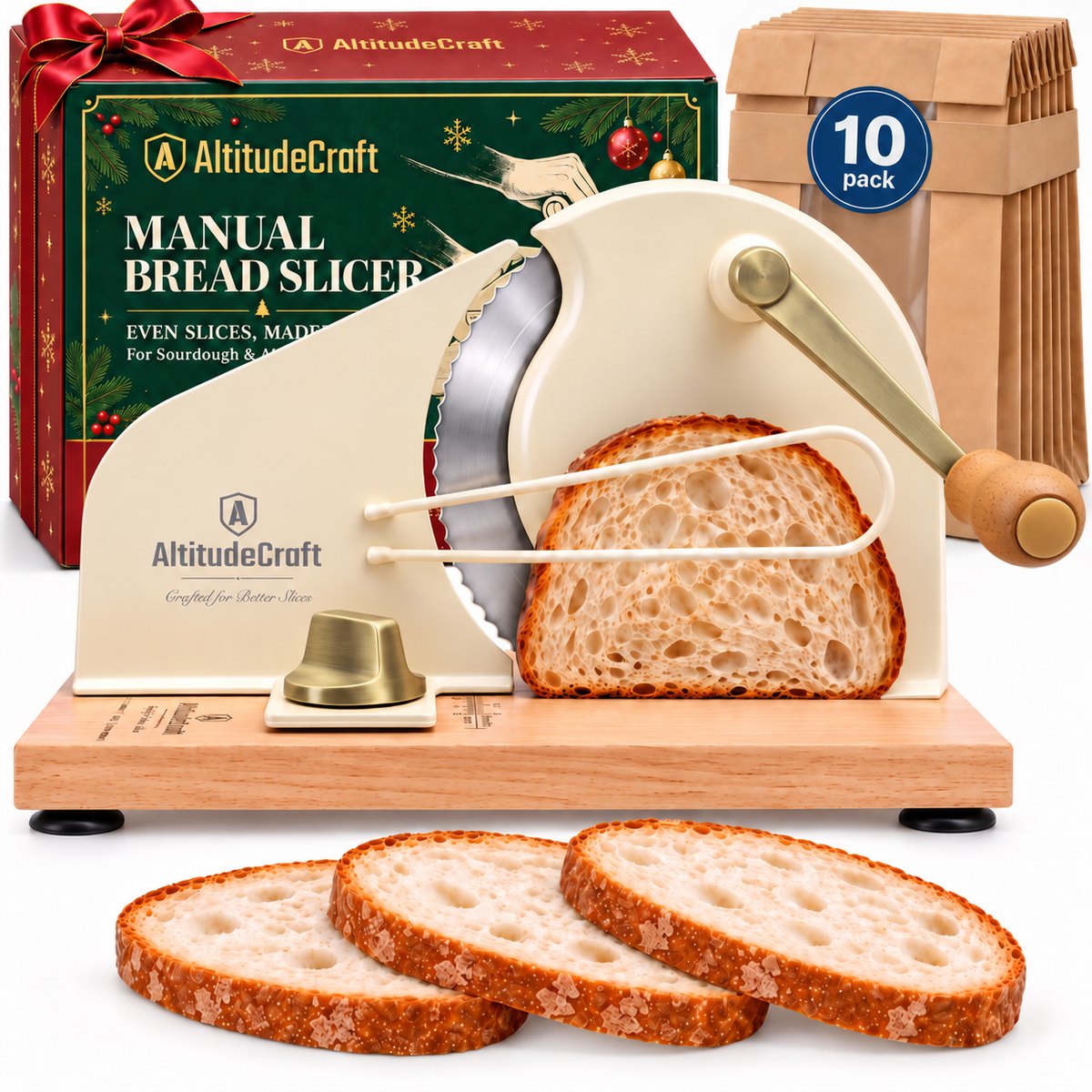




Yes, it needs a fixed spot, on the counter or a cabinet shelf. The AltitudeCraft manual bread slicer is about 30 cm (11.8 in) long not counting the crank, about 20 cm (7.9 in) wide and about 19.5 cm (7.7 in) tall, and it does not fold. Plan for that footprint, plus room to turn the crank and load a loaf.
For the bigger picture on choosing one, see our complete guide to bread slicers.
The footprint below is for our manual sourdough bread slicer.
Key takeaways
- The slicer is about 30 × 20 cm (about 11.8 × 7.9 in) on the counter and about 19.5 cm (7.7 in) tall. It weighs 1.9 kg (about 4.2 lb) and has a fixed frame that does not fold.
- The 30 cm length does not count the crank, which sticks out past the base. The footprint is the box; the working zone is bigger.
- Our reasoning: leave room for the crank to turn, for a loaf to sit in the machine (length is unlimited, so a long loaf extends past it) and for slices to land on the wood base.
- Before you buy, cut a cardboard template, measure the gap under your upper cabinets, and hold a loaf up to it.
- It is a hand crank, so it needs no outlet, but it does need a smooth, clean patch of counter for its suction cup feet.
How Big Is a Manual Bread Slicer, Really?
The AltitudeCraft manual bread slicer measures about 30 cm long, 20 cm wide and 19.5 cm tall (about 11.8 × 7.9 × 7.7 in). The 30 cm does not include the crank, which sticks out past the base. The frame is fixed and does not fold, so the numbers below are its size at all times.
| Measure | Metric | US | Note |
|---|---|---|---|
| Length | about 30 cm | about 11.8 in | Not counting the crank, which sticks out past the base |
| Width | about 20 cm | about 7.9 in | Base footprint |
| Height | about 19.5 cm | about 7.7 in | The slicer itself, with no loaf in it |
| Net weight | 1.9 kg | about 4.2 lb | Slicer only |
| Folds for storage? | No | Fixed frame; plan a counter or cupboard spot | |
A sheet of US letter paper is 11 × 8.5 in. Our reasoning: the footprint is close to one sheet of letter paper, a little longer and a little narrower. The crank adds to the length.
For a second yardstick, the National Kitchen & Bath Association guidelines call for a primary preparation area of continuous countertop "at least 36″ wide × 24″ deep (914 mm × 610 mm)" next to a sink. Our reasoning: the slicer's footprint is about 93 sq in against that area's 864 sq in, roughly 11 percent, before you add the crank and the loaf.

How Much Room Do You Need Around It to Slice?
The footprint is the box on the counter. The working zone is the box plus three things: room for your hand to turn the crank, room for the loaf, and room for slices to land. Our reasoning is that the working zone is larger than the footprint, and the loaf is the part that varies.
- The crank side. The crank sticks out past the base. This guide gives no figure for how far, so check that your hand can circle the handle without hitting a wall, a cabinet or the backsplash.
- The loaf side. The slicer takes loaves up to 5.5 in tall and 10 in wide, and the length is unlimited because you push the loaf forward, so a long loaf extends past the machine.
- The landing side. Cut slices drop out beside the blade onto the solid wood base. Leave a clear spot to lift them off, and keep your hands clear of the blade, as the manual says: "Keep hands and fingers clear of the blade."
Our guide to slicing sourdough bread evenly shows the loaf against the guide.

How Do You Measure Your Counter Before You Buy?
Measure your own spot in five steps: mark the footprint with a cardboard template, add the working zone, check the height under your cabinets, check the depth and confirm the patch is smooth and clean. Our reasoning is that a real loaf held up to the gap beats any single number.
- Cut a template. Cut a sheet of cardboard (or lay down a sheet of paper) about 30 × 20 cm (about 12 × 8 in) and set it where you would keep the slicer.
- Add the working zone. Lay an uncut loaf against the template to see where its length ends up. Then stand where you would crank and mime one full turn on the crank side, which sticks out past the base, to see what your hand and arm touch.
- Measure the height. The slicer is about 7.7 in tall. Costco's guide to measuring for major appliances says: "Measure the width of the opening at the countertop, under the upper cabinets and at the base if there is a molding." Use the same habit for height: measure at several points and keep the smallest gap. Then hold a loaf and your crank hand up to that gap.
- Check the depth. Hunker says "The typical kitchen countertop is 24 to 25 inches deep." Our reasoning: even the longer 11.8 in edge is under half of that, so depth alone is unlikely to be the limit. Your counter may differ, so measure it.
- Check the surface. The suction cup feet need a smooth, clean patch away from seams and tile joints. Our guide to keeping a bread slicer from sliding covers it.
The slicer is a hand crank with no cord, so it does not need to sit near an outlet.

For a planning reference, the National Kitchen & Bath Association guidelines list "24″ (610 mm) deep, with at least 15″ (381 mm) of clearance above" as needed to accommodate all counter uses. Our reasoning: 7.7 in is roughly half of that 15 in, but a loaf in the machine and the crank at the top of its turn add height this guide has not measured.

Three Measuring Mistakes to Avoid
- Measuring only the footprint. Fix: add the loaf and the crank side to the template, as in step 2.
- Measuring height only at the counter's front edge. Fix: measure at several points and keep the smallest gap, as in step 3.
- Guessing that your counter is standard. Fix: measure the depth and check the patch for seams, as in steps 4 and 5.
Is a Hand-Crank Slicer Bigger Than a Knife, Folding Guide or Electric Slicer?
A bread knife takes the least counter space, because it needs only a cutting board and a drawer. A hand-crank slicer takes more and does not fold. The table compares the types in general terms, so check the listed dimensions of any specific model before you buy.
| Tool | Footprint when in use | Between uses | Needs an outlet? |
|---|---|---|---|
| Bread knife | A cutting board | A drawer or knife block | No |
| Folding slicing guide | Varies by model; check the listed dimensions | Folds flat on foldable models | No |
| Electric slicer or knife | Varies by model; check the listed dimensions | Usually a counter spot or a case; the cord needs storing | Yes |
| Hand-crank slicer (AltitudeCraft) | About 30 × 20 cm (11.8 × 7.9 in), 19.5 cm tall, plus the crank | Does not fold; stays on the counter or a cabinet shelf | No |
On space alone, the knife wins. What the crank slicer trades space for is covered in bread slicer vs bread knife.
Is the Counter Space Worth It?
It is worth it if you slice a loaf most weeks and can give the slicer a permanent spot. It is not worth it if you bake only now and then, or if the only free spot is the back of a cupboard.
In return for the footprint, the slicer cuts the whole loaf at a thickness you set, up to 0.9 in. The full list of trade-offs is in is a hand-crank bread slicer worth it, and our pillar guide helps you decide between a counter spot and a shelf.
Where Do You Put It When You're Not Slicing?
The slicer does not fold, so it lives in one fixed spot: on the counter, or on a cabinet shelf you can reach without moving other things. Dry it before it goes away.
Our cleaning guide explains why never to store it damp.

AltitudeCraft Manual Bread Slicer: a hand-crank slicer for sourdough and artisan loaves, with a stainless steel serrated blade and a solid wood base on suction cup feet. No electricity needed.
See the Manual Bread Slicer: see the current price on the product page.
Frequently Asked Questions About Bread Slicer Counter Space
How big is the AltitudeCraft manual bread slicer?
It is about 30 cm (11.8 in) long, about 20 cm (7.9 in) wide and about 19.5 cm (7.7 in) tall. The 30 cm length does not include the crank, which sticks out past the base, and the net weight is 1.9 kg (about 4.2 lb).
Does a manual bread slicer fold flat?
The AltitudeCraft slicer does not. It has a fixed frame, so plan a permanent counter spot or a cabinet shelf for it.
Does it need an outlet or batteries?
No. It is a hand-crank slicer, so there is no cord, outlet or battery. It does need a smooth, clean patch of counter for its suction cup feet.
Will it fit under my upper cabinets?
The slicer is about 7.7 in tall, and a loaf in it and the crank at the top of its turn add height, so we cannot promise a fit. Measure the smallest gap under your cabinets and hold a loaf up to it.
Can I use it in a small kitchen?
It depends on whether you can give a slicer that is about 30 × 20 cm (11.8 × 7.9 in) and does not fold a permanent spot. Mark the footprint with a cardboard template and leave room for the crank and the loaf. If you have no spot, a bread knife is the honest answer on space.
Is it heavy to move around?
The AltitudeCraft slicer's net weight is 1.9 kg (about 4.2 lb), and it does not fold. The manual says: "Clean the counter and press the suction base firmly into place."
The Bottom Line
A bread slicer takes a fixed patch of counter, about 30 × 20 cm (about 11.8 × 7.9 in) and about 19.5 cm (7.7 in) tall, plus room for the crank, the loaf and the slices. Measure with a cardboard template before you decide.
If it suits your counter, the AltitudeCraft Manual Bread Slicer ships free with 30-day returns and a 1-year warranty, which you can extend free when you register it. More guides are in the kitchen baking collection and on the AltitudeCraft Kitchen blog.
How We Put This Guide Together
The dimensions, weight and loaf limits come from AltitudeCraft product records, and quotes from the sources below. This is a measuring guide, not a test report: it gives no figure for crank reach or working room, and points labeled our reasoning are arithmetic. Images marked Illustration are AI-generated.
Sources
- AltitudeCraft product records: dimensions, net weight, loaf size limits and the manual's safety lines.
- National Kitchen & Bath Association: Kitchen Planning Guidelines, Guidelines 12 (Preparation/Work Area) and 25 (Countertop Space) (accessed 2026-10-13)
- Hunker: Standard Kitchen Counter Depth (accessed 2026-10-13)
- Costco: Measure First for Appliances (accessed 2026-10-13)