


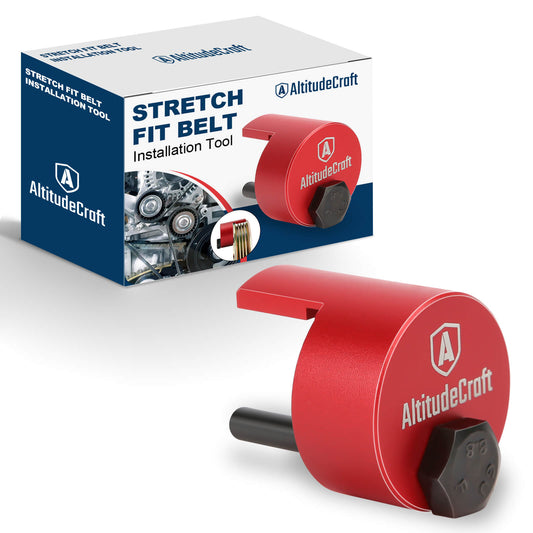


Will a Stretch Belt Tool Fit My Car? A 3-Test Fitment Check (Based on 340 Returns)
A stretch belt tool fits your car only if three things are true: the belt has no tensioner, it is a genuine stretch-fit elastic belt, and the tool can sit flush against the pulley face. Fail any one of them and no brand of stretch belt tool will help you — this guide shows you how to check all three in about a minute.
A stretch belt tool is one of the most returned tools in the automotive aisle — and almost never because it broke. We pulled every return on our own stretch belt installation tool: 340 returns, 279 of them with a written customer comment. Of those comments, 84 (30%) say some version of "it didn't fit my car" — and only a handful describe an actual defect.
That is a fitment problem, not a quality problem. And it is not specific to one brand: reviews of the OEMTOOLS, Duralast, Powerbuilt and Wilmar versions of this same tool contain the same complaints, about the same pulleys, on the same vehicles.
This guide is the fitment filter nobody in this category publishes, because it tells a meaningful share of shoppers not to buy. Three tests, in order. If you fail any one of them, a stretch belt tool will not help you.

The tool for this job
AltitudeCraft Stretch Belt Installation Tool
$14.99
Free shipping & free returns on US orders $25+
View productThe 30-Second Answer
Run these three tests before you buy. They take about a minute with the hood open.
| # | Test | If it fails |
|---|---|---|
| 1 | Does the belt you're replacing have a spring-loaded tensioner or an adjuster? | Wrong tool category. You need a serpentine belt tool, not a stretch belt tool. |
| 2 | Is it a genuine stretch-fit (elastic) belt — short, no tensioner, driving A/C, water pump or power steering only? | Wrong belt type. A stretch tool does nothing for a conventional belt. |
| 3 | Can the tool sit flush on the pulley face — spoked or open face, no raised hub, screw travel long enough? | Right category, wrong geometry. This is where most returns come from. |

Test 1: Does Your Belt Have a Tensioner?
This single question resolves the largest group of failed purchases in our data.
Conventional serpentine belts are built with aramid fiber cord specifically so they don't stretch. Because they can't stretch, the system needs a spring-loaded tensioner or a manual adjuster to take up slack. Stretch-fit belts are built the opposite way — with polyamide tensile cords engineered with a controlled amount of elasticity — which is exactly why they can run without any tensioner or idler at all.
So: if you can see a tensioner pulley on a spring-loaded arm, or a slotted bracket you loosen to adjust, your belt is not a stretch belt. A stretch belt tool has nothing to do on that engine.
This is what happened to a large share of the truck owners in our return data. Two representative comments, verbatim:
"Bought to help install new serpentine belts on 2011 Silverado 1500. The description stated that it was compatible, but it wasn't on any of the pulleys."
"Doesn't work on my 2020 1500 GMC Sierra, too small for the crank shaft pulley."
Both are correct observations — and both bought the wrong category. A full-size truck's crankshaft pulley is enormous compared to the small accessory pulley a stretch belt tool is sized for, and those trucks run tensioner-driven serpentine belts anyway. If that's your situation, a serpentine belt tool set is the tool you actually want.
Test 2: Is It Genuinely a Stretch-Fit Belt?
Stretch-fit belts are used in a narrow set of roles. They typically drive the A/C compressor, the water pump, or the power steering pump — never the whole accessory train. They're short, they loop around only two or three pulleys, and there is no adjustment hardware anywhere in the loop.
Common applications documented by the automotive trade press: GM began using stretch belts for the air-conditioning compressor on some 2009 LS V-8 models; Ford has used them for the power steering pump on the 3.5 V6 since 2007, and for the camshaft-driven water pump on the 3.0 V6. European makes — BMW, Mercedes-Benz, Audi, Volkswagen, Mini, Volvo — use them widely for A/C. UnderhoodService's overview of stretch-fit applications is a good reference if you're unsure about a specific engine.
The rule that catches people out: stretch belts are single-use
This is not a preference, it's the manufacturer's instruction. Gates states it plainly in Technical Service Bulletin TSB_072_US:
"Stretch fit belts are single use applications. Once removed a new Stretch Fit belt must be used."
Removing a stretch belt permanently over-elongates the polyamide cords. Reinstalling the same belt gives you a belt that is now too long, runs slack, squeals, and slips off. If you're planning to pull the belt off to get at something else and then put it back, order a new belt first. Gates also publishes per-part-number elastic belt installation instructions worth checking before you start.

Test 3: Can the Tool Actually Reach Your Pulley?
This is the test that produces the returns from people who bought exactly the right category of tool. 29 of the 279 written comments name the pulley or harmonic balancer specifically. Read together, they describe four distinct geometry failures.
Failure A — a solid pulley face with nothing to grab
The clearest description of the root cause came from a customer who diagnosed it himself:
"Won't work for solid pulleys. Looks like if they have spokes it would work."
That is exactly right, and it generalizes across every brand of stretch belt tool. These tools anchor by reaching through or across the pulley face. A pulley with spoke openings or a recessed face gives the tool purchase. A flat, fully solid disc does not.
Failure B — a raised hub or bolt head in the way
Several returns describe the tool being held off the pulley by something in the center:
"the crankshaft pulley had a bulge that would not let the tool sit flush" — 2011 Ford Fiesta
"would not fit between engine and pulley — bolt head interfered"
"It wouldn't sit flush on the crank pulley to install the serpentine belt. The bolt on the tool is too long."
Failure C — screw travel doesn't span the pulley
Note that this one fails in both directions, which is why a single tool can't cover every application:
"Did not fit on pulley like described — adjustment screw was not long enough" — 2014 Ford Fiesta
"Bought for Ford Edge belt installation. Will not work, bolt too short to contact pulley."
"the portion that fits over the pulley belt ribs is too wide" — Yukon
"The pulley was too wide, so the pin couldn't be placed correctly" — 2004 Mazda 3 s
Failure D — deep harmonic balancer
A harmonic balancer is not a simple pulley; it's a damper assembly with a rubber ring and significant depth. Tools sized for a flat accessory pulley slide right off:
"Item does not fit on the harmonic balancer pulley."
"couldn't even get it to stay on the balancer. Ended up using zip ties to install the belt."
"Says it helps with stretch belts but does not fit over the balancer on LT engines to install belt."

What the Return Data Actually Says
Here is the full reason breakdown for all 340 returns of our stretch belt installation tool, unedited. We're publishing it because the pattern is more useful to you than any spec sheet.
| Amazon return reason | Count | Share | What it usually means |
|---|---|---|---|
| NOT_COMPATIBLE | 86 | 25.3% | Failed Test 1 or Test 3 |
| UNWANTED_ITEM | 63 | 18.5% | Changed mind / no longer needed |
| NOT_AS_DESCRIBED | 34 | 10.0% | Mostly fitment expectations |
| DEFECTIVE | 33 | 9.7% | Mixed — includes "didn't work on my car" |
| QUALITY_UNACCEPTABLE | 26 | 7.6% | Mixed — includes fitment |
| EXCESSIVE_INSTALLATION | 25 | 7.4% | Couldn't get it seated |
| PART_NOT_COMPATIBLE | 24 | 7.1% | Failed Test 1 or Test 3 |
| ORDERED_WRONG_ITEM | 23 | 6.8% | Failed Test 1 |
| All other reasons combined | 26 | 7.6% | Shipping, damage, price |
The three unambiguous fitment codes alone — NOT_COMPATIBLE, PART_NOT_COMPATIBLE and ORDERED_WRONG_ITEM — total 133 of 340 returns (39.1%). Among the 279 written comments, 23 say the tool was too small or not big enough, while only 3 say it was too large. The dominant failure direction is a pulley bigger than the tool was designed for.
Vehicles that come up repeatedly in failed installs
This is not a compatibility list — it's a list of applications that generated real returns, with the reason. Treat it as a warning to run Test 3 carefully, not as proof your specific car won't work.
| Application | Reported failure | Which test it failed |
|---|---|---|
| Chevy Silverado 1500, GMC Sierra 1500, Tahoe, Yukon | Crank pulley far larger than the tool; belt is tensioner-driven | Test 1 |
| Ford Fiesta (2011, 2014, 2017) | Crank pulley bulge blocks flush seating; screw travel too short | Test 3 |
| Ford Edge | Bolt too short to contact the pulley | Test 3 |
| GM LT-series engines | Won't stay on the harmonic balancer | Test 3 |
| 2004 Mazda 3 | Pulley too wide for correct pin placement | Test 3 |
| 2017 Lincoln MKC | Did not fit the drive pulley | Test 3 |
| Medium/heavy trucks (e.g. Mack) | Belt and pulley sizes far outside the tool's range | Test 1 |

If All Three Tests Pass: Installing Without Ruining the Belt
Assuming you've confirmed a genuine stretch-fit belt on a pulley the tool can seat against, the procedure is short. The failure mode to avoid here is a damaged brand-new belt.
- Start with a new belt. Per the Gates bulletin above, the old one is finished the moment it comes off. Confirm the part number matches your engine.
- Seat the tool on the pulley and confirm it sits flush. If it rocks, wobbles, or stands off the face, stop. Forcing it from here is what breaks tools and gouges pulleys.
- Loop the belt over every other pulley first, leaving only the tooled pulley to go.
- Feed the belt onto the tool's guide ramp, so the belt rides the ramp rather than being levered over the pulley's rim edge.
- Rotate the crankshaft by hand in the normal direction of rotation. The belt walks up the ramp and onto the pulley. Never use the starter motor for this — that's how fingers and belts get destroyed.
- Remove the tool and turn the engine over by hand at least two full revolutions. Verify the belt is centered and fully seated in every groove on every pulley before starting the engine.
If the belt sits proud of a groove or rides off-center after two revolutions, it is not seated — take it off, get another new belt, and start again. A stretch belt that isn't fully seated will come off at speed.
What to Use Instead If You Failed a Test
| You failed | Your situation | What you actually need |
|---|---|---|
| Test 1 | Belt has a spring tensioner or adjuster | A serpentine belt tool set — long-reach ratcheting wrench to hold the tensioner off |
| Test 2 | Not sure what belt type you have | Look up the belt part number; a stretch belt has no tensioner anywhere in its loop |
| Test 3 (solid face) | Pulley has no spokes or openings | An application-specific OEM installer for that engine family |
| Test 3 (balancer) | Belt runs on a harmonic balancer | A balancer-specific installer sized to that damper's depth |
If your car does pass all three tests, our stretch belt installation tool is designed exactly for that case, and our comparison of stretch belt installation tools covers how the common options differ. If you're doing wider DIY suspension and drivetrain work, our guides to replacing struts with a spreader tool, choosing a strut spreader and disconnecting electrical connectors without breaking the tabs follow the same "understand the mechanism first" approach.

Frequently Asked Questions
Will a stretch belt tool work on any car?
No. It works only on genuine stretch-fit (elastic) belts, and only where the pulley face lets the tool seat flush. In our own return data, 133 of 340 returns (39.1%) were coded as an outright compatibility or wrong-item problem — the single largest cause of returns in the category.
Why does my stretch belt tool feel too small for my pulley?
Usually because the belt isn't a stretch belt. Stretch belt tools are sized for small accessory pulleys driving A/C, water pump or power steering. A full-size truck crankshaft pulley is much larger and normally sits on a tensioner-driven serpentine system, which this tool category does not address.
Can I reuse a stretch belt after removing it?
No. Gates Technical Service Bulletin TSB_072_US states that stretch fit belts are single-use applications and that once removed, a new belt must be used. Removal permanently over-elongates the polyamide cords, so a reused belt runs slack and can come off.
What's the difference between a stretch belt and a serpentine belt?
Construction. Conventional serpentine belts use aramid fiber cord that resists stretching, so the system needs a tensioner. Stretch-fit belts use polyamide tensile cords with engineered elasticity, which lets them run with no tensioner or idler at all.
Will the tool work on a harmonic balancer?
Often not. A harmonic balancer is a damper assembly with real depth, not a flat pulley. Multiple returns in our data describe the tool refusing to stay on the balancer — including on GM LT-series engines. Check side clearance before buying.
My pulley has a solid face with no spokes. Will it work?
Probably not. The tool anchors by reaching through or across the pulley face. Spoked or open-face pulleys give it purchase; a flat solid disc generally does not.
Can I install a stretch belt without a tool?
People do it with zip ties and screwdrivers — several of our returning customers said exactly that. It works often enough to be tempting, but levering a belt over a rim edge is the fastest way to damage the cords on a brand-new single-use belt, and a damaged stretch belt can fail at speed.
The Bottom Line
A stretch belt tool is a narrow tool that solves one specific problem very well: installing an elastic belt that has no tensioner, onto a pulley the tool can seat against. It is not a universal belt tool, and buying it as one is what generates roughly four in ten of its returns.
Run the three tests first. If you pass, the job takes ten minutes instead of an hour of prying. If you fail, you've saved yourself a return — and we'd rather tell you that up front than sell you the wrong tool.
Featured in this guide
AltitudeCraft Stretch Belt Installation Tool
$14.99
Free shipping & free returns on US orders $25+
View productRelated Articles
 AK and AR-15 Sight Adjustment Tools vs a Pistol Sight Pusher: Which Tool Do You Need? (2026)
Oct 16, 2026
AK and AR-15 Sight Adjustment Tools vs a Pistol Sight Pusher: Which Tool Do You Need? (2026)
Oct 16, 2026
 Which Hornady Comparator for 6.5 Creedmoor? Insert, Bushing, and Shoulder Bump Setup (2026)
Oct 15, 2026
Which Hornady Comparator for 6.5 Creedmoor? Insert, Bushing, and Shoulder Bump Setup (2026)
Oct 15, 2026
 How to Center Work in a 4-Jaw Chuck With a Dial Indicator (2026)
Oct 14, 2026
How to Center Work in a 4-Jaw Chuck With a Dial Indicator (2026)
Oct 14, 2026
 Stihl Trimmer Handle Extension: Will One Fit Your Stihl? (2026 Fitment Guide)
Oct 13, 2026
Stihl Trimmer Handle Extension: Will One Fit Your Stihl? (2026 Fitment Guide)
Oct 13, 2026
