


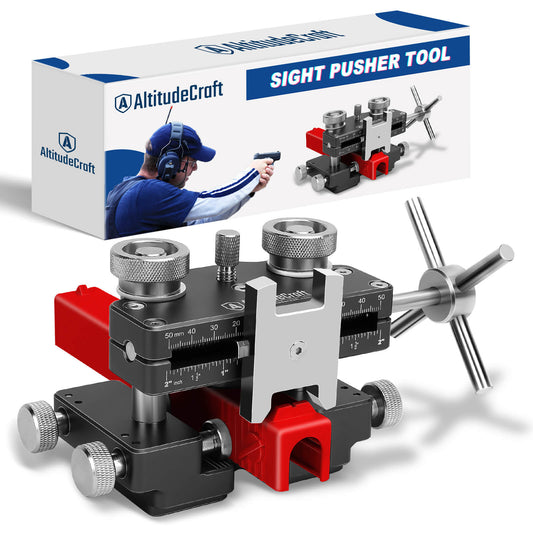

Why AltitudeCraft: Engineering-Grade Quality Tools Made for Professionals (2026)
Disclosure: AltitudeCraft manufactures and sells the products discussed in this article. All specifications, tolerances, and material claims are based on our actual manufacturing data and third-party material certifications. Last updated: April 2026.
The Problem with "Good Enough" Tools
If you've spent any time in a gun shop, automotive garage, or construction site, you already know the frustration. You buy a thread checker that wobbles in the housing. A sight pusher that flexes under pressure, scratching a $600 slide. A wrench extender that rounds off because the steel is too soft.
The tool industry has a dirty secret: most "precision" tools aren't precise at all. They're cast in bulk, finished to cosmetic tolerances, and marketed with specifications that describe the design intent—not what actually ships. When a catalog says "±0.005 inches," that's often the best-case number from a sample run, not an ongoing production standard.
We started AltitudeCraft because we kept running into this gap between what tools promised and what they delivered. The founding question was simple: What if a small manufacturer focused on making fewer tools, but made each one measurably better?

How We Actually Build Our Tools
Every AltitudeCraft product starts as a solid billet of raw material—not a casting, not a stamping, not a metal injection molding blank. We use 3-axis and 4-axis CNC milling centers to cut each part from a single piece of stock. This costs more per unit than casting, but it eliminates the porosity, grain inconsistencies, and dimensional drift that plague cast parts.
The CNC Machining Process
Our standard production cycle for a single component runs approximately 4 to 7 minutes of active cutting time, depending on complexity. Here's what that looks like in practice:
- Raw stock verification: Every billet gets measured with digital calipers before loading. We reject stock that's out of spec from the mill—this happens about 3% of the time with aluminum and 1.5% with steel alloys.
- First-pass roughing: A carbide end mill removes bulk material at 8,000-12,000 RPM, leaving 0.010" of stock for the finish pass.
- Finish machining: A fresh tool path runs at slower feed rates with a fine-pitch end mill, bringing dimensions to final tolerance.
- Deburring and edge break: Every cut edge gets a 0.005-0.010" chamfer to eliminate sharp burrs that could cut hands or damage mating surfaces.
- Surface treatment: Depending on the product, parts receive Type III hard anodizing (aluminum), black oxide coating (steel), or bead blasting for grip texture.
The key difference from mass production is the finish pass. Most high-volume manufacturers skip the dedicated finish cut to save cycle time—it adds 45-90 seconds per part, which multiplies into real cost at 10,000+ units. We run it on every single part because that's where ±0.001" tolerance lives.
Material Selection: Why It Matters More Than Brand Names
Material choice is where most tool buyers get misled. Marketing copy loves phrases like "aircraft-grade aluminum" or "hardened steel" without specifying the actual alloy, temper, or heat treatment. Here's what we use and why:
6061-T6 Aluminum
This is the backbone alloy for our lighter tools—the Optic Adapter Plate, Sight Pusher Tool, and Bullet Comparator Kit. The "T6" designation matters enormously: it means the aluminum has been solution heat-treated and artificially aged, reaching a tensile strength of approximately 45,000 PSI and a Brinell hardness of 95. For reference, the commonly substituted 6063-T5 (which cheaper tools use) only reaches about 27,000 PSI tensile strength—a 40% reduction in structural capacity.
We source our 6061-T6 from domestic mills that certify conformance to ASTM B221, the standard specification for aluminum alloy extruded bars, rods, and profiles. Each shipment arrives with a mill certification showing the actual chemical composition and mechanical test results.
Chrome Vanadium Steel (Cr-V)
Our Wrench Extender Set and Thread Checker use chrome vanadium steel, the same alloy family found in professional socket sets from brands like Snap-on and Knipex. The chrome content (typically 0.80-1.10%) provides corrosion resistance, while vanadium (0.15-0.25%) dramatically improves grain structure and wear resistance after heat treatment.
After machining, Cr-V components go through a controlled heat treatment cycle: austenitizing at approximately 1,550°F, oil quenching, then tempering at 400-450°F to reach a final hardness of HRC 48-52. This is the sweet spot where the steel is hard enough to resist deformation under working loads but tough enough that it won't crack or chip under impact.
Heat-Treated Alloy Steel
For high-stress applications like the Suspension Strut Spreader, we use 4140 alloy steel—a chromium-molybdenum grade with excellent fatigue resistance. The strut spreader experiences repeated high-load cycles as it separates suspension components, so fatigue life is the primary engineering concern. We heat treat to HRC 38-42, which gives a fatigue endurance limit of approximately 80,000 PSI—well above the working stresses the tool encounters in service.
Complete Product Range: 14 Tools Across 4 Disciplines
We deliberately keep our catalog small. Every product exists because we identified a specific gap where existing tools failed professionals. Here's our full lineup with the key material and precision specs:
| Product | Category | Primary Material | Key Tolerance | Surface Finish |
|---|---|---|---|---|
| Optic Adapter Plate | Firearms | 6061-T6 Aluminum | ±0.001" | Type III Hard Anodize |
| Thread Checker | General / Automotive | Chrome Vanadium Steel | ±0.001" | Black Oxide |
| Sight Pusher Tool | Firearms | 6061-T6 Aluminum + Steel | ±0.001" | Hard Anodize + Black Oxide |
| Bullet Comparator Kit | Firearms / Reloading | 6061-T6 Aluminum | ±0.0005" | Precision Ground |
| Strut Spreader | Automotive | 4140 Alloy Steel | ±0.002" | Black Oxide |
| Tubing Straightener | Automotive / Plumbing | Hardened Steel Rollers | ±0.002" | Chrome Plated |
| 16" Framing Layout Tool | Construction | 6061-T6 Aluminum | ±0.005" | Anodized |
| Wrench Extender Set | General / Automotive | Chrome Vanadium Steel | ±0.002" | Chrome Plated |
Note: Tolerances shown are the production standard maintained across all units, not best-case samples. View our complete product catalog to explore every tool in detail.
Quality Control: What ±0.001" Actually Means in Practice
A tolerance of ±0.001 inches is roughly one-quarter the thickness of a human hair. To put that in context: if you stack 10 sheets of standard copy paper, the total thickness is about 0.040 inches. Our tolerance band is 40 times smaller than that stack.
Maintaining this precision requires more than good CNC programming. Here's our actual QC process:
In-Process Inspection
Every 10th part gets pulled from the production run and measured on a granite surface plate with calibrated digital indicators. If any dimension drifts beyond 50% of the tolerance band (±0.0005" on a ±0.001" part), we stop the run and check tool wear. CNC cutting tools wear predictably—carbide end mills lose approximately 0.0002" of effective diameter per 100 minutes of cutting in aluminum—so we replace tools on a preventive schedule, not after a bad part appears.
Final Inspection
Before packaging, every single unit (not sampling—100% inspection) gets checked for critical dimensions, surface finish, and cosmetic defects. Our reject rate after final inspection averages 2.1% across all products, which is significantly tighter than the 5-8% industry norm for precision machined components.
We follow quality management principles aligned with ISO 9001:2015 standards for quality management systems, ensuring our processes are documented, repeatable, and continuously improved.
Honest Competitive Positioning
We're not going to pretend we're the right choice for everyone. Here's an honest assessment of where AltitudeCraft fits in the market:
Where We Win
- Precision-critical applications: If you're mounting a red dot on a carry gun, measuring bullet COAL for a competition load, or identifying a mystery thread pitch on a critical fastener, our tools are measurably more accurate than mass-market alternatives.
- Material quality: We use the same grades of material that professional-tier brands use, at a price point 30-50% lower because we sell direct.
- Specialization: Each tool solves one problem well. We don't make 500 SKUs of mediocre tools—we make 14 that professionals actually rely on.
Where We Don't
- If you need a complete tool set: We're not a one-stop shop. You'll still need your Knipex pliers, Wiha screwdrivers, and Snap-on sockets. We fill specific gaps those brands don't cover.
- If price is the only factor: A $12 Amazon sight pusher exists. It will work—once or twice. But if you're willing to spend $12 and risk scratching a slide, we're not competing for that purchase.
- Large-scale industrial orders: We're set up for professional individual and small-shop volumes. If you need 5,000 units with EDI integration, a larger manufacturer is a better fit.
Real-World Use Cases: How Professionals Use Our Tools
Numbers and materials only matter if they translate to real performance. Here's how our tools perform in the field:
Gunsmiths and the Optic Adapter Plate
Mounting a micro red dot to a pistol slide requires the adapter plate to sit perfectly flush—any gap allows the optic to shift under recoil, destroying zero. Our Optic Adapter Plate machines to a surface flatness of 0.0005" across the mounting face, which is tighter than most optic manufacturers specify for their own mounting surfaces. Gunsmiths who've switched from generic adapter plates consistently report zero retention through 1,000+ round counts without re-zeroing.
Automotive Technicians and the Strut Spreader
Replacing front struts on European vehicles—particularly VW, Audi, and BMW platforms—requires spreading the steering knuckle to clear the strut body. The common approach is a pry bar and hammer, which damages the knuckle bore and leads to premature bushing wear. Our Suspension Strut Spreader applies controlled, even force through a screw mechanism, spreading the knuckle without deformation. Technicians report cutting strut replacement time by 15-20 minutes per side because they're not fighting seized components.
Reloaders and the Bullet Comparator Kit
Competitive shooters measuring cartridge overall length (COAL) to the bullet ogive—rather than the tip—need sub-thousandth repeatability. Our Bullet Comparator Kit inserts are ground to ±0.0005", meaning your measurement variation comes from the caliper, not our tool. This matters when you're chasing 0.3 MOA groups and every thousandth of seating depth affects pressure curves.
The Economics of Precision: Why Smaller Can Mean Better
A reasonable question: if bigger manufacturers have more resources, shouldn't they make better tools? In theory, yes. In practice, scale creates pressures that work against precision:
- Cycle time pressure: When you're making 50,000 units per month, every second of machine time costs real money. The finish pass that takes us to ±0.001" adds 60-90 seconds per part—$0.50-0.75 per unit in machine time. At 50,000 units, that's $25,000-37,500 per month. Most production managers cut it.
- Supplier compromises: Large manufacturers negotiate material contracts on price. When 6061-T6 costs $0.15/lb more than 6063-T5, and you're buying 200,000 lbs per year, that's $30,000 in margin. The spec sheet might still say "aircraft aluminum," but the alloy grade quietly changes.
- QC sampling vs. 100% inspection: Statistical sampling (AQL 2.5, for example) is industry standard at volume. It means approximately 2.5% of defective units are expected to ship. We inspect every unit because our volumes make 100% inspection economically feasible.
This isn't a criticism of large manufacturers—they're optimizing for a different set of constraints. But for professionals who need tools that work perfectly every time, the economics of a focused small manufacturer actually work in your favor.
What We're Working On Next
Transparency means telling you where we're going, not just where we are. In 2026, we're focused on:
- Expanding our firearms tool line with additional caliber-specific components for the Bullet Comparator system
- Improving surface treatments by testing Cerakote alternatives to traditional anodizing for improved abrasion resistance in field conditions
- Building out educational content on our Insights blog with detailed installation guides, material science explanations, and tool maintenance tutorials
We release new products slowly—typically 2-3 per year—because each one goes through a 4-6 month development cycle including multiple prototype iterations and field testing with working professionals before production.
Frequently Asked Questions
Where are AltitudeCraft tools manufactured?
All AltitudeCraft tools are CNC-machined from solid billet stock. We control the entire production process from raw material procurement through final inspection and packaging. Our manufacturing focuses on precision over volume, with every component cut from certified material stock rather than cast or stamped.
What does ±0.001" tolerance mean for everyday use?
A tolerance of ±0.001 inches (one thousandth of an inch) means the finished dimension can vary by no more than the thickness of approximately one-quarter of a human hair from the design specification. In practice, this ensures components like optic adapter plates sit perfectly flush, thread checkers engage accurately on the first try, and bullet comparator measurements are repeatable to a level that competitive shooters require.
Why does AltitudeCraft use 6061-T6 aluminum instead of cheaper alloys?
6061-T6 aluminum offers approximately 45,000 PSI tensile strength compared to about 27,000 PSI for the commonly substituted 6063-T5—a 40% improvement in structural capacity. The T6 temper designation means the material has been solution heat-treated and artificially aged, resulting in superior hardness, wear resistance, and dimensional stability under load. For tools that must maintain precision over thousands of uses, this material difference directly translates to longer service life and consistent performance.
How does AltitudeCraft compare to larger tool brands?
AltitudeCraft is not a replacement for comprehensive tool brands like Snap-on or Knipex—we fill specific precision gaps they don't cover. Our advantage is focus: 14 specialized tools with 100% final inspection, CNC-machined from certified material stock, at price points 30-50% below comparable specialty manufacturers because we sell direct to consumers. Where we don't compete is breadth of catalog or large-volume industrial supply.
Does AltitudeCraft offer a warranty on its tools?
Yes. Every AltitudeCraft tool is backed by our satisfaction guarantee. If a tool doesn't meet the published specifications or develops a defect under normal use, we replace it. Our tools are engineered for professional-grade durability—heat-treated steel components are rated for tens of thousands of cycles, and anodized aluminum components resist corrosion and surface wear in shop and field environments.
What quality standards does AltitudeCraft follow?
Our manufacturing and quality control processes are aligned with ISO 9001:2015 quality management principles. We source materials certified to ASTM specifications (including ASTM B221 for aluminum alloy products), maintain documented inspection procedures, and perform 100% final inspection on every unit produced—significantly exceeding the statistical sampling (AQL) methods used by most manufacturers in our product categories.
The Bottom Line
AltitudeCraft exists to make precision tools that professionals can trust without second-guessing. We're not the cheapest option, and we're not trying to be. We're the manufacturer that machines every part from solid billet, inspects every unit before it ships, and publishes real tolerances—not marketing numbers.
If you're a gunsmith, competitive shooter, automotive technician, or tradesperson who's tired of tools that almost work, explore our complete product lineup and see the difference that genuine precision engineering makes.
Related Articles
 CNC Drag Knife Shank Sizes: Will 1/4", 3/8", or 1/2" Fit Your CNC?
Aug 03, 2026
CNC Drag Knife Shank Sizes: Will 1/4", 3/8", or 1/2" Fit Your CNC?
Aug 03, 2026
 Strut Spreader Tool Complete Guide: DIY Suspension Work Made Easy (2026)
Apr 02, 2026
Strut Spreader Tool Complete Guide: DIY Suspension Work Made Easy (2026)
Apr 02, 2026
 Thread Checker Complete Guide: Identify Any Bolt Size in Seconds (2026)
Apr 02, 2026
Thread Checker Complete Guide: Identify Any Bolt Size in Seconds (2026)
Apr 02, 2026
 Sight Pusher Tool Complete Guide: How to Install Glock Sights Like a Pro (2026)
Apr 02, 2026
Sight Pusher Tool Complete Guide: How to Install Glock Sights Like a Pro (2026)
Apr 02, 2026
