


Tandem Slide Stopper for Dry Van and Reefer Trailers: What Fits, What Doesn't
Reefer operators on multi-stop routes and dry van drivers running the same lanes face the same problem: the axle weights on the scale ticket depend on where the tandems sit, and every extra pass across the scale costs time and money. A tandem slide stopper gives you a physical stop at the hole you calculated, so one move gets you there. This guide covers how that plays out on reefers and dry vans, and which trailers a stopper does not suit.
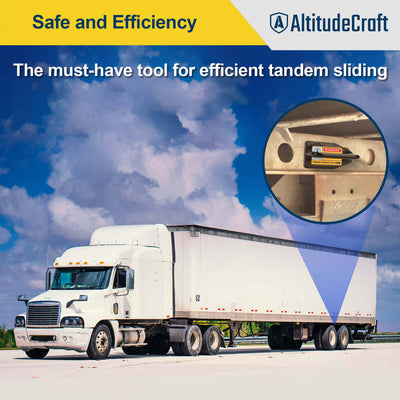
AltitudeCraft Tandem Slide Stopper
A magnetic carbon-steel stopper you set at your target hole before you slide. 1-year warranty, and a 3-year extended warranty can be applied for on altitudecraft.com.
Key Takeaway: A tandem slide stopper is a magnetic alignment aid you set on the slider rail at the target hole before you slide. It is made for trailers with sliding tandems, such as dry vans and reefers. We do not claim fit for flatbed, spread-axle or fixed-axle trailers, and a magnet will not hold on an aluminum rail, so test your rail with a magnet and measure the hole first. The weight each hole moves is not a constant: it equals roughly the weight on the trailer axles times the hole spacing, divided by the kingpin-to-rear-axle distance. That is why a half-empty reefer and a full dry van need different hole counts. Slide back and weight moves forward onto the drives; slide forward and weight moves back onto the trailer tandems. Remove the stopper before you drive.


The tool for this job
AltitudeCraft Tandem Slide Stopper for Semi Truck
$39.99
Free shipping & free returns on US orders $25+
View productWhy Does Tandem Position Matter on a Sliding-Tandem Trailer?
Tandem position decides how the load splits between the tractor's drive axles and the trailer's axles. The kingpin is the pivot. The cargo creates a moment about it, and the trailer axle group carries that moment divided by its distance from the kingpin. Move the bogie rearward and that distance grows, so the trailer axles carry less and the drives carry more. Move it forward and the reverse happens.
How much moves per hole follows the formula used throughout our guides:
Weight shifted per hole ≈ (current trailer axle weight × hole spacing) ÷ kingpin-to-rear-axle distance
An earlier version of this page quoted a per-inch figure. That framing was wrong: the hundreds-of-pounds figures drivers quote are per hole, and holes are 4 or 6 inches apart. The weight per hole also falls as the trailer gets lighter. The tandem slide chart has the full table and the complete sliding guide has the procedure. Federal limits on the Interstate are 20,000 lb on a single axle, 34,000 lb on a tandem axle group and 80,000 lb gross, per the FHWA Bridge Formula Weights publication.
Which Trailers Is the Stopper Not For?
The stopper is made for trailers whose tandems slide on a slider box, which in practice means dry vans and reefers. It does not suit fixed-axle trailers, and we do not claim fit for spread-axle trailers, flatbeds or step-decks: some of them have no sliding tandem at all, and we have not verified fit on them. If you are not sure your trailer slides, look for slider pins and a rail with holes before you buy.
Two checks apply even on a sliding-tandem trailer:
- Check the rail material. Some lightweight trailers use aluminum rails. If a magnet does not stick to your rail, a magnetic stopper will not hold there.
- Measure the hole. Hole size and spacing vary by builder and model year, and the AltitudeCraft pin is 1.5 in (38 mm) in diameter.
Reefer Trailers: Weight Changes at Every Stop
A refrigerated trailer carries the extra weight of its refrigeration unit at the nose, which moves the load toward the front compared with an equivalent dry van load. On a multi-stop route the picture changes at every drop, because delivering freight changes how much weight sits on the trailer axles. And since each hole moves a share of the weight on the trailer axles, the same hole moves less weight as the trailer empties.
Using the formula: with 20,000 lb on the trailer tandems at 6-inch spacing and a 40-foot distance, a hole moves about 250 lb. After enough freight comes off to leave 12,000 lb on those axles, the same hole moves only about 150 lb. A driver who memorized one number and applies it all day will slide too far on the lighter trailer.
- Less time beside the trailer. Setting the stop from outside once beats repeated trips to check pin position in the cold or wet.
- Mark the plan. If you know your stops and their weights, work out each target hole in advance and mark them with a paint marker; the stopper then goes at the one you need.
- Rails are the same as on dry vans. Reefer slider rails use the same basic design, so fit questions are about hole size and rail material, not the refrigeration unit.

Dry Vans: Same Lanes, Same Loads
Dry vans are the highest-volume trailer type, and the driver rarely controls how a shipper places the pallets. You load, scale, and adjust the tandems to fit wherever the freight landed. If you run the same lanes and loads repeatedly, the right hole for each shipper becomes predictable, and a stopper lets you return to it without recounting holes in the dark.
A stopper also helps with training. New drivers overshoot, release pins at the wrong time or skip the check that both pins reseated. A physical stop at the target hole makes the sequence more intuitive, but it does not replace the pin check.

Trailer Types Compared
| Trailer type | Where the weight comes from | Main challenge | How a stopper helps |
|---|---|---|---|
| Reefer | Freight plus the nose-mounted refrigeration unit | Weight on the trailer axles changes at each stop | Fewer trips beside the trailer in bad weather; marked positions per stop |
| Dry van | Palletized freight placed by the shipper | You adjust to wherever the pallets landed | Return to a known hole on repeat lanes |

State Rules That Limit How Far Back You Can Slide
Federal axle limits are only the start. Many states also limit the distance from the kingpin to the rear axle. California is the one most drivers plan around: Caltrans states that legal trucks "must not exceed a kingpin-to-rear-axle (KPRA) length of 40 feet," measured to the rearmost axle of the group. A position that is legal in one state can be illegal two states later, so the route decides the position, not habit. Counting holes controls axle weights; length rules control where the group is allowed to sit, and the two can conflict. For other states, check the state DOT for each state on your route rather than relying on a general table.
Using a Stopper on a Sliding-Tandem Trailer
- Weigh and work out the target hole with the formula above.
- Wipe the rail and the stopper face, then insert the stopper that many holes from the end of the slider box, on the side the tandems will move toward.
- Set the trailer brakes (red knob out), release the tractor brakes (yellow knob in), follow your carrier's chocking procedure and unlock both slider pins.
- Move at walking speed (2-3 mph) until the bogie meets the stopper, then stop.
- Reseat both pins and pull on each by hand to confirm.
- Take the stopper off the rail before you drive, then re-weigh.
The full explanation of each step is in the complete sliding guide. Browse the full trucking tool collection for other tools, and compare stopper designs in magnetic vs manual tandem slide stoppers.

Frequently Asked Questions
Does a tandem slide stopper work on all trailer brands and models?
It works where your slider rail is steel and the rail hole matches the stopper's peg. Those conditions are common but not universal: hole diameter and spacing vary by builder and model year, and some lightweight trailers use aluminum rails. Test the rail with a magnet and measure the hole before you order; the AltitudeCraft pin is 1.5 in (38 mm) in diameter. We claim fit only for sliding-tandem dry vans and reefers.
How strong is the magnetic hold during highway driving?
The stopper is not meant to be on the trailer while you drive. The magnet holds it on the rail during the slide, and the stopper body stops the bogie at walking speed. Once the pins are seated, the pins hold the tandems, and the stopper comes off before you drive.
Can I use a tandem slide stopper in freezing weather?
Yes, but ice and packed snow on the rail create a gap between magnet and steel and weaken the hold. Clear the spot where the stopper goes, wipe the stopper face, and keep the stopper in the cab between uses so it does not freeze to anything.
What is the difference between a slide stopper and the slider lock?
The slider lock is the factory pin mechanism that secures the tandems in place after positioning, and it is the retention mechanism. The stopper is an alignment aid that stops the bogie at your target hole during the slide. They do different jobs: the stopper helps you hit the hole, and the pins hold the tandems there. You need both, and the stopper never replaces the pin check.
Does tandem position affect anything besides weight?
Yes. Tandems set toward the rear improve tracking at speed, while tandems set forward tighten the turning radius for tight docks but put more load on the trailer axles. Both are reasons to move them once you are already legal, subject to state length limits.
Related Articles
- How to Slide Tandems: Complete Trucker Guide
- Tandem Slide Chart: How Much Weight Moves Per Hole
- Tandem Slide Stopper: Magnetic vs Manual Compared
- Tandem Slide Stopper FAQ: Magnet, DOT Rules and Fit
- Tandem Axles Won't Stay Put? Magnetic Stopper Fix
Set the stop once. Slide once.
AltitudeCraft Tandem Slide Stopper: magnetic, carbon steel. Remove it before you drive. 1-year warranty; a 3-year extended warranty can be applied for on altitudecraft.com.
Disclosure: AltitudeCraft makes the Tandem Slide Stopper mentioned in this article. Federal limits are quoted from FHWA publications; state rules vary, so check your state DOT before you run a route. Last updated: October 2026.
Featured in this guide
AltitudeCraft Tandem Slide Stopper for Semi Truck
$39.99
Free shipping & free returns on US orders $25+
View productRelated Articles
 Tandem Slide Chart: How Much Weight Moves Per Hole (2026 Guide)
Aug 08, 2026
 How to Adjust Glock Sights: Which Way to Push the Rear Sight and How Far (2026)
Oct 27, 2026
 The 5 Cut Method: Square a Crosscut Sled (Formula + Worked Example)
Oct 26, 2026
 How to Measure Throat Erosion With an OAL Gauge (and Know When Your Barrel Is Done)
Oct 25, 2026
