


Tandem Slide Calculator: How Many Holes to Slide (Free, 2026)
A tandem slide calculator tells you which way to move your trailer tandems and how many holes to move them. Enter your scale ticket weights, hole spacing and kingpin-to-rear-axle distance. It divides your overweight by the weight one hole moves on your load, then rounds up. The result is an estimate, so re-weigh before you drive.

The tool for this job
AltitudeCraft Tandem Slide Stopper for Semi Truck
$39.99
Free shipping & free returns on US orders $25+
View productTandem Slide Calculator (Free, No Sign-Up)
This calculator needs JavaScript. If this note stays on screen, use the formula and the worked examples below instead, or the tandem slide chart.
Type the numbers from your scale ticket and your trailer. Calculations run in your browser, and the calculator does not send what you enter anywhere.
This calculator gives an estimate from the numbers you enter. Real axle weights also depend on where the freight sits, the trailer and the fifth-wheel setting. Always re-weigh after you slide, and follow federal, state and local weight and length rules. It does not replace a scale ticket.
AltitudeCraft Tandem Slide Stopper
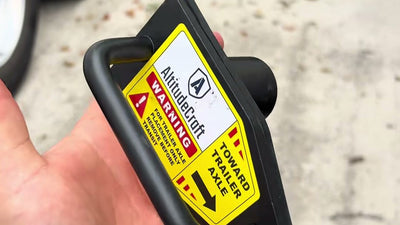
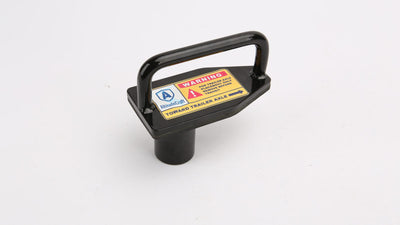
A magnetic carbon-steel stopper that gives the slider box something to stop against. Insert it that many holes from the end of the slider box, on the side the tandems move toward, so the slider box stops against it. Remove it before you drive. 1-year warranty; a 3-year extended warranty can be applied for on altitudecraft.com.
Key Takeaways
- Formula: weight moved per hole is the weight now on the trailer axles times the hole spacing, divided by the kingpin-to-rear-axle distance. At 32,000 lb, 6 in and 40 ft that is 400 lb per hole.
- Inputs: use the Drive and Trailer lines from your CAT scale ticket, your hole spacing (4 in or 6 in) and the kingpin-to-rear-axle distance in feet, measured at the hole the tandems sit in now.
- Direction: if the drive axles are over, slide the tandems toward the cab. If the trailer axles are over, slide them toward the rear doors.
- Round up, then check the other group: a slide only moves weight between the two groups, so one extra hole can push the other group past 34,000 lb.
- Estimate only: re-weigh after every slide, and follow federal, state and local rules, including California's 40 ft kingpin-to-rear-axle limit.

How Does the Tandem Slide Calculator Work?
A tandem slide calculator works in three steps. It finds the weight one hole moves on your load, divides your overweight by that figure, and rounds up to whole holes. It then checks what the other axle group would weigh after the slide.
To estimate how many holes to slide, first work out how much weight one hole moves on your load. The weight moved per hole equals the weight currently on the trailer axles, multiplied by the hole spacing in inches, divided by the kingpin-to-rear-axle distance in inches. A trailer carrying 32,000 lb on 6-inch hole spacing with a 40-foot kingpin-to-rear-axle distance moves about 400 lb per hole; on 4-inch spacing it moves about 267 lb. Divide the amount you are overweight by that figure and round up to get the number of holes. Slide the tandems toward the cab to move weight off the drive axles, and toward the rear doors to move weight off the trailer axles. This is an estimate, so re-weigh after you slide.
Weight moved per hole ≈ (current trailer axle weight × hole spacing) ÷ kingpin-to-rear-axle distance, with the distance in inches (feet × 12). It is the same formula as our tandem slide chart, which lists the per-hole result for common loads.
The calculator reads six inputs. Four come from your scale ticket and your trailer, one is optional, and one is a switch.
| Input | What to enter | Where to find it |
|---|---|---|
| Drive axles weight | Pounds on the drive axles now | Drive line of the CAT scale ticket |
| Trailer axles weight | Pounds on the trailer tandems now | Trailer line of the same ticket |
| Hole spacing | 4 in or 6 in | Measure center to center on your slider rail |
| Kingpin to rear axle | Feet, one decimal is fine | Tape measure or the rail marking |
| Target trailer axles weight | Optional, pounds | Your own goal; blank means 34,000 lb |
| California 40 ft rule | On or off | Switch it on for California routes |
The 34,000 lb figure is the federal tandem-axle limit on the Interstate System. The FHWA bridge formula publication states that axles spaced more than 40 inches and not more than 96 inches apart (tandem axles) are limited to 34,000 pounds, and that gross vehicle weight is limited to 80,000 pounds (FHWA, Bridge Formula Weights). Some states and permits differ, so check the rules for your route.
Schneider's driver guidance gives a general figure of approximately 250 pounds of weight transfer per tandem hole, and notes that the amount depends on how the trailer is loaded and how much distance is between each hole (Schneider). The formula above puts those two factors into numbers.
For a quick check without the tool, this is the per-hole weight at 40 ft from the same formula:
| Weight on trailer axles | 4 in spacing | 6 in spacing |
|---|---|---|
| 12,000 lb | 100 lb per hole | 150 lb per hole |
| 26,000 lb | 217 lb per hole | 325 lb per hole |
| 32,000 lb | 267 lb per hole | 400 lb per hole |
Which Way Do I Slide the Tandems?
Slide the tandems toward the cab to take weight off the drive axles, and toward the rear doors to take weight off the trailer axles. The calculator says “toward the cab” or “toward the rear doors” instead of “forward” or “back”, because those two words are used both for the tandems and for the weight, and drivers read them differently.
| Which group is over | Slide the tandems | Where the weight goes |
|---|---|---|
| Drive axles | Toward the cab | Off the drive axles, onto the trailer axles |
| Trailer axles | Toward the rear doors | Off the trailer axles, onto the drive axles |
Moving the tandems toward the rear doors lengthens the distance from the kingpin to the trailer axles, so the trailer axles carry less. Moving them toward the cab shortens it. The step-by-step mechanics of getting the trailer to move are in our complete guide to sliding tandem axles.

How Many Holes Do I Slide? Two Worked Examples
Divide the overweight by the per-hole figure and round up. The two examples below use the same arithmetic the calculator runs, so you can check the tool against pencil and paper.
Example 1: drive axles over. Drive axles 35,100 lb, trailer axles 31,000 lb, 6 in holes, 40 ft to the rear axle. One hole moves 31,000 × 6 ÷ 480 = 387.5 lb. The drive axles are 1,100 lb over 34,000 lb, and 1,100 ÷ 387.5 = 2.84, which rounds up to 3 holes toward the cab. Three holes move about 1,163 lb, leaving the drive axles near 33,938 lb and the trailer axles near 32,163 lb.

Example 2: trailer axles over, California rule on. Drive axles 33,000 lb, trailer axles 34,800 lb, 6 in holes, 38 ft to the rear axle. One hole moves 34,800 × 6 ÷ 456 = about 458 lb. The trailer axles are 800 lb over, and 800 ÷ 458 = 1.75, which rounds up to 2 holes toward the rear doors. The trailer axles drop to about 33,884 lb and the drive axles rise to about 33,916 lb.
With the California switch on, the kingpin-to-rear-axle distance becomes 38 + (2 × 6 ÷ 12) = 39.0 ft, under the 40 ft limit.

The chart guide tables assume 40 ft, which is why its version of this load shows about 435 lb per hole. At 40 ft the same load moves 435 lb per hole and still needs 2 holes, but then the California check fails, as the California section below shows.
A lightly loaded trailer needs more holes for the same overweight. With drive axles at 34,600 lb, trailer axles at 22,000 lb, 4 in holes and 40 ft, one hole moves only about 183 lb. The drive axles are 600 lb over, so the answer is 4 holes toward the cab, not the 2 a memorized 400 lb rule would give (600 ÷ 400 = 1.5, rounded up).
| Drive / trailer, spacing, KPRA | Per hole | Holes | Estimated weights after |
|---|---|---|---|
| 35,100 / 31,000 lb, 6 in, 40 ft | about 388 lb | 3 toward the cab | Drives 33,938, trailer 32,163 |
| 33,000 / 34,800 lb, 6 in, 38 ft | about 458 lb | 2 toward the rear doors | Drives 33,916, trailer 33,884 |
| 34,600 / 22,000 lb, 4 in, 40 ft | about 183 lb | 4 toward the cab | Drives 33,867, trailer 22,733 |
Common mistakes that make the hole count wrong:
- Reusing one per-hole number across loads. The figure for a full van is roughly double the figure for a half-loaded trailer. Enter the weights from the ticket in front of you.
- Typing the wrong ticket line. The calculator needs the Drive line and the Trailer line, not the Steer line and not the gross.
- Entering hole spacing from memory. Rails differ. Measure center to center once and use that number.
- Sliding the wrong way. Read the direction line first: cab for drive axles over, rear doors for trailer axles over.
- Skipping the re-weigh. The result is a starting point. The ticket after the slide is the answer.
What If the Other Axle Group Goes Over?
Sliding only moves weight between the drive axles and the trailer axles, so it cannot fix a load that is too heavy for both groups together. Two groups at 34,000 lb each carry 68,000 lb. If the drive and trailer lines add up to more than that, the calculator tells you to reduce or re-load the freight instead of giving a hole count.
Whole holes can also overshoot. With drive axles at 36,000 lb and trailer axles at 33,500 lb the two groups carry 69,500 lb, which is 1,500 lb past 68,000 lb, so no slide can bring both under the limit. With drive axles at 35,500 lb and trailer axles at 32,400 lb the total is fine, but at 405 lb per hole, 3 holes leave the drive axles near 34,285 lb and 4 holes push the trailer axles to about 34,020 lb. The calculator flags that case instead of recommending a slide.
Sliding never changes gross weight, so the 80,000 lb gross limit does not move with the tandems. The bridge formula can also set a lower limit: FHWA's exception for two 34,000 lb groups requires the axles to be spaced at least 36 ft apart, which sliding too far toward the cab can affect. The chart guide covers that case, and the calculator does not check it.
Does the Calculator Check the California 40 Foot Rule?
Yes, when you switch it on. Caltrans states that legal trucks in California must not exceed a kingpin-to-rear-axle (KPRA) length of 40 feet, and that a city or county may not restrict the kingpin to rearmost axle measurement to less than 38 feet (Caltrans). The calculator checks the 40 ft figure only; local limits can be tighter.
With the switch on, the calculator adds your slide to the distance you entered: after a slide toward the rear doors the distance is the old distance plus holes × spacing ÷ 12 feet. If that passes 40 ft, it says so and shows how many holes toward the rear doors still fit, which is the whole number part of (40 − distance) × 12 ÷ spacing. A trailer already at 40 ft has room for 0.
That is why example 2 works at 38 ft and fails at 40 ft. Two holes of 6 inches add one foot. At 38 ft the result is 39.0 ft. At 40 ft the result is 41.0 ft, and the answer for the trailer axles has to come from moving freight inside the trailer instead.

How Accurate Is a Tandem Slide Calculator?
A tandem slide calculator gives a first-order estimate, not a measurement. It treats the weight moved per hole as the same for every hole, and it uses the kingpin-to-rear-axle distance as the lever arm. Three things move the real result away from it.
- Lever arm. The calculator uses the distance to the rear axle because that is what drivers measure and what California checks. A lever model would use the distance to the middle of the tandem group, which is shorter. For example, 2 ft shorter at 40 ft raises the per-hole figure by about 5 percent (40 ÷ 38).
- Size of the slide. The estimate is linear, and the lever model is not. Our own arithmetic for a 6-hole slide on 34,000 lb, 6 in holes and 40 ft: the linear figure is 34,000 × 36 ÷ 480 = 2,550 lb, while the lever model gives 34,000 × 36 ÷ 516 = about 2,372 lb toward the rear doors and 34,000 × 36 ÷ 444 = about 2,757 lb toward the cab. That is a gap of 7 to 8 percent, so the calculator adds a note when the answer is 5 holes or more.
- The truck itself. Where the freight sits, the trailer, and the fifth-wheel setting all change the real weights.
The per-hole figure in the result also shows a range for a kingpin-to-rear-axle distance that is off by 1 ft. That range shows only how sensitive the answer is to the measurement. It is not an error bar for the whole estimate.
We have not yet compared this tool with before-and-after scale tickets, so we do not state a measured accuracy. Re-weigh after the slide, every time.

Once You Know the Hole Count, How Do You Stop on It?
Once you have the hole count, a stopper gives the slider box something to stop against. With the AltitudeCraft Tandem Slide Stopper you decide how many holes to move, then insert the stopper that many holes from the end of the slider box, on the side the tandems move toward. Slide until the box stops against it, lock the slider pins, and remove the stopper before you drive. The full walk-through is in the complete trucker guide.
The stopper is built for sliding tandem dry van and reefer trailers; see tandem slide stoppers for dry van and reefer trailers. It is not for fixed-axle trailers. For a side-by-side with other stop tools, read the magnetic vs manual comparison, and for every slide guide in one place, the tandem sliding guide.

Count the holes. Set the stop. Slide once.
AltitudeCraft Tandem Slide Stopper: magnetic, carbon steel. Remove it before you drive. 1-year warranty; a 3-year extended warranty can be applied for on altitudecraft.com.
Frequently Asked Questions
How does a tandem slide calculator work?
It estimates the weight one hole moves, then divides your overweight by it. The weight per hole is the trailer axle weight times the hole spacing, divided by the kingpin-to-rear-axle distance. The result is rounded up to whole holes, and the calculator then checks what the other axle group would weigh.
How accurate is a tandem slide calculator?
It is a first-order estimate. Real results shift with the lever arm used, the size of the slide, the freight position and the trailer. For slides of 5 holes or more the linear estimate can be off by several percent. Re-weigh after sliding.
Why does the calculator ask for the kingpin-to-rear-axle distance?
The kingpin is the pivot, and the distance from it to the tandems is the lever arm. A shorter distance moves more weight per hole, and a longer one moves less. At 6 in spacing and 32,000 lb, 40 ft gives 400 lb per hole and 36 ft gives about 444 lb.
What if no hole count gets both axle groups under 34,000 lb?
Then the load is too heavy for the two groups together, or one hole is too coarse a step. Sliding only moves weight between the groups, so the fix is to take weight off or move freight inside the trailer, then weigh again.
Does this calculator work for fifth-wheel slides?
No. It calculates only the trailer tandem slide, where the axle group moves along the slider rail. A fifth-wheel slide changes the weight split in a different way and is not covered here.
Does the calculator check the California 40 foot rule?
Yes, when the California switch is on. It adds your slide to the kingpin-to-rear-axle distance and tells you if the result passes 40 ft. It checks 40 ft only, and local limits and other states can differ.
Related Articles
- Tandem Slide Chart: How Much Weight Moves Per Hole
- How to Slide Tandem Axles: Complete Trucker Guide
- Tandem Slide Stopper for Dry Van and Reefer Trailers
- Tandem Slide Stopper: Magnetic vs Manual Compared
By AltitudeCraft Gear Lab. AltitudeCraft Gear Lab is the product team behind AltitudeCraft tools. Disclosure: AltitudeCraft makes the Tandem Slide Stopper mentioned in this article. This guide reflects our own reasoning, the formula shown above and public sources, not a product test or scale-ticket study. Sources: FHWA Bridge Formula Weights; Caltrans, Legal Basis for Truck Restrictions; Schneider driver guidance on sliding tandems. Last updated: October 2026.
Featured in this guide
AltitudeCraft Tandem Slide Stopper for Semi Truck
$39.99
Free shipping & free returns on US orders $25+
View productRelated Articles
 How to Slide Tandems by Yourself (Without a Spotter)
Oct 28, 2026
 Gifts for Truck Drivers 2026: Useful Picks Truckers Actually Use
Oct 22, 2026
 Headspace Gauge vs Headspace Comparator vs Case Gauge: Which One Do You Need? (2026)
Oct 29, 2026
 16 vs 24 Stud Spacing: When 24 On Center Is Allowed (and When It Isn't)
Oct 28, 2026
