




Miter Saw Protractor for Stair Trim and Non-90 Corners (2026)
Disclosure: AltitudeCraft manufactures precision measurement tools for woodworking and construction professionals. This article contains product recommendations informed by our engineering team. Last updated April 2026.


The tool for this job
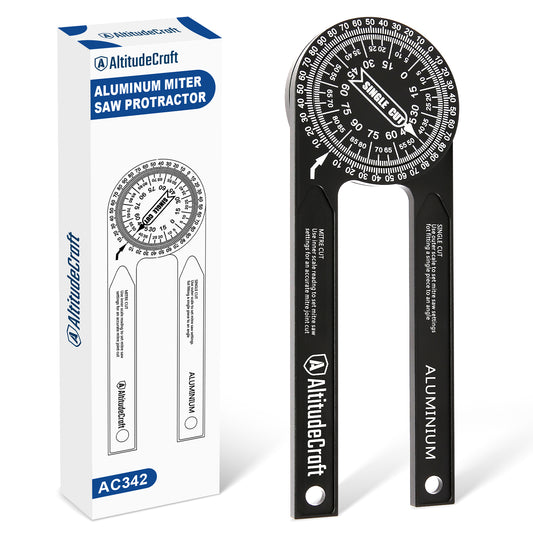
AltitudeCraft Precision Aluminum Miter Saw Protractor
$20.99
Free shipping & free returns on US orders $25+
View productBeyond 90 Degrees: Where Standard Miter Settings Fail
Most miter saw tutorials assume you are working with right-angle corners. Set the saw to 45 degrees, cut two pieces, and the joint closes perfectly. But the moment you step away from standard rectangular rooms, that assumption breaks down completely.
Stair trim, bay windows, cathedral ceilings, and multi-sided rooms all present angles that have nothing to do with 90 degrees. These are the situations where a miter saw protractor shifts from a convenience tool to an essential one. Without it, you are either doing trigonometry on the job site or burning through expensive trim on test cuts.
This article covers the most common non-standard angle applications and provides the exact measurement-to-saw-setting workflow for each one.
Ready to upgrade your toolbox?
See the Miter Saw ProtractorCommon Non-Standard Angles and Miter Saw Settings
Before diving into specific applications, here is a reference table of common non-standard angles you will encounter in residential and commercial finish work. Each entry includes the typical corner angle and the corresponding miter saw setting:
| Application | Typical Corner Angle | Miter Saw Setting | Notes |
|---|---|---|---|
| Standard inside corner | 90° | 45° | Baseline reference; verify with protractor |
| Bay window (3-panel) | 135° | 22.5° | Actual angle varies; always measure on site |
| Bay window (5-panel) | 108° | 36° | Less common; found in Victorian-style homes |
| Octagonal room / gazebo | 135° | 22.5° | Interior angle of regular octagon |
| Hexagonal room / gazebo | 120° | 30° | Interior angle of regular hexagon |
| Stair skirt board (standard pitch) | 30°–38° | 15°–19° | Depends on rise/run ratio of stairs |
| Cathedral ceiling rake trim | Variable (20°–45°) | Variable (10°–22.5°) | Depends on roof pitch; measure on each wall |
| 120° corner (e.g., angled hallway) | 120° | 30° | Common in modern open-plan designs |
| Bump-out / addition junction | Variable (85°–100°) | Variable (42.5°–50°) | Never assume 90°; additions are the worst offenders |
The "Miter Saw Setting" column assumes you are dividing the corner angle by two. In practice, always measure with your protractor first—these nominal angles are starting points, not gospel. Actual measurements on site will differ by 1° to 3° in almost every case.
Application 1: Stair Skirt Boards and Stair Trim
Stair skirt boards are one of the most demanding applications for miter accuracy. The skirt board must follow the exact pitch of the staircase, and any deviation creates a gap that is visible from the bottom of the stairs—the most common viewing angle for guests.
Why Stairs Are Uniquely Challenging
The stair angle is determined by the rise-to-run ratio, which varies by design and building code. The International Residential Code (IRC) Section R311.7 allows a range of stair dimensions: risers from 4 inches to 7-3/4 inches and treads with a minimum 10-inch run. This means stair angles in code-compliant homes can range from about 27° to 38°—a wide spread that makes guessing impossible.
Additionally, the skirt board meets the baseboard at the top and bottom of the staircase at compound angles. These transitions are where most installers struggle, because the skirt-to-baseboard joint is not a simple 90° corner. It is the stair angle plus the wall angle, which could be any combination.
The Protractor Method for Stair Trim
- Measure the stair angle. Place your AltitudeCraft protractor along the stringer or the nose line of the treads. Read the angle relative to the horizontal floor. A typical reading is 33° to 37°.
- Measure the baseboard transition angle. Where the skirt meets the baseboard at the top and bottom landing, place the protractor in the corner formed by the skirt line and the wall. This angle determines how the two pieces will join.
- Calculate the miter setting. For the baseboard-to-skirt transition, divide the measured angle by two. Set your saw to this number.
- Cut and verify. Dry-fit the joint before nailing. The fit should be tight across the full width of the trim.
Professional stair trim installers report that this four-step process reduces their average installation time by 40 percent compared to the test-cut method, because they get the angle right on the first attempt.
Application 2: Bay Windows
Bay windows are the application that sends most DIYers to the internet searching for help. The angles look simple—they are often described as "135 degrees" in architectural plans—but the as-built reality is more complex.
Why Bay Window Angles Are Never Exactly 135°
Framing tolerances, settling, and window unit manufacturing variations mean that actual bay window angles typically range from 132° to 138°. A protractor reading of 134° instead of the assumed 135° changes the miter saw setting from 22.5° to 23°—a half-degree difference that produces a visible gap on trim wider than 3 inches.
Bay Window Trim Workflow
- Measure each angle in the bay window separately. The two side angles are not always identical.
- Record the actual angles: for example, left angle 134°, right angle 136°.
- Set your saw for each joint individually: left at 23°, right at 22°.
- Label each piece before cutting to avoid mixing up left and right joints.
This per-joint approach is more methodical than cutting all pieces at a single setting, but it produces gap-free results that look professional. For more measurement techniques and workshop tips, visit the AltitudeCraft insights blog.
Application 3: Cathedral Ceilings and Rake Angles
Cathedral ceilings introduce angles that are entirely absent in standard rooms. The junction where the sloped ceiling meets a vertical wall creates an angle determined by the roof pitch, which can range from a gentle 3:12 (14°) to a steep 12:12 (45°).
The Compound Angle Challenge
Crown molding on a cathedral ceiling is one of the most complex cuts in finish carpentry. You are working with three angles simultaneously: the wall corner angle, the ceiling pitch angle, and the crown molding spring angle. Getting any one of these wrong produces a gap.
The protractor eliminates one of these variables by giving you an exact reading of the wall-to-ceiling angle at each corner. With that number locked in, you can calculate the compound miter and bevel settings with confidence.
Practical Tips for Rake Trim
- Measure at the actual installation height. Ceilings can change pitch slightly from the wall plate up to the ridge. Measure where the trim will actually sit.
- Check both sides of the ridge. The two slopes of a cathedral ceiling are not always identical, especially in renovations or additions.
- Use the protractor to verify plumb walls. A wall that leans even slightly changes the effective angle where the rake trim meets it.
Detailed guidance on working with compound angles is available from Fine Homebuilding's crown molding project guide, which covers the theory behind compound miter calculations.
Application 4: Octagonal and Multi-Sided Rooms
Octagonal gazebos, turret rooms in Victorian homes, and modern architectural features with angled walls all require precise non-90° measurements. In a regular octagon, each interior angle is 135°, requiring a 22.5° miter saw setting. But "regular" is the operative word—real-world octagons are rarely perfect.
Why You Must Measure Every Joint
In a theoretical regular octagon, all eight corners are identical at 135°. In a built octagon, each corner can differ by 1° to 4° due to framing tolerances. If you cut all sixteen pieces of baseboard at 22.5° and three corners are actually 132°, those three joints will gap visibly.
The professional approach: walk the octagon with your protractor, record all eight corner angles, calculate each saw setting individually, and label every piece for its specific corner. It takes 10 extra minutes and saves an hour of rework.
The same principle applies to hexagonal rooms (120° nominal, 30° miter), pentagonal bump-outs, and any multi-sided space. Measure every joint. Assume nothing.
Application 5: Angled Hallways and Open-Plan Transitions
Modern home designs frequently include hallways that meet at angles other than 90°, open-plan rooms with angled walls, and additions that join the original structure at odd angles. These transitions are where the baseboard, chair rail, or crown molding must change direction at a non-standard angle.
A protractor makes these transitions straightforward:
- Place the protractor in the corner where the two walls meet.
- Read the angle. Common readings for angled hallways are 110° to 140°.
- Divide by two for the miter saw setting.
- Cut and install. The joint will close on the first attempt.
Without a protractor, these joints require multiple test cuts because the angle is visually ambiguous. Is that corner 120° or 125°? The 2.5° difference in saw setting is the difference between a tight joint and a gap you will spend time filling. Explore the full lineup of AltitudeCraft tools designed for precision measurement.
Pro Tips for Non-Standard Angle Work
After years of working with protractors on job sites, here are the techniques that separate clean work from mediocre results:
- Always record angles on a room sketch. Draw a simple floor plan and write the measured angle and calculated saw setting at each corner. This reference sheet saves time and prevents cutting errors when you are moving between corners.
- Measure twice with the protractor. Remove the protractor from the corner, reposition it, and read again. If the two readings differ by more than 0.5°, the wall surface may be irregular—scrape away any drywall compound or paint buildup and re-measure.
- Account for material spring. On crown molding, the protractor reads the wall corner angle, but the crown sits at a spring angle away from the wall. You need both measurements for compound cuts.
- Label every cut. On multi-angle projects, label each piece with its corner position (e.g., "NE corner, 134°, saw at 23°"). This prevents costly mix-ups during installation.
- Keep a dedicated protractor in your trim kit. Sharing tools between framing and trim leads to damaged reference surfaces. A protractor used for finish work should be clean and undamaged.
When to Cope Instead of Miter
A protractor gives you exact miter settings for any angle, but there are situations where coping the joint is a better approach than mitering:
- Inside corners in rooms with uneven walls. Coped joints accommodate wall irregularities that a miter cannot.
- Very acute angles (below 60°). Miter cuts on acute angles create fragile feather edges that chip and crack.
- Painted trim. Coped joints hide seasonal wood movement better than mitered joints in painted applications.
However, outside corners and most non-90° applications (bay windows, octagons, stair transitions) cannot be coped—they require precision miters. This is where the protractor remains indispensable. For additional reading on angle applications and tool reviews, check the latest articles on our blog.
Frequently Asked Questions
What angle do I set my miter saw for a bay window?
For a standard 3-panel bay window, the nominal angle is 135 degrees, which gives a miter saw setting of 22.5 degrees. However, actual bay window angles vary between 132 and 138 degrees due to construction tolerances. Always measure the actual angle with a protractor before cutting—a 3-degree deviation changes the saw setting enough to produce a visible gap on trim wider than 3 inches.
How do I find the angle for stair skirt boards?
Place a miter saw protractor along the stringer or the line formed by the tread nosings. The protractor reads the stair pitch angle relative to horizontal, typically between 30 and 38 degrees for code-compliant residential stairs. For the transition joint where the skirt meets the baseboard, place the protractor in that specific corner and divide the reading by two for your saw setting.
Can I use a miter protractor on cathedral ceiling trim?
Yes. Place the protractor at the junction where the sloped ceiling meets the vertical wall to read the rake angle. This reading is essential for calculating compound miter cuts on crown molding in cathedral ceilings. Note that you will also need the crown molding spring angle and the wall corner angle to compute the complete compound cut settings.
What is the miter angle for an octagonal room?
In a theoretical regular octagon, each interior angle is 135 degrees, giving a miter saw setting of 22.5 degrees. In practice, built octagons rarely have perfectly equal angles. Measure each corner individually with a protractor. Variations of 1 to 4 degrees per corner are common, and each variation requires a different saw setting for a tight joint.
How accurate does the protractor need to be for non-standard angles?
For finish trim work on non-standard angles, you need at least 0.5-degree accuracy. Non-standard joints are more sensitive to error than 90-degree corners because the miter cut exposes more material at shallower angles. A 1-degree error on a 22.5-degree miter (bay window) creates a proportionally larger gap than the same error on a 45-degree miter. The AltitudeCraft Precision Aluminum Miter Saw Protractor provides the resolution needed for these demanding applications.
Do I need different protractors for different applications?
No. A quality miter saw protractor covers the full range of angles you will encounter in residential and commercial finish work—from acute stair angles around 30 degrees to obtuse bay window angles around 135 degrees. One protractor handles all applications. The key is choosing one with clear markings and rigid construction, like the AltitudeCraft aluminum protractor, so the readings are reliable across the full range.
Every Angle. First Attempt. Zero Waste.
From stair skirt boards to bay windows to octagonal gazebos, the AltitudeCraft Precision Aluminum Miter Saw Protractor reads any corner angle and converts it to your exact saw setting. Aircraft-grade aluminum construction with laser-engraved markings that will not wear off.
Upgrade Your Workflow with AltitudeCraft
Engineering-grade tools built for professionals and serious DIYers. Free shipping on all orders.
Shop Miter Saw ProtractorFeatured in this guide
AltitudeCraft Precision Aluminum Miter Saw Protractor
$20.99
Free shipping & free returns on US orders $25+
View productRelated Articles
 Strut Spreader Tool Complete Guide: DIY Suspension Work Made Easy (2026)
Apr 02, 2026
Strut Spreader Tool Complete Guide: DIY Suspension Work Made Easy (2026)
Apr 02, 2026
 Thread Checker Complete Guide: Identify Any Bolt Size in Seconds (2026)
Apr 02, 2026
Thread Checker Complete Guide: Identify Any Bolt Size in Seconds (2026)
Apr 02, 2026
 Sight Pusher Tool Complete Guide: How to Install Glock Sights Like a Pro (2026)
Apr 02, 2026
Sight Pusher Tool Complete Guide: How to Install Glock Sights Like a Pro (2026)
Apr 02, 2026
 Miter Cuts Dont Match the Wall Angle How a Protractor Solves It (2026)
Apr 02, 2026
Miter Cuts Dont Match the Wall Angle How a Protractor Solves It (2026)
Apr 02, 2026
